
The manufacturing of hypoid gears is a sophisticated process critical for high-performance automotive and aerospace drive systems. A pivotal stage in this process is the roughing operation of the pinion, which directly impacts production efficiency and the quality of the final gear mesh. Insufficient or uneven stock allowance after roughing can lead to catastrophic tool wear during finishing, improper tooth geometry, and ultimately, poor transmission performance characterized by noise, vibration, and reduced durability. This article presents a comprehensive methodology for determining the rough machining parameters specifically tailored for finishing parameters derived from the Local Synthesis method, along with a robust computational procedure for overcutting verification. The core of this work is the precise control of the finishing stock allowance distribution across the complex pinion tooth flank of hypoid gears.
The design and manufacture of hypoid gears have been significantly advanced by the development of the Local Synthesis method. This method provides a powerful framework for controlling the meshing and contact characteristics of a gear pair at and around a designated reference point by utilizing second-order design parameters. It allows for the pre-determination of desirable transmission error functions and contact path orientation, leading to optimized performance in terms of noise and load capacity. While the Local Synthesis method excels at defining the final, precise geometry of the hypoid gears, its standard formulation primarily addresses the finishing process. The preceding roughing operation, which removes the bulk of the material, requires an equally systematic approach to ensure it prepares the tooth slot correctly for the finishing cut. This article bridges that gap, extending the local synthesis philosophy into the roughing stage for hypoid gears.
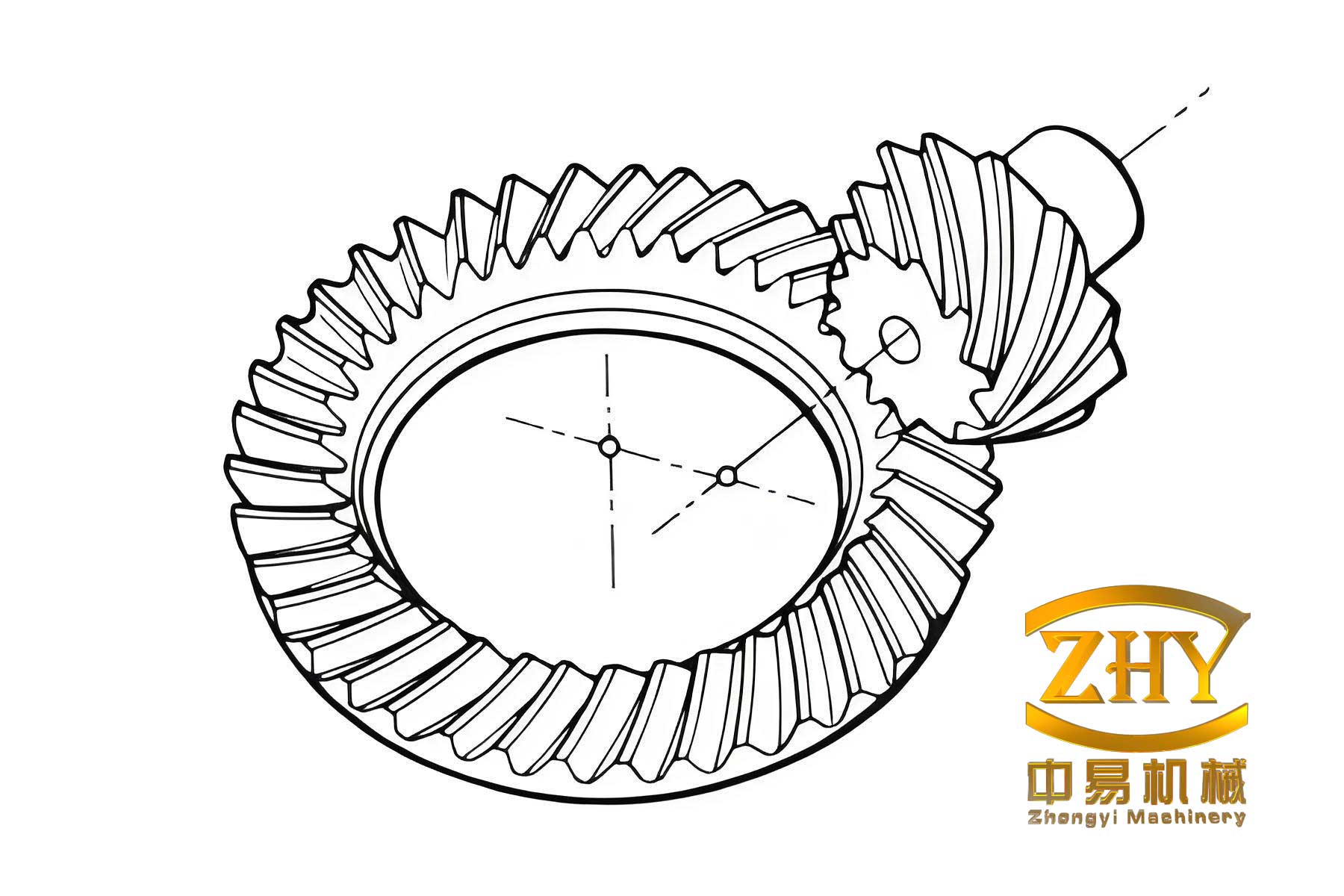
The geometry of hypoid gears is inherently complex due to the offset between the pinion and gear axes. The tooth surfaces are spatially curved, and their generation involves a series of coordinated motions between the workpiece and the cutter. The surface of a generated hypoid pinion can be represented mathematically as the envelope of the family of cutter surfaces during the machining process. A generic form of the pinion tooth surface \(\Sigma_p\) can be described in a coordinate system attached to the pinion as:
$$\mathbf{r}_p(u, \theta, \phi) = \mathbf{M}_{pc}(\phi) \cdot \mathbf{r}_c(u, \theta)$$
where \(\mathbf{r}_c(u, \theta)\) defines the cutter surface (a circular cone for a blade) in the cutter coordinate system, parameterized by \(u\) and \(\theta\). \(\mathbf{M}_{pc}(\phi)\) is the homogeneous coordinate transformation matrix from the cutter system to the pinion system, which is a function of the machine tool motion parameter \(\phi\) (often related to the cradle rotation). The generation of the surface requires satisfaction of the equation of meshing:
$$\mathbf{n}_c \cdot \mathbf{v}_c^{(pc)} = 0$$
Here, \(\mathbf{n}_c\) is the normal to the cutter surface, and \(\mathbf{v}_c^{(pc)}\) is the relative velocity vector between the cutter and the pinion at the contact point. For hypoid gears, the transformation matrix \(\mathbf{M}_{pc}(\phi)\) incorporates complex settings including the machine root angle \(\gamma_m\), sliding base setting \(X_B\), swivel angle \(j\), and most critically, the ratio of generating roll between the cradle and the workpiece, often termed the “machine roll ratio” \(R_{m}\). This ratio is not constant for hypoid gears but follows a polynomial function, typically a second-order polynomial:
$$R_{m}(\phi) = a_0 + a_1 \phi + a_2 \phi^2$$
The coefficients \(a_0, a_1, a_2\) are derived from the basic gear design and the chosen motion curves. Proper calculation of these coefficients and other machine settings is essential for both roughing and finishing of hypoid gears.
The finishing parameters for hypoid gears obtained via Local Synthesis are designed to achieve a specific contact pattern and transmission error. The goal of roughing is to efficiently remove material while leaving a controlled, uniform layer of stock for the finishing cut. A common and efficient method for pinion roughing is the two-profile (or duplex) formate method, where both the convex and concave flanks of a tooth slot are cut simultaneously using a special cutter head with two distinct blade groups. The primary machining parameters for this roughing operation include:
| Parameter | Symbol | Description |
|---|---|---|
| Radial Setting | S_R | Distance from the machine center to the cutter axis. |
| Angular Setting | q | Orientation angle of the cutter axis relative to the cradle. |
| Vertical Offset (Work Setting) | V | Vertical displacement of the pinion blank. |
| Horizontal Offset (Sliding Base) | X_B | Horizontal displacement of the pinion blank. |
| Machine Roll Ratio | R_m | The generating roll relationship (often a constant for roughing). |
| Machine Root Angle | γ_m | Tilting angle of the pinion blank on the machine. |
| Blank Offset (Feed Depth) | ΔX | Infeed distance of the cutter to set tooth depth. |
| Tool Inside/Outside Blade Angles | α_i, α_o | Pressure angles of the cutter blades for convex/concave sides. |
| Cutter Radius | R_c | Nominal radius of the cutter head. |
Initial estimates for these roughing parameters for hypoid gears can be derived from standard gear geometry and basic machine kinematics formulas. For instance, the radial setting \(S_R\) can be approximated from the mean cone distance and cutter tilt. However, these initial settings, when paired with highly optimized finishing parameters from Local Synthesis, may lead to non-uniform stock allowance or, worse, overcutting (where the rough-cut surface intrudes into the finishing surface, leaving negative stock). Therefore, a verification and correction cycle is imperative.
The core contribution of this work is the establishment of a systematic overcutting test and parameter correction loop. The flowchart below illustrates the integrated process for determining and validating roughing parameters for hypoid gears designed via Local Synthesis.
The process begins with the calculation of initial roughing parameters using modified classical formulas. The finishing surface \(\Sigma_{p}^{fin}\) is precisely known from the Local Synthesis output. The roughing surface \(\Sigma_{p}^{rough}\) is simulated using the initial roughing parameters and the mathematical model of the duplex formate process. The critical step is the quantitative evaluation of the stock allowance between these two surfaces. A robust method for this evaluation is the “Rotational Projection” technique. This method involves:
- Discretization: Both the finishing surface \(\Sigma_{p}^{fin}\) and the roughing surface \(\Sigma_{p}^{rough}\) are densely sampled into discrete points \(\mathbf{P}_{i}^{fin}\) and \(\mathbf{P}_{i}^{rough}\).
- Projection Plane Definition: A projection plane is defined, typically an axial cross-section of the pinion (e.g., a plane containing the pinion axis).
- Point Mapping: Each surface point is orthogonally projected onto this axial plane. The projection maps a 3D point \((x, y, z)\) to a 2D coordinate in the plane, often represented as \((R, Z)\), where \(R\) is the radial distance from the pinion axis and \(Z\) is the axial position.
- Allowance Calculation: For a given location on the projection plane (a specific \((R, Z)\) cell), the corresponding points from the finishing and roughing surfaces are identified. The stock allowance \(\delta\) at that location is calculated as the normal distance between these two surfaces along the direction perpendicular to the projection plane, or more precisely, as the difference in their true spatial coordinates along the path normal to the finishing surface. A simplified but effective measure is the difference in the projection coordinate that is orthogonal to the plane (e.g., the difference in the circumferential coordinate transformed into a thickness).
This calculation yields a detailed 2D map of the stock allowance distribution over the entire tooth flank of the hypoid gears. The analysis of this map drives the decision logic:
$$ \text{If } \delta_{min} < \delta_{required} \text{ at any point, overcutting is detected.}$$
$$ \text{If the variation } \Delta\delta = \delta_{max} – \delta_{min} \text{ is too large, stock is non-uniform.}$$
If overcutting or excessive non-uniformity is detected, a correction module is activated. This module adjusts key roughing parameters—most commonly the Radial Setting \(S_R\), Angular Setting \(q\), and the Blade Pressure Angles \(\alpha_i, \alpha_o\)—based on sensitivity coefficients that describe how the roughing surface changes with these parameters. The process iterates until the stock allowance distribution meets the specified criteria: positive and above a minimum threshold (e.g., 0.2mm) at all points, and with acceptable uniformity. This closed-loop verification is crucial for the reliable production of high-quality hypoid gears.
To demonstrate the application of this methodology, consider a hypoid gear pair with the following fundamental design parameters. The processing of such hypoid gears requires meticulous planning.
| Parameter | Pinion | Gear |
|---|---|---|
| Number of Teeth | 10 | 41 |
| Face Width (mm) | – | 79 |
| Pinion Offset (mm) | 38 | – |
| Gear Pitch Diameter at Apex (mm) | – | 508 |
| Mean Pressure Angle (°) | 22.5 | 22.5 |
| Shaft Angle (°) | 90 | |
| Pinion Mean Spiral Angle (°) | 49 | – |
| Hand of Spiral | Left | Right |
Using the Local Synthesis method, the finishing machine settings for the pinion are computed to achieve a parabolic function of transmission error and a desired contact pattern. The finishing parameters include a specific, variable machine roll ratio \(R_m(\phi)\) and other kinematic settings. Subsequently, the proposed roughing parameter calculation and verification flow is executed. The initial roughing parameters are computed. After simulation and stock allowance analysis, suppose the initial parameters lead to an insufficient stock at the toe region on the concave flank. The correction algorithm adjusts the Angular Setting \(q\) and the concave side blade angle slightly. The final, validated roughing parameters for the hypoid pinion are determined.
| Roughing Parameter | Value | Note |
|---|---|---|
| Radial Setting \(S_R\) (mm) | 187.61 | – |
| Angular Setting \(q\) (°) | 67.12 | – |
| Vertical Offset \(V\) (mm) | 38.75 | – |
| Horizontal Offset \(X_B\) (mm) | -7.73 | – |
| Machine Roll Ratio \(R_m\) | 4.3192 | Constant for roughing |
| Machine Root Angle \(\gamma_m\) (°) | 15.286 | – |
| Blank Feed \(\Delta X\) (mm) | 2.038 | – |
| Cutter Blade Angle (Concave) \(\alpha_i\) (°) | 20.12 | Use 20° blade |
| Cutter Blade Angle (Convex) \(\alpha_o\) (°) | -24.82 | Use -25° blade |
| Nominal Cutter Radius \(R_c\) (mm) | 203.2 | (8 inches) |
The effectiveness of the verification is visualized through the stock allowance distribution plot. The contour plot shows a uniform layer of stock across the entire active tooth flank of the hypoid gears, with a minimum value well above zero, confirming the absence of overcutting. The mathematical representation of the final allowance \(\delta(R,Z)\) can be summarized for key regions:
| Tooth Region | Allowance Range (mm) | Status |
|---|---|---|
| Heel, Concave | 0.35 – 0.42 | Acceptable |
| Toe, Concave | 0.28 – 0.32 | Acceptable (Corrected) |
| Heel, Convex | 0.38 – 0.45 | Acceptable |
| Toe, Convex | 0.30 – 0.35 | Acceptable |
The adjustment of parameters is based on sensitivity relationships. For example, the change in the roughing surface \(\Delta \Sigma_p^{rough}\) due to a small change in the Angular Setting \(\Delta q\) can be linearized as:
$$\Delta \mathbf{r}_p \approx \frac{\partial \mathbf{r}_p(u, \theta, \phi; q)}{\partial q} \Delta q$$
The partial derivative is computed numerically via the generation model. The correction algorithm solves a least-squares problem to find the set of parameter adjustments \(\Delta \mathbf{p} = [\Delta S_R, \Delta q, \Delta \alpha_i, \Delta \alpha_o]^T\) that minimizes the deviation from the desired stock allowance \(\delta_{target}\) at all sampled points \(j\):
$$\min_{\Delta \mathbf{p}} \sum_{j=1}^{N} \left[ \delta_{initial}(j) + \mathbf{S}(j) \cdot \Delta \mathbf{p} – \delta_{target} \right]^2$$
where \(\mathbf{S}(j)\) is the sensitivity vector of the stock allowance at point \(j\) with respect to the roughing parameters. This systematic approach ensures the roughing process is optimally prepared for the finishing of hypoid gears.
In practical manufacturing environments, this entire methodology is encapsulated within dedicated computer-aided manufacturing (CAM) software. The software integrates the gear design module (based on Local Synthesis), the roughing parameter generator, the sophisticated simulation engine for cutting both finishing and roughing surfaces of hypoid gears, and the graphical stock allowance analyzer. The simulation engine calculates the surface points using the equations:
$$\mathbf{r}_p^{fin} = \mathbf{M}_{pf}(\phi, R_m^{fin}(\phi), \ldots) \cdot \mathbf{r}_c^{fin}$$
$$\mathbf{r}_p^{rough} = \mathbf{M}_{pr}(\phi, R_m^{rough}, \ldots) \cdot \mathbf{r}_c^{rough}$$
where the transformation matrices \(\mathbf{M}_{pf}\) and \(\mathbf{M}_{pr}\) differ due to different machine settings. The graphical output provides an intuitive, color-coded map where blue might indicate low stock and red high stock, allowing the engineer to instantly assess the readiness for the finishing cut of the hypoid gears.
The advantages of this integrated approach are manifold. Firstly, it prevents costly machining errors by guaranteeing positive stock before physical cutting begins. Secondly, it optimizes tool life for the finishing cutter by ensuring a uniform load during the final cut. Thirdly, it enhances the final quality of the hypoid gears by providing a geometrically consistent starting point for the finishing process, allowing the Local Synthesis optimizations to be realized accurately on the physical part. This is particularly important for high-contact-ratio or low-noise designs for hypoid gears, where the tooth flank geometry is extremely sensitive.
In conclusion, the manufacturing of hypoid gears requires a holistic view that encompasses both finishing and roughing operations. The Local Synthesis method provides an excellent foundation for defining optimal meshing performance. The methodology expounded herein completes the cycle by providing a rigorous, simulation-based method for determining and verifying the roughing parameters. By establishing a closed-loop process of calculation, simulation, stock allowance analysis, and parameter correction, it ensures that the roughing operation for hypoid gears creates an ideal pre-form for the subsequent finishing operation. This not only safeguards against overcutting but also promotes efficiency, tool longevity, and the realization of the designed high-performance characteristics in the final hypoid gear pair. The development of such computer-aided verification tools is indispensable for the advanced and reliable production of these complex and critical mechanical components.