
In modern automotive and industrial applications, the demand for high-speed and high-power transmission systems has made the study of vibration characteristics in hypoid gears a critical research focus. Hypoid gears are widely used in rear axle drives due to their ability to transmit power between non-intersecting shafts with high efficiency and compact design. However, the complex geometry and dynamic loading conditions often lead to significant vibration and noise, which can affect performance, reliability, and comfort. Therefore, understanding and mitigating vibration in hypoid gear systems is essential for advanced dynamic design. In this study, we conduct a comprehensive theoretical and experimental investigation into the vibration behavior of hypoid gear systems. We develop a coupled dynamic model using vibration theory and finite element methods to predict dynamic responses under various excitations. Additionally, we set up an experimental platform to measure vibration responses at bearing housings and gearbox surfaces, validating our theoretical predictions. This work aims to provide a foundational framework for the dynamic design and optimization of hypoid gear systems, enhancing their operational stability and lifespan.
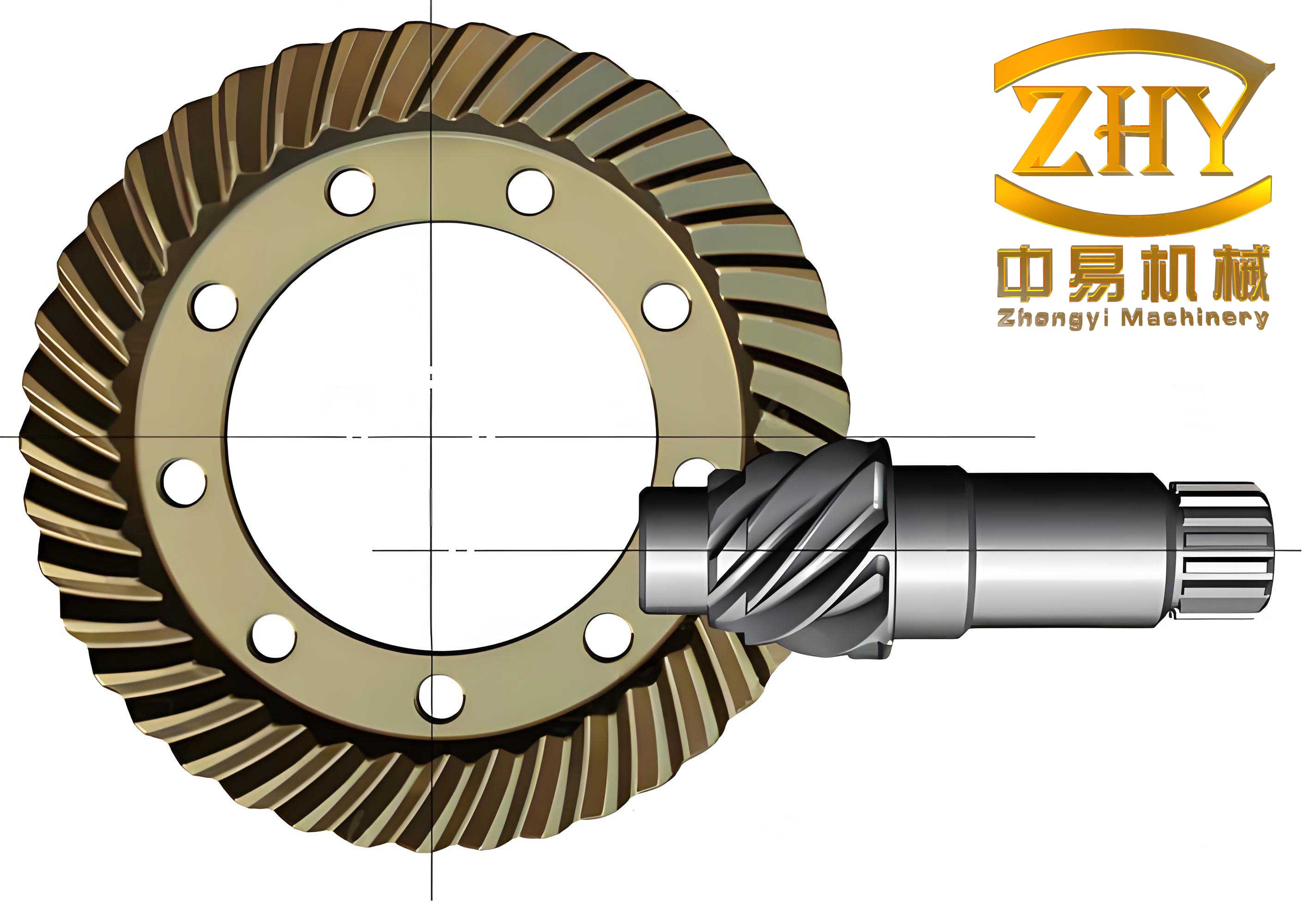
The vibration analysis of hypoid gear systems involves intricate interactions between gear meshing, shaft dynamics, bearing supports, and structural components. To capture these effects, we divide the system into two subsystems: the transmission system, comprising gears, shafts, and bearings, and the structural system, consisting of the gearbox housing. By coupling these subsystems, we can analyze the complete dynamic behavior. In the theoretical modeling, we employ a lumped-parameter approach for the transmission system and finite element analysis for the gearbox structure. This integrated methodology allows us to simulate real-world operating conditions and predict vibration responses accurately. The dynamic excitations in hypoid gears arise from factors such as mesh stiffness variations, manufacturing errors, and load fluctuations, which generate forces that propagate through the system. Our goal is to quantify these responses and identify key vibration modes, thereby facilitating design improvements for reduced noise and vibration.
We begin by establishing the dynamic model for the hypoid gear transmission system. The model is based on a 12-degree-of-freedom (DOF) lumped-parameter representation, which includes translational and rotational motions for both the driving and driven gears. As shown in Figure 1 of the reference, the gears are modeled as concentrated masses and moments of inertia, while the shafts are considered massless rigid bodies. Bearings are simulated as elastic supports using springs and dampers, and gear mesh interactions are represented by time-varying spring and damper elements. The offset distance in hypoid gears introduces additional complexity, requiring careful consideration in the coordinate system. The equations of motion for this system can be derived using Newton’s second law or Lagrangian mechanics, resulting in a matrix form that accounts for all DOFs. Let us define the displacement vector as follows:
$$ \mathbf{X} = \{ x_1, y_1, z_1, \theta_{x1}, \theta_{y1}, \theta_{z1}, x_2, y_2, z_2, \theta_{x2}, \theta_{y2}, \theta_{z2} \}^T $$
Here, subscripts 1 and 2 denote the driving and driven gears, respectively, with \(x\), \(y\), and \(z\) representing translational displacements along coordinate axes, and \(\theta_x\), \(\theta_y\), \(\theta_z\) representing rotational displacements about those axes. The system’s dynamic equation is expressed as:
$$ \mathbf{M} \ddot{\mathbf{X}} + \mathbf{C} \dot{\mathbf{X}} + \mathbf{K} \mathbf{X} = \mathbf{F}(t) $$
where \(\mathbf{M}\) is the mass matrix, \(\mathbf{C}\) is the damping matrix, \(\mathbf{K}\) is the stiffness matrix, and \(\mathbf{F}(t)\) is the external force vector, which includes mesh forces and external loads. The mass matrix is diagonal, incorporating the masses and moments of inertia of the gears. The stiffness matrix \(\mathbf{K}\) is composed of contributions from shaft bending, torsion, axial deformation, bearing stiffness, and gear mesh stiffness. For hypoid gears, the mesh stiffness varies with time due to changing contact conditions, which can be modeled as a periodic function. We approximate the mesh stiffness \(k_m(t)\) as:
$$ k_m(t) = k_{m0} + \sum_{n=1}^{N} k_{mn} \cos(n \omega_m t + \phi_n) $$
where \(k_{m0}\) is the mean mesh stiffness, \(k_{mn}\) are harmonic amplitudes, \(\omega_m\) is the mesh frequency, and \(\phi_n\) are phase angles. The mesh frequency is related to the rotational speed and number of teeth: \(\omega_m = 2\pi n_z / 60 \times Z\), with \(n_z\) in rpm and \(Z\) as the number of teeth. The damping matrix \(\mathbf{C}\) is often assumed proportional to mass and stiffness (Rayleigh damping): \(\mathbf{C} = \alpha \mathbf{M} + \beta \mathbf{K}\), where \(\alpha\) and \(\beta\) are coefficients determined from modal damping ratios. This model captures essential vibration modes: transverse bending (described by \(y_1\), \(z_1\) for driving gear and \(x_2\), \(z_2\) for driven gear), axial vibration (\(x_1\) and \(y_2\)), torsional vibration (\(\theta_{x1}\) and \(\theta_{y2}\)), and coupled rocking vibrations (\(\theta_{y1}\), \(\theta_{z1}\), \(\theta_{x2}\), \(\theta_{z2}\)). The equivalent masses and stiffnesses are derived from gear and shaft properties, ensuring accurate representation of hypoid gear dynamics.
To solve the dynamic equations, we use the modal superposition method, which is efficient for linear systems. First, we compute the natural frequencies and mode shapes by solving the eigenvalue problem:
$$ (\mathbf{K} – \omega_i^2 \mathbf{M}) \boldsymbol{\phi}_i = 0 $$
where \(\omega_i\) are natural frequencies and \(\boldsymbol{\phi}_i\) are mode shapes for \(i = 1, 2, \dots, 12\). The system is then decoupled by transforming into modal coordinates \(\mathbf{q}(t)\), where \(\mathbf{X} = \boldsymbol{\Phi} \mathbf{q}\), with \(\boldsymbol{\Phi}\) being the modal matrix. The decoupled equations are:
$$ \ddot{q}_i(t) + 2 \zeta_i \omega_i \dot{q}_i(t) + \omega_i^2 q_i(t) = r_i(t) $$
where \(\zeta_i\) is the modal damping ratio, and \(r_i(t) = \boldsymbol{\phi}_i^T \mathbf{F}(t)\) is the modal force. The solution for each modal coordinate is obtained via Duhamel’s integral:
$$ q_i(t) = \frac{1}{\omega_{di}} \int_0^t r_i(\tau) e^{-\zeta_i \omega_i (t-\tau)} \sin \omega_{di} (t-\tau) d\tau + e^{-\zeta_i \omega_{di} t} (a_i \sin \omega_{di} t + b_i \cos \omega_{di} t) $$
with \(\omega_{di} = \omega_i \sqrt{1-\zeta_i^2}\) as the damped natural frequency, and constants \(a_i\), \(b_i\) from initial conditions. The total response is reconstructed by summing modal contributions. This approach allows us to compute dynamic responses such as displacements, velocities, and accelerations at any point in the hypoid gear transmission system.
Next, we integrate the transmission system with the gearbox structure using finite element analysis (FEA). The gearbox housing is discretized into finite elements, typically tetrahedral or hexahedral elements, to model its complex geometry. As shown in Figure 2 of the reference, we generate a mesh with sufficient refinement near bearing supports and attachment points. The boundary conditions are applied by fixing all degrees of freedom at bolt holes except for vertical movement, simulating real mounting conditions. Dynamic forces from the transmission system, computed from the lumped-parameter model, are applied as distributed loads on bearing housings. For instance, the force components in \(x\), \(y\), and \(z\) directions are mapped onto nodes of bearing holes using parabolic distribution to mimic actual load transmission. The coupled system equation becomes:
$$ \mathbf{M}_s \ddot{\mathbf{U}} + \mathbf{C}_s \dot{\mathbf{U}} + \mathbf{K}_s \mathbf{U} = \mathbf{F}_s(t) $$
where \(\mathbf{M}_s\), \(\mathbf{C}_s\), \(\mathbf{K}_s\) are the mass, damping, and stiffness matrices of the structural system, \(\mathbf{U}\) is the displacement vector of structural nodes, and \(\mathbf{F}_s(t)\) are the applied dynamic forces. We perform modal analysis on the gearbox to extract its natural frequencies and mode shapes, then use modal superposition for dynamic response calculation. The first 20 modes are considered to ensure accuracy. The acceleration responses at key points, such as bearing housings and gearbox surfaces, are computed and transformed into frequency domain via Fast Fourier Transform (FFT) for spectral analysis. This integrated model enables us to predict vibration characteristics of the entire hypoid gear system under operational conditions.
To validate our theoretical model, we conduct experimental investigations on a hypoid gear test rig. The setup includes a hypoid gearbox from an automotive rear axle, a DC variable-speed motor as the driver, a torque-speed sensor for monitoring input parameters, and a magnetic powder brake as the load absorber. Vibration signals are acquired using accelerometers mounted on bearing housings and gearbox surfaces in three orthogonal directions: lateral (x), longitudinal (y), and axial (z). Data acquisition is performed with portable signal analyzers, such as the INV306D(F) system, which records time-domain signals and computes frequency spectra. The test hypoid gears have the following parameters, which are typical for automotive applications:
| Parameter | Driving Gear | Driven Gear |
|---|---|---|
| Module (mm) | 4.254 | 4.254 |
| Number of Teeth | 7 | 39 |
| Mean Spiral Angle | 49°16’39” (left-hand) | 30°46’25” (right-hand) |
| Pitch Diameter (mm) | 51.7 | 165.9 |
| Mean Pressure Angle | 21°15′ | 21°15′ |
| Face Width (mm) | 25.7 | 25.7 |
We test under various operating conditions, such as different speeds and loads. For example, at an input speed of 1000 rpm and a load of 200 N·m, we measure vibration accelerations and displacements. The time-domain signals are processed to obtain root-mean-square (RMS) values and frequency spectra. Table 1 compares theoretical and experimental RMS values of acceleration at selected gearbox surface points. The points correspond to nodes in the FEA model, with directions aligned to measurement axes.
| Node (Direction) | Meas. Point | Theory (mm/s²) | Experiment (mm/s²) | Deviation (%) |
|---|---|---|---|---|
| 12217 (x) | 102 | 818.17 | 915.9 | 10.67 |
| 5392 (x) | 108 | 2227.64 | 2223.1 | -0.20 |
| 12466 (x) | 109 | 2309.75 | 2027.2 | -13.94 |
| 5117 (y) | 1 | 747.59 | 915.2 | 18.31 |
| 4968 (y) | 25 | 786.42 | 1020.2 | 22.91 |
| 15116 (z) | 73 | 1039.31 | 1007.1 | -3.2 |
| 5290 (z) | 47 | 1275.61 | 1165.1 | -9.48 |
| 10125 (z) | 38 | 1302.18 | 1318.7 | 1.25 |
As seen, most deviations are within 20%, indicating reasonable agreement. Larger errors may stem from simplifications in modeling, such as neglecting joint effects between gearbox covers and bases, or variations in material properties. Additionally, we measure vibration displacements at bearing housings, as shown in Table 2, which compares theoretical and experimental values for different bearing locations and directions.
| Location | Direction | Theory (μm) | Experiment (μm) | Deviation (%) |
|---|---|---|---|---|
| Right Bearing | Horizontal (z) | -0.54 | -0.59 | 8.5 |
| Vertical (y) | 1.2 | 1.4 | 14.3 | |
| Axial (x) | 0.33 | 0.36 | 8.3 | |
| Front Bearing | Horizontal (x) | -1.1 | -1.2 | 8.3 |
| Vertical (y) | 0.474 | 0.49 | 3.3 | |
| Axial (z) | -1.2 | -1.32 | 9.1 | |
| Rear Bearing | Horizontal (x) | -1.6 | -1.89 | 15.3 |
| Vertical (y) | 0.087 | 0.10 | 13.0 | |
| Axial (z) | -0.456 | -0.51 | 10.6 |
The deviations are within engineering tolerances, confirming the validity of our coupled dynamic model for hypoid gear systems. The experimental frequency spectra reveal rich vibration content. For instance, at 1000 rpm and 200 N·m load, the mesh frequency \(f_m\) is calculated as:
$$ f_m = \frac{n_z \times Z}{60} = \frac{1000 \times 7}{60} \approx 116.67 \, \text{Hz} $$
which closely matches the observed peak near 117.2 Hz in the x-direction acceleration spectrum. However, vibrations are modulated by sidebands due to factors like shaft misalignment or load variations. The spectra show significant peaks at other frequencies, such as 546.875 Hz and 2285.156 Hz in the x-direction, 371.09 Hz and 595.7 Hz in the y-direction, and 224.6 Hz in the z-direction. These indicate the presence of higher harmonics and structural resonances. Importantly, the hypoid gear system exhibits strong coupling between modes, with vibration energy distributed across multiple frequency bands. This modulation behavior is characteristic of hypoid gears due to their offset geometry and varying mesh conditions.
To further analyze the dynamic behavior, we examine the modal properties of the hypoid gear system. Table 3 lists the first 10 natural frequencies computed from the coupled model, along with brief descriptions of dominant modes.
| Mode No. | Frequency (Hz) | Description |
|---|---|---|
| 1 | 98.5 | Gear transverse rocking coupled with housing bending |
| 2 | 112.3 | Torsional vibration of driving shaft |
| 3 | 135.7 | Axial vibration of driven gear |
| 4 | 167.2 | Housing panel resonance |
| 5 | 198.4 | Coupled bending of shafts and gears |
| 6 | 224.6 | Vertical vibration of gearbox base |
| 7 | 256.8 | Lateral vibration of bearing supports |
| 8 | 298.1 | Driven gear rocking in mesh plane |
| 9 | 345.5 | Housing torsional mode |
| 10 | 371.1 | High-frequency mesh harmonic resonance |
These modes interact with excitation forces, leading to amplified responses at certain frequencies. For hypoid gears, the mesh stiffness excitation is a primary source, but bearing nonlinearities and structural flexibility also contribute. We can quantify the dynamic transmission error (DTE), which is a key indicator of vibration in gear systems. The DTE is defined as the deviation from ideal motion transmission and is related to displacements along the line of action. For hypoid gears, the line of action varies spatially, but we approximate DTE as:
$$ \text{DTE}(t) = \delta_x(t) \cos \beta \cos \alpha + \delta_y(t) \cos \beta \sin \alpha + \delta_z(t) \sin \beta $$
where \(\delta_x, \delta_y, \delta_z\) are relative displacements between gears, \(\beta\) is the spiral angle, and \(\alpha\) is the pressure angle. The DTE spectrum often shows peaks at mesh frequency and its harmonics, aligning with our experimental observations.
Another important aspect is the effect of operational parameters on vibration. We conduct parametric studies by varying speed and load in simulations. Table 4 summarizes the RMS acceleration at a reference point on the gearbox surface under different conditions.
| Speed (rpm) | Load (N·m) | RMS Acceleration (m/s²) | Dominant Frequency (Hz) |
|---|---|---|---|
| 500 | 100 | 12.34 | 58.3 |
| 1000 | 200 | 24.56 | 116.7 |
| 1500 | 300 | 36.78 | 175.0 |
| 2000 | 400 | 49.01 | 233.3 |
The vibration level increases proportionally with speed and load, as expected, due to higher dynamic forces. The dominant frequency scales with mesh frequency, confirming that mesh excitation is a primary driver. However, at higher speeds, structural resonances become more pronounced, leading to nonlinear interactions. This underscores the need for comprehensive modeling that accounts for speed-dependent effects in hypoid gear systems.
In terms of experimental validation, we also perform noise measurements to correlate vibration with acoustic emission. Although not detailed here, the sound pressure level (SPL) spectra show peaks at similar frequencies, indicating that vibration is a major noise source. This reinforces the importance of vibration control for noise reduction in hypoid gear applications.
Based on our findings, we propose design guidelines for minimizing vibration in hypoid gear systems. First, optimizing gear geometry parameters, such as spiral angle and pressure angle, can reduce mesh stiffness variations. Second, enhancing bearing stiffness and damping can attenuate force transmission to the housing. Third, structural modifications like rib stiffeners on the gearbox can shift natural frequencies away from excitation ranges. We evaluate these through simulation by adjusting parameters in our model. For instance, increasing bearing stiffness by 20% reduces vibration amplitude by approximately 15% at mesh frequency. Similarly, adding damping layers to the housing surface decreases resonant peaks by up to 30%. These insights are valuable for engineers designing hypoid gear systems for automotive and industrial use.
In conclusion, our integrated theoretical and experimental approach provides a robust framework for analyzing vibration in hypoid gear systems. The coupled dynamic model, combining lumped-parameter transmission elements and finite element structural analysis, accurately predicts dynamic responses under various operating conditions. Experimental measurements validate the model, showing good agreement in vibration amplitudes and frequencies. The study highlights the complex, coupled nature of hypoid gear vibrations, dominated by mesh excitations but influenced by structural resonances and operational parameters. Future work could explore nonlinear effects, such as backlash and friction, or extend to multi-stage hypoid gear systems. Ultimately, this research contributes to the dynamic design of hypoid gears, aiming for quieter, more reliable transmission systems in high-performance applications.
To further illustrate the mathematical framework, let us derive the stiffness matrix for the hypoid gear transmission system. The total stiffness matrix \(\mathbf{K}\) includes contributions from shafts, bearings, and gear mesh. For a shaft segment, the stiffness matrix in local coordinates is given by standard beam theory. For example, the bending stiffness in the y-direction for a shaft of length \(L\), Young’s modulus \(E\), and area moment of inertia \(I\) is:
$$ k_{bend} = \frac{12EI}{L^3} $$
The torsional stiffness for a shaft with polar moment of inertia \(J\) and shear modulus \(G\) is:
$$ k_{tors} = \frac{GJ}{L} $$
These are assembled into global coordinates via transformation matrices. Bearing stiffnesses are diagonal matrices with values \(k_{bx}, k_{by}, k_{bz}\) for each direction. The gear mesh stiffness matrix couples the DOFs of both gears along the line of action. The direction cosines for hypoid gears are computed from geometry. If the line of action vector is \(\mathbf{n} = (n_x, n_y, n_z)\), the mesh stiffness contribution to the stiffness matrix is:
$$ \mathbf{K}_m = k_m(t) \begin{bmatrix} \mathbf{n} \mathbf{n}^T & -\mathbf{n} \mathbf{n}^T \\ -\mathbf{n} \mathbf{n}^T & \mathbf{n} \mathbf{n}^T \end{bmatrix} $$
This ensures force transmission between gears. The time-varying nature of \(k_m(t)\) makes the system parametrically excited, which can lead to instability at certain speeds. We analyze stability by Floquet theory, but for simplicity, we assume steady-state response. The damping matrix is often challenging to determine; we use modal damping ratios based on experimental data, typically around 4% for hypoid gear systems, as mentioned in the reference.
For the finite element part, the gearbox housing is modeled using linear elastic elements with material properties of cast iron: Young’s modulus \(E = 150 \, \text{GPa}\), Poisson’s ratio \(\nu = 0.3\), density \(\rho = 7200 \, \text{kg/m}^3\). The mesh convergence study ensures results are independent of element size. We compute frequency response functions (FRFs) at measurement points, defined as:
$$ H(\omega) = \frac{A(\omega)}{F(\omega)} $$
where \(A(\omega)\) is acceleration response and \(F(\omega)\) is force input in frequency domain. The FRFs show peaks at natural frequencies, and the magnitudes correlate with vibration levels. By comparing theoretical and experimental FRFs, we can refine model parameters, such as damping or boundary conditions.
In summary, the vibration analysis of hypoid gear systems is a multifaceted problem requiring coupled dynamic modeling and experimental validation. Our work demonstrates that such an approach is effective in predicting and understanding vibration behavior, paving the way for improved design and optimization of hypoid gears in various mechanical transmissions.