
In the field of gear engineering, the design and manufacturing of hypoid gears have long been recognized as a complex task due to the spatial geometry involved. Traditional methods, which rely heavily on graphical analysis and spatial geometry, often lead to cumbersome calculations with numerous variables, making the process difficult to understand and implement. As someone deeply involved in gear research, I have sought to simplify this process through a purely analytical approach. This paper presents a new method that leverages mathematical equations to handle the tangential contact conditions between two skew cones, which are fundamental to hypoid gear design. The goal is to provide a clearer, more computationally straightforward framework that unifies various aspects of hypoid gear development, from blank design to machining adjustments. By focusing on analytical expressions, we aim to demystify the complexities and offer a tool that is both accessible and efficient for engineers and designers.
Hypoid gears are essential components in many mechanical systems, particularly in automotive differentials, where they enable smooth power transmission between non-intersecting axes. Their unique geometry, characterized by offset axes and curved teeth, allows for high torque capacity and quiet operation. However, this same geometry poses significant challenges in design and fabrication. Existing literature often approaches these challenges through extensive graphical methods, which, while historically valuable, can be opaque and computationally intensive. In contrast, our method employs a systematic analytical formulation, reducing the problem to solving sets of equations that describe the contact conditions. This not only simplifies the process but also enhances accuracy and reproducibility. Throughout this discussion, we will emphasize the term “hypoid gear” to underscore the focus of our work, and we will incorporate tables and formulas to summarize key concepts and variables.
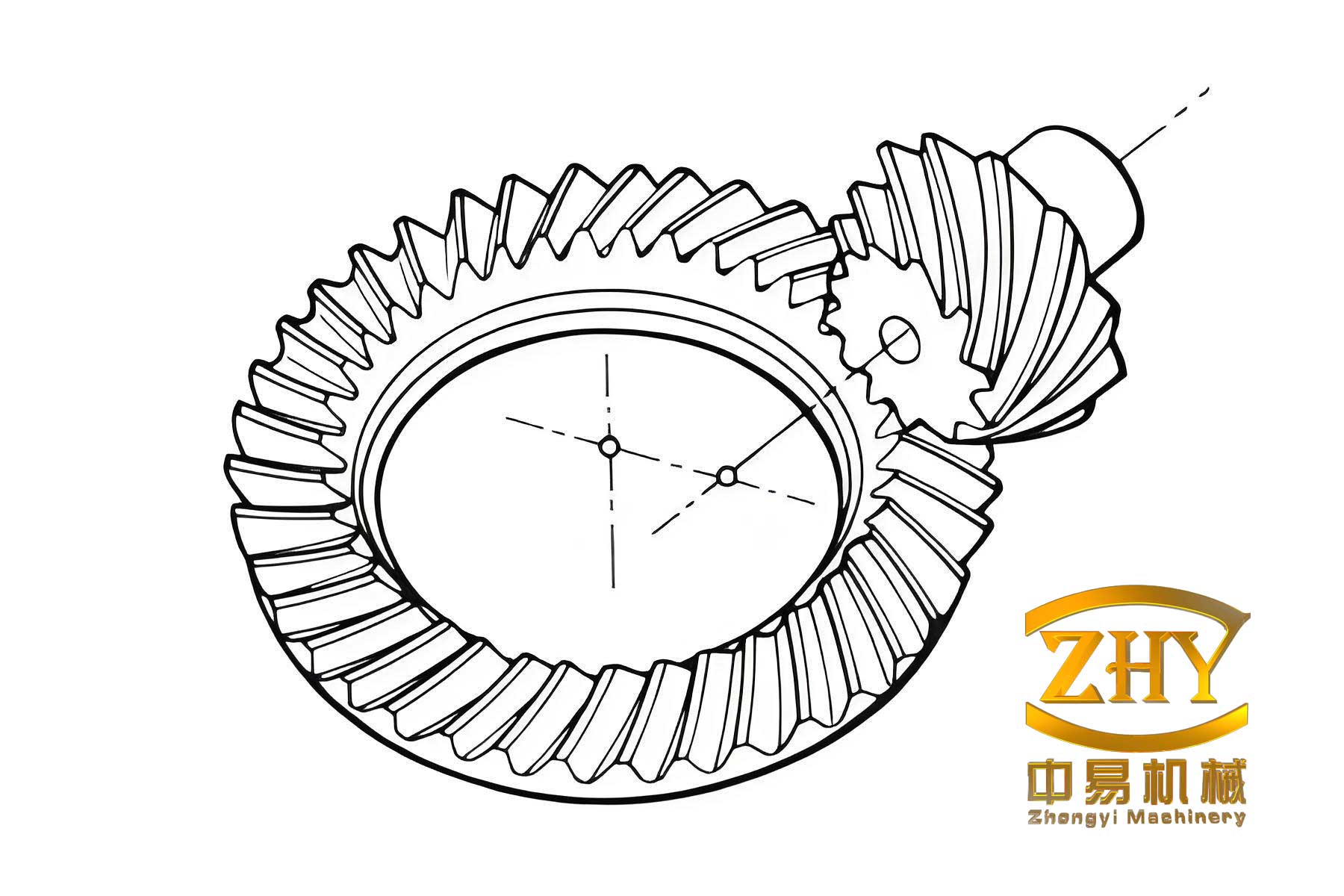
The core of hypoid gear design lies in understanding the pitch cones, which represent the theoretical surfaces where two gears mesh without sliding. For hypoid gears, these cones are skew—meaning their axes do not intersect and are offset by a distance. To model this, we define two conical surfaces, each associated with a gear. Let us consider the first cone (for the pinion) and the second cone (for the gear). In their local coordinate systems, the parametric equations for these cones can be expressed as follows. For cone 1, we have: $$x^{(1)}_1 = r_1 \cos\theta_1, \quad y^{(1)}_1 = r_1 \cot\gamma_1, \quad z^{(1)}_1 = r_1 \sin\theta_1$$ where \(r_1\) is the radial distance from the cone apex, \(\gamma_1\) is the cone angle, and \(\theta_1\) is the angular position. Similarly, for cone 2: $$x^{(2)}_2 = r_2 \cos\theta_2, \quad y^{(2)}_2 = r_2 \sin\theta_2, \quad z^{(2)}_2 = -r_2 \cot\gamma_2$$ with corresponding parameters \(r_2\), \(\gamma_2\), and \(\theta_2\). The normal vectors to these surfaces are crucial for determining contact conditions. For cone 1, the normal vector is: $$\mathbf{n}^{(1)}_1 = (\cos\gamma_1 \cos\theta_1, -\sin\gamma_1, \cos\gamma_1 \sin\theta_1)$$ and for cone 2: $$\mathbf{n}^{(2)}_2 = (\cos\gamma_2 \cos\theta_2, \cos\gamma_2 \sin\theta_2, \sin\gamma_2)$$ These vectors are derived from the partial derivatives of the surface equations and represent the direction perpendicular to the cone at any given point.
To analyze the interaction between the two hypoid gear cones, we must transform these local coordinates into a unified global coordinate system. This system is defined such that the axes of the two gears are skew lines in space, separated by an offset distance \(E\). The transformation involves shifting the origins to account for the offset and the distances from the cone apices to the point of skewness, denoted as \(e_1\) and \(e_2\). After transformation, the coordinates in the global system \((x^{(0)}, y^{(0)}, z^{(0)})\) become: $$x^{(0)}_1 = x^{(1)}_1 + E, \quad y^{(0)}_1 = y^{(1)}_1 – e_1, \quad z^{(0)}_1 = z^{(1)}_1$$ $$x^{(0)}_2 = x^{(2)}_2, \quad y^{(0)}_2 = y^{(2)}_2, \quad z^{(0)}_2 = z^{(2)}_2 – e_2$$ Similarly, the normal vectors are transformed accordingly, though their directions remain invariant under translation. The condition for tangential contact between the two hypoid gear cones requires that at the contact point, the normal vectors are parallel, and the coordinates coincide. This leads to a set of equations that must be satisfied simultaneously.
First, the parallelism of normal vectors gives: $$\mathbf{n}^{(0)}_1 \parallel \mathbf{n}^{(0)}_2$$ which translates into two scalar equations: $$-\sin\gamma_1 \sin\gamma_2 = \cos\gamma_2 \cos\gamma_1 \sin\theta_1 \sin\theta_2 \quad \text{(1)}$$ $$\cos\gamma_1 \cos\gamma_2 \cos\theta_1 \sin\theta_2 = -\sin\gamma_1 \cos\gamma_2 \cos\theta_2 \quad \text{(2)}$$ Second, the coincidence of coordinates yields three equations: $$r_1 \cos\theta_1 + E = r_2 \cos\theta_2 \quad \text{(3)}$$ $$r_1 \cot\gamma_1 – e_1 = r_2 \sin\theta_2 \quad \text{(4)}$$ $$r_1 \sin\theta_1 = -r_2 \cot\gamma_2 – e_2 \quad \text{(5)}$$ In these equations, there are eight unknowns: \(r_1\), \(r_2\), \(\gamma_1\), \(\gamma_2\), \(e_1\), \(e_2\), \(\theta_1\), and \(\theta_2\). To solve for them, additional conditions are required, typically derived from gear design specifications such as tooth curvature, spiral angles, and dimensions.
One key additional condition relates to the curvature at the pitch point, which must match the cutter radius in machining. This involves the limit normal curvature, given by: $$r_c = \frac{\tan\psi_1 – \tan\psi_2}{\left[ \pm \tan\phi_0 \left( \frac{\tan\psi_1}{L_1 \tan\gamma_1} + \frac{\tan\psi_2}{L_2 \tan\gamma_2} \right) + \left( \frac{1}{L_1 \cos\psi_1} – \frac{1}{L_2 \cos\psi_2} \right) \right]} \quad \text{(6)}$$ where \(\tan\phi_0 = \frac{\tan\gamma_1 \tan\gamma_2 (L_1 \sin\psi_1 – L_2 \sin\psi_2)}{L_1 \tan\gamma_1 + L_2 \tan\gamma_2}\), and \(\psi_1\) and \(\psi_2\) are the spiral angles of the two hypoid gears, \(L_1\) and \(L_2\) are the cone distances at the pitch point, and \(\phi_0\) is the limit pressure angle. Furthermore, the pitch radius for the gear (often the larger wheel) is typically set at the midpoint of the tooth width, leading to: $$r_2 = \frac{D – F \sin\gamma_2}{2} \quad \text{(7)}$$ where \(D\) is the outer diameter and \(F\) is the face width. The spiral angle for the pinion is constrained by: $$\tan\psi_1 = \frac{k – \cos\varepsilon’}{\sin\varepsilon’} \quad \text{(8)}$$ with \(k = \frac{N_2 r_1}{N_1 r_2}\), where \(N_1\) and \(N_2\) are tooth numbers, and \(\varepsilon’\) is the angle between the generating lines of the cones at the contact point. This angle can be derived from the dot product of the tangent vectors along the cone generators: $$\mathbf{t}^{(0)}_1 \cdot \mathbf{t}^{(0)}_2 = \cos\varepsilon’ \quad \text{(9)}$$ where the tangent vectors are: $$\mathbf{t}^{(0)}_1 = (\sin\gamma_1 \cos\theta_1, \cos\gamma_1, \sin\gamma_1 \sin\theta_1)$$ $$\mathbf{t}^{(0)}_2 = (\sin\gamma_2 \cos\theta_2, \sin\gamma_2 \sin\theta_2, -\cos\gamma_2)$$ Expanding this dot product yields: $$\cos\varepsilon’ = \sin\gamma_1 \sin\gamma_2 \cos\theta_1 \cos\theta_2 + \cos\gamma_1 \sin\gamma_2 \sin\theta_2 – \cos\gamma_2 \sin\gamma_1 \sin\theta_1$$ Additionally, the spiral angles are related by \(\psi_1 = \psi_2 + \varepsilon’\).
Given these equations, the solution process for hypoid gear design can be simplified. Instead of solving all eight unknowns simultaneously, we can reduce the system to a two-variable nonlinear problem. Specifically, by assuming values for \(\gamma_1\) and \(\gamma_2\), we can compute \(r_1\) and \(r_2\) from equations (3) and (7). Then, \(e_1\) and \(e_2\) are obtained from equations (4) and (5), while \(\theta_1\) and \(\theta_2\) are derived from equations (1) and (2). Next, \(\varepsilon’\) is calculated using equation (9), and finally, equations (6) and (8) are checked to see if the computed values match the desired cutter radius \(r_{co}\) and spiral angle \(\psi_{1o}\). This iterative approach transforms a complex multidimensional problem into a manageable search over \(\gamma_1\) and \(\gamma_2\), making it more accessible for practical hypoid gear design. The table below summarizes the key variables and their meanings in this analytical framework.
| Symbol | Description | Typical Units |
|---|---|---|
| \(r_1, r_2\) | Radial distances from cone apices on pinion and gear | mm |
| \(\gamma_1, \gamma_2\) | Cone angles of pinion and gear | radians or degrees |
| \(\theta_1, \theta_2\) | Angular positions on cone surfaces | radians |
| \(e_1, e_2\) | Distances from cone apices to skew point | mm |
| \(E\) | Offset distance between gear axes | mm |
| \(\psi_1, \psi_2\) | Spiral angles of pinion and gear | radians |
| \(L_1, L_2\) | Cone distances at pitch point | mm |
| \(\phi_0\) | Limit pressure angle | radians |
| \(\varepsilon’\) | Angle between generating lines at contact | radians |
| \(r_c\) | Cutter radius or limit normal curvature | mm |
This analytical method is not limited to orthogonal hypoid gears, where the axes are perpendicular. It can be extended to non-orthogonal hypoid gears, where the axis angle \(\Sigma\) is not 90 degrees. In such cases, the coordinate transformations become more involved due to the additional rotation. For non-orthogonal hypoid gears, the transformation matrix from the local coordinate system of the pinion to the global system includes a rotation by \(\Sigma\) around the x-axis. The composite transformation matrix is: $$\mathbf{M}_{o1} = \mathbf{M}_{ot} \mathbf{M}_{tu} \mathbf{M}_{u1} = \begin{bmatrix} 1 & 0 & 0 & E \\ 0 & \cos\Sigma & \sin\Sigma & -e_1 \cos\Sigma \\ 0 & -\sin\Sigma & \cos\Sigma & e_1 \sin\Sigma \\ 0 & 0 & 0 & 1 \end{bmatrix}$$ This modifies the contact equations. The conditions for normal vector parallelism become: $$\cos\gamma_1 \cos\gamma_2 \cos\theta_1 \sin\theta_2 = (-\sin\gamma_1 \cos\Sigma + \cos\gamma_1 \sin\theta_1 \sin\Sigma) \cos\gamma_2 \cos\theta_2 \quad \text{(1′)}$$ $$\cos\gamma_1 \sin\gamma_2 \cos\theta_1 = (\sin\gamma_1 \sin\Sigma + \cos\gamma_1 \sin\theta_1 \cos\Sigma) \cos\gamma_2 \cos\theta_2 \quad \text{(2′)}$$ The coordinate coincidence equations are adjusted to: $$r_1 \cos\theta_1 + E = r_2 \cos\theta_2 \quad \text{(3′)}$$ $$r_1 \cot\gamma_1 \cos\Sigma + r_1 \sin\theta_1 \sin\Sigma – e_1 \cos\Sigma = r_2 \sin\theta_2 \quad \text{(4′)}$$ $$-r_1 \cot\gamma_1 \sin\Sigma + r_1 \sin\theta_1 \cos\Sigma = -r_2 \cot\gamma_2 – e_2 \quad \text{(5′)}$$ And the angle between generating lines is given by: $$\cos\varepsilon’ = \sin\gamma_1 \sin\gamma_2 \cos\theta_1 \cos\theta_2 + (\cos\gamma_1 \cos\Sigma + \sin\gamma_1 \sin\theta_1 \sin\Sigma) \sin\gamma_2 \sin\theta_2 – \cos\gamma_2 (\sin\gamma_1 \sin\theta_1 \cos\Sigma – \cos\gamma_1 \sin\Sigma) \quad \text{(9′)}$$ These equations maintain the same structure but incorporate \(\Sigma\), allowing the method to handle a wider range of hypoid gear configurations. The solution process remains similar, with iterations over \(\gamma_1\) and \(\gamma_2\) to satisfy design constraints.
The versatility of this analytical approach extends beyond pitch cone determination to other critical aspects of hypoid gear design and manufacturing. For instance, once the pitch cones are established, the addendum and dedendum cones (top and root cones) can be derived. The addendum cone angle for the pinion is determined based on tooth addendum height, and the dedendum cone of the gear must be tangent to the pinion’s addendum cone. Given known values of \(\gamma_1\), \(e_1\), and \(e_2\) from pitch cone analysis, equations (1′) to (5′) can be solved to find \(r_1\), \(r_2\), \(\gamma_2\), \(\theta_1\), and \(\theta_2\) for these auxiliary cones. This ensures proper clearance and meshing in the hypoid gear pair. Moreover, the manufacturing process involves defining process cones—the surfaces used during cutting. For the gear, the process cone is often an equidistant surface from the dedendum cone at the pitch point, while for the pinion, a new pitch cone equidistant from the addendum cone is used. These adjustments ensure that the cutting tools generate the correct tooth profiles.
In machining setup calculations, the relationship between the workpiece and the generating gear (or crown gear) is crucial. The generating gear is typically a flat-top gear with a cone angle of \(90^\circ\) minus the addendum angle, i.e., \(\delta = 90^\circ – \delta_h\). The tangency condition between the workpiece process cone and the flat-top gear leads to a system where \(r_2\), \(\gamma_1\), \(\gamma_2\), and \(E\) are known from design, and we solve for \(e_1\), \(e_2\), \(\theta_1\), \(\theta_2\), \(r_1\), and an additional parameter like the offset \(E\) if needed. Equations (1′) to (5′) along with equation (6) provide six equations for these six unknowns. Once solved, \(\varepsilon’\) is computed from equation (9′), and the spiral angle \(\psi_{1G}\) for the generating process is found. From equation (8), the ratio \(k\) is determined, which relates to tooth numbers and allows calculation of the roll ratio \(N/n\) for the machining machine. This integrated approach streamlines the entire process, from design to manufacturing, for hypoid gears.
To further illustrate the computational steps, let’s outline a typical procedure for designing a hypoid gear using this method. First, gather input parameters: axis offset \(E\), gear ratio, tooth numbers \(N_1\) and \(N_2\), outer diameter \(D\), face width \(F\), desired spiral angles, and cutter radius \(r_c\). Then, initialize guesses for \(\gamma_1\) and \(\gamma_2\). For each iteration, compute \(r_2\) from equation (7), and solve equations (3) and (4) for \(r_1\) and \(e_1\). Use equations (1) and (2) to find \(\theta_1\) and \(\theta_2\), and equation (5) for \(e_2\). Calculate \(\varepsilon’\) from equation (9), and then \(\psi_1\) from equation (8). Check if equation (6) yields the desired \(r_c\). Adjust \(\gamma_1\) and \(\gamma_2\) using a nonlinear solver until convergence. This process can be automated in software, making hypoid gear design efficient and accurate. The table below provides an example of input and output parameters for a sample hypoid gear design.
| Input Parameter | Value | Output Variable | Computed Value |
|---|---|---|---|
| Axis offset \(E\) | 30 mm | Pinion cone angle \(\gamma_1\) | 20.5° |
| Gear teeth \(N_2\) | 40 | Gear cone angle \(\gamma_2\) | 65.2° |
| Pinion teeth \(N_1\) | 10 | Pinion spiral angle \(\psi_1\) | 45.3° |
| Outer diameter \(D\) | 200 mm | Gear spiral angle \(\psi_2\) | 30.1° |
| Face width \(F\) | 40 mm | Pinion pitch radius \(r_1\) | 45.7 mm |
| Cutter radius \(r_c\) | 150 mm | Gear pitch radius \(r_2\) | 85.2 mm |
| Desired spiral angle difference | 15° | Offset distances \(e_1, e_2\) | 12.3 mm, 18.9 mm |
The advantages of this analytical method are manifold. It replaces traditional graphical techniques, which have been used since the early 20th century, with a pure mathematical formulation. This not only reduces the complexity but also enhances precision and repeatability. In traditional methods, designers often rely on extensive charts and nomograms, which can introduce errors and require significant experience to interpret. Our approach, by contrast, encodes all relationships into equations that can be solved systematically. This is particularly beneficial for hypoid gears, where small changes in parameters can have large effects on performance. Furthermore, the method unifies various design stages—pitch cone determination, addendum/dedendum design, and machining setup—into a coherent framework, reducing the need for separate ad hoc calculations.
Another significant aspect is the handling of tooth curvature and contact patterns. Hypoid gears must have controlled contact ellipses to ensure smooth load transmission and minimal noise. The limit normal curvature equation (6) directly ties the cutter geometry to the gear tooth curvature, allowing designers to optimize contact patterns by adjusting parameters like spiral angles or cutter radius. By incorporating this into the iterative solution, we can ensure that the designed hypoid gear meets both geometric and performance criteria. Additionally, the method facilitates sensitivity analysis, where the impact of parameter variations on gear geometry can be studied by perturbing the equations. This is valuable for robust design in industrial applications.
From a manufacturing perspective, the analytical method simplifies machine setup. Once the design parameters are computed, the machine adjustments—such as the tilt angle, swivel angle, and offset—can be derived directly from the solved variables. For example, \(e_1\) and \(e_2\) relate to the machine offsets, while \(\gamma_1\) and \(\gamma_2\) inform the cradle angles. The roll ratio \(N/n\) is obtained from the tooth numbers and pitch radii, ensuring correct tooth generation. This eliminates guesswork and reduces trial-and-error during production, leading to faster setup times and higher quality hypoid gears. In practice, this can result in cost savings and improved consistency, especially in mass production environments.
To deepen the understanding, let’s explore the mathematical foundations further. The core idea is to model the hypoid gear cones as parametric surfaces and use differential geometry to enforce contact conditions. The tangency condition requires that the surfaces share a common point and have parallel normals at that point. This is equivalent to saying that the distance function between the surfaces has a critical point, which leads to the equations we derived. The normal vectors are computed as the cross product of partial derivatives: for a cone parameterized by \(r\) and \(\theta\), the partial derivatives are \(\frac{\partial \mathbf{r}}{\partial r}\) and \(\frac{\partial \mathbf{r}}{\partial \theta}\), and the normal is their cross product. For cone 1: $$\frac{\partial \mathbf{r}^{(1)}_1}{\partial r} = (\cos\theta_1, \cot\gamma_1, \sin\theta_1), \quad \frac{\partial \mathbf{r}^{(1)}_1}{\partial \theta} = (-r_1 \sin\theta_1, 0, r_1 \cos\theta_1)$$ The cross product yields: $$\mathbf{n}^{(1)}_1 = \frac{\partial \mathbf{r}^{(1)}_1}{\partial r} \times \frac{\partial \mathbf{r}^{(1)}_1}{\partial \theta} = (-r_1 \cot\gamma_1 \cos\theta_1, r_1 \sin\gamma_1, -r_1 \cot\gamma_1 \sin\theta_1)$$ which, after normalization, gives the earlier expression. Similar steps apply to cone 2. This geometric insight reinforces the robustness of the method.
In terms of computational implementation, the two-variable reduction is key. By fixing \(\gamma_1\) and \(\gamma_2\), we effectively parameterize the solution space. This reduces the dimensionality of the problem, making it amenable to numerical methods like Newton-Raphson or gradient-based optimization. The residuals are defined as the differences between computed and desired values of \(r_c\) and \(\psi_1\), and the solver adjusts \(\gamma_1\) and \(\gamma_2\) to minimize these residuals. This is far more efficient than solving eight nonlinear equations simultaneously, which might suffer from convergence issues or require extensive computational resources. For hypoid gear designers, this means that even complex designs can be handled on standard computers, potentially with custom software or spreadsheets.
The method also accommodates design constraints common in hypoid gear applications. For instance, in automotive differentials, hypoid gears must fit within limited spaces, necessitating specific offset distances \(E\) and face widths \(F\). Our equations incorporate these directly, allowing designers to iterate quickly to meet packaging requirements. Similarly, noise and vibration considerations often dictate spiral angles; equations (8) and (9) link these angles to the cone geometry, enabling optimization for acoustic performance. By integrating all these factors, the analytical method supports holistic hypoid gear design that balances multiple engineering objectives.
Looking ahead, this approach opens doors to further advancements. For example, it could be extended to incorporate tooth modifications, such as crowning or bias, by modifying the surface equations or adding correction terms. It could also be integrated with finite element analysis to predict stress distributions and durability. Moreover, as manufacturing technologies evolve, such as with 3D printing for prototypes, the precise geometric control offered by this method becomes even more valuable. Ultimately, the goal is to make hypoid gear design more accessible and systematic, fostering innovation in industries that rely on these components.
In conclusion, the analytical method presented here represents a significant step forward in hypoid gear technology. By grounding the design process in mathematical equations, it eliminates much of the ambiguity and complexity associated with traditional graphical methods. From pitch cone determination to machining setup, every stage is handled through a unified set of formulas, making the process transparent and reproducible. For engineers and designers working with hypoid gears, this means faster development cycles, improved accuracy, and better-performing gears. As we continue to refine and apply this method, we hope it will become a standard tool in the gear industry, contributing to more efficient and reliable mechanical systems worldwide. The hypoid gear, with its unique geometry and challenges, deserves such a clear and powerful design approach, and we are confident that this method will meet that need.
To summarize key equations in one place for reference, here are the core formulas for orthogonal hypoid gears. First, the cone surface equations: $$ \text{Cone 1: } \begin{cases} x^{(1)}_1 = r_1 \cos\theta_1 \\ y^{(1)}_1 = r_1 \cot\gamma_1 \\ z^{(1)}_1 = r_1 \sin\theta_1 \end{cases} \quad \text{Cone 2: } \begin{cases} x^{(2)}_2 = r_2 \cos\theta_2 \\ y^{(2)}_2 = r_2 \sin\theta_2 \\ z^{(2)}_2 = -r_2 \cot\gamma_2 \end{cases} $$ Normal vectors: $$ \mathbf{n}^{(1)}_1 = (\cos\gamma_1 \cos\theta_1, -\sin\gamma_1, \cos\gamma_1 \sin\theta_1), \quad \mathbf{n}^{(2)}_2 = (\cos\gamma_2 \cos\theta_2, \cos\gamma_2 \sin\theta_2, \sin\gamma_2) $$ Contact conditions: $$ -\sin\gamma_1 \sin\gamma_2 = \cos\gamma_2 \cos\gamma_1 \sin\theta_1 \sin\theta_2 $$ $$ \cos\gamma_1 \cos\gamma_2 \cos\theta_1 \sin\theta_2 = -\sin\gamma_1 \cos\gamma_2 \cos\theta_2 $$ $$ r_1 \cos\theta_1 + E = r_2 \cos\theta_2 $$ $$ r_1 \cot\gamma_1 – e_1 = r_2 \sin\theta_2 $$ $$ r_1 \sin\theta_1 = -r_2 \cot\gamma_2 – e_2 $$ Additional constraints: $$ r_c = \frac{\tan\psi_1 – \tan\psi_2}{\left[ \pm \tan\phi_0 \left( \frac{\tan\psi_1}{L_1 \tan\gamma_1} + \frac{\tan\psi_2}{L_2 \tan\gamma_2} \right) + \left( \frac{1}{L_1 \cos\psi_1} – \frac{1}{L_2 \cos\psi_2} \right) \right]}, \quad \tan\phi_0 = \frac{\tan\gamma_1 \tan\gamma_2 (L_1 \sin\psi_1 – L_2 \sin\psi_2)}{L_1 \tan\gamma_1 + L_2 \tan\gamma_2} $$ $$ r_2 = \frac{D – F \sin\gamma_2}{2}, \quad \tan\psi_1 = \frac{k – \cos\varepsilon’}{\sin\varepsilon’}, \quad k = \frac{N_2 r_1}{N_1 r_2} $$ $$ \cos\varepsilon’ = \sin\gamma_1 \sin\gamma_2 \cos\theta_1 \cos\theta_2 + \cos\gamma_1 \sin\gamma_2 \sin\theta_2 – \cos\gamma_2 \sin\gamma_1 \sin\theta_1 $$ For non-orthogonal cases, include the axis angle \(\Sigma\) in modified equations as shown earlier. This comprehensive set forms the backbone of the new hypoid gear design and machining method, offering a clear path from concept to production.