
In the quest for improved vehicle performance and comfort, the design of the final drive axle is of paramount importance. Among the various gear types employed, hypoid gears have proven exceptionally valuable, particularly in passenger cars, SUVs, and light trucks. The primary advantage of a hypoid gear set lies in the offset between the pinion and gear axes. This spatial configuration allows for more flexible vehicle packaging, enabling a lower drivetrain tunnel and consequently a lower vehicle center of gravity. Furthermore, compared to spiral bevel gears, hypoid gears often exhibit superior smoothness, load-carrying capacity, and bearing stiffness. However, a critical challenge in their application is the control of noise, vibration, and harshness (NVH). Gear meshing noise constitutes a significant portion of the overall axle noise. This article, from my perspective as a design engineer, delves into a methodological approach to optimize the geometric parameters of a hypoid gear pair specifically to minimize noise by precisely controlling a key performance indicator: the contact ratio.
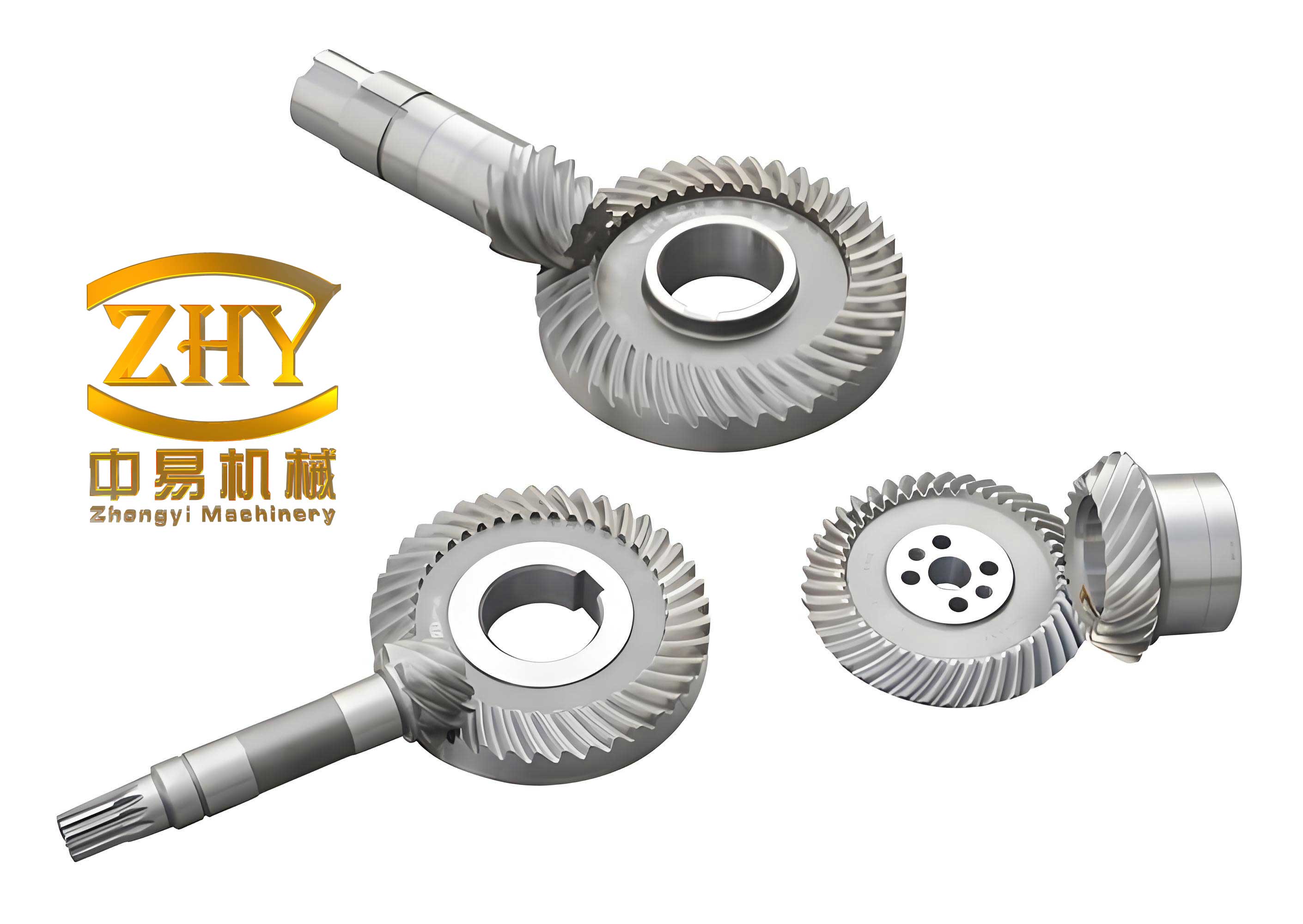
The core principle guiding this design philosophy is the relationship between meshing smoothness and the contact ratio. In spur or helical gears, we consider the transverse contact ratio and the overlap ratio. For hypoid gears, the analogous and most influential metric for noise generation is the face contact ratio, often denoted as $\epsilon_\beta$. This parameter represents the average number of tooth pairs in contact along the path of action as projected onto the pitch plane. Empirical evidence strongly suggests that when the face contact ratio exceeds a value of 1.5, a dramatic improvement in meshing smoothness and a corresponding reduction in noise can be achieved. A higher $\epsilon_\beta$ ensures a more gradual transfer of load from one tooth pair to the next, smoothing out force fluctuations that excite vibrations and generate sound.
The traditional design process for hypoid gears often relies on iterative empirical selection of parameters and subsequent verification. This approach can be time-consuming and may not converge on the most optimal set of parameters for a given noise target. The method proposed here reverses this logic: we define the desired face contact ratio (e.g., $\epsilon_\beta \geq 1.5$) as the primary target and employ mathematical optimization techniques to determine the combination of geometric parameters that precisely achieves this goal while satisfying all necessary strength and manufacturing constraints.
1. Mathematical Foundation: Calculating the Face Contact Ratio ($\epsilon_\beta$)
The face contact ratio for a hypoid gear set is derived from its geometry and is fundamentally related to the axial overlap of the teeth, similar to the overlap ratio in helical gears. Its calculation is more complex due to the shaft offset and differing spiral angles. The formula is given by:
$$ \epsilon_\beta = \frac{F}{p_{ax}} $$
Where $F$ is the face width of the gear (typically the larger ring gear) and $p_{ax}$ is the axial pitch. The axial pitch can be further broken down into components related to the gear’s geometry at the mean point. A more detailed operational formula involves several key geometric parameters:
$$ \epsilon_\beta = \frac{F \cdot \cos \beta_m}{A_m \cdot \tan \beta} $$
In this expression, $\beta_m$ is the mean spiral angle, $A_m$ is the mean cone distance, and $\tan \beta$ is derived from the difference in spiral angles between the gear and pinion. A comprehensive computational form consolidates these relationships:
$$ \epsilon_\beta = \frac{F}{A_m} \cdot \frac{\cos \beta_m}{\tan \beta_2 – \tan \beta_1} $$
Where $\beta_1$ and $\beta_2$ are the spiral angles of the pinion and gear, respectively, at their mean points. The mean spiral angle $\beta_m$ is simply the average: $\beta_m = (\beta_1 + \beta_2)/2$. The denominator $(\tan \beta_2 – \tan \beta_1)$ is crucial and is related to the shaft offset $E$ and the gear ratio $i_0$. The mean cone distance $A_m$ for the gear is calculated as $A_m = R_{m2} / \sin \delta_2$, where $R_{m2}$ is the mean pitch radius of the gear and $\delta_2$ is its pitch angle. These parameters are interconnected through the following fundamental relations for a hypoid gear set:
| Parameter | Symbol | Formula / Relation |
|---|---|---|
| Gear Pitch Angle | $\delta_2$ | $\delta_2 = \arctan(Z_2 / (i_0 \cdot Z_1))$ (approx.) |
| Pinion Pitch Angle | $\delta_1$ | $\delta_1 = 90^\circ – \delta_2$ (approx., varies with offset) |
| Gear Mean Pitch Radius | $R_{m2}$ | $R_{m2} = (d_2 – F \cdot \sin \delta_2) / 2$ |
| Gear Outer Pitch Diameter | $d_2$ | $d_2 = m_t \cdot Z_2$ |
| Offset Angle | $\zeta$ | $\zeta = \arcsin(E / A_m)$ |
| Gear Spiral Angle (mean) | $\beta_2$ | $\beta_2 = \beta_m + \Delta \beta / 2$ |
| Pinion Spiral Angle (mean) | $\beta_1$ | $\beta_1 = \beta_m – \Delta \beta / 2$ |
| Spiral Angle Difference | $\Delta \beta = \beta_2 – \beta_1$ | $\tan \beta_2 – \tan \beta_1 \approx \frac{2E}{A_m \cdot \cos \beta_m}$ |
Therefore, the face contact ratio $\epsilon_\beta$ is ultimately a function of several independent geometric parameters: the mean spiral angle $\beta_m$, the outer transverse module $m_t$, the face width $F$, the pinion offset $E$, and the number of teeth on the pinion $Z_1$ (with the gear teeth $Z_2 = i_0 \cdot Z_1$). This functional relationship is the cornerstone of the optimization problem.
2. Formulating the Optimization Problem
The goal is to find the best combination of hypoid gear parameters that yields a specific, desirable face contact ratio. This is framed as a constrained nonlinear programming problem.
2.1 Design Variables
Based on the analysis of $\epsilon_\beta$, the independent variables that define the gear geometry and directly influence the contact ratio are selected. For a given gear ratio $i_0$, these are:
$$ \mathbf{X} = [x_1, x_2, x_3, x_4, x_5]^T = [\beta_m, m_t, F, E, Z_1]^T $$
Where:
$\beta_m$ = Mean spiral angle (degrees or rad)
$m_t$ = Outer transverse module (mm)
$F$ = Face width of the ring gear (mm)
$E$ = Pinion offset (mm)
$Z_1$ = Number of pinion teeth
2.2 Objective Function
The primary design target is to achieve a pre-defined face contact ratio $\epsilon_{\beta, target}$, typically 1.5 or higher for optimal noise performance. Therefore, the objective is to minimize the absolute difference between the calculated $\epsilon_\beta(\mathbf{X})$ and the target value. The objective function $f(\mathbf{X})$ is defined as:
$$ f(\mathbf{X}) = \left[ \epsilon_\beta(\mathbf{X}) – \epsilon_{\beta, target} \right]^2 $$
Minimizing this function drives the design towards the precise desired contact ratio.
2.3 Constraints
The optimization must yield a design that is not only quiet but also strong, manufacturable, and functionally viable. The following constraints are essential for a practical hypoid gear design.
2.3.1 Geometrical and Empirical Constraints
– Total Number of Teeth: Too few teeth risk undercutting and low contact ratio; too many lead to large, impractical dimensions. The sum is typically constrained:
$$ 40 \leq Z_1 + Z_2 \leq 50 $$
– Face Width Limit: Excessive face width causes manufacturing difficulties (undercut, heat treatment distortion) and assembly space issues. A common rule is:
$$ F \leq 0.3 \cdot A_0 \quad \text{or} \quad F \leq 10 \cdot m_t $$
where $A_0$ is the outer cone distance.
– Pinion Offset Limit: A large offset increases sliding action, leading to potential scoring and reduced efficiency. For passenger cars, it should not exceed ~20% of the gear pitch diameter $d_2$:
$$ E \leq 0.2 \cdot d_2 $$
2.3.2 Strength Constraints (Bending and Contact)
The gear must withstand the operational loads. Bending stress ($\sigma_F$) and contact stress ($\sigma_H$) must be below their respective allowable limits $[\sigma_F]$ and $[\sigma_H]$ for the chosen material.
Bending Stress ($\sigma_F$): Calculated for both pinion and gear using a modified Lewis formula. For the gear:
$$ \sigma_{F2} = \frac{2 T_{2, mean} \cdot K_A \cdot K_V \cdot K_{m\beta}}{m_t^3 \cdot Z_2 \cdot Y_{F2} \cdot Y_{S2} \cdot Y_\epsilon \cdot Y_K} \leq [\sigma_{F2}] $$
Contact Stress ($\sigma_H$): Based on the Hertzian theory:
$$ \sigma_H = Z_E \cdot Z_H \cdot Z_\epsilon \cdot \sqrt{ \frac{2 T_{2, max} \cdot K_A \cdot K_V \cdot K_{m\beta}}{b \cdot d_1^2} \cdot \frac{i_0 + 1}{i_0} } \leq [\sigma_H] $$
Where:
$T_{2, mean}, T_{2, max}$ = Mean and maximum torque on the gear (N·mm)
$K_A$ = Application factor
$K_V$ = Dynamic factor
$K_{m\beta}$ = Load distribution factor
$Y_{F}, Y_{S}$ = Tooth form factor and stress correction factor
$Y_\epsilon, Y_K, Z_\epsilon$ = Contact ratio factors
$Z_E$ = Elasticity coefficient ($\sqrt{\text{N/mm}^2}$)
$Z_H$ = Zone factor
$d_1$ = Pinion pitch diameter ($d_1 = m_t \cdot Z_1$)
The calculation of input torque $T_2$ is derived from vehicle parameters: total mass $G_a$, rolling radius $r_r$, final drive ratio $i_0$, and wheel-side ratio $i_{wheel}$.
2.3.3 Side Constraints (Bounds)
Practical ranges are assigned to each design variable based on experience and manufacturing limits.
| Variable | Lower Bound | Upper Bound | Typical Range/Note |
|---|---|---|---|
| $\beta_m$ (deg) | 35 | 50 | Balances axial thrust and smoothness |
| $m_t$ (mm) | 4.0 | 7.0 | Scales with torque |
| $F$ (mm) | 30 | 45 | Subject to $F \leq 10 m_t$ |
| $E$ (mm) | 20 | 35 | Subject to $E \leq 0.2 d_2$ |
| $Z_1$ | 8 | 12 | Subject to $40 \leq Z_1+Z_2 \leq 50$ |
2.4 Complete Optimization Model
The problem can be summarized as follows:
Find the vector $\mathbf{X} = [\beta_m, m_t, F, E, Z_1]^T$ that:
$$ \text{Minimizes:} \quad f(\mathbf{X}) = [\epsilon_\beta(\mathbf{X}) – \epsilon_{\beta, target}]^2 $$
$$ \text{Subject to:} $$
$$ g_1(\mathbf{X}): 40 – (Z_1 + i_0 Z_1) \leq 0 $$
$$ g_2(\mathbf{X}): (Z_1 + i_0 Z_1) – 50 \leq 0 $$
$$ g_3(\mathbf{X}): F – 10 \cdot m_t \leq 0 $$
$$ g_4(\mathbf{X}): E – 0.2 \cdot (m_t \cdot i_0 \cdot Z_1) \leq 0 $$
$$ g_5(\mathbf{X}): \sigma_{F2}(\mathbf{X}) – [\sigma_{F2}] \leq 0 $$
$$ g_6(\mathbf{X}): \sigma_H(\mathbf{X}) – [\sigma_H] \leq 0 $$
$$ \text{And:} \quad \beta_m^L \leq \beta_m \leq \beta_m^U, \quad m_t^L \leq m_t \leq m_t^U, \quad … $$
3. Application Example & Computational Results
To demonstrate the methodology, consider the design of a hypoid gear final drive for a passenger car with the following specifications:
| Parameter | Symbol | Value |
|---|---|---|
| Total Vehicle Weight | $G_a$ | 15000 N |
| Max Engine Torque | $T_{emax}$ | 150 N·m |
| Final Drive Ratio | $i_0$ | 4.111 |
| Wheel-side Ratio | $i_{wheel}$ | 1.0 |
| Tire | – | 185/70 R14 |
Material & Heat Treatment: 20CrMnTi steel, case-carburized and hardened to 58-62 HRC.
Allowable Stresses: $[\sigma_F] = 700 \text{ MPa}$, $[\sigma_H] = 2800 \text{ MPa}$.
Pressure Angle: $\alpha_n = 20^\circ$.
The optimization algorithm (e.g., a constrained random search or Sequential Quadratic Programming method) is implemented. The target face contact ratio is set first to $\epsilon_{\beta, target} = 1.5$ and then to $\epsilon_{\beta, target} = 2.0$ to observe the effect. Key vehicle parameters for torque calculation are input, such as the performance factor, road resistance coefficient, overload factor, and various correction factors ($K_A$, $K_V$, $K_{m\beta}$, $Y_F$, $Z_H$, etc.).
Optimization Results: The algorithm successfully converges, providing optimal parameter sets.
| Design Variable / Result | Case 1: $\epsilon_{\beta, target}=1.5$ | Case 2: $\epsilon_{\beta, target}=2.0$ |
|---|---|---|
| Mean Spiral Angle, $\beta_m$ (deg) | 40.5 | 42.8 |
| Outer Transverse Module, $m_t$ (mm) | 4.85 | 4.62 |
| Face Width, $F$ (mm) | 42.1 | 44.7 |
| Pinion Offset, $E$ (mm) | 25.8 | 28.3 |
| Number of Pinion Teeth, $Z_1$ | 9 | 10 |
| Number of Gear Teeth, $Z_2$ | 37 (from $i_0 \cdot Z_1$) | 41 |
| Achieved Face Contact Ratio, $\epsilon_\beta$ | 1.500 | 2.000 |
| Gear Pitch Diameter, $d_2$ (mm) | ~179.5 | ~189.4 |
| Bending Stress, $\sigma_{F2}$ (MPa) | 665 (< 700) | 640 (< 700) |
| Contact Stress, $\sigma_{H}$ (MPa) | 2750 (< 2800) | 2710 (< 2800) |
4. Analysis and Conclusion
The optimization results clearly validate the proposed methodology for hypoid gear design. By directly targeting the face contact ratio $\epsilon_\beta$, the algorithm systematically determines a set of geometric parameters that precisely meet the noise reduction objective. Both result sets satisfy all strength and geometric constraints.
Comparing the two cases offers valuable insights. To achieve a higher contact ratio ($\epsilon_\beta = 2.0$), the optimization tends to select a slightly larger mean spiral angle, a marginally smaller module (leading to more teeth), a larger face width, and a greater offset. This combination effectively increases the axial overlap of the teeth. Notably, the design for $\epsilon_\beta = 2.0$ results in a gear pair that is not only predicted to be quieter but also has slightly lower bending and contact stresses, all within a very comparable overall size envelope. This demonstrates that pursuing a higher contact ratio for NVH purposes can be synergistic with achieving a robust and compact design.
The primary advantage of this optimization-based approach over traditional iterative methods is the elimination of guesswork and the direct, precise attainment of a key performance target. It efficiently navigates the complex, nonlinear interactions between hypoid gear parameters. After optimization, some variables (like tooth count) may need minor integer adjustment, followed by a quick re-verification of the contact ratio and stresses. This method provides a powerful, systematic foundation for designing low-noise, high-performance hypoid gear drives, aligning perfectly with the evolving demands for quieter and more efficient automotive drivetrains.