
This article presents a novel and efficient computational methodology, termed the Stress Influence Matrix (SIM) method, for the precise calculation of the bending stress distribution and its transient evolution throughout the meshing cycle of hypoid gears. The increasing demands for higher power density, operating speeds, and reliability in modern automotive and aerospace transmissions necessitate a move beyond traditional, empirically-based design rules towards high-fidelity, physics-based simulation tools. While the finite element method (FEM) offers the required accuracy, its direct application to simulate the entire gear meshing process is computationally prohibitive due to the need for solving numerous independent structural analyses. The proposed method overcomes this fundamental limitation by decoupling the complex, load-varying contact problem from the structural response of the gear tooth. By performing a single, preparatory finite element analysis to establish a characteristic stress influence matrix for the tooth structure, the complete bending stress history under arbitrary meshing loads can be obtained through efficient matrix operations and interpolation techniques. This approach retains the accuracy of full FEM while achieving computational efficiency suitable for iterative design and analysis, including the effects of manufacturing errors, assembly misalignments, and load fluctuations.
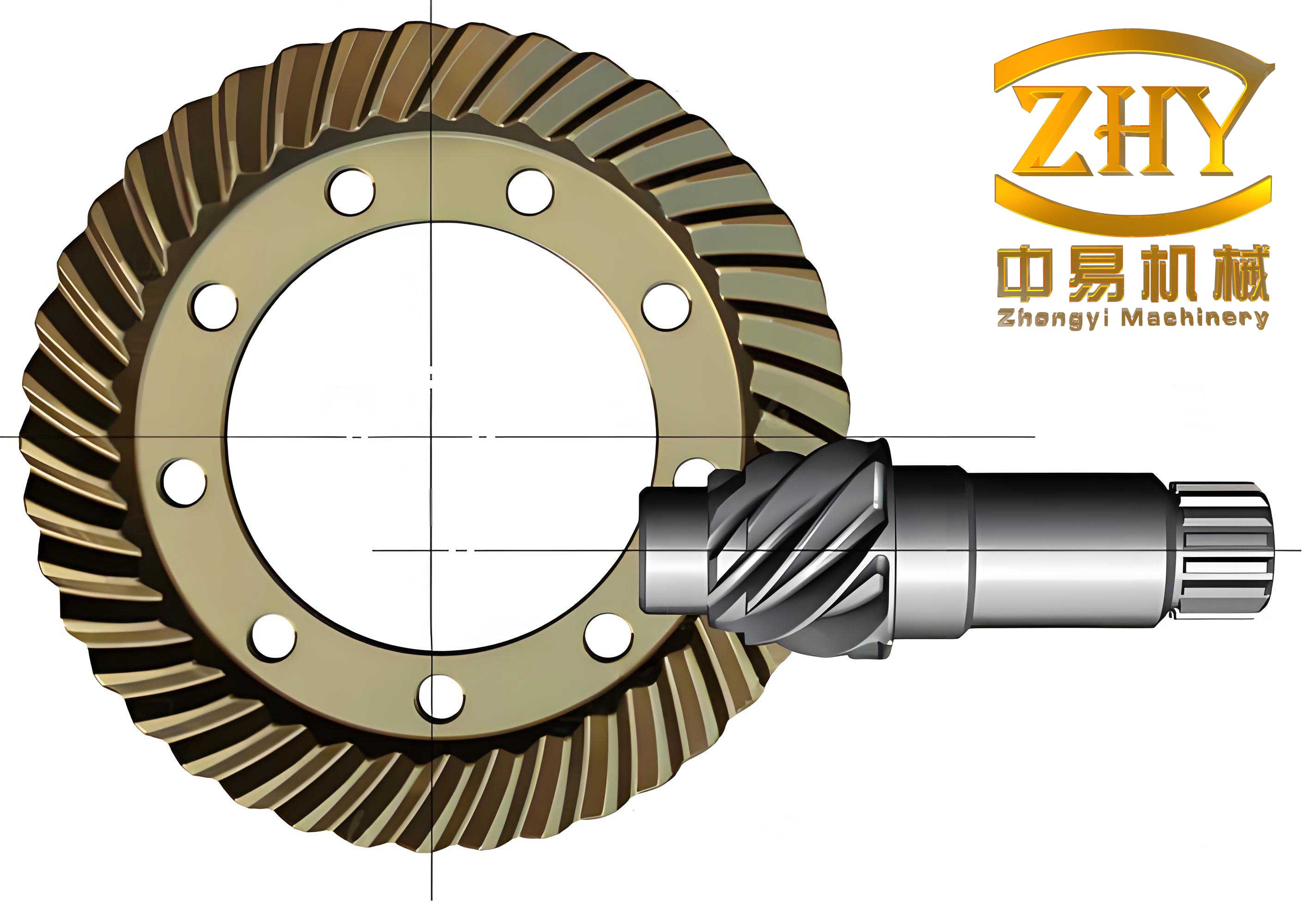
The design and validation of hypoid gear strength, particularly bending strength at the tooth root, is a cornerstone of driveline engineering. The complex spatial geometry of hypoid gear teeth, characterized by offset axes and curved paths of contact, results in a highly three-dimensional and time-varying state of stress. For decades, the industry relied heavily on standardized calculation methods, such as those developed by Gleason, which are rooted in simplified beam theory and heavily calibrated with extensive experimental data. Although convenient, these methods are inherently approximate. They cannot accurately capture the dynamic redistribution of root stress during the mesh, nor can they quantitatively account for the influence of real-world conditions like flank form deviations due to cutter wear, mounting deflections, or support structure compliance. As performance boundaries are pushed, the need for a more rigorous and flexible analysis framework becomes critical.
The advent of powerful computational hardware and software has made finite element analysis (FEA) a common tool in gear research. Numerous studies have demonstrated its capability to model the detailed stress state in gear teeth, including those of hypoid gear pairs. However, a significant barrier to its widespread adoption in routine engineering practice is the “brute-force” computational cost. Simulating a full mesh cycle requires discretizing the continuous process into a sequence of dozens, if not hundreds, of static stress analyses—one for each incremental position of contact. Each analysis requires solving a large system of equations for a complex 3D model. The cumulative demand on memory and CPU time is immense, making iterative design studies or statistical analysis considering tolerances practically infeasible. Therefore, a method that bridges the gap between the accuracy of FEA and the speed of analytical methods is highly desirable for the advanced development of hypoid gear drives.
Theoretical Foundation: Saint-Venant’s Principle and Superposition
The proposed Stress Influence Matrix method is rigorously founded upon two fundamental principles of linear elasticity: Saint-Venant’s principle and the principle of stress superposition.
Saint-Venant’s Principle states that the stress distribution in a body at locations sufficiently remote from the region of load application is statically equivalent to the applied load. For a hypoid gear tooth, the area of load application is the instantaneous contact ellipse on the tooth flank. The principle allows us to replace the distributed contact pressure over this ellipse with an equivalent set of discrete concentrated forces acting along the major axis of the ellipse without significantly affecting the stress field in the critical root fillet region. This replacement is crucial for simplifying the load input to the structural model.
The Principle of Stress Superposition is valid for linear elastic material behavior. It dictates that the stress state caused by multiple loads acting simultaneously is the sum of the stress states caused by each load acting individually. If the stress response of the tooth structure to a unit load at a specific point on the flank is known, then the response to any arbitrary combination of loads at various points can be constructed by a weighted summation of these individual unit responses.
The mathematical formulation combining these principles is as follows. Let the tooth flank surface be discretized into \( N_s \) nodal points. The stress state at \( N_r \) nodes in the root fillet region, due to a unit normal force applied at a single flank node \( j \), can be represented as a column vector \( \mathbf{s}_j \):
$$ \mathbf{s}_j = \begin{bmatrix} \sigma_{1j} & \sigma_{2j} & \dots & \sigma_{N_r j} \end{bmatrix}^T $$
where \( \sigma_{ij} \) represents a stress component (e.g., von Mises, principal stress) at root node \( i \) due to the unit load at flank node \( j \). By performing this calculation for all \( N_s \) flank nodes, we assemble the complete Stress Influence Matrix (SIM) \( [\mathbf{S}] \):
$$ [\mathbf{S}] = [\mathbf{s}_1, \mathbf{s}_2, \dots, \mathbf{s}_{N_s}] $$
Thus, \( [\mathbf{S}] \) is an \( N_r \times N_s \) matrix that fully characterizes the elastic stress response of the hypoid gear tooth structure.
Methodology of the Stress Influence Matrix Method
The implementation of the SIM method for a hypoid gear involves a sequence of integrated steps, from geometric definition to final stress process calculation. The workflow is designed for automation and efficiency.
Step 1: Geometric Modeling and Automated Mesh Generation
Accurate geometry is paramount. Given the machine-tool settings and basic gear parameters, the exact tooth flanks, including the vital root fillet surfaces, are generated numerically through simulation of the gear manufacturing process (e.g., face-hobbing or face-milling). This digital twin of the hypoid gear pair serves as the basis for FEA.
An automated algorithm is employed to generate the finite element mesh:
- Surface Discretization: The tooth working surface and root fillet are discretized into a mesh of nodes. The density is user-controlled based on a compromise between accuracy and computational cost.
- Projection and Parameter Solution: Nodes are initially defined on a rotational projection plane. Their 3D coordinates \( (x_i, y_i, z_i) \) on the actual curved surface are found by solving a system of nonlinear equations derived from the surface geometry, relating radial distance \( R_i \) and angle \( \delta_i \) to the surface parameters.
- Solid Mesh Generation: Using the surface nodes as a guide, a three-dimensional solid mesh (typically using tetrahedral or hexahedral elements) is generated for the tooth and a sufficient portion of the gear blank. The mesh transitions smoothly from the fine surface grid to a coarser grid in the gear body.
- Boundary Conditions: Nodes on the gear body’s inner bore or connection face are constrained to represent the mounting. Nodes on the tooth flank are identified as potential load application points.
| Step | Action | Output |
|---|---|---|
| 1 | Define flank & fillet surface grid density | Grid parameters |
| 2 | Place nodes in rotational projection plane | 2D nodal coordinates \( (R_i, \delta_i) \) |
| 3 | Solve for 3D surface coordinates | 3D nodal coordinates \( (x_i, y_i, z_i) \) |
| 4 | Generate volume mesh and apply BCs | Complete FE model ready for analysis |
Step 2: Calculation of the Base Stress Influence Matrix
A single static finite element analysis is run in a preparatory phase. In this analysis, a unit normal force is applied sequentially to each of the \( N_s \) nodes on the working flank of the hypoid gear tooth. For each load case, the resulting stress field at all \( N_r \) root nodes is extracted and stored. As described in the theory section, this data forms the base Stress Influence Matrix \( [\mathbf{S}] \). This matrix is a property of the gear tooth geometry and material and is computed once for a given hypoid gear design.
Step 3: Load Distribution Analysis via LTCA
To determine the actual loads during mesh, a Loaded Tooth Contact Analysis (LTCA) is performed. This analysis computes the path of contact, the size and orientation of the contact ellipse at each meshing position, and the distribution of normal pressure across the ellipses for a given input torque. The LTCA accounts for tooth bending and shear deflection, contact deformation, and misalignments. The continuous pressure distribution on each instantaneous contact ellipse is discretized into an equivalent set of \( M_k \) concentrated forces \( F_{k,m} \) acting at points along the ellipse’s major axis. For a meshing cycle discretized into \( K \) contact positions, this forms a Load Matrix \( [\mathbf{F}] \):
$$ [\mathbf{F}] = \begin{bmatrix} F_{1,1} & F_{1,2} & \dots & F_{1,M_1} & 0 & \dots & 0 \\
0 & 0 & \dots & 0 & F_{2,1} & \dots & F_{2,M_2} \\
\vdots & \vdots & \ddots & \vdots & \vdots & \ddots & \vdots \\
0 & 0 & \dots & 0 & 0 & \dots & F_{K, M_K}
\end{bmatrix}^T $$
The total number of discrete load points across all contact positions is \( M_{total} = \sum_{k=1}^{K} M_k \).
Step 4: Interpolation to Form the Contact Load Influence Matrix
The base SIM \( [\mathbf{S}] \) is defined for loads at the predefined flank mesh nodes. However, the LTCA-derived load points \( F_{k,m} \) generally do not coincide with these nodes. A mapping via bivariate interpolation is required. The flank mesh, defined by its nodes, is first parameterized into a regular, normalized coordinate system \( (u, v) \). The stress influence values are then interpolated onto the \( (u, v) \) coordinates of each LTCA load point using a smooth interpolation scheme like bicubic splines. This process generates a Contact Load Influence Matrix \( [\mathbf{S}_c] \) of size \( N_r \times M_{total} \), where each column corresponds to the root stress vector due to a unit load at an LTCA load point.
Let \( \mathbf{p}_{node} \) be a node with known influence vector \( \mathbf{s}_{node} \), and \( \mathbf{p}_{contact} \) be a contact point. The interpolation for a scalar stress component \( \sigma \) can be expressed as:
$$ \sigma(\mathbf{p}_{contact}) = \sum_{j=1}^{n} N_j(u,v) \cdot \sigma(\mathbf{p}_{node,j}) $$
where \( N_j(u,v) \) are the interpolation basis functions and the sum is over the \( n \) surrounding grid nodes. This is performed for all stress components and all root nodes to build \( [\mathbf{S}_c] \).
Step 5: Calculation of the Bending Stress Process
The final bending stress history is obtained through a single matrix multiplication, embodying the superposition principle. The root stress vector for meshing position \( k \) is the sum of the stress contributions from all discrete loads \( F_{k,m} \) active at that instant:
$$ \mathbf{\Sigma}_k = \sum_{m=1}^{M_k} F_{k,m} \cdot \mathbf{s}_{c}^{(k,m)} $$
where \( \mathbf{s}_{c}^{(k,m)} \) is the column in \( [\mathbf{S}_c] \) corresponding to load point \( m \) at position \( k \). For the entire mesh cycle, this can be written compactly as:
$$ [\mathbf{\Sigma}] = [\mathbf{S}_c] \cdot [\mathbf{F}] $$
Here, \( [\mathbf{\Sigma}] \) is the Bending Stress Process Matrix of size \( N_r \times K \). Each column \( \mathbf{\Sigma}_k \) is the full-field root stress distribution at meshing instant \( k \), and each row is the time-history of stress at a specific root node throughout the mesh cycle.
| Method | Basis | Accuracy for Stress Process | Computational Cost for Full Cycle | Ability to Model Errors & Deflections |
|---|---|---|---|---|
| Traditional (e.g., Gleason) | Empirical/Beam Theory | Low (Single-point, static) | Very Low | Very Limited (via approximate factors) |
| Direct Sequential FEM | Finite Element Analysis | Very High | Prohibitively High (Requires ~K full FE solves) | High (But requires re-analysis for each scenario) |
| Stress Influence Matrix (Proposed) | FEM + Superposition | Very High (Equivalent to FEM) | Low (One FE solve + matrix ops) | High (Easily integrated via updated LTCA inputs) |
Computational Example and Analysis
The efficacy of the SIM method is demonstrated through its application to a drive-side (pinion concave, gear convex) hypoid gear pair. The geometric and manufacturing parameters align with standard industrial designs. The finite element model for both pinion and gear was generated automatically, resulting in models with several hundred thousand degrees of freedom. The base Stress Influence Matrix \( [\mathbf{S}] \) was calculated in a single run.
Loaded Tooth Contact Analysis predicted the contact path comprising approximately 12 distinct contact positions from the toe to the heel of the tooth. Under a designated maximum load (e.g., output torque of 3000 Nm), the load distribution across the contact ellipses was computed, accounting for tooth flexibility. Using the described interpolation and superposition technique, the complete bending stress process matrix \( [\mathbf{\Sigma}] \) was obtained in a matter of minutes on a standard engineering workstation.
The results vividly illustrate the dynamic nature of root stress in a hypoid gear. The location of the maximum root stress (e.g., maximum von Mises or principal stress) migrates along the root fillet in synchronization with the moving contact zone. For the pinion (with a specific hand of spiral), the most critical stress region tends to be towards the heel of the tooth on the loaded flank. Conversely, for the gear, the peak stress often resides closer to the toe. This asymmetry is a direct consequence of the complex relative curvature and load sharing characteristics inherent to hypoid gear meshing, which the SIM method captures accurately.
Table 3 below summarizes key stress results at critical meshing positions for both the pinion and gear of the example hypoid gear set, highlighting the stress migration.
| Component | Stress Measure | Contact Position 1 (Toe) | Contact Position 6 (Mid) | Contact Position 12 (Heel) | Absolute Maximum |
|---|---|---|---|---|---|
| Pinion | Max Principal Stress | 412 | 587 | 721 | 721 (Pos. 12) |
| von Mises Stress | 385 | 545 | 698 | 698 (Pos. 12) | |
| Gear | Max Principal Stress | 655 | 520 | 401 | 655 (Pos. 1) |
| von Mises Stress | 632 | 498 | 388 | 632 (Pos. 1) |
This entire process, from geometry input to full stress history, was completed in approximately 30 minutes on a standard PC. A direct sequential FEM approach for the same 12 contact positions would require 12 separate, full-scale FE solutions, consuming orders of magnitude more time and computational resources, thus validating the supreme efficiency of the SIM method for analyzing hypoid gear bending fatigue.
Advantages and Application Scope
The Stress Influence Matrix method offers transformative advantages for the design and analysis of hypoid gears:
- High Efficiency: The decoupling of the contact/load problem from the structural response problem is the key innovation. The computationally expensive FEM is used only once to characterize the structure. All subsequent stress calculations for different loads, misalignments, or error conditions are reduced to fast matrix algebra.
- Full-Fidelity Stress History: It provides the complete time-varying 3D stress tensor at every point in the root fillet, enabling detailed investigation of failure initiation sites and multi-axial fatigue criteria.
- Seamless Integration with System Analysis: The method naturally incorporates results from LTCA, which itself can model effects like misalignments (pinion offset error, axial shim change), assembly deflections (bearing compliance), and manufacturing errors (ease-off topography modifications). Any change in these conditions alters the Load Matrix \( [\mathbf{F}] \), and the new stress process is obtained instantly by re-multiplying with the unchanged \( [\mathbf{S}_c] \).
- Design Optimization Friendly: The rapid evaluation of stress for a given set of machine settings makes it feasible to integrate this method into optimization loops aiming to minimize root stress or balance stress between pinion and gear, leading to more robust hypoid gear designs.
The practical calculation steps within an integrated software system are summarized as:
- Perform a single FEM run with unit loads on all flank nodes to generate the base SIM \( [\mathbf{S}] \).
- Execute LTCA for the intended operating condition (including any errors/deflections) to generate the Load Matrix \( [\mathbf{F}] \) and contact point coordinates.
- Interpolate \( [\mathbf{S}] \) onto the LTCA contact points to form \( [\mathbf{S}_c] \).
- Compute the Bending Stress Process Matrix: \( [\mathbf{\Sigma}] = [\mathbf{S}_c] \cdot [\mathbf{F}] \).
- Post-process \( [\mathbf{\Sigma}] \) to extract stress contours, time histories, and perform fatigue life predictions.
Conclusion and Future Perspectives
This article has detailed the Stress Influence Matrix method, a precise and highly efficient computational framework for determining the bending stress distribution process in hypoid gear teeth. By leveraging Saint-Venant’s principle and the superposition principle of linear elasticity, the method reduces the prohibitive computational burden of traditional sequential FEM to a single preparatory finite element analysis followed by efficient matrix operations. It delivers a complete, three-dimensional, time-resolved picture of the root fillet stress state throughout the meshing cycle, a capability far beyond that of traditional empirical methods.
The significance of this approach lies in its practical engineering utility. It brings the accuracy of detailed finite element modeling into the realm of practical, iterative design analysis for hypoid gears. Engineers can now rapidly assess the impact of geometric modifications, misalignments, and load variations on tooth root bending strength, facilitating more reliable and optimized gear designs. Future extensions of this work could involve integrating the SIM method with thermo-mechanical analysis to account for the effects of operating temperature gradients on stress, or further automation within a digital twin environment for real-time performance monitoring and predictive maintenance of hypoid gear transmissions. The foundational concept of a pre-computed influence matrix also holds promise for application to other complex, load-varying contact problems in mechanical engineering.