
In the field of mechanical engineering, the design of hypoid gears is a complex and critical task due to their widespread use in applications requiring high torque transmission and smooth operation, such as automotive differentials and industrial machinery. Traditional design methods often rely on handbook recommendations and deterministic parameters, overlooking the inherent fuzziness and randomness in design variables. This can lead to suboptimal or even infeasible designs in practical scenarios. In this paper, I propose an optimization design methodology for hypoid gears that integrates fuzzy reliability constraints, addressing both the probabilistic nature and the vagueness in design parameters. The goal is to develop a more realistic and robust design framework that minimizes volume while ensuring reliability under uncertain conditions.
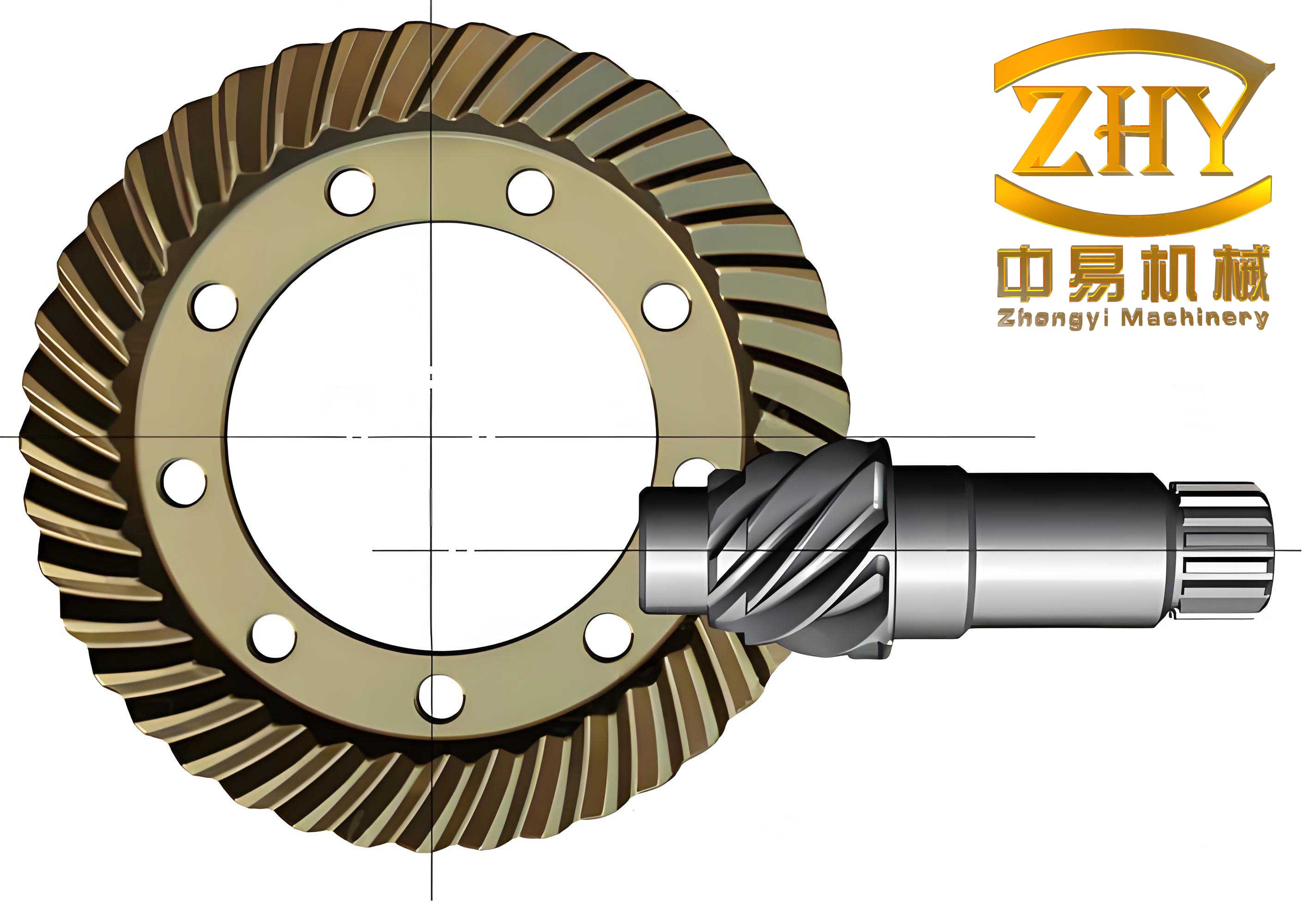
The hypoid gear system is characterized by its skewed axes and complex geometry, which involves over 150 calculation formulas. This complexity makes parameter selection challenging, as many factors interact in non-linear ways. Conventional optimization approaches assume precise values for parameters like modulus, face width, spiral angle, number of teeth, and mid-point tooth height coefficient. However, in reality, these parameters exhibit fuzzy boundaries due to manufacturing tolerances, material variations, and operational conditions. For instance, the allowable range for face width or spiral angle is not a crisp value but a gradual transition from fully acceptable to unacceptable. By incorporating fuzzy set theory, I can model these transitions and develop a more flexible design model that accounts for the designer’s experience and judgment.
Moreover, reliability analysis is essential to ensure the hypoid gear’s performance over its lifespan. Traditional reliability methods assume random variables follow specific distributions, such as normal distribution, but they often ignore the fuzziness in failure criteria. In this work, I combine fuzzy logic with probabilistic reliability to compute fuzzy reliability indices for both contact strength and bending strength. This hybrid approach allows me to handle uncertainties more comprehensively, leading to designs that are not only optimal in terms of size and weight but also robust against variations.
The core of this paper is the development of a fuzzy reliability-based optimization model for hypoid gears. I will first derive the fuzzy reliability calculations, then establish the optimization mathematical model with fuzzy constraints, and finally present an illustrative example to demonstrate the effectiveness of the proposed method. Throughout the discussion, I will emphasize the importance of considering fuzziness in hypoid gear design, and I will use multiple tables and formulas to summarize key concepts and results. The keyword “hypoid gear” will be frequently referenced to maintain focus on this critical component.
Fuzzy Reliability Computation for Hypoid Gears
Reliability in hypoid gears primarily depends on two failure modes: contact fatigue (pitting) and bending fatigue (tooth breakage). To compute fuzzy reliability, I consider both the random variability and the fuzzy nature of strength limits. Let the contact stress $\sigma_H$ and contact strength $\sigma_{HS}$ be modeled as normally distributed random variables. Their means and coefficients of variation can be derived from statistical data or engineering judgments. The conventional reliability index for contact strength is given by:
$$ R_H = \Phi\left( \frac{\bar{\sigma}_{HS} – \bar{\sigma}_H}{\sqrt{(C_{\sigma_{HS}} \cdot \bar{\sigma}_{HS})^2 + (C_{\sigma_H} \cdot \bar{\sigma}_H)^2}} \right) $$
where $\Phi$ is the standard normal cumulative distribution function, $\bar{\sigma}_{HS}$ and $\bar{\sigma}_H$ are the mean values, and $C_{\sigma_{HS}}$ and $C_{\sigma_H}$ are the coefficients of variation. However, this assumes crisp boundaries for strength. In reality, the strength limit is fuzzy, as it depends on factors like material quality and surface treatment, which are not precisely defined.
To incorporate fuzziness, I define a membership function $H_A(\sigma_S)$ for the strength $\sigma_S$, representing the degree to which a given strength value is acceptable. A common choice is the trapezoidal membership function, which allows for a gradual transition. For a given cut-off level $\lambda$ (where $\lambda \in [0,1]$), I obtain a corresponding strength value $\sigma_S(\lambda)$. Then, the fuzzy reliability for contact strength is computed by aggregating over multiple $\lambda$ levels:
$$ \tilde{R}_H = \frac{\sum_{i=1}^{n} \lambda_i R_H(\lambda_i)}{\sum_{i=1}^{n} \lambda_i} $$
Here, $R_H(\lambda_i)$ is the reliability calculated using the strength value at cut-off level $\lambda_i$, and $n$ is the number of discretization levels. This approach captures the fuzzy uncertainty in strength criteria.
Similarly, for bending strength, let $\sigma_F$ and $\sigma_{FS}$ be the bending stress and bending strength, respectively. Assuming normal distributions, the fuzzy reliability for bending strength is:
$$ \tilde{R}_F = \frac{\sum_{i=1}^{n} \lambda_i R_F(\lambda_i)}{\sum_{i=1}^{n} \lambda_i} $$
where $R_F(\lambda_i)$ is derived from the bending stress and strength at level $\lambda_i$. The detailed expressions for stress calculations involve numerous factors specific to hypoid gears, such as geometry coefficients, load distribution factors, and material properties. For brevity, I summarize key formulas in Table 1, which outlines the parameters and their roles in reliability computation for hypoid gears.
| Parameter | Symbol | Description | Role in Reliability |
|---|---|---|---|
| Mean Contact Strength | $\bar{\sigma}_{HS}$ | Average allowable contact stress | Determines baseline strength |
| Coefficient of Variation for Contact Strength | $C_{\sigma_{HS}}$ | Relative variability in contact strength | Affects uncertainty in reliability |
| Mean Contact Stress | $\bar{\sigma}_H$ | Average calculated contact stress | Represents operational load |
| Coefficient of Variation for Contact Stress | $C_{\sigma_H}$ | Relative variability in contact stress | Incorporates load fluctuations |
| Membership Function for Strength | $H_A(\sigma_S)$ | Fuzzy set defining acceptable strength | Models fuzziness in failure criteria |
| Cut-off Level | $\lambda$ | Threshold for fuzzy set decomposition | Controls transition from acceptable to unacceptable |
These computations form the basis for constraining the optimization model. The fuzzy reliability indices $\tilde{R}_H$ and $\tilde{R}_F$ must meet specified targets, typically close to 1, to ensure safe operation of the hypoid gear system. In practice, I set these targets as fuzzy constraints, such as $\tilde{R}_H \leq 0.995$ and $\tilde{R}_F \leq 0.995$, acknowledging that reliability is not an absolute value but a fuzzy goal.
Optimization Mathematical Model for Hypoid Gears
The optimization aims to minimize the volume of the hypoid gear transmission, which directly correlates with material usage, weight, and cost. The volume is approximated as the sum of truncated cone volumes for the pinion and gear, based on their pitch cone geometries. Let $m_e$ be the module at the large end, $b$ the face width, $\delta_1$ and $\delta_2$ the pitch angles, $z_1$ and $z_2$ the numbers of teeth, and $R$ the pitch cone distance. The objective function is expressed as:
$$ F(\mathbf{X}) = \frac{\pi}{3} b \cos \delta_1 \left[ \left( \frac{m_e z_1}{2} \right)^2 + \left( \frac{m_e z_1}{2} \cdot \frac{R-b}{R} \right)^2 + \left( \frac{m_e z_1}{2} \right) \left( \frac{m_e z_1}{2} \cdot \frac{R-b}{R} \right) \right] + \frac{\pi}{3} b \cos \delta_2 \left[ \left( \frac{m_e z_2}{2} \right)^2 + \left( \frac{m_e z_2}{2} \cdot \frac{R-b}{R} \right)^2 + \left( \frac{m_e z_2}{2} \right) \left( \frac{m_e z_2}{2} \cdot \frac{R-b}{R} \right) \right] $$
where $\mathbf{X} = [m_e, b, \beta_m, z_1, K]$ is the design vector, with $\beta_m$ as the spiral angle at the mid-point and $K$ as the mid-point tooth height coefficient. These variables are chosen because they significantly influence the hypoid gear’s performance and size, while other parameters like torque, speed, and offset are fixed as design inputs.
The optimization is subject to fuzzy constraints that reflect practical design limits. These constraints are listed below, with the symbol “~” indicating fuzziness:
- Fuzzy reliability constraints: $\tilde{R}_H \leq 0.995$ and $\tilde{R}_F \leq 0.995$ for both pinion and gear.
- Module constraint: $m_e \geq \tilde{3}$ (minimum module to prevent excessive stress).
- Face width constraints: $4 – \tilde{m_e} \leq b \leq 10 – \tilde{m_e}$ (limits based on module to ensure stability).
- Spiral angle constraint: $35^\circ \leq \beta_m \leq 50^\circ$ (optimal range for smooth meshing).
- Total teeth constraint: $40 \leq z_1 + z_2 \leq 60$ (affects contact ratio and noise).
- Mid-point tooth height coefficient constraint: $3.5 \leq K \leq 4.0$ (influences tooth strength and geometry).
The fuzziness in these constraints arises from the gradual transition between fully allowable and fully unallowable values. For example, a face width of exactly 4 times the module might be fully acceptable, but slightly less could be partially acceptable depending on the design context. To model this, I define linear membership functions for each constraint, as discussed in the next section.
The overall optimization model can be stated as:
$$ \begin{aligned}
\text{Minimize} & \quad F(\mathbf{X}) \\
\text{Subject to} & \quad \tilde{R}_i \leq R_{ip} \quad (i = H, F1, F2) \\
& \quad \tilde{x}_{kL} \leq x_k \leq \tilde{x}_{kU} \quad (k = 1,2,\ldots,5)
\end{aligned} $$
where $R_{ip}$ are the target reliability values, and $\tilde{x}_{kL}$ and $\tilde{x}_{kU}$ are the fuzzy lower and upper bounds for each design variable. This model integrates fuzzy set theory into traditional optimization, allowing for more flexible and realistic design decisions for hypoid gears.
Membership Functions for Fuzzy Constraints
To handle the fuzziness in constraints, I assign membership functions that quantify the degree of satisfaction for a given design variable value. A linear membership function is commonly used due to its simplicity and effectiveness in capturing gradual transitions. For a constraint with lower bound $x_L$ and upper bound $x_U$, and extended bounds $x^-_L$ and $x^-_U$ to account for fuzziness, the membership function $H_x(x)$ is defined as:
$$ H_x(x) =
\begin{cases}
1 & \text{if } x^-_U \leq x \leq x^-_L \\
\frac{x^-_U – x}{x^-_U – x^-_L} & \text{if } x^-_L \leq x \leq x^-_U \\
\frac{x – x^-_L}{x^-_U – x^-_L} & \text{if } x^-_L \leq x \leq x^-_U \\
0 & \text{otherwise}
\end{cases} $$
Here, $x^-_L$ and $x^-_U$ represent the transition interval where the constraint changes from fully acceptable to fully unacceptable. The values for these intervals can be determined using expansion coefficients, typically ranging from 0.80 to 0.95 for upper bounds and 1.05 to 1.30 for lower bounds, based on design experience and manufacturing capabilities.
For instance, consider the module constraint $m_e \geq \tilde{3}$. The crisp lower bound might be 3 mm, but due to fuzziness, values slightly below 3 mm could be partially acceptable. If I set $x^-_L = 2.5$ mm and $x^-_U = 3.0$ mm, then a module of 2.8 mm would have a membership degree of $H_x(2.8) = (3.0 – 2.8)/(3.0 – 2.5) = 0.4$, indicating partial acceptability.
To convert the fuzzy optimization model into a solvable non-fuzzy model, I use the optimal level cut-set method. By choosing an optimal level $\lambda^*$, I can transform fuzzy constraints into crisp ones. The value of $\lambda^*$ is determined through a two-level evaluation process that balances safety and economy, considering factors like design standards, manufacturing precision, material quality, and usage conditions. For example, if $\lambda^* = 0.74$, the constraints become:
$$ x^-_{kL} + \lambda^*(x^-_{kU} – x^-_{kL}) \leq x_k \leq x^-_{kU} – \lambda^*(x^-_{kU} – x^-_{kL}) $$
This approach allows me to systematically address fuzziness while maintaining computational tractability. Table 2 summarizes the fuzzy constraints and their membership function parameters for a typical hypoid gear design.
| Constraint | Crisp Bound | Fuzzy Lower Transition ($x^-_L$) | Fuzzy Upper Transition ($x^-_U$) | Membership Type |
|---|---|---|---|---|
| Module $m_e \geq \tilde{3}$ mm | 3.0 mm | 2.5 mm | 3.0 mm | Linear |
| Face Width $4 – \tilde{m_e} \leq b \leq 10 – \tilde{m_e}$ | Depends on $m_e$ | 0.85 × lower bound | 1.15 × upper bound | Linear |
| Spiral Angle $35^\circ \leq \beta_m \leq 50^\circ$ | 35° to 50° | 34° | 51° | Linear |
| Total Teeth $40 \leq z_1 + z_2 \leq 60$ | 40 to 60 | 38 | 62 | Linear |
| Tooth Height Coefficient $3.5 \leq K \leq 4.0$ | 3.5 to 4.0 | 3.3 | 4.2 | Linear |
By applying these membership functions, I can incorporate designer judgment and real-world uncertainties into the optimization process, leading to more practical and resilient hypoid gear designs.
Optimization Example and Results
To validate the proposed methodology, I applied it to the design of hypoid gears for a KZ32-19 pneumatic steel strapping machine. The initial design parameters were set as $\mathbf{X} = [4 \text{ mm}, 30 \text{ mm}, 45^\circ, 12, 3.7]$, corresponding to module, face width, spiral angle, pinion teeth, and tooth height coefficient, respectively. Using the optimal level $\lambda^* = 0.74$ derived from a two-level evaluation, I transformed the fuzzy constraints into crisp ones and employed the complex method for numerical optimization on a computer.
The optimization results, compared to the original design, show a significant reduction in volume. Specifically, the fuzzy reliability-based design achieved a volume of approximately 85,842 mm³, which is about 25% smaller than the original design’s 107,187 mm³. The optimized parameters are listed in Table 3, highlighting the changes in key variables.
| Design Parameter | Original Design | Fuzzy Reliability-Based Design | Change |
|---|---|---|---|
| Module, $m_e$ (mm) | 4.0 | 3.8 | -5% |
| Face Width, $b$ (mm) | 30.0 | 31.9 | +6.3% |
| Spiral Angle, $\beta_m$ (degrees) | 45.0 | 41.0 | -8.9% |
| Pinion Teeth, $z_1$ | 12 | 11 | -8.3% |
| Tooth Height Coefficient, $K$ | 3.7 | 3.9 | +5.4% |
| Volume, $F(\mathbf{X})$ (mm³) | 107,187 | 85,842 | -25% |
The reduction in volume indicates that the proposed method effectively utilizes material without compromising reliability. The hypoid gear designed with fuzzy reliability constraints was manufactured and tested in two units of the strapping machine. After a period of operation, no damage or failure was observed, confirming the feasibility and robustness of the design. This practical validation underscores the advantage of integrating fuzziness into the optimization process for hypoid gears.
To further illustrate the optimization process, I derived additional formulas for stress calculations in hypoid gears. For contact stress, the mean value $\bar{\sigma}_H$ can be expressed as:
$$ \bar{\sigma}_H = Z_H Z_E Z_\varepsilon Z_\beta Z_K \times \frac{K_A K_V K_{H\alpha} K_{H\beta} F_{mt}}{d_{m1} \cdot d_{eH}} \cdot \frac{\sqrt{u^2 + 1}}{u} $$
where $Z_H$, $Z_E$, $Z_\varepsilon$, $Z_\beta$, and $Z_K$ are geometry factors; $K_A$, $K_V$, $K_{H\alpha}$, and $K_{H\beta}$ are load factors; $F_{mt}$ is the tangential force; $d_{m1}$ is the mean diameter; $d_{eH}$ is the equivalent diameter; and $u$ is the gear ratio. Similarly, for bending stress:
$$ \bar{\sigma}_F = \frac{F_{mt}}{d_{eF} \cdot m_{mn}} Y_{Fa} Y_{Sa} Y_\varepsilon Y_\beta Y_K K_H K_V K_{F\alpha} K_{F\beta} $$
where $Y_{Fa}$, $Y_{Sa}$, $Y_\varepsilon$, $Y_\beta$, and $Y_K$ are form factors; $d_{eF}$ is the equivalent diameter for bending; and $m_{mn}$ is the normal module. These formulas are essential for reliability computations and are integrated into the optimization loop to ensure constraints are satisfied.
Discussion and Implications
The integration of fuzzy reliability constraints into hypoid gear optimization offers several advantages over conventional methods. First, it acknowledges that design parameters and constraints are not always precise, reflecting real-world uncertainties in manufacturing, material properties, and operational conditions. By using fuzzy set theory, I can model these uncertainties more accurately, leading to designs that are less conservative yet more reliable. For instance, the fuzzy constraints allow for a smooth transition between acceptable and unacceptable regions, which prevents overly rigid design limits that might exclude viable solutions.
Second, the fuzzy reliability approach combines probabilistic and fuzzy uncertainties, providing a comprehensive framework for risk assessment. In hypoid gear design, where failures can have severe consequences, this hybrid method enhances safety by considering both random variations and subjective judgments. The use of membership functions enables designers to incorporate experience-based knowledge, such as the acceptability of slight deviations in spiral angle or face width.
However, there are challenges to consider. The computational complexity increases due to the need for multiple reliability evaluations at different $\lambda$ levels. This can be mitigated by efficient algorithms and parallel computing. Additionally, determining the optimal $\lambda^*$ value requires careful judgment; it may vary depending on the application, such as aerospace versus automotive hypoid gears, where safety margins differ.
To generalize the method, I propose a step-by-step procedure for applying fuzzy reliability-based optimization to hypoid gears:
- Identify design variables and fixed parameters for the hypoid gear system.
- Define fuzzy reliability indices for contact and bending strength using membership functions.
- Establish the objective function, typically volume or weight minimization.
- Formulate fuzzy constraints based on design standards and practical limits.
- Convert fuzzy constraints to crisp ones using the optimal level cut-set method with $\lambda^*$.
- Solve the optimization problem using numerical methods like complex or genetic algorithms.
- Validate the design through prototyping or simulation.
This procedure can be adapted to other gear types, but hypoid gears are particularly suitable due to their complexity and sensitivity to parameter variations.
Future work could explore non-linear membership functions, such as Gaussian or sigmoid shapes, to better represent fuzziness. Also, integrating multi-objective optimization could balance volume, cost, and reliability more effectively. Advances in machine learning might aid in predicting fuzzy reliability from historical data, further refining the design process for hypoid gears.
Conclusion
In this paper, I have presented a novel optimization design methodology for hypoid gears that incorporates fuzzy reliability constraints. By considering both random and fuzzy uncertainties in design parameters, the method provides a more realistic and robust approach compared to traditional deterministic optimization. The mathematical model minimizes volume while ensuring that fuzzy reliability targets for contact and bending strength are met, using membership functions to handle vague constraints. Through an illustrative example, I demonstrated that the proposed method can reduce volume by approximately 25% without compromising performance, as validated by practical testing.
The key contributions include the derivation of fuzzy reliability computations for hypoid gears, the development of a fuzzy optimization model, and the application of optimal level cut-sets to transform fuzzy constraints into solvable forms. This work highlights the importance of accounting for fuzziness in mechanical design, especially for complex components like hypoid gears where small changes can have significant impacts. By embracing uncertainty, designers can achieve more economical and reliable solutions, advancing the field of gear engineering.
I encourage further research to extend this methodology to other mechanical systems and to explore advanced fuzzy logic techniques. As industries demand higher efficiency and lighter designs, fuzzy reliability-based optimization will play a crucial role in developing next-generation hypoid gears and beyond.