
The design of hypoid gears represents a significant advancement in power transmission technology, offering compact, efficient, and high-torque solutions for applications with non-intersecting, offset axes. The geometric foundation of any hypoid gear set lies in the precise definition of its gear blanks. A clear, rigorous, and universally applicable methodology for this design is therefore of paramount importance. In this article, I will present a comprehensive vector-based approach to hypoid gear blank design, elucidating the fundamental geometric relationships, establishing a solvable system for determining the critical nominal point, and discussing practical methods for calculation. This methodology aims to provide a clearer and more systematic philosophy for the geometric design process.
The design process begins with a set of prescribed requirements. These include the shaft angle $\Sigma$, the offset distance $E$, and the gear ratio $i$. Furthermore, based on strength and size constraints, the face width $F$ and the pitch diameter at the gear’s outer end $D$ of the gear (often the larger member) are typically given. Our objective is to define all other essential geometric parameters of the gear blanks based on these inputs.
A central concept in this design is the nominal point, denoted as $M$. This point is chosen in the fixed space containing the two gear axes and represents the primary contact position for tooth surface design. To establish the fundamental geometric framework, we define key parameters with reference to this point. Referring to the gear as the “Gear” (larger member) and the pinion as the “Pinion” (smaller member), we establish the following fundamental geometric parameters for a hypoid gear pair:
| Symbol | Description | Determined By |
|---|---|---|
| $R$ | Pitch radius of the gear at the nominal point M. | From $D$ and $\Gamma$. |
| $R_p$ | Pitch radius of the pinion at the nominal point M. | Solved iteratively with $\theta$. |
| $\Gamma$ | Pitch cone angle of the gear. | Related to $R$, $\delta_V$, and gear ratio. |
| $\gamma$ | Pitch cone angle of the pinion. | Derived from other parameters. |
| $\delta_V$ | Offset angle of the gear’s radius vector at M. | Given or derived. |
| $\theta_V$ | Offset angle of the pinion’s radius vector at M. | Primary variable, solved iteratively. |
| $Z_p$ | Distance from M to the plane through the pinion axis’ “crossing point”. | Derived from other parameters. |
| $\zeta$ | Angle between the two pitch cone elements in the pitch plane. | Derived from other parameters. |
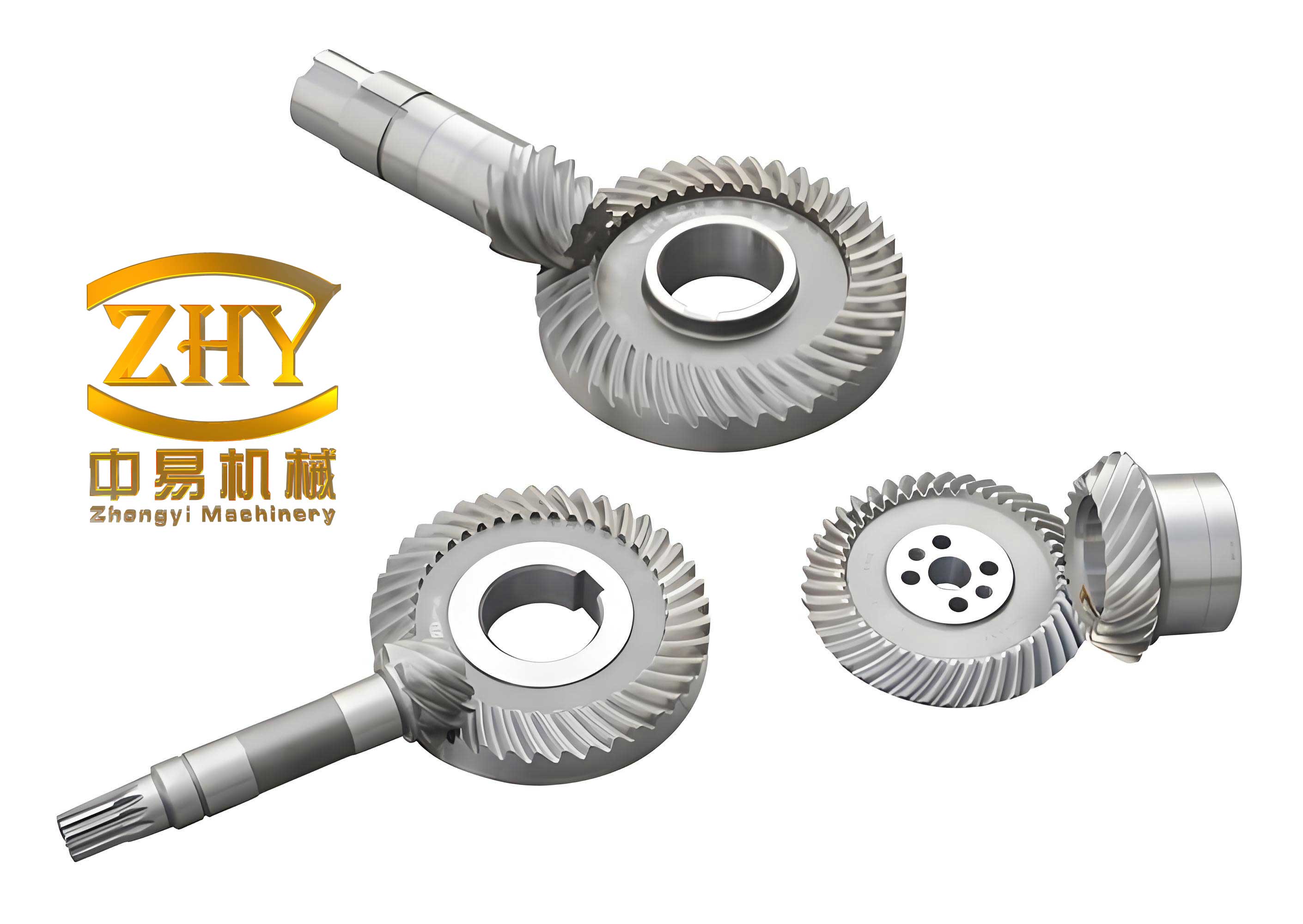
The core of the geometric design for hypoid gear blanks lies in six fundamental relational equations that connect these eight parameters. These equations are derived elegantly using vector algebra. First, coordinate systems are established. A primary frame $o_p: (i_p, j_p, k_p)$ is fixed with its $k_p$ axis along the gear axis and its $i_p$ axis along the common perpendicular between the two axes. A second frame $o: (i, j, k)$ is obtained by rotating $o_p$ about $k_p$ by an angle of $(90^\circ – \delta_V)$, so that $k$ lies along the pinion axis.
In the gear frame $o_p$, the unit normal vector of the pitch plane $\vec{e}_1’$ and the unit normal vector of the gear’s axial section through M, $\vec{n}_1’$, can be expressed using the gear’s basic parameters. Similarly, in the pinion frame $o$, the unit normal of the pitch plane $\vec{e}_2$ and the unit normal of the pinion’s axial section through M, $\vec{n}_2$, are written using the pinion’s parameters. By transforming $\vec{e}_1’$ and $\vec{n}_1’$ into the $o$ frame (denoted as $\vec{e}_1$ and $\vec{n}_1$), and enforcing fundamental orthogonality and spatial relationship conditions, we arrive at the following six independent equations:
1. Relationship for the gear pitch angle $\Gamma$:
$$\tan \Gamma = \frac{\sin \Sigma}{\cos \Sigma \tan \theta_V + \cos \delta_V \tan \gamma}$$
2. Relationship for the pinion pitch angle $\gamma$:
$$\tan \gamma = \frac{\sin \Sigma}{\cos \Sigma \tan \delta_V + \cos \theta_V \tan \Gamma}$$
3. Relationship defining the angle $\zeta$:
$$\sin \zeta = \frac{\sin \Sigma \cos \theta_V}{\cos \gamma}$$
4. Equation relating the offset $E$ to the pitch radii and offset angles:
$$E = R_p \sin \theta_V – R \sin \delta_V$$
5. Equation for the distance $Z_p$:
$$\tan \zeta = \frac{E – R_p \sin \theta_V}{Z_p – R \cos \delta_V \cos \Sigma}$$
6. A consistency equation relating $Z_p$, $R_p$, and $R$:
$$Z_p = \frac{R_p \cos \theta_V – R \sin \delta_V \cos \Sigma}{\cos \delta_V}$$
Given that we can fix three parameters to locate a point in space, we choose $R$, $\theta_V$, and $R_p$ as the primary variables defining the position of the nominal point M. The remaining five basic parameters ($\Gamma$, $\gamma$, $\delta_V$, $Z_p$, $\zeta$) can then be determined from the equations above. The challenge, therefore, is to find the correct values for $R$, $\theta_V$, and $R_p$ that satisfy not only these geometric constraints but also the critical conditions for proper tooth meshing and manufacturability.
The gear pitch radius $R$ is determined relatively straightforwardly from the given outer pitch diameter $D$ and an initial estimate of the gear pitch cone angle $\Gamma_0$. For a bevel gear pair, the relationship $\sin(90^\circ + \delta_V – \Gamma_0) / \sin \Gamma_0 = n/N$ holds, where $n$ and $N$ are the pinion and gear tooth numbers, respectively. This gives $\tan \Gamma_0 = \cos \delta_V / (n/N – \sin \delta_V)$. For a hypoid gear pair, this is modified by introducing an “enlargement coefficient” $k_s$ (typically taken as 1.2) to account for the axis offset. Thus, the initial gear pitch cone angle for a hypoid gear calculation is:
$$\tan \Gamma_s = 1.2 \cdot \frac{\cos \delta_V}{(n/N – \sin \delta_V)}$$
Consequently, the gear pitch radius at the nominal point is:
$$R = \frac{D – F \sin \Gamma_s}{2}$$
The determination of $R_p$ and $\theta_V$ is more complex and is governed by the requirements for optimal tooth contact and matching the manufacturing tool. A fundamental condition for good meshing performance is that the limit tooth trace curvature radius $\rho_{vl}$ at the nominal point of the gear being generated must equal the radius $r_c$ of the selected standardized cutting tool (cutter radius). This provides our first crucial constraint equation:
$$\rho_{vl} = r_c \quad \text{(Equation A)}$$
The formula for $\rho_{vl}$ is derived from differential geometry and meshing theory and can be expressed as:
$$\frac{1}{\rho_{vl}} = \frac{\tan \psi_p – \tan \psi_0}{A_p \tan \Gamma} – \frac{\tan \psi_0 – \tan \psi_g}{A \tan \gamma} + \frac{1}{R_p \cos \psi_0} \cdot \frac{\tan \Gamma}{\tan \gamma} \cdot k_s$$
where $\psi_0$ is the limit pressure angle at M, $\psi_g$ and $\psi_p$ are the spiral angles at M for the gear and pinion respectively, $A = R / \sin \Gamma$ and $A_p = R_p / \sin \gamma$ are the pitch cone generatrices. The angles are related by:
$$\tan \psi_0 = \frac{A \sin \psi_g – A_p \sin \psi_p}{A \tan \Gamma + A_p \tan \gamma}$$
$$\tan \psi_g = \frac{\tan \Gamma \cos \zeta}{\cos(\delta_V – \theta_V) / \cos \theta_V}$$
$$\psi_p = \psi_g – \Sigma’$$
and $\Sigma’$ is related to the shaft angle and offset angles. To satisfy the fundamental equation of meshing at M ($\vec{v}_{12} \cdot \vec{n} = 0$), a specific relationship for $k_s$ must hold:
$$k_s = \frac{R_p \tan \delta_V \sin \zeta + \cos \zeta}{R \tan \Gamma \sin \zeta + \cos \zeta} \quad \text{(Equation B)}$$
We now have our system. For a strictly defined pinion spiral angle $\psi_p$, Equations (A) and (B), which both involve $R_p$ and $\theta_V$ (through their influence on $\Gamma$, $\gamma$, $\zeta$, $\psi_g$, etc.), form a system of two nonlinear equations in two unknowns. This system can be solved robustly using numerical methods like the Newton-Raphson algorithm on a computer.
For manual calculation, a practical approach is often employed. A target pinion spiral angle $\psi_{p0}$ is recommended, for instance, $\psi_{p0} = 25^\circ + 5^\circ \sqrt{F/E} + 9^\circ \sqrt[3]{i}$, with a permissible variation of about $\pm 5^\circ$. This flexibility allows us to treat $\psi_p$ as approximately given within a range. We can then use an iterative procedure focused on satisfying Equation (A).
Initial estimates are crucial. An initial estimate for $R_p$, denoted $R_{p0}$, can be derived by comparing the geometry of a hypoid gear to that of an equivalent bevel gear, leading to the approximate formula:
$$k_{s0} = \frac{E \sin \Gamma}{R}$$
and then
$$R_{p0} = R \cdot \frac{k_{s0} \tan \Gamma \sin \zeta + \cos \zeta}{\tan \delta_V \sin \zeta + \cos \zeta}$$
An initial estimate for $\theta_V$, denoted $\theta_{V1}$, can be found from the bevel gear analogy:
$$\tan \theta_{V1} = \frac{E + R_p \cos \delta_V \tan \zeta_0 – R \sin \delta_V}{R \cos \delta_V – R_p \sin \delta_V \tan \zeta_0}$$
where $\zeta_0$ is an initial estimate for $\zeta$.
Starting with $\theta_{V1}$ and $R_{p0}$, we calculate initial values for $\zeta$, $\gamma$, $\Gamma$, and $\psi_p$ (call these $\zeta_1$, $\gamma_1$, $\Gamma_1$, $\psi_{p1}$). Because $\psi_{p1}$ will differ from the target $\psi_{p0}$, we adjust the enlargement coefficient $k_s$. Taking the differential of Equation (B), we get a correction factor $\Delta k_s$:
$$\Delta k_s \approx \frac{k_{s0}}{\cos^2 \psi_{p1}} (\tan \psi_{p0} – \tan \psi_{p1})$$
We then set $k_{s1} = k_{s0} + \Delta k_s$ and recalculate a new $R_{p1}$ and other parameters ($\zeta_2$, $\gamma_2$, $\Gamma_2$, $\psi_{p2}$, $\psi_0$, etc.). These are used in Equation (A) to compute $\rho_{vl1}$.
We define an error function $f(x) = \rho_{vl} / r_c$, where $x = \tan \theta_V$. Our goal is $f(x)=1$. If $f(\tan \theta_{V1}) \neq 1$, we iterate on $x$. Using a Newton-Raphson step for one variable:
$$x_{n+1} = x_n – \frac{f(x_n) – 1}{f'(x_n)}$$
A simple secant-like approach can be used manually: try a new angle $\theta_{V2}$ slightly different from $\theta_{V1}$ (e.g., $\tan \theta_{V2} = \tan \theta_{V1} – 0.01$), repeat the calculation to get $f(x_2)$, and estimate the next value. Typically, just a few iterations (2-3) are needed to satisfy the condition $\rho_{vl} \approx r_c$ while keeping $\psi_p$ close to its target. The final values of $\theta_V$ and $R_p$ from this process, along with the originally computed $R$, form the complete solution for the nominal point location. All other fundamental blank geometry parameters ($\Gamma$, $\gamma$, $Z_p$, $\delta_V$, $\zeta$) are then directly computed from the six basic equations.
In summary, the vector-based geometric design of hypoid gear blanks provides a clear and systematic framework. The process revolves around solving for the three coordinates of the nominal point ($R$, $R_p$, $\theta_V$) subject to the geometric constraints of the axes and the kinematic/manufacturing constraint of matching the cutter radius. The methodology can be implemented precisely via computer-based solution of a two-variable nonlinear system, or efficiently via a streamlined single-variable iteration suitable for manual calculation. This approach ensures that the resulting hypoid gear blanks are not only geometrically consistent but also predisposed to exhibit favorable contact characteristics when the teeth are generated, forming a solid foundation for the entire hypoid gear design process.