
In the design and manufacturing of hypoid gears, the phenomenon of undercutting presents a significant challenge, particularly when aiming for high-tooth configurations that enhance load capacity and durability. As a researcher focused on gear mechanics, I have explored various methods to predict and prevent undercutting in hypoid gears, especially when deviating from standard design parameters. This article delves into a comprehensive approach derived from gear meshing theory, providing a robust framework for assessing undercut risks in high-tooth hypoid gears. The goal is to offer designers a reliable tool to optimize tooth geometry without compromising integrity, thereby expanding the application range of hypoid gears in automotive and industrial systems.
Hypoid gears are widely used in differential systems due to their ability to transmit motion between non-intersecting axes with high efficiency and smooth operation. However, when designing hypoid gears with increased tooth height—referred to as high-tooth systems—traditional guidelines, such as those from Gleason, may not suffice, leading to potential undercutting. Undercutting weakens the tooth root, reducing strength and causing premature failure. Thus, developing a method to determine safe design limits is crucial. This work presents a first-principles analysis using meshing theory, culminating in practical criteria for avoiding undercut in hypoid gears.
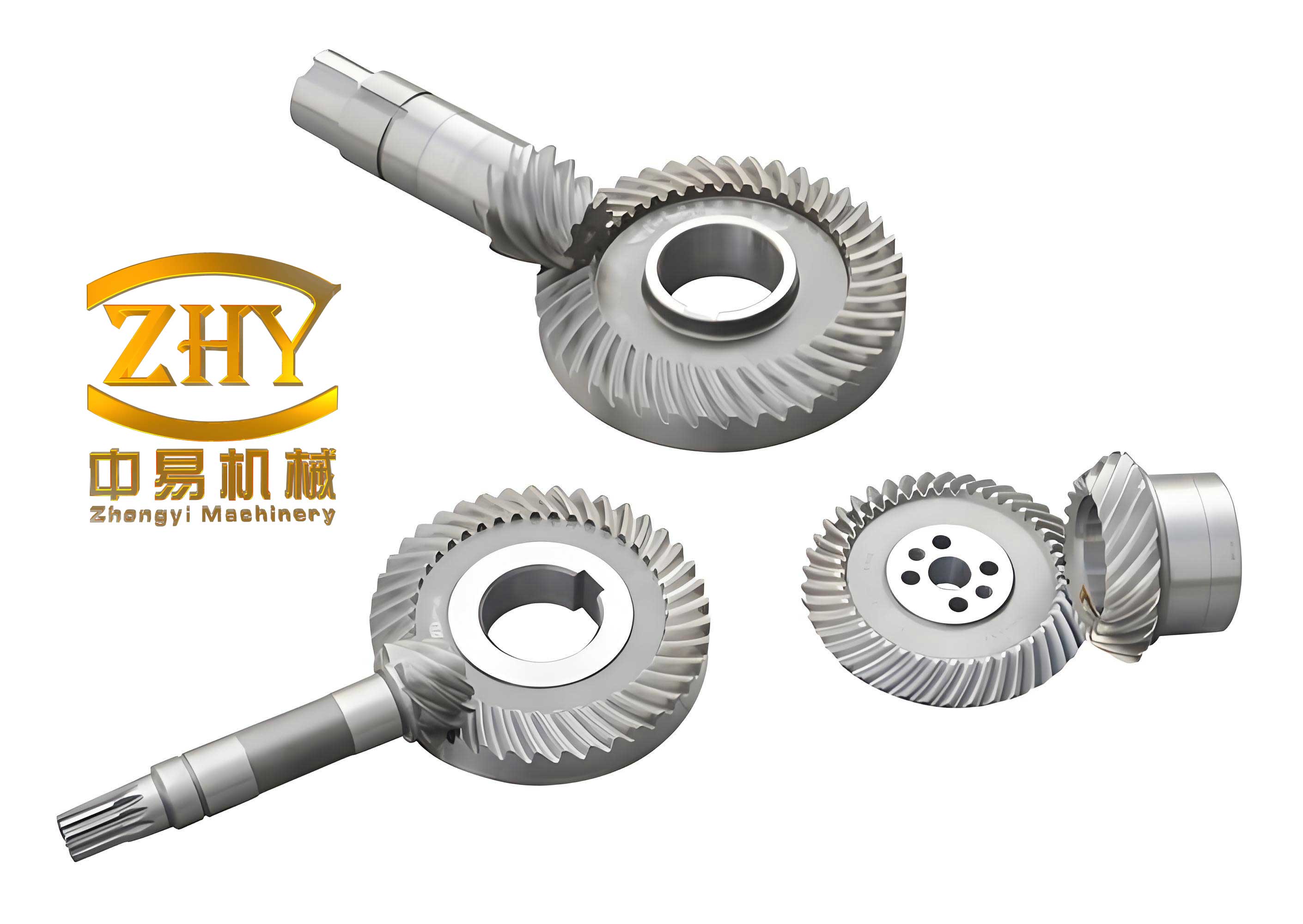
The core of this analysis lies in the geometry of conjugate surfaces. For two meshing surfaces \( S^{(1)} \) and \( S^{(2)} \), the condition for a first-order boundary point—where undercut may initiate—is given by the equation:
$$ \phi = -\mathbf{q} \cdot \mathbf{n} + \mathbf{a} \cdot \mathbf{v}_{12} = 0 $$
Here, \(\phi\) is the inspection function, \(\mathbf{n}\) is the unit normal vector, \(\mathbf{v}_{12}\) is the relative velocity between surfaces, and \(\mathbf{q}\) and \(\mathbf{a}\) are derived from curvature properties. This equation stems from the meshing condition \(\mathbf{v}_{12} \cdot \mathbf{n} = 0\) and the requirement for non-interference in curvature. When \(\phi > 0\) or \(\phi < 0\) depending on the surface orientation, undercutting is avoided; at \(\phi = 0\), the induced normal curvature becomes infinite, indicating a singular point or potential undercut. This principle forms the basis for evaluating hypoid gear teeth.
To apply this to hypoid gears, precise mathematical modeling of the tooth surface is essential. Using the tool-tilting method for cutting the pinion (small gear), coordinate systems are established to describe the cutter and workpiece positions. Let \(\{\mathbf{i}_1, \mathbf{j}_1, \mathbf{k}_1\}\) define the machine coordinate system with origin \(O’\). The cutter surface is represented parametrically. For a blade with tip radius \(r_{01}\), the position vector \(\mathbf{r}_0\) of a point on the cutter surface is:
$$ \mathbf{r}_0 = r_{01} \left[ \cos i \sin(q_1 – j) \cos\theta_1 – \sin\theta_1 \cos(q_1 – j) \right] \mathbf{i}_1 – r_{01} \left[ \cos i \cos(q_1 – j) \cos\theta_1 – \sin\theta_1 \sin(q_1 – j) \right] \mathbf{j}_1 + r_{01} \sin i \cos\theta_1 \mathbf{k}_1 $$
The unit tangent vector \(\mathbf{t}_1\) and normal vector \(\mathbf{n}_1\) along the cutter are derived from geometry and cutting angles. For instance, \(\mathbf{n}_1\) is expressed as:
$$ \mathbf{n}_1 = \left[ \cos\theta_1 \cos(\alpha_{01} – i) \sin(q_1 – j) + \sin\alpha_{01} \sin i \sin(q_1 – j)(1 – \cos\theta_1) – \sin\theta_1 \cos\alpha_{01} \cos(q_1 – j) \right] \mathbf{i}_1 + \left[ -\cos\theta_1 \cos(\alpha_{01} – i) \cos(q_1 – j) – \sin\alpha_{01} \sin i \cos(q_1 – j)(1 – \cos\theta_1) – \sin\theta_1 \cos\alpha_{01} \sin(q_1 – j) \right] \mathbf{j}_1 + \left[ -\cos\theta_1 \sin(\alpha_{01} – i) – \sin\alpha_{01} \cos i (1 – \cos\theta_1) \right] \mathbf{k}_1 $$
The pinion tooth surface \(\mathbf{r}_1\) is then generated by sweeping the cutter relative to the workpiece. The relative velocity \(\mathbf{v}’_{12}\) between the generating gear and pinion is:
$$ \mathbf{v}’_{12} = \boldsymbol{\omega}’_{12} \times \mathbf{r}_{01} + s_1 \mathbf{t}_1 – \frac{d\varphi_1}{dt} \mathbf{p}_1 \times \mathbf{m}_1 $$
Here, \(s_1\) is a parameter along the cutting path, \(\boldsymbol{\omega}’_{12}\) is the angular velocity, and \(\mathbf{m}_1\) is a vector from the design crossing point. Substituting into the meshing equation \(\mathbf{v}’_{12} \cdot \mathbf{n} = 0\) yields \(s_1\) as a function of parameters \(q_1\) and \(\theta_1\):
$$ s_1 = \frac{(\boldsymbol{\omega}’_{12}, \mathbf{r}_{01}, \mathbf{n}) – \frac{d\varphi}{dt} (\mathbf{p}_1, \mathbf{m}_1, \mathbf{n}_1)}{(\boldsymbol{\omega}’_{12}, \mathbf{t}_1, \mathbf{n}_1)} $$
The pinion surface equation becomes:
$$ \mathbf{r}_1 = \mathbf{r}_{01} + s_1 \mathbf{t}_1 + \mathbf{m}_1 $$
With the surface defined, undercut inspection proceeds by analyzing curves of constant \(\theta_1\) over the tooth width. For each curve, parameterized by \(\Delta q_1\), the inspection function \(\phi\) is evaluated at critical points. A key aspect is the cutter geometry: for a blade with tip radius \(r_c\) and pressure angle \(\alpha\), the distance from the tip to the point of tangency \(M_a\) is:
$$ b_r’ = r_c \cot\left(45^\circ + \frac{\alpha}{2}\right) = r_c \frac{1 – \sin\alpha}{\cos\alpha} $$
Setting \(s_1 = b_r’\) in the parameter space allows checking the meshing condition at \(M_a\). The inspection function components are computed as:
$$ \mathbf{q} \cdot \mathbf{n}_1 = (\mathbf{k}_1 \times \mathbf{r}_{C1}) \cdot (\mathbf{n}_1 \times \boldsymbol{\omega}’_{12}) + (\mathbf{y}’_{12}, \mathbf{k}_1, \mathbf{n}_1) $$
And the vector \(\mathbf{a}\) is:
$$ \mathbf{a} = A_{01} \mathbf{v}’_{12} + \boldsymbol{\omega}’_{12} \times \mathbf{n}_1 $$
where \(A_{01}\) is the normal curvature of the cutter surface in the direction of \(\mathbf{t}_1 \times \mathbf{n}_1\). For the concave side of the hypoid gear pinion, the normal vector points from solid to void, requiring \(\phi > 0\) to avoid interference. For the convex side, the normal points from void to solid, requiring \(\phi < 0\). Violations indicate undercutting.
To illustrate this method, consider a hypoid gear pair with parameters typical for automotive applications. The design variables include pinion teeth \(z_1\), gear teeth \(z_2\), offset \(E\), and cutter radius \(r_c\). Critical are the tooth height coefficient \(K\) and addendum coefficient \(f_a\). Standard Gleason guidelines for hypoid gears suggest values like \(K = 3.8\) and \(f_a = 0.17\) for ratio >2 and pinion teeth of 9, but high-tooth designs may use larger \(K\). The goal is to find \(f_a\) that prevents undercut for given \(K\).
Extensive computations were performed across the tooth width, sampling multiple \(\theta_1\) values. Results for \(K = 3.9\) and \(K = 4.2\) are summarized in tables below. Each table shows \(\theta_1\), trial \(f_a\), corresponding \(q_1\), and \(\phi\) values for concave and convex sides. Negative \(\phi\) on concave or positive on convex indicates undercut risk.
| \(\theta_1\) (degrees) | \(f_a\) | \(q_1\) (degrees) | \(\phi\) (Concave) | \(\phi\) (Convex) |
|---|---|---|---|---|
| 52 | 0.17 | -5.18 | -1.957095 | N/A |
| 52 | 0.18 | -5.35 | 0.295529 | 7.604092 |
| 54 | 0.19 | -3.10 | -0.490197 | N/A |
| 54 | 0.20 | -3.28 | 1.434832 | N/A |
| 56 | 0.20 | -0.74 | -0.492927 | N/A |
| 56 | 0.21 | -0.90 | 1.120926 | 10.108049 |
| 58 | 0.20 | 1.8 | -0.528455 | N/A |
| 58 | 0.21 | 1.8 | 1.463194 | N/A |
| 60 | 0.19 | 5.28 | -0.098588 | N/A |
| 60 | 0.20 | 5.28 | 1.223538 | N/A |
| 61 | 0.17 | 6.75 | -1.083900 | N/A |
| 61 | 0.18 | 6.75 | 0.019396 | 8.441424 |
For \(K = 3.9\), a safe design requires \(f_a \geq 0.18\) to ensure \(\phi > 0\) on concave sides across all \(\theta_1\). Note that convex sides show \(\phi\) values far from zero, indicating minimal undercut risk there. This aligns with known behavior in hypoid gears: the concave side is more prone to undercutting.
| \(\theta_1\) (degrees) | \(f_a\) | \(q_1\) (degrees) | \(\phi\) (Concave) | \(\phi\) (Convex) |
|---|---|---|---|---|
| 52 | 0.21 | -4.76 | -0.468006 | N/A |
| 52 | 0.22 | -5.21 | 0.000147 | N/A |
| 54 | 0.22 | -2.45 | -0.512098 | N/A |
| 54 | 0.23 | -2.65 | 1.602125 | N/A |
| 56 | 0.23 | -0.09 | -0.394014 | N/A |
| 56 | 0.24 | -0.30 | 1.698809 | 9.012808 |
| 58 | 0.22 | 2.50 | -0.780170 | N/A |
| 58 | 0.23 | 2.34 | 0.713620 | N/A |
| 60 | 0.22 | 5.28 | -0.929905 | N/A |
| 60 | 0.23 | 5.14 | 0.287953 | N/A |
| 61 | 0.21 | 6.75 | -0.898752 | N/A |
| 61 | 0.22 | 6.62 | 0.001164 | 11.269557 |
For \(K = 4.2\), \(f_a \geq 0.22\) is necessary to avoid undercut on concave sides. The convex side again shows high \(\phi\) values, confirming its resistance. These results were validated through actual cutting tests on a hypoid gear set with \(K = 4.2\) and \(f_a = 0.22\), using the same base parameters: \(z_1 = 9\), \(z_2 = 41\), face width \(b_2 = 33\) mm, offset \(E = 30\) mm, gear diameter \(d_2 = 202\) mm, cutter radius \(r_c = 95.25\) mm, pinion spiral angle \(\beta_{10} = 50^\circ\). The manufactured hypoid gears exhibited no undercut, verifying the method’s accuracy.
The inspection function \(\phi\) serves as a powerful tool for hypoid gear design. By computing \(\phi\) across the tooth surface, designers can iteratively adjust \(f_a\) for any given \(K\) to ensure \(\phi\) remains in the safe zone. This approach is more flexible than relying solely on empirical tables, enabling custom high-tooth configurations for specific applications. Moreover, the method highlights that undercut in hypoid gears primarily affects the concave side; the convex side’s geometry is inherently less susceptible due to curvature distributions. This asymmetry is crucial when optimizing tooth profiles for strength and noise reduction.
Expanding on the theory, the derivation of \(\phi\) involves detailed differential geometry. For two surfaces in mesh, the relative curvature is governed by the second fundamental form. The condition \(\phi = 0\) corresponds to a singularity in the envelope of contact lines, often leading to undercut. In practice, for hypoid gears, this is influenced by machine settings, cutter geometry, and tooth modifications. Parametric studies can be conducted using numerical software, automating the inspection process. For instance, varying \(q_1\) and \(\theta_1\) over ranges representative of the tooth flank generates a map of \(\phi\) values, identifying regions of risk.
To further elucidate, consider the mathematical formulation of the inspection function in terms of gear parameters. Define the position vector of a point on the pinion as \(\mathbf{r}_1(u, v)\), where \(u\) and \(v\) are surface parameters. The normal curvature \(\kappa_n\) in the direction of relative motion is related to \(\phi\) by:
$$ \kappa_n = \frac{\phi}{\|\mathbf{v}_{12}\|^2} $$
Thus, \(\phi \to 0\) implies \(\kappa_n \to \infty\), a hallmark of undercut. For hypoid gears, this often occurs near the root on the concave side, where curvature changes rapidly. By analyzing \(\phi\) along root curves, one can pinpoint the limiting addendum.
In design workflows, the following steps are recommended for hypoid gears targeting high-tooth configurations: (1) Select desired tooth height coefficient \(K\) based on load requirements. (2) Choose an initial \(f_a\) from standard guidelines. (3) Compute \(\phi\) over the tooth surface using the derived equations. (4) If \(\phi\) violates safety margins (e.g., \(\phi \leq 0\) on concave), increase \(f_a\) incrementally until \(\phi > 0\) everywhere. (5) Verify with manufacturing simulations or prototype cutting. This iterative loop ensures robust hypoid gear designs.
The advantages of this method are multifold. It provides a theoretical foundation for undercut prediction in hypoid gears, reducing reliance on trial-and-error. It enables exploration of non-standard tooth heights, potentially improving gear performance. Additionally, it can be integrated into CAD/CAM systems for automated design checks. However, it requires accurate input of machine kinematics and cutter data, which may necessitate collaboration with gear manufacturers.
Looking beyond undercut, other aspects of hypoid gear design, such as contact pattern optimization and stress analysis, can benefit from similar meshing theory approaches. The principles discussed here form a basis for comprehensive gear synthesis. Future work could extend the method to include effects of misalignment or dynamic loading, further enhancing the reliability of high-tooth hypoid gears.
In conclusion, the inspection function derived from gear meshing theory offers a reliable means to prevent undercut in high-tooth hypoid gears. By evaluating \(\phi\) across design parameters, safe addendum coefficients can be determined for any tooth height. This method underscores the importance of concave-side scrutiny in hypoid gear design and provides a practical tool for engineers. As demand for efficient and compact gear systems grows, such analytical approaches will be invaluable in advancing hypoid gear technology, ensuring durability and performance in demanding applications.
The development of hypoid gears continues to evolve, with high-tooth designs representing a significant innovation. By leveraging mathematical rigor, designers can push boundaries while maintaining geometric integrity, ultimately contributing to more efficient mechanical transmissions. This work aims to bridge theory and practice, fostering better hypoid gear solutions for industry.