
In the field of power transmission, hypoid gears play a critical role due to their ability to transmit motion between non-intersecting shafts with high efficiency and load capacity. Traditional design methods, such as the Gleason system, often impose symmetric engagement conditions on both tooth flanks, ensuring identical performance for forward and reverse rotations. However, in practical applications like automotive and agricultural machinery, forward operation predominates, rendering the symmetric requirement unnecessarily restrictive. This observation motivates the development of a new geometric parameter calculation method for hypoid gear pairs that discards the symmetry condition, thereby unlocking potential for enhanced performance in primary rotation directions. The core innovation lies in treating the gear outer end reference diameter \(D\), gear facewidth \(F\), pinion spiral angle \(\psi_P\), and gear pitch cone angle \(\Gamma\) as direct control parameters. By deriving explicit relationships, this approach allows designers to manipulate gear geometry and strength characteristics more flexibly, paving the way for optimization tailored to specific operational needs.
The fundamental challenge in hypoid gear design is determining the geometry of the pitch cone surfaces given fixed spatial relationships: the shaft angle \(\Sigma\), offset distance \(E\), and gear ratio \(i_{12}\). Traditional iterative procedures adjust \(\Gamma\) until calculated cutter radius aligns with preselected values, but this can limit design freedom. In contrast, the proposed method directly solves for the reference point \(P\)—the tangency point of the pitch cones—using the four control parameters \(D\), \(F\), \(\psi_P\), and \(\Gamma\). This not only simplifies computations but also provides intuitive control over gear morphology and mechanical behavior. The importance of hypoid gears in heavy-duty applications necessitates such advancements, as even marginal improvements in strength or size reduction can yield significant economic and performance benefits.
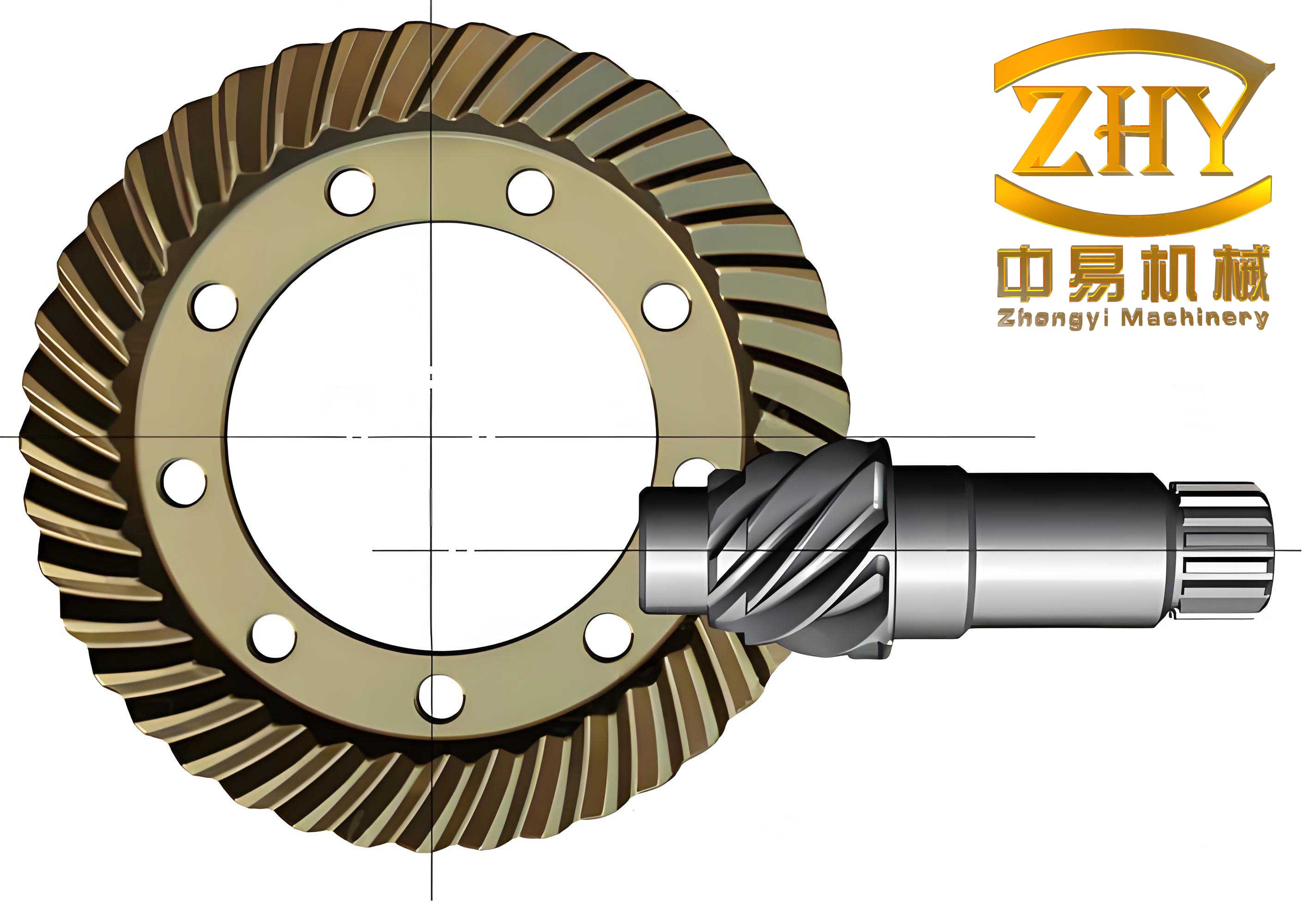
To establish a mathematical model, consider a right-handed Cartesian coordinate system with origin \(O\), where the gear axis \(OA\) aligns with the \(Z\)-axis, and the \(X\)-axis is parallel to the common perpendicular between the gear and pinion axes \(BK\). The reference point \(P\) is uniquely defined by its coordinates \(P(R, \epsilon, H)\), where \(R\) is the distance from \(P\) to the gear axis, \(\epsilon\) is the angle between the projection of \(OK\) (the line through \(O\) and \(K\)) onto the \(XY\)-plane and the \(Y\)-axis, and \(H\) is the vertical distance from \(P\) to the \(XY\)-plane. The geometry yields the following set of equations, which form the basis for calculating all pitch cone parameters:
$$ R = \frac{1}{2} (D – F \sin \Gamma) $$
$$ \tan \eta = \frac{E}{\sin \epsilon (\tan \Gamma \sin \Sigma + \cos \epsilon \cos \Sigma)} $$
$$ \tan \gamma = \frac{\sin \eta}{\tan \epsilon \sin \Sigma – \frac{\cos \eta}{\tan \Sigma}} $$
$$ \cos \theta = \frac{\tan \gamma \tan \Gamma + \cos \Sigma}{\cos \gamma \cos \Gamma} $$
$$ R_P = (E \sin \epsilon – R) \frac{\cos \gamma}{\cos \Gamma} $$
$$ \tan \psi_P = \frac{\frac{i_{12} R_P}{R} – \cos \theta}{\sin \theta} $$
$$ H = R \tan \Gamma $$
Here, \(\gamma\) denotes the pinion pitch cone angle, \(\eta\) is the offset angle in the pinion axis rotation plane, \(\theta\) is the offset angle in the pitch plane, and \(R_P\) is the pinion mid-point pitch radius. Given \(\Sigma\), \(E\), and \(i_{12}\) as known inputs, along with the four control parameters \(D\), \(F\), \(\psi_P\), and \(\Gamma\), these seven equations can be solved simultaneously for \(R\), \(\epsilon\), and \(H\), thereby fully defining the pitch cone geometry. This systematic approach eliminates iterations for symmetry, streamlining the design process for hypoid gear pairs.
The influence of control parameters on gear pair轮廓 is profound and can be analyzed quantitatively. Clearly, the gear outer end reference diameter \(D\) and facewidth \(F\) dictate the basic size of the gear. The pinion outer end reference diameter \(d\) and pinion facewidth \(F_P\) generally increase with \(D\) and \(F\), respectively. When the shaft angle \(\Sigma\) is constant, the pinion pitch cone angle \(\gamma\) tends to decrease as \(\Gamma\) increases, leading to a reduction in \(d\). However, variations in \(\psi_P\) introduce more nuanced effects. For fixed \(\Sigma\) and \(\Gamma\), an increase in \(\psi_P\) causes \(\epsilon\) to decrease and \(\gamma\) to increase, which subsequently enlarges \(d\) according to the formula:
$$ d = 2 \left[ (E \sin \epsilon – R) \frac{\cos \gamma}{\cos \Gamma} + 0.5 F_P \right] \sin \gamma $$
This relationship highlights the interdependence of parameters in shaping hypoid gear geometry.
To encapsulate these effects, the table below summarizes the directional changes in key geometric variables with respect to \(D\), \(F\), \(\psi_P\), and \(\Gamma\). Such summaries are invaluable for designers seeking to balance size constraints with performance goals in hypoid gear applications.
| Parameter | Effect on Gear Size \(D\) | Effect on Gear Facewidth \(F\) | Effect on Pinion Diameter \(d\) | Effect on Pinion Facewidth \(F_P\) |
|---|---|---|---|---|
| Increase in \(D\) | Direct increase | Minimal | Increase | Minimal |
| Increase in \(F\) | None | Direct increase | Increase | Increase |
| Increase in \(\psi_P\) | None | None | Increase | Minimal |
| Increase in \(\Gamma\) | None | None | Decrease | Minimal |
Beyond geometry, the control parameters exert significant influence on the strength characteristics of hypoid gear pairs, which is paramount for ensuring reliability under load. The contact stress and bending stress are primary indicators of strength, and their dependence on \(D\), \(F\), \(\psi_P\), and \(\Gamma\) can be derived from established formulas. For contact stress \(S_{ac}\), the standard expression is:
$$ S_{ac} = C_P C_b \sqrt{ \frac{2 T_D C_a C_v}{T_P} \cdot \frac{T_D}{z_1} \cdot \frac{F}{d^2} \cdot \frac{C_s C_m C_{xc} C_f}{I} } $$
Here, \(C_P\) is the elastic coefficient, \(C_b\) is the size factor, \(T_D\) is the pinion design torque, \(C_a\) is the application factor, \(C_v\) is the dynamic factor, \(T_P\) is the pinion torque, \(z_1\) is the number of pinion teeth, \(C_s\) is the surface condition factor, \(C_m\) is the load distribution factor, \(C_{xc}\) is the crowning factor, \(C_f\) is the surface finish factor, and \(I\) is the geometry factor. Changes in \(\psi_P\) and \(\Gamma\) affect \(d\), which in turn alters \(T_D\) and \(C_m\). Specifically, as \(\psi_P\) increases, \(d\) increases, leading to higher \(T_D\) and \(C_m\), but the net effect is a reduction in \(S_{ac}\) due to the inverse relationship with \(d^2\). Conversely, an increase in \(\Gamma\) reduces \(d\), thereby decreasing \(T_D\) and \(C_m\), but ultimately raises \(S_{ac}\) because of the dominant \(1/d^2\) term. The table below illustrates these relationships qualitatively.
| Parameter Change | Effect on \(d\) | Effect on \(T_D\) | Effect on \(C_m\) | Net Effect on \(S_{ac}\) |
|---|---|---|---|---|
| \(\psi_P \uparrow\) | Increases | Increases | Increases | Decreases |
| \(\Gamma \uparrow\) | Decreases | Decreases | Decreases | Increases |
For bending strength, the pinion bending stress \(S_{tP}\) is given by:
$$ S_{tP} = \frac{2 T_P K_a K_v}{P_d} \cdot \frac{F}{d} \cdot \frac{K_s K_m}{K_x J_P} $$
where \(K_a\) is the application factor, \(K_v\) is the dynamic factor, \(P_d\) is the diametral pitch, \(K_s\) is the size factor, \(K_m\) is the load distribution factor, \(K_x\) is the longitudinal curvature factor, and \(J_P\) is the pinion geometry factor. The factor \(K_x\) is particularly sensitive to \(\psi_P\) and \(\Gamma\), as it depends on the spiral angle and pitch cone geometry. Its expression is:
$$ K_x = 0.211 \left( \frac{r_c}{A_{mG}} \right)^q + 0.789 $$
with \( q = \frac{0.279}{\log \sin \psi_G} \), where \(r_c\) is the cutter radius, \(A_{mG}\) is the gear mean cone distance, and \(\psi_G\) is the gear spiral angle. To avoid undercutting, \(r_c / A_{mG} \leq 1\). As \(\psi_P\) increases, \(\psi_G\) typically increases, causing \(q\) to decrease (since \(\sin \psi_G > 0\)), which elevates \(K_x\). Meanwhile, an increase in \(\Gamma\) reduces \(A_{mG}\), thereby lowering \(K_x\) if \(\psi_G\) remains relatively constant. Combining these effects with changes in \(d\) and \(K_m\), we observe that \(S_{tP}\) decreases with higher \(\psi_P\) but increases with higher \(\Gamma\). Similarly, the gear bending stress \(S_{tG}\) follows:
$$ S_{tG} = \frac{2 T_G K_a K_v}{P_d} \cdot \frac{F}{D} \cdot \frac{K_s K_m}{K_x J_G} $$
where \(T_G\) is the gear torque and \(J_G\) is the gear geometry factor. Here, \(K_x\) varies within a narrow range (1.0 to 1.15), so the dominant influence comes from \(K_m\). Consequently, \(S_{tG}\) increases with \(\psi_P\) and decreases with \(\Gamma\). The tables below consolidate these bending stress dependencies, emphasizing the contrasting effects on pinion and gear for hypoid gear pairs.
| Parameter Change | Effect on \(d\) for Pinion | Effect on \(K_m\) | Effect on \(K_x\) | Net Effect on \(S_{tP}\) |
|---|---|---|---|---|
| \(\psi_P \uparrow\) | Increases | Increases | Increases | Decreases |
| \(\Gamma \uparrow\) | Decreases | Decreases | Decreases | Increases |
| Parameter Change | Effect on \(D\) for Gear | Effect on \(K_m\) | Effect on \(K_x\) | Net Effect on \(S_{tG}\) |
|---|---|---|---|---|
| \(\psi_P \uparrow\) | Minimal | Increases | Slight increase | Increases |
| \(\Gamma \uparrow\) | Minimal | Decreases | Slight decrease | Decreases |
The interplay between control parameters and strength metrics underscores the complexity of hypoid gear design. For instance, while increasing \(D\) and \(F\) uniformly reduces both contact and bending stresses, adjusting \(\psi_P\) and \(\Gamma\) introduces trade-offs between pinion and gear performance. This nuanced behavior is precisely why the proposed method is valuable: it enables targeted optimization. For applications where forward rotation is primary, designers can prioritize reducing pinion bending stress by increasing \(\psi_P\), even if it slightly raises gear bending stress. Such flexibility was unattainable under traditional symmetric engagement constraints.
To further elucidate the parametric relationships, consider the following extended analysis. The geometry factor \(I\) for contact stress depends on the curvature of tooth surfaces, which is influenced by \(\psi_P\) and \(\Gamma\). A general form can be expressed as:
$$ I = \frac{\cos \alpha \cos \beta}{\cos^2 \phi} \cdot f(\rho_1, \rho_2) $$
where \(\alpha\) is the pressure angle, \(\beta\) is the helix angle, \(\phi\) is the operating pressure angle, and \(\rho_1\), \(\rho_2\) are the radii of curvature. For hypoid gears, these curvatures are functions of \(R\), \(\gamma\), and \(\theta\), linking back to the control parameters. Similarly, the geometry factors \(J_P\) and \(J_G\) for bending stress incorporate tooth form dimensions that vary with pitch cone geometry. Empirical data suggest that for typical hypoid gear configurations, the sensitivity of strength to parameter changes can be quantified through dimensionless coefficients. For example, defining a contact stress sensitivity coefficient \(\kappa_C\) as:
$$ \kappa_C = \frac{\partial S_{ac}}{\partial \psi_P} \cdot \frac{\psi_P}{S_{ac}} $$
allows comparative assessment across designs. Using the derived equations, one can compute approximate values for \(\kappa_C\) under various \(\Gamma\) settings, as summarized in the table below. These coefficients facilitate rapid evaluation during the design phase, especially when optimizing hypoid gear pairs for specific load conditions.
| Range of \(\Gamma\) (degrees) | \(\kappa_C\) for \(\psi_P\) Increase | \(\kappa_C\) for \(\Gamma\) Increase | Typical Application |
|---|---|---|---|
| 30–40 | -0.15 to -0.10 | 0.08 to 0.12 | Light-duty automotive |
| 40–50 | -0.10 to -0.05 | 0.12 to 0.18 | Heavy-duty trucks |
| 50–60 | -0.05 to -0.02 | 0.18 to 0.25 | Industrial machinery |
Moreover, the longitudinal curvature factor \(K_x\) warrants deeper examination. Its derivation from the cutter radius and cone distance implies that manufacturing constraints directly interact with design choices. For a given hypoid gear pair, the permissible range of \(r_c\) is bounded by \(A_{mG}\), and optimizing \(K_x\) involves balancing \(\psi_P\) and \(\Gamma\) to minimize bending stress without violating producibility limits. A useful approximation for \(K_x\) in terms of control parameters is:
$$ K_x \approx 0.211 \left( \frac{r_c}{R \sec \Gamma} \right)^{\frac{0.279}{\log \sin(\psi_P + \Delta \psi)}} + 0.789 $$
where \(\Delta \psi\) accounts for the difference between pinion and gear spiral angles. This formula highlights how increases in \(\psi_P\) elevate the exponent’s denominator, thus raising \(K_x\), whereas increases in \(\Gamma\) reduce the base term \(r_c / (R \sec \Gamma)\), lowering \(K_x\). Designers can use such relationships to perform sensitivity analyses before committing to final parameters.
The impact of control parameters on dynamic behavior is another critical aspect. Hypoid gears often operate at high speeds, where vibrations and noise are concerns. The dynamic factor \(C_v\) or \(K_v\) in stress equations typically depends on the pitch line velocity \(v\), which is a function of \(d\) and rotational speed. Since \(d\) changes with \(\psi_P\) and \(\Gamma\), the dynamic response is indirectly affected. For instance, a larger \(d\) due to higher \(\psi_P\) may increase \(v\), potentially raising \(C_v\) and thus stresses. However, the overall effect might be mitigated by improved tooth mesh stiffness from geometry adjustments. Comprehensive dynamic modeling would require finite element analysis, but for preliminary design, empirical correlations can be incorporated. A simplified dynamic multiplier \(\lambda_v\) can be defined as:
$$ \lambda_v = 1 + \frac{v}{v_0} \cdot g(\psi_P, \Gamma) $$
where \(v_0\) is a reference velocity and \(g\) is a function capturing geometry-dependent vibrations. Experimental data for hypoid gears suggest that \(g\) tends to decrease with higher \(\psi_P\) due to smoother engagement but increases with \(\Gamma\) because of sharper cone angles. This introduces another layer of trade-off in parameter selection.
In addition to strength and dynamics, efficiency is a key performance metric for hypoid gear pairs. Power losses arise primarily from sliding friction between tooth flanks, which depends on the relative curvature and sliding velocity. The latter is influenced by the offset \(E\) and spiral angles. Using the control parameters, one can estimate the sliding velocity \(v_s\) at the reference point as:
$$ v_s = \omega_1 \sqrt{ (E \sin \epsilon – R)^2 + (R_P \sin \theta)^2 } $$
where \(\omega_1\) is the pinion angular velocity. Substituting expressions for \(R\), \(\epsilon\), and \(R_P\) from the model shows that \(v_s\) increases with \(\psi_P\) but decreases with \(\Gamma\). Higher sliding velocities generally elevate friction losses, so for efficiency-critical applications, lower \(\psi_P\) and higher \(\Gamma\) might be preferred, albeit at the cost of increased contact stress. This again illustrates the multifaceted decisions involved in hypoid gear design.
To aid designers in navigating these trade-offs, the proposed method can be integrated into optimization frameworks. An objective function, such as minimizing total volume or maximizing fatigue life, can be formulated with constraints on stresses, sizes, and manufacturing limits. The control parameters \(D\), \(F\), \(\psi_P\), and \(\Gamma\) serve as decision variables. For example, a typical optimization problem for a hypoid gear pair might be stated as:
$$ \text{Minimize } V = k_1 D^2 F + k_2 d^2 F_P $$
subject to:
$$ S_{ac} \leq S_{ac,\text{allow}}, \quad S_{tP} \leq S_{tP,\text{allow}}, \quad S_{tG} \leq S_{tG,\text{allow}} $$
$$ \psi_P^{\min} \leq \psi_P \leq \psi_P^{\max}, \quad \Gamma^{\min} \leq \Gamma \leq \Gamma^{\max} $$
where \(k_1\) and \(k_2\) are proportionality constants, and allowable stresses are material-dependent. The geometric relationships derived earlier provide the necessary links between variables. Solving such problems numerically yields Pareto-optimal designs that balance competing objectives, a capability enhanced by the direct parameter control offered by the new method.
Furthermore, the method’s compatibility with computer-aided design (CAD) systems accelerates prototyping and validation. By automating the calculation of pitch cone parameters from \(D\), \(F\), \(\psi_P\), and \(\Gamma\), designers can rapidly generate 3D models for simulation or manufacturing. This aligns with modern trends in digital twin technology, where virtual testing precedes physical production. For hypoid gears, which require precise tooth flank modifications to control contact patterns, integrating the method with flank correction algorithms can yield superior performance. The basic geometry from the control parameters serves as a foundation for adding profile crowning, lead crowning, or bias modifications, all of which are essential for noise reduction and load distribution in real-world operations.
In summary, the novel geometric parameter calculation method for hypoid gear pairs represents a paradigm shift from traditional symmetric engagement approaches. By prioritizing the control parameters \(D\), \(F\), \(\psi_P\), and \(\Gamma\), designers gain unprecedented influence over gear size, shape, and strength characteristics. The analytical relationships derived here elucidate how each parameter affects contact and bending stresses, often in opposing ways for pinion and gear. This knowledge enables targeted optimization, especially for applications where forward rotation dominates. Future work could extend the method to include more detailed tooth geometry, such as tooth thickness adjustments or fillet radius optimization, further enhancing the design toolkit for hypoid gears. As transmission systems evolve towards higher efficiency and compactness, such advanced methodologies will be indispensable in realizing next-generation hypoid gear designs that meet stringent performance and reliability standards.
The tables and formulas presented throughout this discussion serve as a comprehensive reference for engineers. To conclude, the following consolidated table offers a quick guide to the effects of increasing each control parameter on key output metrics for a hypoid gear pair. This synthesis underscores the method’s utility in making informed design choices.
| Control Parameter Increase | Gear Size | Pinion Size | Contact Stress \(S_{ac}\) | Pinion Bending Stress \(S_{tP}\) | Gear Bending Stress \(S_{tG}\) |
|---|---|---|---|---|---|
| \(D \uparrow\) | Increases | Increases | Decreases | Decreases | Decreases |
| \(F \uparrow\) | Facewidth increases | Facewidth increases | Decreases | Decreases | Decreases |
| \(\psi_P \uparrow\) | Minimal change | Diameter increases | Decreases | Decreases | Increases |
| \(\Gamma \uparrow\) | Minimal change | Diameter decreases | Increases | Increases | Decreases |
Ultimately, the success of any hypoid gear design hinges on a holistic understanding of these interdependencies. The proposed method, with its emphasis on direct parameter control, provides a robust foundation for achieving optimal solutions across diverse applications, from automotive differentials to industrial reducers. As computational tools advance, integrating this approach with machine learning for pattern recognition or real-time adjustment could further revolutionize hypoid gear engineering, ensuring that these critical components continue to drive progress in power transmission technology.