
In the manufacturing and design of hypoid gears, achieving precise contact patterns on the tooth surfaces is critical for ensuring optimal performance, durability, and noise reduction in applications such as automotive differentials. Traditional methods, such as those outlined in the Gleason system, often rely on approximations that can introduce errors, leading to diagonal contact or misalignment during initial gear cutting trials. This necessitates iterative adjustments, which are time-consuming and costly. In this article, I present an exact calculation method for determining the cutter tip radius of the pinion in hypoid gear pairs. This approach eliminates the approximations inherent in classical formulas by leveraging computational geometry and differential geometry principles, allowing for direct control over the contact pattern size and shape. The method ensures that the first cutting trial yields a contact pattern with high accuracy, minimizing the need for corrective machining.
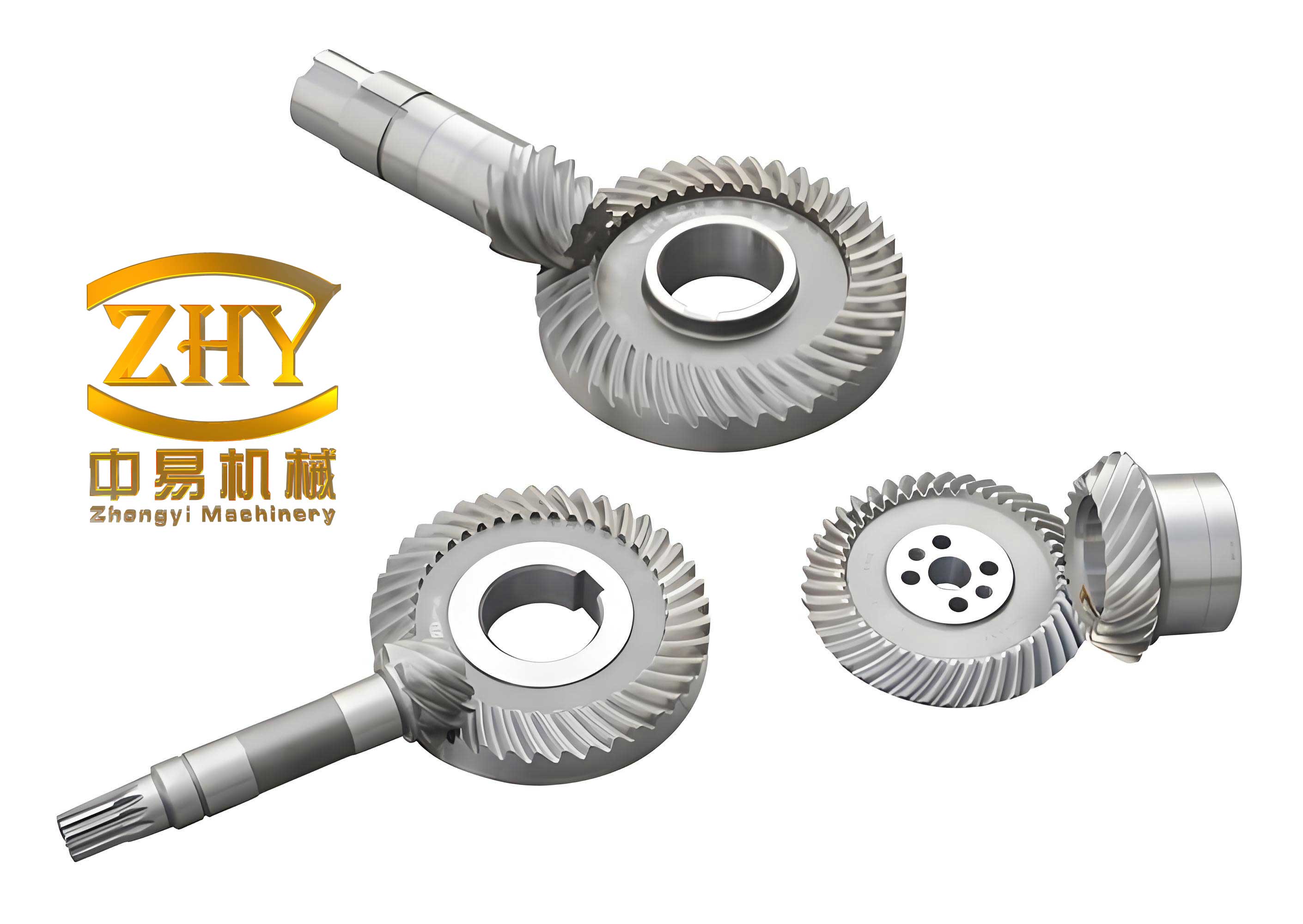
The hypoid gear geometry is inherently complex due to the offset between the pinion and gear axes, which introduces cross-axes and requires sophisticated tooth surface generation. The cutter tip radius plays a pivotal role in defining the tooth profile, as it influences the curvature of the generated surface and, consequently, the contact pattern under load. In the Gleason method, the principal directions of the generating surface are approximated as the tooth length direction for calculating the cutter tip diameter, leading to inaccuracies. My method addresses this by employing exact geometric relationships and coordinate transformations, ensuring that the cutter tip radius is computed based on the actual kinematics of the cutting process. This not only enhances precision but also provides flexibility in selecting any point on the tooth surface for calculation, which is essential for optimizing hypoid gear performance across varying operating conditions.
To lay the groundwork, let me define key geometric parameters and coordinate systems used throughout this analysis. The hypoid gear pair consists of a pinion and a gear, with the pinion being the smaller member. The cutting process involves a imaginary generating surface that envelopes the tooth surface during machining. For the pinion, the cutter is positioned on a virtual machine tool setup, often referred to as the cradle or摇台 in traditional contexts. I establish fixed coordinate systems to describe the relative motions between the workpiece and the cutter. Let Σp be the fixed coordinate system attached to the machine tool, Σh be the coordinate system attached to the pinion, and Σc be the coordinate system attached to the cutter. The origin Op is at the machine center, Oh is the pinion offset point, and Pp is the cutter tip point. The key parameters include the pinion root angle γR, the pinion spiral angle Ψx, the machine setting parameters such as sliding base Sp and radial distance Rp, and the cutter blade angle φbp.
The core of my method revolves around determining the distance bp, which is defined as the distance along the generating surface母线 from the conjugate contact point P1 to the cutter tip Pp. This distance is crucial for linking the tooth surface geometry to the cutter parameters. Consider a point Mp on the pinion tooth surface, with a tooth root height bmp measured as the distance from Mp to the pinion root cone surface. Using geometric relations in the pinion coordinate system, bmp can be expressed as:
$$ b_{mp} = R_{ho} \cos \gamma_R – (G_R + L_p) \sin \gamma_R $$
where Rho is a radial distance, GR is the distance from the pinion offset point to the root cone vertex, and Lp is a machine setting parameter. The cone distance Am from the root cone等距曲面 vertex to Mp is given by:
$$ A_m = \frac{R_{ho}}{\sin \gamma_R} $$
In the fixed coordinate system Σp, the position vector of the cutter tip is Ap = Sp + Rp, where Sp is the sliding base vector and Rp is the radial vector. The unit vector along the cutter blade母线 in Σc is tc = (0, -\sin \varphi_{bp}, \cos \varphi_{bp})^T. Transforming this into Σp using the machine spiral angle Ψx, we have tp = M_k(\Psi_x) tc, where M_k is a rotation matrix about the k-axis. The position vector of the conjugate contact point on the generating surface is then:
$$ A_{bp} = A_p – b_p t_p = S_p + R_p – b_p t_p $$
By equating this to the position vector of the pinion tooth point Mp transformed into the cutting position, and applying dot product operations with the unit vector kp, I derive the exact expression for bp:
$$ b_p = \frac{b_{mp} – [M_j(\gamma_R) M_R(i_h, \tau) A_h] \cdot k_p}{\cos \varphi_{bp}} $$
Here, M_j and M_R are rotation matrices, ih is the pinion axis unit vector, τ is the forming angle at Mp, and Ah is the position vector in Σh. This formula eliminates approximations by directly incorporating the pinion kinematics.
Next, I compute the angle Δ between the generating surface母线和 the tooth surface母线 in the common tangent plane at the conjugate contact point. This angle is essential for understanding the orientation mismatch that can lead to diagonal contact in hypoid gears. After coordinate transformations, the unit vectors th (tooth surface母线 direction) and tc(h) (generating surface母线 direction in Σh) are obtained. Their dot and cross products yield:
$$ \cos \Delta = t_c^{(h)} \cdot t_h $$
$$ \sin \Delta = t_c^{(h)} \cdot (t_h \times n_c^{(h)}) $$
where nc(h) is the normal vector of the generating surface. The angle Δ can be positive or negative, depending on the relative orientation, and it directly influences the contact pattern geometry.
To further refine the calculation, I determine the angle between the principal directions of the generating surface and the tooth length direction. For the gear member, I first find the normal vector CG2 to the gear pitch cone等距曲面 at point MG in the gear coordinate system Σ2. Starting with CG = (\sin \delta_G, 0, -\cos \delta_G)^T in ΣG, where δG is the gear root angle, I transform it through rotations involving the gear pitch angle Γm and the shaft angle α:
$$ C_{G2} = M_R(i_2, -\alpha) M_j(\Gamma_m) C_G $$
The vector e2 = (CG2 × n2) / |CG2 × n2| lies in the common tangent plane and is perpendicular to the tooth surface normal n2. Transforming e2 into the pinion coordinate system Σh during conjugate meshing, and then to the forming position, gives eh. The angle Δ1 between eh and th is:
$$ \cos \Delta_1 = e_h \cdot t_h $$
$$ \Delta_1 = \arccos(e_h \cdot t_h) $$
Similarly, for the pinion, I compute the normal vector Cp to the pinion pitch cone in the forming position: Cp = M_R(i_h, \tau) C’p, with C’p = (-\sin \gamma, 0, -\cos \gamma)^T, where γ is the pinion pitch angle. Then, eph = (Cp × nh) / |Cp × nh|, and the angle Δp1 from th × nh to eph is found via sin Δp1 = eph · th. The relative angle Δp = Δp1 – Δ2, where Δ2 = π/2 – Δ1, describes the orientation of the pinion tooth length direction. Finally, the acute angle Δp2 between the pinion tooth length direction and the non-母线 principal direction of the generating surface is:
$$ \Delta’_{p2} = \Delta + \Delta_{p1} $$
$$ \Delta_{p2} = 180^\circ – \Delta’_{p2} $$
These angles are critical for curvature analysis and contact pattern control in hypoid gears.
With the geometric relationships established, I proceed to curvature correction and the exact determination of the cutter tip radius. The tooth surfaces of hypoid gears are designed to have specific curvatures to ensure localized contact under load. The theoretical normal curvatures and geodesic torsions in the th × nh and th directions are denoted as Kx1, G1, and Ky1 for the pinion. Using the generalized Euler and Bertrand formulas, I compute the curvatures in the eh direction (Kx2, G2) and the eh × nh direction (Ky2). Since the tooth length directions of the pinion and gear are not aligned in the common tangent plane—a characteristic of hypoid gears—some diagonal contact is inevitable. However, to minimize its adverse effects, I perform curvature correction such that the geodesic torsion in a chosen direction remains unaltered. Typically, I select the eh direction for this purpose, setting G’2 = G2. The corrected normal curvatures are:
$$ K’_{x2} = K_{x2} \mp \Delta K_x $$
$$ K’_{y2} = K_{y2} \mp \Delta K_y $$
where the upper sign (-) applies to the outer cutter (concave side) and the lower sign (+) to the inner cutter (convex side). The adjustments ΔKx and ΔKy are based on the desired contact pattern dimensions and are computed using the induced curvature relationships between the gear and pinion surfaces.
Now, focusing on the generating surface, I determine its principal curvatures. Let Kxd and Gd be the normal curvature and geodesic torsion in the non-母线 principal direction, and Kyd be the normal curvature in the母线 direction. From the geometry, the normal curvature Kxc and geodesic torsion Gc in the tc(h) × nc(h) direction, and Kyc in the tc(h) direction, are derived. Using Meusnier’s theorem and the relationship between the induced curvatures of the generating surface and the cutter blade, the required cutter tip radius r’φ is given by:
$$ r’_{\varphi} = \frac{\cos \varphi_{hp}}{K_{xd} – b_p \sin \varphi_{bp}} $$
where φhp is related to the cutter blade geometry. This radius is then rounded to a practical value rcp for manufacturing. By adjusting bp and the curvature corrections, the contact pattern length and width can be controlled independently, without inducing unwanted diagonal contact. This precision is paramount for hypoid gears used in high-performance applications.
To illustrate the computational steps and parameter dependencies, I summarize key formulas and variables in the following tables. These tables provide a quick reference for engineers implementing this exact calculation method for hypoid gears.
| Symbol | Description | Formula or Relation |
|---|---|---|
| γR | Pinion root angle | Machine setting parameter |
| Ψx | Machine spiral angle | From hypoid gear design |
| bmp | Tooth root height at Mp | $$ b_{mp} = R_{ho} \cos \gamma_R – (G_R + L_p) \sin \gamma_R $$ |
| Am | Cone distance at Mp | $$ A_m = \frac{R_{ho}}{\sin \gamma_R} $$ |
| φbp | Cutter blade angle | Cutter specification |
| bp | Distance along generating surface母线 | $$ b_p = \frac{b_{mp} – [M_j(\gamma_R) M_R(i_h, \tau) A_h] \cdot k_p}{\cos \varphi_{bp}} $$ |
| Angle | Description | Calculation Method |
|---|---|---|
| Δ | Angle between generating and tooth surface母线 in tangent plane | $$ \cos \Delta = t_c^{(h)} \cdot t_h, \sin \Delta = t_c^{(h)} \cdot (t_h \times n_c^{(h)}) $$ |
| Δ1 | Angle between eh and th | $$ \Delta_1 = \arccos(e_h \cdot t_h) $$ |
| Δp1 | Angle from th × nh to eph | $$ \sin \Delta_{p1} = e_{ph} \cdot t_h $$ |
| Δp2 | Acute angle between pinion tooth length and generating non-母线 direction | $$ \Delta_{p2} = 180^\circ – (\Delta + \Delta_{p1}) $$ |
| Symbol | Description | Role in Hypoid Gear Contact |
|---|---|---|
| Kx1, G1, Ky1 | Theoretical curvatures in th × nh and th directions | Base values for pinion tooth surface |
| Kx2, G2, Ky2 | Curvatures in eh and eh × nh directions | Derived via Euler/Bertrand formulas |
| K’x2, K’y2, G’2 | Corrected curvatures | $$ K’_{x2} = K_{x2} \mp \Delta K_x, K’_{y2} = K_{y2} \mp \Delta K_y, G’_{2} = G_{2} $$ |
| Kxd, Gd | Generating surface principal curvatures | Used for cutter tip radius calculation |
| r’φ | Required cutter tip radius | $$ r’_{\varphi} = \frac{\cos \varphi_{hp}}{K_{xd} – b_p \sin \varphi_{bp}} $$ |
The implementation of this exact calculation method for hypoid gears involves iterative computational algorithms, often coded in environments like MATLAB or Python. By inputting the hypoid gear design parameters—such as offset, shaft angle, tooth numbers, and pressure angle—the algorithm computes the exact cutter tip radius and related settings. This approach has been validated through cutting trials, showing that the first trial produces contact patterns with minimal diagonal contact and desired dimensions. For instance, by varying bp or the curvature corrections, the contact patch length can be extended or narrowed without affecting other parameters, offering unparalleled control in hypoid gear manufacturing.
In practice, the benefits of this method extend beyond initial cutting accuracy. It reduces scrap rates, shortens development cycles, and enhances the performance of hypoid gears in terms of load capacity and noise. The ability to compute for any point on the tooth surface allows for optimized modifications, such as tip and root relief, which are crucial for dynamic performance. Moreover, this exact method can be integrated with modern CNC machine tools, enabling real-time adjustments and adaptive manufacturing for hypoid gears.
To further elucidate the mathematical framework, let me delve into the coordinate transformation matrices used. The rotation matrix about the k-axis by angle Ψx is:
$$ M_k(\Psi_x) = \begin{bmatrix} \cos \Psi_x & -\sin \Psi_x & 0 \\ \sin \Psi_x & \cos \Psi_x & 0 \\ 0 & 0 & 1 \end{bmatrix} $$
Similarly, rotations about the j-axis by γR and about the i-axis by angles like τ are defined. These transformations ensure precise mapping between coordinate systems, which is fundamental for accurate hypoid gear analysis. The differential geometry of surfaces plays a key role here. The normal curvature K in a direction given by unit vector u is K = II(u, u) / I(u, u), where I and II are the first and second fundamental forms. For the tooth surface, these forms are derived from the parametric equations based on the cutting process.
In conclusion, the exact calculation of the cutter tip radius for hypoid gear pinions represents a significant advancement over traditional approximate methods. By rigorously modeling the geometric and kinematic relationships, I have developed a method that eliminates errors associated with principal direction approximations. This leads to precise control over the contact pattern, enhancing the performance and reliability of hypoid gears. The integration of computational tools makes this method practical for industrial applications, allowing for efficient design and manufacturing. As hypoid gears continue to be critical in automotive and aerospace industries, such precise calculation techniques will drive innovations in gear technology. Future work may involve extending this approach to other gear types or incorporating thermal and elastic deformations for even more accurate predictions.
The tables and formulas provided herein serve as a comprehensive guide for engineers. By adopting this exact calculation method, manufacturers can achieve superior hypoid gear quality with fewer trials, ultimately reducing costs and improving product performance. The emphasis on exact geometry and curvature correction ensures that hypoid gears meet the stringent demands of modern machinery, where efficiency and durability are paramount.