
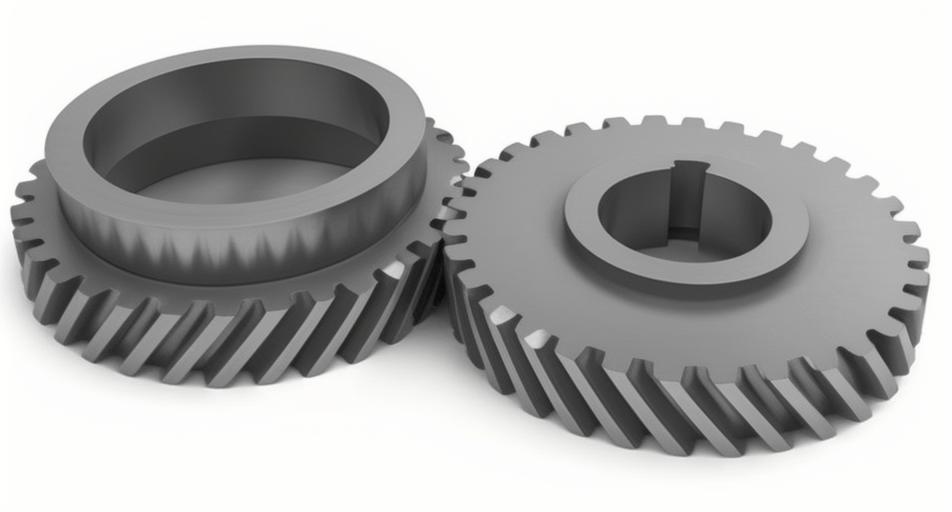
In modern industrial manufacturing, the demand for rapid, precise, and non-destructive quality control is paramount. Helical gears are a critical component in countless transmission systems, prized for their superior operational smoothness, higher load capacity, and reduced noise compared to spur gears. A key geometric parameter defining a helical gear is its helix angle. Traditional measurement methods for this angle, such as using universal bevel protractors or lead testing instruments, are often contact-based, time-consuming, and difficult to integrate into automated production lines. This creates a bottleneck for high-volume manufacturing where online, in-process inspection is crucial. This article presents a comprehensive machine vision-based methodology for the online measurement of the helix angle and handedness of helical gears, addressing the shortcomings of conventional techniques.
The proposed system is designed for seamless integration into an existing industrial gear inspection setup. A typical online station for measuring gear face parameters (like number of teeth, tip diameter, and pitch diameter) uses a top-down camera. Our method augments this by adding a secondary, side-view measurement system. The core hardware consists of a high-resolution CCD camera equipped with a double telecentric lens, a combination of a ring light (for top illumination) and a bar light (for side illumination), a sturdy camera stand, and a processing computer. The double telecentric lens is essential for its deep depth of field, minimal distortion, and elimination of perspective error, ensuring that the side profile of the helical gear is captured with high geometric fidelity regardless of minor placement variations.
The workflow begins with system calibration and image acquisition. The camera is aligned using spirit levels to ensure its sensor plane is parallel to the gear’s axis. Camera calibration and lens distortion correction are performed. The gear is positioned, and its side image is captured. Crucially, the top-view measurement system provides real-time data such as the actual tip diameter, which is used to automatically define the Region of Interest (ROI) for the side image, ensuring full automation. Image preprocessing includes grayscale conversion and, if necessary, tilt correction based on the gear’s shaft image to align the image coordinate system with the gear’s world coordinates.
Theoretical Foundation of Helical Gear Tooth Flank Projection
The tooth flank of a helical gear can be described as a set of helices lying on a coaxial cylinder. In a 3D Cartesian coordinate system where the z-axis aligns with the gear axis, the parametric equations for a single helix are:
$$ x = r \cdot \cos\left(\theta + \theta_0 + \frac{2\pi(n-1)}{c}\right) $$
$$ y = r \cdot \sin\left(\theta + \theta_0 + \frac{2\pi(n-1)}{c}\right) $$
$$ z = \pm r \cdot \theta \cdot \cot(\beta) = \pm \frac{r \cdot \theta}{\tan(\beta)} $$
Where:
\( r \) is the cylinder radius (e.g., tip radius),
\( \theta \) is the angular parameter,
\( \theta_0 \) is the initial phase angle,
\( n \) is the tooth index (from 1 to \( c \)),
\( c \) is the total number of teeth,
\( \beta \) is the helix angle.
The sign of \( z \) determines the handedness: positive for right-handed and negative for left-handed helical gears.
Since the side-view camera only captures the profile in the x-z plane (y > 0 region), we project the 3D helix onto this plane. By combining the equations for \( x \) and \( z \), we eliminate \( \theta \) to obtain the functional form of a single tooth line as seen from the side:
$$ x – x_0 = r \cdot \cos\left( \frac{m \cdot (z – z_0) \cdot \tan(\beta)}{r} + \theta_0 + \frac{2\pi(n-1)}{c} \right) $$
Here, \( (x_0, z_0) \) is the intersection point of the gear axis with the top plane in the image. This equation shows that the side projection of the tooth line is a cosine function, not a straight line. However, for the central tooth line in the camera’s field of view, the curvature is often minimal and can be approximated as linear for coarse methods, leading to inherent errors. Our method fits the precise cosine model, significantly improving accuracy. Crucially, the shape of this projected curve is uniquely determined by the helix angle \( \beta \). A simulation for a helical gear with a 45° helix angle clearly demonstrates this unique, identifiable profile. Furthermore, the helix angle at the tip circle (\( \beta_y \)) measured from the image is related to the standard pitch circle helix angle (\( \beta \)) by:
$$ \beta = \arctan\left( \frac{d}{d_y} \cdot \tan(\beta_y) \right) $$
where \( d \) is the pitch diameter and \( d_y \) is the tip diameter (measured by the top-view system).
Core Machine Vision Measurement Methodology
1. Determination of Gear Handedness
Before calculating the angle, determining whether the helical gear is left or right-handed is necessary. We employ a morphological approach based on the dominant edge direction in the preliminary side image. After basic edge detection, we count occurrences of specific slanted structuring elements. For a left-handed helical gear, the visible tooth edges predominantly have a negative slope, and vice-versa. By statistically comparing the count of positive-slope versus negative-slope elements, the handedness is robustly identified, even under challenging conditions like rust or non-uniform lighting.
| Gear Type & Condition | Count of +45° Elements | Count of -45° Elements | Inferred Handedness |
|---|---|---|---|
| 45° Left-Hand (Normal) | 4,941 | 18,088 | Left |
| 45° Right-Hand (Rusted) | 28,861 | 11,946 | Right |
| 19° Left-Hand (Overexposed) | 1,569 | 2,637 | Left |
| Spur Gear (Tilted) | ~3,200 | ~900 | Indeterminate |
2. Advanced Edge Detection for Tooth Lines
Capturing clear tooth line edges is challenging due to the curved surface of the helical gear, which causes highly non-uniform illumination (bright on the left/top, dark on the right/bottom for left-handed gears). Standard edge detectors (Sobel, basic Canny) perform poorly, producing broken edges. We implemented a comparative analysis of several advanced methods:
| Algorithm | Edge Connectivity | Robustness to Lighting | Processing Speed | Suitability |
|---|---|---|---|---|
| Sobel Operator | Poor (Many Breaks) | Low | Very Fast | Low |
| Canny + Gaussian Filter | Moderate | Low | Fast | Moderate |
| Canny + High-pass Filter | Poor (Many Breaks) | Moderate | Fast | Low |
| Ant Colony Optimization | Good (Smooth) | High | Very Slow (>4s) | Low |
| Canny + Homomorphic Filter | Very Good | Very High | Fast (<0.3s) | High |
The homomorphic filter effectively normalizes illumination by operating in the frequency domain, compressing the brightness range (addressing shadows and highlights) while enhancing contrast. Applying the Canny edge detector to this normalized image yields the most continuous and complete tooth line edges, making it the chosen method for our online system.
3. Morphological Processing for Edge Isolation
The initial edge map contains not only the desired tooth lines but also noise, texture, and edges from other features (like the gear bore). To isolate only the tooth line edges, we developed a slope-screening algorithm based on an improved Hit-or-Miss Transform. The process is as follows:
- Remove Small Noise: Eliminate small connected components (blobs) from the binary edge image.
- Break Unwanted Connections: Use the Hit-or-Miss Transform with slanted structuring elements to disconnect the tooth lines from any connecting horizontal or vertical edges (e.g., from the gear’s top/bottom faces).
- Filter by Orientation: Sequentially apply transforms with horizontal and vertical structuring elements to remove any remaining purely horizontal or vertical lines, leaving primarily the slanted tooth line edges.
- Final Cleanup: Perform morphological closing to join small gaps within the now-isolated tooth lines.
This customized morphological workflow is highly effective in extracting clean, continuous tooth line edges from a cluttered initial edge map, which is critical for accurate subsequent curve fitting.
4. Curve Fitting and Helix Angle Calculation
With clean tooth line edges extracted, the next step is to fit the theoretical cosine model to the pixel data. First, pixel coordinates \((x_{img}, y_{img})\) are transformed into a real-world coordinate system centered on the gear axis and corrected for any image tilt, resulting in coordinates \((x_{real}, z_{real})\).
The longest, most continuous edge is selected for the primary fit. Using a non-linear least squares optimization algorithm (like MATLAB’s `fit` function), the parameters of the following equation are determined for that edge (assigning it an arbitrary index \(n=1\)):
$$ x_{fit} = r \cdot \cos\left( \frac{m \cdot z_{real} \cdot \tan(\beta_{guess})}{r} + \theta_0 \right) + x_0 $$
The optimization varies \(\beta_{guess}\), \(\theta_0\), \(x_0\) to minimize the difference between \(x_{fit}\) and the actual \(x_{real}\) values of the edge pixels. This yields a preliminary helix angle estimate \(\beta_{guess}\).
To refine this estimate and correct for potential index misassignment, we use a multi-edge consensus approach. The fitted model predicts the x-position for all other detected tooth edges at their respective z-coordinates, assuming an index \(n\). The variance between these predictions and the actual x-positions of all edge pixels across all teeth is calculated. The process iterates slightly, adjusting the helix angle and the integer tooth indices to find the global minimum of this total variance. This robust fitting procedure effectively averages out local errors from any single edge, leading to a highly accurate and stable measurement of the helix angle \(\beta_y\) at the tip circle, which is then converted to the standard pitch circle helix angle \(\beta\) using the formula previously stated.
Experimental Validation and Performance Analysis
The proposed system was tested on several helical gears with different specifications and under various conditions. The results were compared against the gears’ design values to evaluate accuracy and robustness.
| Gear Specification | Design Helix Angle | Measured Helix Angle | Absolute Error | Relative Error |
|---|---|---|---|---|
| 45°, 1.5 mod, 26 teeth, Left (Sample 1) | 45.000° | 45.106° | 6.34′ | 0.23% |
| 45°, 1.5 mod, 26 teeth, Left (Sample 2) | 45.000° | 45.126° | 7.53′ | 0.28% |
| 19°, 1.25 mod, 25 teeth, Left (Sample 3) | 19.524° | 19.451° | 4.38′ | 0.37% |
| 19°, 1.25 mod, 25 teeth, Left (Sample 4) | 19.524° | 19.617° | 5.59′ | 0.48% |
| 45°, 1.5 mod, 26 teeth, Right (Rusted) | 45.000° | 44.871° | 7.74′ | 0.29% |
Performance Summary:
- Accuracy: The average measurement error is within approximately 7 arc-minutes, which is comparable to the precision grade of a manual universal bevel protractor (2′-5′). This represents a significant improvement over simpler vision methods that assume straight-line projections.
- Speed: The entire measurement cycle, including image acquisition and all processing steps, is completed in approximately 1 second. This is over 15 seconds faster than manual methods and about 7 seconds faster than semi-automated offline vision methods, making it perfectly suited for online, in-line inspection.
- Robustness: The method correctly identified handedness in all cases, including a rusted gear. The use of homomorphic filtering and consensus-based fitting makes it tolerant to common industrial image defects like non-uniform lighting and minor surface imperfections.
Primary Sources of Error:
1. System Assembly Error: Residual misalignment of the camera relative to the gear axis.
2. Tilt Correction Error: Inaccuracy in measuring and compensating for the gear’s tilt in the image.
3. Gear Surface Defects: Scratches, pits, or debris can break the edge continuity or create false edges.
4. Chamfer/Edge Break: The tooth tip chamfer means the very top edge is not on the theoretical tip cylinder, slightly affecting the initial part of the fitted curve. The method is most accurate for gears without a large chamfer.
Conclusion
This research presents a fully developed machine vision solution for the online measurement of helical gear helix angle and handedness. By leveraging a double telecentric lens, advanced image processing combining homomorphic filtering and morphological shape filtering, and a precise cosine-curve fitting model with multi-edge consensus, the system achieves a balance of high speed (≈1 second) and good accuracy (≈4-8 arc-minutes). The system is designed as an add-on module to existing gear face measurement stations, enabling comprehensive geometric inspection of helical gears—including tooth count, tip diameter, and helix parameters—in a single, automated cycle. While the accuracy may not yet surpass that of the most precise coordinate-based contact methods, its superior speed and non-contact nature make it an ideal solution for 100% inspection in production environments, preliminary quality assessment, and automated sorting of helical gears. Future work will focus on further algorithm optimization for execution speed, enhancing robustness to severe chamfers, and reducing reliance on specific lighting setups.