
The pursuit of optimal performance and reliability in mechanical power transmission systems is a constant engineering challenge. Among the core components, the helical gear pair stands out for its ability to transmit high loads smoothly and quietly due to its gradual tooth engagement. However, the idealized models of perfect geometry seldom hold in real-world applications. Manufacturing imperfections are inevitable, and among these, pitch error is a primary source of transmission inaccuracy and dynamic excitation. This deviation of the actual tooth spacing from the theoretical design introduces periodic disturbances in the meshing process, fundamentally altering the dynamic behavior of the gear system. Therefore, a deep understanding of how pitch error influences the vibration characteristics of a helical gear pair is not merely academic; it is essential for predictive maintenance, fault diagnosis, noise reduction, and the design of more robust and efficient drivetrains. This article delves into this critical interaction, employing a nonlinear dynamic model to quantify the effects of pitch error on the complex vibratory response of a helical gear system.
The analysis of gear dynamics has long been a focus of research, with significant attention given to factors like time-varying mesh stiffness, backlash, and manufacturing errors. While studies often explore these effects in spur gears, the dynamics of the helical gear are inherently more complex due to the axial force component introduced by the helix angle. This complexity necessitates models that account for coupled vibrations across multiple degrees of freedom. Traditional models that neglect these couplings or simplify error profiles may fail to capture the true dynamic response. This work addresses this gap by integrating a realistic, time-varying model of pitch error into a comprehensive multi-degree-of-freedom dynamic model for a helical gear pair, providing a clearer window into its vibrational consequences.
Nonlinear Dynamic Model of a Helical Gear Pair with Pitch Error
To accurately capture the dynamic interactions, a six-degree-of-freedom (6-DOF) lumped-parameter model is established. This model considers the bending, torsional, and axial vibrations of both the driving and driven gears, creating a fully coupled bending-torsion-axial vibration system. The model incorporates key nonlinear factors essential for realism: time-varying mesh stiffness, mesh damping, backlash, and crucially, the periodic displacement excitation caused by pitch error. Friction effects between the teeth are considered negligible for this analysis.
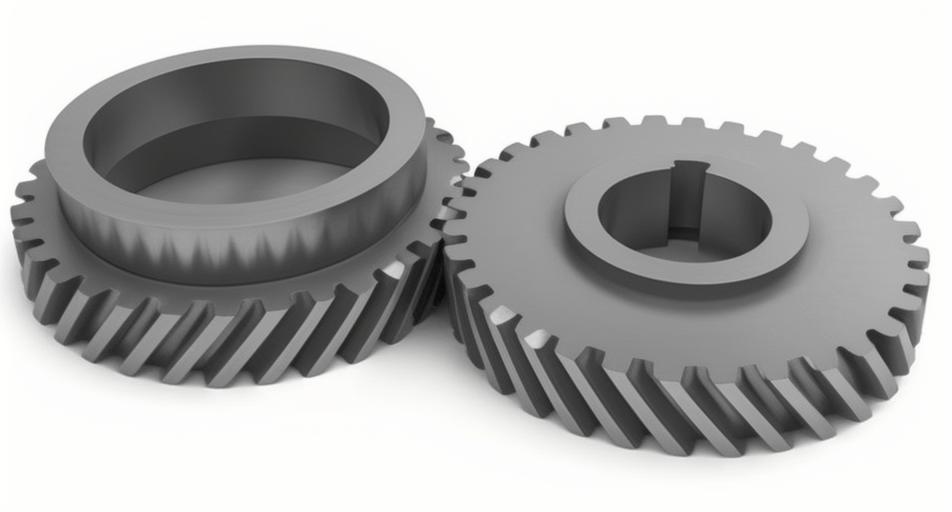
The system is defined with the following parameters for the pinion (p) and gear (g): masses \(m_p\), \(m_g\); moments of inertia \(I_p\), \(I_g\); base circle radii \(r_{bp}\), \(r_{bg}\). The supporting bearings are modeled with equivalent stiffness and damping in the axial (z) and transverse (y) directions: \(k_{pz}, k_{gz}, k_{py}, k_{gy}\) and \(c_{pz}, c_{gz}, c_{py}, c_{gy}\). The gear pair interaction is defined by the input torque \(T_p\), load torque \(T_g\), time-varying mesh stiffness \(k(t)\), mesh damping \(c_m\), total backlash \(2b_n\), and base helix angle \(\beta_b\). The kinematic excitation due to pitch error is represented by \(e(t)\).
System Equations of Motion
Applying Newton’s second law, the equations of motion for the system are derived. The displacements are: transverse vibrations \(y_p, y_g\); axial vibrations \(z_p, z_g\); and rotational vibrations \(\theta_p, \theta_g\). The dynamic mesh forces along the transverse (y) and axial (z) directions are \(F_y\) and \(F_z\), respectively.
$$
\begin{aligned}
m_p \ddot{y}_p + c_{py} \dot{y}_p + k_{py} y_p &= F_y \\
m_g \ddot{y}_g + c_{gy} \dot{y}_g + k_{gy} y_g &= -F_y \\
m_p \ddot{z}_p + c_{pz} \dot{z}_p + k_{pz} z_p &= -F_z \\
m_g \ddot{z}_g + c_{gz} \dot{z}_g + k_{gz} z_g &= F_z \\
I_p \ddot{\theta}_p &= T_p – F_y r_{bp} \\
I_g \ddot{\theta}_g &= -T_g + F_y r_{bg}
\end{aligned}
$$
For analysis convenience, the equations are non-dimensionalized. A nominal displacement \(b’\) is introduced, defining non-dimensional displacements \(\delta_1 = y_p/b’\), \(\delta_2 = y_g/b’\), \(\delta_3 = z_p/b’\), \(\delta_4 = z_g/b’\), and \(\delta_5 = [\theta_p r_{bp} – \theta_g r_{bg} – e(t)]/b’\). The relative displacements are \(y_1\) (transverse) and \(y_2\) (axial). Non-dimensional time \(\tau\) and mesh frequency \(\omega\) are used. Combining the torsional equations and non-dimensionalizing yields the final system:
$$
\boxed{
\begin{aligned}
\ddot{\delta}_1 + 2\eta_{11}\dot{\delta}_1 + \kappa_{11}\delta_1 &= \cos\beta \left[ \kappa_{10} f_y(y_1) + 2\varepsilon_{10}\dot{y}_1 \right] \\
\ddot{\delta}_2 + 2\eta_{21}\dot{\delta}_2 + \kappa_{21}\delta_2 &= -\cos\beta \left[ \kappa_{20} f_y(y_1) + 2\varepsilon_{20}\dot{y}_1 \right] \\
\ddot{\delta}_3 + 2\eta_{12}\dot{\delta}_3 + \kappa_{12}\delta_3 &= -\sin\beta \left[ \kappa_{10} f_z(y_2) + 2\varepsilon_{10}\dot{y}_2 \right] \\
\ddot{\delta}_4 + 2\eta_{22}\dot{\delta}_4 + \kappa_{22}\delta_4 &= \sin\beta \left[ \kappa_{20} f_z(y_2) + 2\varepsilon_{20}\dot{y}_2 \right] \\
\ddot{\delta}_5 + \cos\beta \left[ \kappa_{0} f_y(y_1) + 2\varepsilon_{0}\dot{y}_1 \right] &= f_n + \omega^2 \bar{e}(\tau)
\end{aligned}
}
$$
Where the non-dimensional parameters are related to the physical ones as follows: \(\eta_{11}=c_{py}/(2m_p\omega_n)\), \(\kappa_{11}=k_{py}/(m_p\omega_n^2)\), \(\kappa_{10}=k_m/(m_p\omega_n^2)\), \(\varepsilon_{10}=c_m/(2m_p\omega_n)\), \(\kappa_{0}=k_m/(m_e\omega_n^2)\), \(\varepsilon_{0}=c_m/(2m_e\omega_n)\), \(f_n = T_p/(m_e b’ r_{bp} \omega_h^2)\), and \(\bar{e}(\tau) = e(t)/b’\) is the non-dimensional pitch error. Here, \(k_m\) is the average mesh stiffness, \(m_e\) is the equivalent mass, \(\omega_n\) is the mesh frequency, and \(\omega_h\) is the natural frequency. The backlash functions \(f_y(y_1)\) and \(f_z(y_2)\) are defined piecewise.
Modeling the Pitch Error
Pitch error, defined as the deviation between the actual and theoretical arc distance between corresponding tooth flanks, is a cyclical source of excitation. As a helical gear rotates, the error experienced by the meshing teeth repeats with each mesh cycle. This periodicity allows it to be effectively modeled as a sinusoidal function:
$$
e(t) = e_0 + e_r \sin(2\pi f t + \phi)
$$
where \(e_0\) is the mean error, \(e_r\) is the amplitude of error variation, \(f\) is the gear mesh frequency, and \(\phi\) is the initial phase. For the purpose of studying the dynamic effect, the mean error \(e_0\) and phase \(\phi\) can be set to zero, simplifying the model to \(e(t) = e_r \sin(2\pi f t)\). The amplitude \(e_r\) can be derived from gear accuracy standards (e.g., ISO 1328) based on the gear’s quality grade. This sinusoidal representation captures the essential time-varying nature of the excitation introduced by pitch error in a helical gear pair.
Time-Varying Mesh Stiffness and Damping
The mesh stiffness of a helical gear \(k(t)\) is inherently time-varying due to the changing number and length of contact lines. It can be expressed as proportional to the total length of contact lines \(l(t)\): \(k(t) = \lambda \cdot l(t)\), where \(\lambda\) is a proportionality constant related to the average stiffness \(k_m\) and average contact length \(l_m\). For computational ease in dynamic simulations, \(k(t)\) is often approximated by a Fourier series:
$$
k(t) = k_m + \sum_{n=1}^{N} \left[ a_n \cos\left(\frac{2\pi n}{T_z}t\right) + c_n \sin\left(\frac{2\pi n}{T_z}t\right) \right]
$$
where \(a_n, c_n\) are Fourier coefficients, \(N\) is the series order (often 4-6 is sufficient), and \(T_z\) is the mesh period. Mesh damping \(c_m\) is typically modeled as proportional damping:
$$
c_m = 2 \xi \sqrt{ \frac{k_m r_{bp}^2 r_{bg}^2 I_p I_g}{r_{bp}^2 I_p + r_{bg}^2 I_g} }
$$
where \(\xi\) is the damping ratio, usually within the range of 0.03 to 0.17.
Analysis of Vibration Characteristics: Influence of Pitch Error
The system of non-linear differential equations is solved numerically using the fourth-order Runge-Kutta method. The analysis focuses on the vibration acceleration responses in the transverse (y), axial (z), and torsional (\(\delta_5\)) directions. The baseline system parameters are chosen for a typical steel helical gear pair.
System Response With and Without Pitch Error
The first investigation compares the dynamic response of a perfect gear pair (zero pitch error) to one with a defined sinusoidal pitch error. The time-domain acceleration responses and their corresponding frequency spectra (via FFT) are analyzed.
Key Observations from Time-Domain Plots:
- Periodicity: All vibration responses exhibit clear periodicity, with the period matching the non-dimensional mesh period, confirming the excitation source.
- Dominant Vibration Mode: The vibration acceleration amplitude in the torsional direction is orders of magnitude larger than those in the transverse and axial directions. This unequivocally identifies torsional vibration as the primary vibration mode in the helical gear pair system. The transverse and axial vibrations are secondary, coupled responses driven by the torsional excitation.
- Impact of Pitch Error: Introducing pitch error increases the vibration amplitude in all directions. The most significant increase occurs in the torsional direction, followed by the axial direction, with the smallest increase in the transverse direction. This indicates that pitch error most strongly excites the system’s primary (torsional) mode.
Key Observations from Frequency-Domain Plots:
- Dominant Frequency: The primary spectral component for all responses, with or without error, is the mesh frequency. This underscores the importance of avoiding coincidence between the mesh frequency and system natural frequencies to prevent resonance.
- Amplitude Change: The spectral analysis corroborates the time-domain finding: the amplitude at the mesh frequency increases most in the torsional direction due to pitch error.
The following table summarizes a comparison between the theoretical acceleration amplitudes from this model and typical experimental data for a helical gear pair, validating the model’s credibility. The hierarchy of response amplitudes (Torsional >> Axial > Transverse) is clearly evident.
| Direction | Pinion (Transverse) | Gear (Transverse) | Pinion (Axial) | Gear (Axial) | Torsional |
|---|---|---|---|---|---|
| Experimental Data (g) | 0.0066 | 0.0061 | 0.0163 | 0.0149 | 0.0579 |
| Theoretical Result (g) | 0.0070 | 0.0067 | 0.0170 | 0.0161 | 0.0640 |
Effect of Progressively Increasing Pitch Error
Given the dominant effect on torsional vibration, a detailed study is conducted by systematically increasing the pitch error amplitude. The non-dimensional error is scaled as \(\bar{e}(\tau)\), \(3\bar{e}(\tau)\), \(5\bar{e}(\tau)\), up to \(11\bar{e}(\tau)\).
Key Findings:
- Monotonic Increase: The amplitude of the torsional vibration acceleration increases monotonically with the increase in pitch error amplitude.
- Linear Region: When the pitch error increases by a constant increment (e.g., from \(3\bar{e}(\tau)\) to \(5\bar{e}(\tau)\), a step of \(2\bar{e}(\tau)\)), the resulting increase in vibration acceleration amplitude is nearly constant, provided the system does not undergo a bifurcation or jump phenomenon. This suggests a region of quasi-linear sensitivity to error changes.
- Non-Linear Jump: The initial increase from \(\bar{e}(\tau)\) to \(3\bar{e}(\tau)\) often shows a disproportionately large change in response amplitude, indicating a potential non-linear jump as the system transitions into a different dynamic state due to the initial significant error introduction.
The frequency spectra for these cases confirm that the mesh frequency remains dominant, and the amplitude at this frequency increases according to the trends described above.
Conclusions and Implications
This detailed investigation into the dynamics of a helical gear pair with pitch error leads to several significant conclusions that have direct implications for design and condition monitoring:
- Primary Influence on Torsional Vibration: The introduction of pitch error has its most pronounced effect on the torsional vibration of the helical gear system, which is the dominant vibration mode. The effect on axial vibration is secondary, and on transverse vibration is the least significant. This hierarchy provides crucial guidance for sensor placement in vibration-based condition monitoring systems for helical gearboxes; accelerometers should ideally measure torsional or axial acceleration for optimal fault detection sensitivity related to pitch errors.
- Predictable Response to Error Changes: Within the typical operating range and barring non-linear jumps, the torsional vibration response of the system exhibits a predictable, nearly linear relationship with changes in pitch error amplitude. Specifically, an increase in pitch error by a fixed amount leads to a consistent increase in vibration amplitude. This relationship can be potentially inverted to estimate the severity of developing pitch errors from measured vibration levels.
- Model Validation: The established 6-DOF bending-torsion-axial coupling model, incorporating a sinusoidal pitch error function and time-varying stiffness, provides results consistent with experimental observations. This validates its utility as a tool for predicting the dynamic behavior of imperfect helical gear pairs and for performing parametric studies in the design phase to ensure vibrational performance targets are met.
In summary, understanding the quantified link between pitch error and the vibration signature of a helical gear pair is fundamental for advancing gear technology. It informs tolerance allocation during design, aids in the diagnosis of manufacturing defects or wear during operation, and ultimately contributes to the development of quieter, more reliable, and higher-performance gear transmission systems.