
In modern industrial applications, helical gears are extensively employed due to their superior performance characteristics, such as smooth transmission and high load-bearing capacity. These gears are critical components in various machinery, including those used in petrochemical and mechanical transmission systems. However, the operational environment for such machinery is often harsh, involving alternating loads, strong nonlinear interactions, and fluctuating temperatures. Under these conditions, helical gear transmission systems are prone to developing faults like cracks, which can lead to localized reductions in stiffness. This, in turn, generates impact forces that accelerate wear and compromise the lifespan of the equipment, posing significant safety risks. Therefore, analyzing the dynamic characteristics and evolution patterns of helical gear systems under fault conditions is essential for effective fault feature extraction, accurate fault identification, and ensuring operational safety.
Previous research has laid a foundation for understanding gear faults, with studies focusing on processing optimizations, diagnostic models, and system improvements. For instance, some investigations have analyzed machining processes for helical gears in reducers to mitigate fault occurrences, while others have developed fused models combining Long Short-Term Memory (LSTM) and Random Forest (RF) algorithms to enhance diagnostic accuracy and efficiency for gearbox faults in electric drilling rigs. Additionally, optimizations in helical gear transmission systems for energy-saving pumping units and analyses of causes and prevention methods for axial displacement in reducer gearboxes have been conducted. Maintenance strategies for drilling equipment, such as mud pumps, have also been emphasized, highlighting the importance of routine checks and targeted measures for common gearbox failures. These efforts underscore the necessity of accurately acquiring fault features and performing efficient diagnostics in helical gear systems.
To elucidate the mechanisms underlying gear faults, two primary methodologies are commonly employed: phenomenological models and dynamic models. Phenomenological models simplify the analysis by representing interaction forces between gear pairs or components, offering clear insights into modulation components and carrier frequencies. For example, such models have been used to analyze modulation mechanisms and response behaviors in planetary gears, as well as to study crack fault mechanisms and secondary modulation phenomena induced by transmission paths. In contrast, dynamic models focus on the detailed simulation of system behavior, with the calculation of time-varying mesh stiffness (TVMS) excitation being a crucial step. Accurate TVMS computation is vital for realistic simulations and understanding system-level dynamics. Methods like the finite element approach have been applied to compute TVMS for helical gears and integrate it into multi-body dynamics software to explore response mechanisms under stiffness excitations. Alternatively, analytical methods, such as the potential energy method, are favored for their precision, despite higher computational costs, and have been extensively used to develop TVMS analytical models for gears with cracks.
The selection of sensitive failure features is a key aspect of gear fault diagnosis, requiring thorough investigation into their sensitive properties and quantitative screening. From a dynamics perspective, this study aims to investigate the response and sensitive features of helical gear systems by establishing a dynamic model that incorporates crack faults. We employ the potential energy method and infinitesimal element method to derive the TVMS for faulty helical gears and use Lagrange’s equations based on the principle of least action to formulate the system’s dynamic differential equations, including dissipative terms. This approach allows us to analyze the dynamic response characteristics of crack faults through time-domain, frequency-domain, and statistical representations, revealing evolution patterns of vibration statistical features with varying fault parameters.
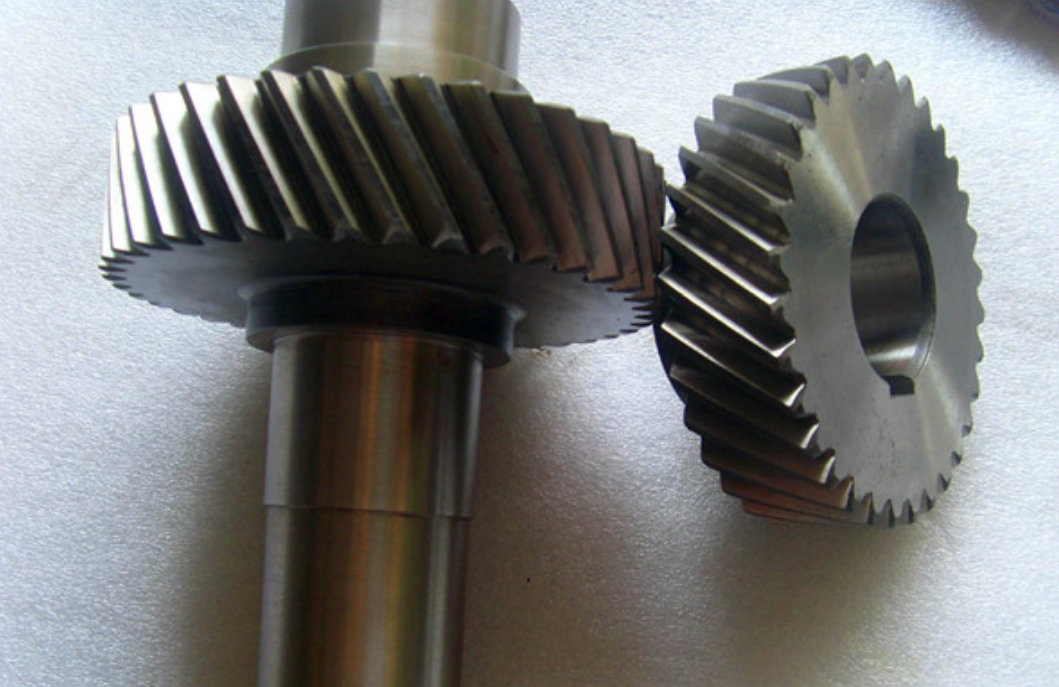
The helical gear, with its angled teeth, introduces complexities in fault analysis compared to spur gears. The presence of a helix angle means that forces are distributed along the tooth width, leading to axial vibrations in addition to radial and torsional motions. This three-dimensional behavior necessitates a comprehensive dynamic model that accounts for multiple degrees of freedom. In our work, we focus on a helical gear pair consisting of a pinion (driving gear) and a gear (driven gear), with key parameters summarized in Table 1. The system is subjected to operational conditions typical of petrochemical machinery, including high speeds and varying loads, which exacerbate fault progression.
| Parameter | Symbol | Value (Pinion/Gear) |
|---|---|---|
| Number of Teeth | \( Z \) | 13 / 100 |
| Module (mm) | \( m_n \) | 2.5 |
| Helix Angle (degrees) | \( \beta \) | 15 |
| Pressure Angle (degrees) | \( \alpha \) | 20 |
| Face Width (mm) | \( B \) | 20 |
| Mass (kg) | \( m \) | 0.5 / 3.0 |
| Moment of Inertia (kg·m²) | \( I \) | 0.001 / 0.05 |
| Base Circle Radius (mm) | \( R_b \) | 15.3 / 117.8 |
To compute the TVMS for a helical gear with a root crack, we integrate the potential energy method with an infinitesimal element approach. Due to the helix angle, the gear tooth is discretized along its width into multiple slices, and the stiffness contributions from each slice are summed. The crack fault primarily affects the bending stiffness \( k_b \) and axial compressive stiffness \( k_a \) by altering the cross-sectional area \( A_x \) and area moment of inertia \( I_x \) of the tooth cantilever beam structure. For a non-penetrating crack, the crack depth function \( q(x) \) varies along the tooth profile, influencing the stiffness components. The modified cross-sectional properties are given by:
$$ A_{xc} = \begin{cases} (h + h_x) B, & h_x \leq h_c \\ (h + h_c) B, & h_x > h_c \end{cases} $$
$$ I_{xc} = \begin{cases} \frac{1}{12} (h + h_x)^3 B, & h_x \leq h_c \\ \frac{1}{12} (h + h_c)^3 B, & h_x > h_c \end{cases} $$
where \( h_c \) is the crack length, \( h_x \) is the distance from the crack tip to the centerline of the tooth slice, \( h \) is the distance from the tooth top to the profile, and \( B \) is the face width. The crack depth function for a non-penetrating crack is defined as:
$$ q(x) = \begin{cases} q_s \sqrt{\frac{w_c – x}{w_c}}, & w_c > x \\ 0, & w_c \leq x \end{cases} $$
Here, \( q_s \) is the initial crack depth, \( w_c \) is the effective crack width, and \( x \) is the position parameter from the root to the tip. The bending stiffness \( k_b \) and shear stiffness \( k_s \) for each slice, considering the crack, are derived from energy principles:
$$ k_b = \sum_{i=1}^{N} \Delta y \int_{-\alpha_y}^{\alpha_2} \frac{3\{1 + (\alpha_2 – \alpha_y’) \sin \alpha – \cos \alpha \cos \alpha_y\}^2 (\alpha_2 – \alpha) \cos \alpha}{2E \left[ \sin \alpha_2 – \frac{q(y)}{R_b} \sin \alpha_c + \sin \alpha + \cos \alpha (\alpha_2 – \alpha) \right]^3} \, d\alpha $$
$$ k_s = \sum_{i=1}^{N} \Delta y \int_{-\alpha_y}^{\alpha_2} \frac{\cos \alpha (\alpha_2 – \alpha) \cos \alpha \cos^2 \alpha_y’}{1.2(1+\nu) E \left[ \sin \alpha_2 – \frac{q(y)}{R_b} \sin \alpha_c + \sin \alpha + \cos \alpha (\alpha_2 – \alpha) \right]} \, d\alpha $$
In these equations, \( E \) is Young’s modulus, \( \nu \) is Poisson’s ratio, \( \alpha \) is the angle between the centerline and radius, \( \alpha_2 \) is the approach angle, \( \alpha_y \) is the angle at the slice, and \( R_b \) is the base circle radius. The total TVMS \( k_t \) for the helical gear pair is then obtained by combining the stiffness components from both gears:
$$ k_t = \sum_{i=1}^{N} \left( \frac{1}{k_{f1,i} + \frac{1}{k_{b1,i}} + \frac{1}{k_{s1,i}} + \frac{1}{k_{a1,i}}} + \frac{1}{k_{f2,i} + \frac{1}{k_{b2,i}} + \frac{1}{k_{s2,i}} + \frac{1}{k_{a2,i}}} + \frac{1}{k_h} \right)^{-1} $$
where \( k_f \), \( k_b \), \( k_s \), \( k_a \) represent fillet, bending, shear, and axial compressive stiffnesses, respectively, and \( k_h \) is the Hertzian contact stiffness. A comparison of TVMS curves for healthy and cracked helical gears is illustrated in Figure 1, showing reduced stiffness in the faulty case due to the crack’s effect on tooth integrity.
Building on the TVMS calculation, we establish the dynamic model of the helical gear system. The system is modeled with eight degrees of freedom (DOFs), including three translational and one rotational DOF for each gear. The generalized displacements are denoted as \( \mathbf{q} = \{ x_p, y_p, z_p, \theta_p, x_g, y_g, z_g, \theta_g \} \), with corresponding velocities \( \dot{\mathbf{q}} \). The Lagrangian function \( L \) is formulated using the kinetic energy \( K.E. \) and potential energy \( P \):
$$ L = K.E. – P = \frac{1}{2} \dot{\mathbf{q}}^T \mathbf{M} \dot{\mathbf{q}} – \frac{1}{2} \mathbf{q}^T \mathbf{K} \mathbf{q} $$
Here, \( \mathbf{M} \) is the mass matrix and \( \mathbf{K} \) is the stiffness matrix. To account for energy dissipation from lubrication and damping effects, we introduce the Rayleigh dissipation function \( D \):
$$ D = \frac{1}{2} \dot{\mathbf{q}}^T \mathbf{C} \dot{\mathbf{q}} $$
where \( \mathbf{C} \) is the damping matrix. Applying the principle of least action, the Lagrange equation with dissipative terms is:
$$ \frac{d}{dt} \left( \frac{\partial L}{\partial \dot{\mathbf{q}}} \right) – \frac{\partial L}{\partial \mathbf{q}} + \frac{\partial D}{\partial \dot{\mathbf{q}}} = \mathbf{Q} $$
The generalized force vector \( \mathbf{Q} \) includes the mesh force \( F_m \), friction force \( F_f \), driving torque \( T_p \), and load torque \( T_g \). The dynamic transmission error (DTE) and its first derivative are critical for defining these forces. For a helical gear, DTE accounts for the helix angle \( \beta_b \):
$$ \text{DTE} = \frac{\text{DTE}_t}{\cos \beta_b}, \quad \text{DTE}\_1st = \frac{\text{DTE}_{t\_1st}}{\cos \beta_b} $$
with
$$ \text{DTE}_t = R_{b,p} \theta_p – R_{b,g} \theta_g + (x_p – x_g) \cos \alpha + (y_p – y_g) \sin \alpha – e(t) $$
$$ \text{DTE}_{t\_1st} = R_{b,p} \dot{\theta}_p – R_{b,g} \dot{\theta}_g + (\dot{x}_p – \dot{x}_g) \cos \alpha + (\dot{y}_p – \dot{y}_g) \sin \alpha – \dot{e}(t) $$
where \( e(t) \) is the static transmission error. The mesh force and friction force are expressed as:
$$ F_m = k_m \times \text{DTE} + c_m \times \text{DTE}\_1st $$
$$ F_f = -\mu F_m $$
Here, \( k_m \) is the average mesh stiffness, \( c_m = 2\xi \sqrt{\bar{k}_m m} \) is the mesh damping coefficient with damping ratio \( \xi \) and equivalent mass \( m = \frac{m_p m_g}{m_p + m_g} \), and \( \mu \) is the friction coefficient. The components of \( F_m \) along the coordinate axes are:
$$ F_{mx} = F_m \cos \beta_b \cos \alpha, \quad F_{my} = F_m \cos \beta_b \sin \alpha, \quad F_{mz} = F_m \sin \beta_b $$
Substituting these into the Lagrange equation yields the system of differential equations governing the helical gear dynamics:
$$ \begin{aligned}
m_p \ddot{x}_p + c_{bx} \dot{x}_p + k_{bx} x_p &= -F_{mx} – F_f \\
m_p \ddot{y}_p + c_{by} \dot{y}_p + k_{by} y_p &= -F_{my} \\
m_p \ddot{z}_p + c_{bz} \dot{z}_p + k_{bz} z_p &= -F_{mz} \\
I_p \ddot{\theta}_p &= F_{my} R_{b,p} – T_p \\
m_g \ddot{x}_g + c_{bx} \dot{x}_g + k_{bx} x_g &= F_{mx} + F_f \\
m_g \ddot{y}_g + c_{by} \dot{y}_g + k_{by} y_g &= F_{my} \\
m_g \ddot{z}_g + c_{bz} \dot{z}_g + k_{bz} z_g &= F_{mz} \\
I_g \ddot{\theta}_g &= -F_{my} R_{b,g} + T_g
\end{aligned} $$
In these equations, subscripts \( p \) and \( g \) denote the pinion and gear, respectively; \( c_b \) and \( k_b \) represent bearing damping and stiffness in each direction. This model forms the basis for analyzing the dynamic response of the helical gear system under crack faults.
We now investigate the dynamic characteristics of the helical gear system with root crack faults, focusing on the influence of crack geometric parameters. Among these, crack depth is identified as a critical factor affecting system response. Simulations are conducted under a rotational speed of 2920 rpm, with a crack angle of 45 degrees, and varying crack depths from 1 mm to 7 mm. The time-domain responses of the pinion’s vertical acceleration for different crack depths reveal distinct modulation effects. For instance, at a crack depth of 5 mm, amplitude modulation is observable in the signal, with an impact period \( T_{cp} \) of 0.0016 s. As the crack depth increases to 7 mm, the modulation becomes more pronounced, and the kurtosis value of the vertical acceleration rises from 3.9498 to 4.0667, indicating enhanced impulsivity and non-Gaussian behavior. Moreover, the waveform asymmetry decreases with deeper cracks, suggesting changes in the vibration pattern due to stiffness reduction.
Frequency-domain analysis further elucidates the fault characteristics. The spectra of the pinion’s vertical acceleration exhibit modulation sidebands around the mesh frequency \( f_m = 631.89 \, \text{Hz} \), which serve as the carrier frequency. The modulation frequency corresponds to the fault frequency, and asymmetric sidebands are clearly visible. Notably, in the resonance band between 1700 Hz and 2500 Hz, the fault modulation frequencies become even more distinct, providing a robust basis for fault detection using techniques like resonance demodulation. This behavior underscores the complexity of helical gear dynamics, where the helix angle contributes to multi-directional vibrations that enrich the frequency content.
To quantify fault progression and identify sensitive features, we construct a feature space using statistical representations of the vibration signals. A set of 33 statistical indicators, commonly employed in gear fault diagnosis, is applied to characterize the helical gear system’s condition. These indicators encompass time-domain, frequency-domain, and time-frequency domain measures, such as root mean square, crest factor, kurtosis, and spectral entropy. By mapping the sampled signals into this feature space, we enhance fault visibility and reduce dimensionality for analysis. Table 2 lists a subset of these statistical indicators used in our study.
| Indicator Number | Description | Formula (Example) |
|---|---|---|
| 1 | Root Mean Square (RMS) | \( \sqrt{\frac{1}{N} \sum_{i=1}^{N} x_i^2} \) |
| 2 | Crest Factor | \( \frac{\max|x_i|}{\text{RMS}} \) |
| 3 | Kurtosis | \( \frac{\frac{1}{N} \sum_{i=1}^{N} (x_i – \bar{x})^4}{\sigma^4} \) |
| 4 | Skewness | \( \frac{\frac{1}{N} \sum_{i=1}^{N} (x_i – \bar{x})^3}{\sigma^3} \) |
| 5 | Impulse Factor | \( \frac{\max|x_i|}{\frac{1}{N} \sum_{i=1}^{N} |x_i|} \) |
| 6 | Shape Factor | \( \frac{\text{RMS}}{\frac{1}{N} \sum_{i=1}^{N} |x_i|} \) |
| 7 | Clearance Factor | \( \frac{\max|x_i|}{\left( \frac{1}{N} \sum_{i=1}^{N} \sqrt{|x_i|} \right)^2} \) |
| 8-33 | Other measures (e.g., spectral features) | Various |
We analyze the evolution of these statistical representations with increasing crack depth for both horizontal and vertical acceleration signals. For the pinion’s vertical acceleration, features such as kurtosis (Indicator 3) and crest factor (Indicator 2) show increasing trends as the crack deepens, reflecting the growing impact of the fault. In contrast, some indicators like Indicator 21 exhibit decreasing behavior, highlighting the diverse sensitivity of features. The vertical acceleration features generally display more stable variations compared to horizontal ones, where fluctuations are more pronounced due to the directional coupling of forces in the helical gear system. To quantitatively assess feature importance, we employ the ReliefF algorithm, which assigns weights to each statistical indicator based on its ability to distinguish between fault severities. The weights for the vertical acceleration indicators under crack faults are summarized in Table 3, revealing that time-domain features like kurtosis and RMS are highly sensitive, aiding in effective fault diagnosis.
| Indicator Number | Weight (Importance) | Sensitivity Trend |
|---|---|---|
| 1 (RMS) | 0.85 | Increasing with crack depth |
| 2 (Crest Factor) | 0.78 | Increasing |
| 3 (Kurtosis) | 0.92 | Increasing |
| 4 (Skewness) | 0.65 | Variable |
| 5 (Impulse Factor) | 0.80 | Increasing |
| 6 (Shape Factor) | 0.55 | Stable |
| 7 (Clearance Factor) | 0.70 | Increasing |
| Other indicators | 0.30-0.60 | Mixed |
The dynamic analysis of helical gear systems with crack faults provides insights into the underlying mechanisms and offers practical guidelines for condition monitoring. The modulation phenomena observed in both time and frequency domains serve as clear indicators of fault presence, especially near resonance bands where fault-related frequencies are amplified. Additionally, the statistical characterization approach enables a quantitative assessment of fault severity, with directional sensitivities highlighting the need for multi-sensor data fusion in helical gear diagnostics. For instance, incorporating acceleration signals from all three axes (x, y, z) can improve diagnosis accuracy by capturing the full dynamic behavior induced by the helix angle.
In practical applications, such as petrochemical machinery, where helical gears operate under variable loads and speeds, our findings suggest implementing vibration-based monitoring systems that leverage both modulation analysis and statistical feature extraction. Real-time algorithms can be developed to track features like kurtosis and modulation sideband ratios, triggering alarms when thresholds are exceeded. Moreover, the dynamic model presented here can be extended to include other fault types, such as spalling or pitting, by adjusting the TVMS calculations accordingly. This adaptability makes the framework valuable for comprehensive gear health management.
In conclusion, our study on helical gear systems with crack faults demonstrates the effectiveness of combining analytical modeling with statistical analysis for fault diagnosis. The key findings are twofold: First, crack faults in helical gears induce noticeable modulation effects in acceleration signals, with clear fault frequencies observable in resonance bands, supporting techniques like demodulation for feature extraction. Second, statistical representations of vibration signals exhibit varying sensitivities across directions, with time-domain features in both horizontal and vertical directions being particularly sensitive to crack progression, as quantified by ReliefF algorithm weights. These insights contribute to the theoretical foundation for fault monitoring and diagnosis in helical gear transmission systems, enhancing safety and reliability in industrial operations. Future work could explore the integration of machine learning models with these dynamic features for automated fault classification and prognosis in helical gear applications.