
Helical gears are pivotal power transmission components in critical machinery across aerospace, heavy-duty vehicles, naval vessels, and energy equipment. Among their various failure modes, adhesive wear on the tooth flank stands out as a primary concern throughout their operational life. This wear mechanism, initiated by localized plastic deformation and metal adhesion following lubricant film breakdown, progressively removes material from the tooth surface. This alteration in surface integrity directly impacts load distribution, increases transmission error, degrades transmission precision, and can exacerbate vibration, noise, and frictional heat generation, ultimately compromising efficiency and reliability. Consequently, developing accurate methodologies to calculate adhesive wear and understand the influence of key parameters is essential for enhancing gear performance and durability.
This work proposes a novel calculation method for adhesive wear on standard helical gear tooth surfaces, applicable under both quasi-static and dynamic loading conditions. The approach integrates a dynamic model for load determination, an equivalent contact model for pressure and slip calculation, and the foundational Archard wear formula. The core methodology involves determining the time-varying load on individual tooth pairs, calculating the local contact pressure and sliding distance at discrete points along the contact line, and finally integrating the incremental wear over numerous loading cycles.
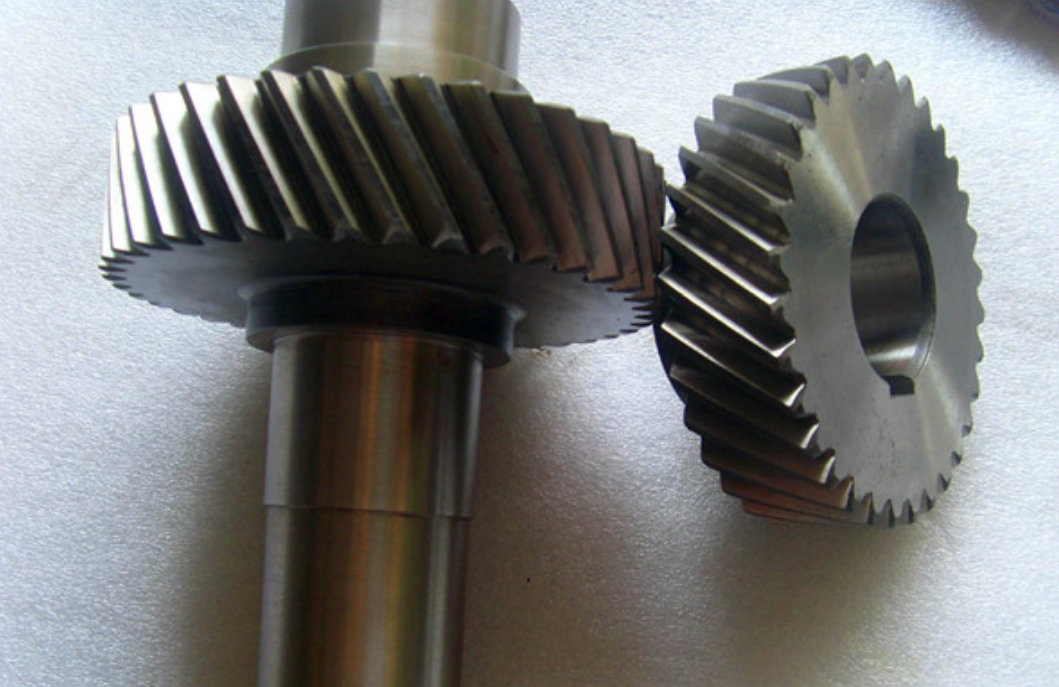
Methodology and Theoretical Models
1. Tooth Surface Load Determination
The load on a single tooth flank of a helical gear is determined differently for quasi-static and dynamic scenarios. For quasi-static analysis, the load is distributed among simultaneously engaged tooth pairs based on the percentage of the total contact line length they share at any given meshing instant. This method assumes a uniform load distribution along each contact line.
The length of a single contact line, \( l_1(t) \), over a meshing cycle \( T_m \) can be derived geometrically. Let \( \varepsilon_{\alpha} \), \( \varepsilon_{\beta} \), and \( \varepsilon_{\gamma} \) represent the transverse, axial, and total contact ratios, respectively. Let \( p_{bt} \) be the base pitch and \( \beta_b \) the base helix angle. For the case where \( \varepsilon_{\alpha} \leq \varepsilon_{\beta} \):
$$ l_1(t) =
\begin{cases}
\frac{p_{bt}}{\sin \beta_b} \cdot \frac{t}{T_m / \varepsilon_{\alpha}}, & 0 \leq t \leq T_m \cdot \frac{\varepsilon_{\alpha}}{\varepsilon_{\gamma}} \\
\frac{p_{bt}}{\sin \beta_b}, & T_m \cdot \frac{\varepsilon_{\alpha}}{\varepsilon_{\gamma}} < t \leq T_m \cdot \frac{\varepsilon_{\beta}}{\varepsilon_{\gamma}} \\
\frac{p_{bt}}{\sin \beta_b} \left( \frac{\varepsilon_{\gamma} T_m – t}{T_m (\varepsilon_{\gamma} – \varepsilon_{\beta})} \right), & T_m \cdot \frac{\varepsilon_{\beta}}{\varepsilon_{\gamma}} < t \leq T_m \\
0, & T_m < t \leq (1+M)T_m
\end{cases} $$
where \( M \) is the largest integer less than \( \varepsilon_{\gamma} \). A similar piecewise function applies for \( \varepsilon_{\alpha} > \varepsilon_{\beta} \).
The total contact line length \( L(t) \) is the sum of the lengths of all \( M+1 \) simultaneously engaged lines. The quasi-static load on the \( i \)-th tooth pair is then:
$$ F_i^{qs} = F_n^{qs} \cdot \frac{l_i(t)}{L(t)} $$
where \( F_n^{qs} \) is the total normal quasi-static load derived from the input torque.
For dynamic load calculation, a six-degree-of-freedom bending-torsion-axial coupling dynamic model of the helical gear transmission system is established. The equations of motion are formulated using the lumped mass method. The system dynamics are governed by the following equations for the pinion (p) and gear (g):
For the pinion:
$$ \begin{cases}
m_p \ddot{y}_p + c_{py} \dot{y}_p + k_{py} y_p + F_n \cos \beta_b = 0 \\
m_p \ddot{z}_p + c_{pz} \dot{z}_p + k_{pz} z_p + F_n \sin \beta_b = 0 \\
I_p \ddot{\theta}_p + c_m (\dot{y}_p – \dot{y}_g + R_p \dot{\theta}_p – R_g \dot{\theta}_g) + k_m (y_p – y_g + R_p \theta_p – R_g \theta_g + e_n) \cos \beta_b – T_p = 0
\end{cases} $$
For the gear:
$$ \begin{cases}
m_g \ddot{y}_g + c_{gy} \dot{y}_g + k_{gy} y_g – F_n \cos \beta_b = 0 \\
m_g \ddot{z}_g + c_{gz} \dot{z}_g + k_{gz} z_g – F_n \sin \beta_b = 0 \\
I_g \ddot{\theta}_g – c_m (\dot{y}_p – \dot{y}_g + R_p \dot{\theta}_p – R_g \dot{\theta}_g) – k_m (y_p – y_g + R_p \theta_p – R_g \theta_g + e_n) \cos \beta_b + T_g = 0
\end{cases} $$
Here, \( y, z, \theta \) are translational and rotational displacements; \( m, I \) are mass and moment of inertia; \( c_{y,z}, k_{y,z} \) are support damping and stiffness; \( R \) is the base circle radius; \( T \) is torque; \( e_n \) is static transmission error; and \( c_m, k_m \) are the time-varying meshing damping and stiffness. The meshing stiffness \( k_m(t) \) is related to the unit line stiffness \( k_r \) and the total contact length \( L(t) \): \( k_m(t) = k_r \cdot L(t) \). The steady-state periodic solution for the total normal dynamic load \( F_n^{dyn} \) is obtained by solving these equations numerically (e.g., using the Runge-Kutta method). The dynamic load on a specific tooth pair \( i \) is then: \( F_i^{dyn} = F_n^{dyn} \cdot (l_i(t)/L(t)) \).
2. Adhesive Wear Model Based on Archard’s Formula
The fundamental model for calculating adhesive wear depth is the Archard equation:
$$ \frac{dh}{ds} = k \cdot p $$
where \( dh \) is the incremental wear depth, \( ds \) is the incremental sliding distance, \( p \) is the Hertzian contact pressure, and \( k \) is the dimensional wear coefficient, which is assumed constant for a given material pair and lubrication condition under adhesive wear.
3. Equivalent Contact Model for Helical Gears
To compute the contact pressure \( p \) and sliding distance \( s \), the contact of a single helical gear pair at any instant is modeled as an equivalent contact between two opposing tapered rollers. Their axes lie along the tangents to the base cylinders within the plane of action, and their generating lines correspond to the instantaneous contact line. The actual meshing plane is discretized into an \( I \times J \) grid, where each grid node \( A(i,j) \) corresponds to a point on the contact line and its conjugate point on the tooth flank.
The relative curvature radius \( \rho_{ij} \) at point \( A(i,j) \) is:
$$ \rho_{ij} = \frac{\rho_{1,ij} \cdot \rho_{2,ij}}{\rho_{1,ij} + \rho_{2,ij}} $$
where \( \rho_{1,ij} \) and \( \rho_{2,ij} \) are the principal radii of curvature on the pinion and gear tooth surfaces at that point, derived from the gear geometry and the equivalent model.
Applying Hertzian theory, the contact half-width \( a_{ij} \) and the maximum Hertzian pressure \( p_{H,ij} \) at the node are:
$$ a_{ij} = \sqrt{ \frac{4 F_{ij} \rho_{ij}}{\pi E_{eq}} }, \quad p_{H,ij} = \frac{2 F_{ij}}{\pi a_{ij}} $$
where \( F_{ij} \) is the normal load component at the node (from \( F_i \)), and \( E_{eq} \) is the equivalent elastic modulus.
The sliding distances \( s_1(ij) \) and \( s_2(ij) \) for the pinion and gear at point \( A \) during one meshing pass are:
$$ s_1(ij) = 2 a_{ij} \left| \frac{u_1(ij) – u_2(ij)}{u_1(ij)} \right|, \quad s_2(ij) = 2 a_{ij} \left| \frac{u_1(ij) – u_2(ij)}{u_2(ij)} \right| $$
with the tangential velocities \( u_1(ij) = \rho_{1,ij} \omega_1 \) and \( u_2(ij) = \rho_{2,ij} \omega_2 \).
4. Calculation of Cumulative Wear Depth
The wear depth increment for one mesh cycle at node \( A(i,j) \) is obtained by integrating the Archard equation over the sliding distance:
$$ \Delta h_{1,2}(ij) = k \cdot 2 a_{ij} \cdot p_{H,ij} \cdot \left| \frac{u_1(ij) – u_2(ij)}{u_{1,2}(ij)} \right| = k \cdot \frac{4 F_{ij}}{\pi} \cdot \left| \frac{1}{u_{2,1}(ij)} – \frac{1}{u_{1,2}(ij)} \right| $$
For \( N \) loading cycles, if the wear depth is small enough that the surface geometry and pressure distribution remain essentially unchanged, the cumulative wear is simply \( N \cdot \Delta h(ij) \). For larger cumulative wear, an iterative updating scheme is used. After every \( c^k \) cycles in the \( k \)-th update step, when the wear reaches a small threshold \( \zeta \), the surface profile and consequent pressure distribution are recalculated. The total wear depth \( h(ij) \) after \( K \) updates and \( C_{tot} \) total cycles is the sum of the incremental wears from all steps.
Simulation Results and Parametric Analysis
The proposed method was first validated against published results for a specific helical gear set under quasi-static loads. The comparison showed excellent agreement in the wear depth distribution pattern along the profile and across the face width. The wear was highest near the root and tip, approached zero at the pitch line, and varied from the front to the rear transverse plane.
A comprehensive parametric study was then conducted using the base geometric and working parameters listed in the table below, analyzing their influence on the pinion’s wear depth after \( 1 \times 10^4 \) load cycles under both quasi-static and dynamic conditions.
| Parameter | Symbol | Base Value |
|---|---|---|
| Number of Teeth (Pinion/Gear) | \( z_p / z_g \) | 17 / 26 |
| Normal Module | \( m_n \) | 4.5 mm |
| Normal Pressure Angle | \( \alpha_n \) | 20° |
| Helix Angle | \( \beta \) | 15° |
| Face Width | \( B \) | 20 mm |
| Wear Coefficient | \( k \) | \( 1 \times 10^{-16} \, \text{m}^2/\text{N} \) |
| Pinion Speed (Quasi-static / Dynamic) | \( n_1 \) | 150 / 1500 rpm |
| Input Torque | \( T_1 \) | 300 Nm |
Key Findings from the Analysis:
1. Wear Distribution Characteristics: For the standard helical gear, the maximum wear depth on the pinion is greater than on the gear. Wear is significant near the root and tip regions, with root wear being more severe. Wear depth approaches zero at the pitch line due to pure rolling. Along the face width, the wear on the pinion decreases from the front to the rear transverse plane, while the opposite trend is observed for the driven gear. This asymmetry is attributed to the helix-induced axial load component and the resulting variation in contact pressure distribution. For wide-faced helical gears (face width > \( 10 m_n \)), the wear depth tends to become more uniformly distributed across the face width.
2. Influence of Geometric Parameters (Quasi-static & Dynamic):
- Normal Module (\( m_n \)): Increasing the module significantly reduces wear depth, especially in the root-to-pitch region. This is due to increased curvature radii and reduced load per unit contact length, leading to lower contact pressure. The difference between dynamic and quasi-static wear decreases with larger modules.
- Transmission Ratio (\( i \)): Increasing the ratio (by increasing gear teeth) reduces wear on the pinion. Higher ratios increase the total contact ratio and curvature radii, distributing the load over longer contact lines and reducing pressure.
- Helix Angle (\( \beta \)): Increasing the helix angle slightly reduces wear due to a longer effective contact line. However, its effect is less pronounced compared to module or face width. The dynamic wear increment remains relatively constant across different helix angles.
- Face Width (\( B \)): Increasing the face width dramatically reduces wear depth by distributing the load over a larger area, thus lowering contact pressure. The wear distribution also becomes more uniform across the face. The difference between dynamic and quasi-static results diminishes with wider faces.
3. Influence of Working Parameters (Quasi-static & Dynamic):
- Input Torque (\( T_1 \)): Increasing the input torque linearly increases the wear depth, as it directly raises the normal load and thus the contact pressure. The difference between dynamic and quasi-static wear also increases proportionally with torque.
- Input Speed (\( n_1 \)): When neglecting the excitation from dynamic transmission error, varying the input speed has a minimal direct impact on the calculated wear depth for the same number of cycles. This is because the sliding distance per cycle, derived from geometry and kinematics \( ( s \propto a_{ij} |1 – \rho_{1,ij}/\rho_{2,ij}| ) \), is independent of speed. Speed affects wear indirectly by potentially altering dynamic loads, but this effect is relatively small for stable helical gear meshing within the studied range. The small observed difference between dynamic and quasi-static results is primarily due to the dynamic load factor, not the speed itself.
Conclusion
This study presents an effective methodology for calculating adhesive wear depth on standard helical gear tooth surfaces under both quasi-static and dynamic loading. The method combines a time-varying contact line load distribution model (or a full dynamic model), a computationally efficient equivalent tapered-roller contact model for pressure and slip analysis, and the Archard wear formula.
The results quantify the characteristic wear distribution: severe at the root and tip (root > tip), minimal at the pitch line, and variable along the face width depending on the driving/driven status. The parametric analysis provides crucial design insights. To minimize wear in helical gear systems, designers should prioritize increasing the normal module, transmission ratio, and face width, while carefully managing the transmitted torque. Increasing the helix angle offers a marginal benefit. Operating speed, within stable ranges, has a negligible direct effect on the wear depth per cycle. Understanding these relationships allows for the optimal matching of geometric and working parameters, contributing directly to improved surface quality, enhanced transmission performance, and the development of more wear-resistant helical gear designs.