
In modern manufacturing, the pursuit of higher machining efficiency and precision has driven the adoption of advanced technologies like turn-mill composite machining. As traditional methods fall short in meeting the demands of complex parts, we explore the application of a 9-axis, 4-linkage turn-mill center for producing intricate helical gear transmission shafts. This article, based on first-hand experience, delves into the entire process—from 3D modeling and process planning to tool selection, toolpath generation, and code implementation using Esprit software. We emphasize the use of tables and formulas to summarize key parameters, and the keyword ‘helical gear’ is highlighted throughout to underscore its significance in this context. The goal is to demonstrate how multi-axis synchronization minimizes human error and enhances accuracy for high-tolerance components.
The turn-mill composite machining center, exemplified by models like the HT665, integrates turning, milling, drilling, and grinding capabilities into a single setup. This versatility is crucial for machining complex helical gear transmission shafts, which require tight tolerances for coaxiality (e.g., 0.015 mm) and circular runout (e.g., 0.008 mm). These shafts typically feature external cylinders, helical gears, internal holes, spherical surfaces, grooves, and threaded columns—all demanding precise coordination. For instance, the helical gear and end-face flower teeth must be machined with minimal repeated clamping to avoid cumulative errors. We focus on a case study involving a helical gear transmission shaft made of hard aluminum alloy 6065, analyzing its challenges and solutions through systematic approaches.
First, we conduct a detailed part analysis. The helical gear, with its helical teeth wrapped around the shaft, presents unique machining difficulties due to its geometry. The tooth profile requires continuous multi-axis interpolation to achieve accurate form and surface finish. Key dimensions include outer diameters, gear modules, and helix angles, which we model using mid-size values to account for tolerance stacks. For example, a diameter specified as $$ \phi 35^{+0.05}_{-0.02} $$ mm is modeled as: $$ \text{Mid-size} = \frac{35.05 + 35.02}{2} = 35.035 \, \text{mm}. $$ This approach ensures that minor deviations during machining still yield acceptable parts. The helical gear’s helix angle, denoted as $$ \beta $$, influences toolpath calculations, with the lead $$ L $$ derived from $$ L = \pi \cdot d \cdot \cot(\beta) $$, where $$ d $$ is the pitch diameter. Such formulas guide our toolpath strategies in Esprit software.
Next, we devise a machining scheme leveraging the turn-mill center’s dual spindles and dual turrets. The sub-spindle handles the left-end features, while the main-spindle processes the right end, including the helical gear. Tables summarize the steps and parameters. For example, Table 1 outlines the tool selection and cutting parameters for various operations, emphasizing tools suited for aluminum alloys like 6065.
| Operation | Tool Name | Spindle Speed (rpm) | Feed Rate (mm/min) | Cutting Depth (mm) |
|---|---|---|---|---|
| Face Turning | 90° External Turning Tool (Triangle Insert) | 1000–1500 | 100–150 | 0.5 |
| Rough Turning | 90° Rough Turning Tool | 400–600 | 150–200 | 4 |
| Finish Turning | 90° Finish Turning Tool | 1000–1800 | 100–150 | 0.2–0.4 |
| Grooving | Grooving Tool (3 mm Width) | 400–600 | 60–100 | 1 |
| Drilling | φ18 mm Twist Drill | 350–450 | 40–50 | – |
| Center Drilling | A2 Center Drill | 1500–2000 | 50–80 | – |
| Helical Gear Rough Milling | φ6 mm Carbide End Mill | 2500–5000 | 1000–1500 | 0.1–0.3 |
| Helical Gear Finish Milling | φ4 mm Carbide End Mill | 3000–6000 | 800–1200 | 0.05–0.2 |
| Thread Milling | Thread Mill | 2000–4000 | 200–400 | – |
We optimize cutting parameters using formulas. The cutting speed $$ V_c $$ in m/min is calculated as: $$ V_c = \frac{\pi \times D \times N}{1000}, $$ where $$ D $$ is tool diameter in mm and $$ N $$ is spindle speed in rpm. For aluminum, we target $$ V_c $$ between 200 and 500 m/min. The feed per tooth $$ f_z $$ in mm/tooth relates to the feed rate $$ F $$: $$ F = f_z \times Z \times N, $$ with $$ Z $$ as the number of teeth. For the helical gear milling, we adjust $$ f_z $$ dynamically based on tool engagement. Additionally, the material removal rate $$ Q $$ in cm³/min is given by: $$ Q = a_p \times a_e \times F, $$ where $$ a_p $$ is cutting depth and $$ a_e $$ is cutting width. These calculations ensure efficient chip removal and tool life.
The machining process involves synchronized operations. On the sub-spindle, we perform turning, drilling, and boring for left-end features, followed by milling of columns and threads. The helical gear on the right end requires 4-axis联动 (simultaneous control of X, Y, Z, and C axes) to generate the helical teeth. We use Esprit software to program toolpaths, incorporating B-axis摆动 for spherical surfaces to avoid tool interference. For example, when machining the spherical groove, the tool axis is tilted using B-axis to maintain optimal cutting angles. The toolpath for the helical gear is generated via free-form surface strategies, with tool orientation adjusted continuously. We simulate collisions and optimize paths to prevent errors.
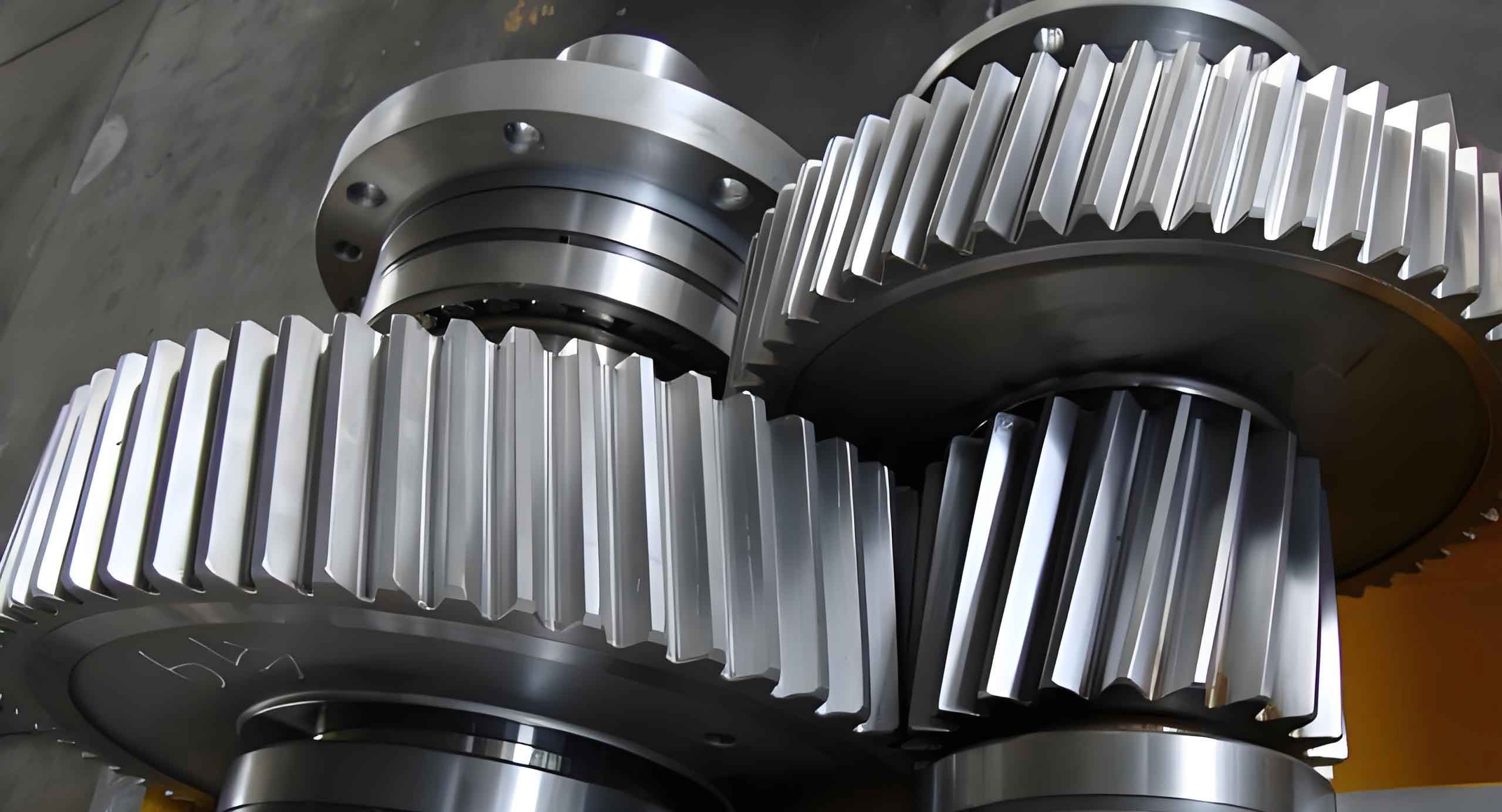
To illustrate the helical gear’s complexity, consider this visual representation of a typical helical gear used in transmission shafts. The helical teeth provide smooth engagement and high load capacity, but machining them demands precise coordination of multiple axes.
In Esprit, we define the helical gear geometry using parametric equations. For a helical gear with module $$ m $$, number of teeth $$ N_t $$, and helix angle $$ \beta $$, the transverse pitch $$ p_t $$ is: $$ p_t = \pi \cdot m. $$ The normal pitch $$ p_n $$ relates as: $$ p_n = p_t \cdot \cos(\beta). $$ During toolpath generation, we use these to calculate stepovers and feed rates. The toolpath points are derived from the gear’s involute profile, expressed as: $$ x = r_b (\cos(\theta) + \theta \sin(\theta)), \quad y = r_b (\sin(\theta) – \theta \cos(\theta)), $$ where $$ r_b $$ is the base radius and $$ \theta $$ is the roll angle. For multi-axis milling, we add tool axis vectors $$ \mathbf{A} = (A_i, B_j, C_k) $$ to control orientation.
We further detail the tool selection with a focus on helical gear machining. Carbide end mills with coatings like TiAlN are preferred for aluminum. Table 2 lists specialized tools for gear features, emphasizing their role in achieving the required surface roughness of Ra 1.6 μm.
| Feature | Tool Type | Diameter (mm) | Coating | Application Note |
|---|---|---|---|---|
| Helical Gear Roughing | Carbide End Mill | 6 | TiAlN | High material removal with reduced vibration |
| Helical Gear Finishing | Carbide End Mill | 4 | Diamond | Fine finishing for tooth profile accuracy |
| Gear Root Cleaning | Micro End Mill | 1 | Diamond | Clears residuals in tight spaces |
| Spherical Groove | Ball Nose End Mill | 8 | TiAlN | Contours spherical surfaces with B-axis tilt |
The cutting parameters are optimized using empirical formulas. For aluminum 6065, we calculate the specific cutting force $$ k_c $$ as approximately 700 N/mm². The cutting power $$ P_c $$ in kW is: $$ P_c = \frac{F_c \times V_c}{60000}, $$ where $$ F_c $$ is the cutting force. We monitor these to prevent tool wear. During helical gear milling, the effective cutting diameter $$ D_e $$ varies with helix angle: $$ D_e = D \cdot \sin(\kappa), $$ with $$ \kappa $$ as the tool entering angle. This affects chip thickness and requires adaptive feed adjustments.
In the 3D modeling phase, we use mid-size values for all dimensions to mitigate tolerance issues. For instance, a helical gear tooth thickness $$ t $$ specified as $$ 5^{+0.1}_{-0.05} $$ mm is modeled as: $$ t = \frac{5.1 + 4.95}{2} = 5.025 \, \text{mm}. $$ The gear’s lead error is compensated in the toolpath by adjusting the C-axis rotation synchronously with linear axes. We export the model to Esprit, where toolpaths are generated via milling strategies like “Wrap Contouring” for grooves and “Multi-Axis Swarf” for gears. The post-processor converts these into G-code tailored for the 9-axis machine, ensuring syntax compatibility.
We validate the process through simulation and actual machining. The helical gear transmission shaft is produced in about 3 hours, with all features machined in one setup. Measurements via coordinate measuring machines confirm that dimensions, coaxiality, and surface finishes meet specifications. The helical gear’s tooth profile deviation is within 0.01 mm, and runout is below 0.008 mm. This success underscores the turn-mill center’s ability to handle complex helical gears with high precision.
To summarize, we leverage multi-axis turn-mill centers for machining helical gear transmission shafts, integrating advanced software and optimized parameters. The helical gear, as a critical component, benefits from synchronized axes and careful tool management. We present key formulas and tables to encapsulate the methodology, such as the cutting speed equation and tool selection matrices. This approach not only improves accuracy but also reduces setup times and human intervention, making it ideal for aerospace and automotive applications where helical gears are prevalent. Future work may explore adaptive control for real-time parameter adjustments during helical gear machining.
In conclusion, the turn-mill composite technology, combined with Esprit programming, offers a robust solution for complex parts like helical gear shafts. By emphasizing multi-axis strategies and rigorous planning, we achieve tight tolerances and high efficiency. The helical gear serves as a prime example of how modern manufacturing can overcome traditional limitations, paving the way for more intricate designs. This research highlights the importance of continuous innovation in machining processes, especially for helical gears that demand precision and reliability.