
In modern mechanical transmission systems, helical gears are widely employed due to their smooth operation, high load capacity, and reduced noise. However, under high-speed and heavy-load conditions, the load distribution on the tooth surface becomes a critical factor influencing gear performance, affecting contact temperatures, wear, and even leading to failure modes such as scuffing. Therefore, a thorough investigation into the load distribution characteristics of helical gears under such extreme conditions is essential for design optimization and reliability enhancement. In this study, we focus on analyzing the actual meshing process of helical gears, establishing a tooth contact model based on finite line contact, and deriving a discrete formulation for contact load distribution using numerical methods. Our aim is to provide a reference for analyzing helical gear tooth surface load distribution in high-speed heavy-load applications.
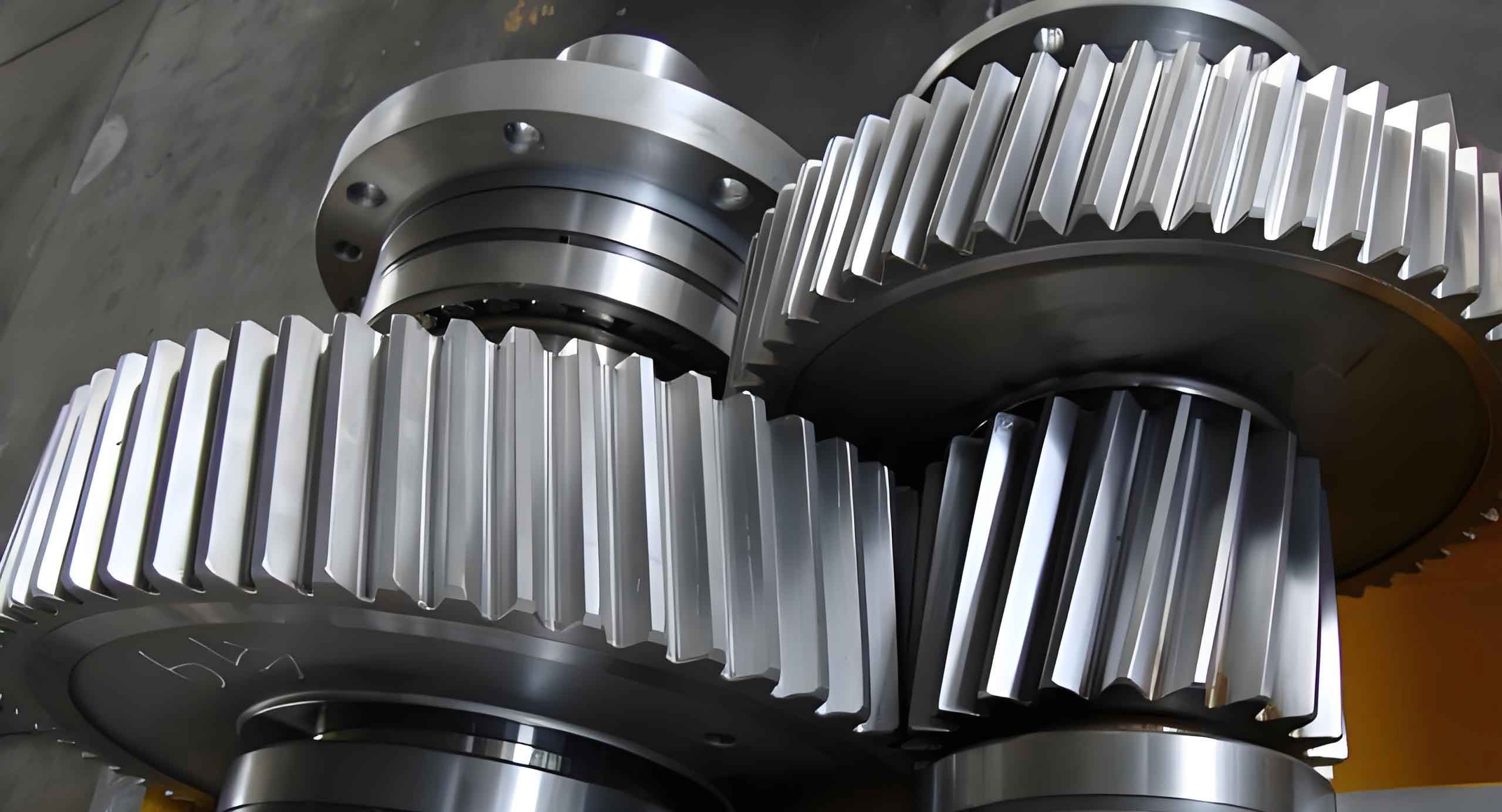
The meshing process of helical gears is more complex than that of spur gears due to the helical angle, which introduces axial forces and affects the contact pattern. For a helical gear pair under high-speed heavy-load conditions, the tooth surface load distribution is influenced by factors such as gear geometry, manufacturing errors, assembly misalignments, and operating conditions. Traditional methods often assume simplified contact conditions, but in reality, the contact lines between meshing teeth are of finite length and vary during the engagement cycle. This variation must be accounted for to accurately predict load distribution and subsequent thermal and stress fields.
In this article, we first analyze the meshing process of helical gears, considering the end-face engagement and the calculation of contact line length. We then develop a localized contact model for the tooth surface, incorporating relative sliding velocity analysis. Based on tooth contact analysis (TCA), we derive a discrete formulation for contact load distribution using MATLAB-based numerical algorithms. A case study is presented to illustrate the application of our method, and results are compared with traditional approaches. Throughout, we emphasize the importance of helical gear design parameters and their impact on performance under demanding operational scenarios.
Analysis of Helical Gear Meshing Process
The meshing of helical gears can be analyzed in the transverse plane, where the teeth engage along a line of action. Consider a helical gear pair with a center distance a, transverse pressure angle $\alpha_t$, and rotational angles $\theta_1$ and $\theta_2$ for the driving and driven gears, respectively. The theoretical line of action is defined by points $N_1$ and $N_2$, which are the tangent points on the base circles. The actual path of contact extends from the start point $B_2$ to the end point $B_1$, as shown in the end-face engagement diagram. The length of the path of contact, $B_1B_2$, can be expressed as:
$$B_1B_2 = \sum_{i=1}^{2} \sqrt{r_{ai}^2 – r_{bi}^2} – a \sin \alpha_t$$
where $r_{ai}$ and $r_{bi}$ are the tip radius and base radius of gear i (i=1 for driving gear, i=2 for driven gear), respectively. This equation accounts for the geometry of both gears and is fundamental for determining the engagement characteristics.
For helical gears, the total contact ratio $\varepsilon$ consists of the transverse contact ratio $\varepsilon_{\alpha}$ and the axial contact ratio $\varepsilon_{\beta}$. These are calculated based on gear parameters such as the number of teeth $z$, normal module $m_n$, helix angle $\beta$, and face width $b$. The formulas are:
$$\varepsilon_{\alpha} = \frac{1}{2\pi} \left[ z_1 (\tan \alpha_{at1} – \tan \alpha_t’) + z_2 (\tan \alpha_{at2} – \tan \alpha_t’) \right]$$
$$\varepsilon_{\beta} = \frac{b \sin \beta}{\pi m_n}$$
$$\varepsilon = \varepsilon_{\alpha} + \varepsilon_{\beta}$$
Here, $\alpha_{ati}$ is the transverse pressure angle at the tip of gear i, and $\alpha_t’$ is the operating transverse pressure angle. The contact ratio significantly affects the length and number of contact lines during meshing, which in turn influences load distribution. High contact ratios, common in helical gears, lead to multiple tooth pairs in contact simultaneously, enhancing load-sharing but complicating analysis.
The contact line length varies during the meshing cycle due to the helical nature. For a helical gear pair, we classify them into two types based on the relative magnitudes of $\varepsilon_{\alpha}$ and $\varepsilon_{\beta}$. Let $L$ be the contact line length for a single tooth pair, $L_e$ be the effective contact length, and $\lambda$ represent the position along the path of contact. The base pitch is $p_b$, and the base helix angle is $\beta_b$. For Type I helical gears where $\varepsilon_{\alpha} > \varepsilon_{\beta}$, the contact line length variation is given by:
$$L(\lambda) = \begin{cases}
\lambda \cot \beta_b & \text{for } 0 \leq \lambda \leq L_e \\
B – (\lambda – L_e) \cot \beta_b & \text{for } L_e < \lambda \leq B_1B_2
\end{cases}$$
For Type II helical gears where $\varepsilon_{\alpha} < \varepsilon_{\beta}$, the variation is:
$$L(\lambda) = \begin{cases}
\lambda \cot \beta_b & \text{for } 0 \leq \lambda \leq p_b \\
p_b \cot \beta_b & \text{for } p_b < \lambda \leq L_e \\
B – (\lambda – L_e) \cot \beta_b & \text{for } L_e < \lambda \leq B_1B_2
\end{cases}$$
Here, $B$ is the face width, and $L_e = B / \cos \beta$. The total contact line length is the sum of lengths from all engaging tooth pairs, and it fluctuates periodically, affecting the instantaneous load capacity.
Localized Contact Region Analysis on Tooth Surface
To analyze the load distribution, we must examine the localized contact between mating tooth surfaces. Consider a point $M$ on the tooth surface, defined by parameters $u$ and $\theta$ in a coordinate system attached to the gear. The position vector $\mathbf{r}(u, \theta)$ can be expressed as:
$$\mathbf{r}(u, \theta) = x(u, \theta) \mathbf{i} + y(u, \theta) \mathbf{j} + z(u, \theta) \mathbf{k}$$
where $\mathbf{i}, \mathbf{j}, \mathbf{k}$ are unit vectors along the coordinate axes. The normal vector $\mathbf{n}$ at point $M$ is derived from partial derivatives:
$$\mathbf{n}_i = \frac{\partial \mathbf{r}_i}{\partial u} \times \frac{\partial \mathbf{r}_i}{\partial \theta}$$
for gear $i$ (i=1,2). The unit normal vector $\mathbf{e}_i$ is then:
$$\mathbf{e}_i = \frac{\mathbf{n}_i}{\left| \mathbf{n}_i \right|}$$
This formulation allows us to describe the tooth surface geometry and orientation accurately.
During meshing, the contact between teeth occurs over a small elliptical region due to elastic deformation. At a point $M_0$ on the common tangent plane, the corresponding points on the driving and driven gear surfaces are $M_1$ and $M_2$, respectively. The position vectors for these points, considering the normal separation due to deformation, are:
$$\mathbf{r}_{M_i} = \mathbf{r}_{M_0} – \delta_i \mathbf{e}_{M_i}$$
where $\delta_i$ is the normal approach at point $M_i$. The absolute velocity $\mathbf{v}_i$ of a point on the tooth surface is given by:
$$\mathbf{v}_i = \boldsymbol{\omega}_i \times \mathbf{r}_{M_i}$$
with $\boldsymbol{\omega}_i$ being the angular velocity vector. The tangential velocity $\mathbf{v}_{ti}$ and normal velocity $\mathbf{v}_{ni}$ components are:
$$\mathbf{v}_{ni} = (\mathbf{v}_i \cdot \mathbf{e}_{M_i}) \mathbf{e}_{M_i}, \quad \mathbf{v}_{ti} = \mathbf{v}_i – \mathbf{v}_{ni}$$
The relative sliding velocity $\mathbf{v}_c$ between the contacting surfaces is crucial for friction and heat generation:
$$\mathbf{v}_c = \mathbf{v}_{t1} – \mathbf{v}_{t2}$$
This velocity varies along the contact line, with higher values away from the pitch point, contributing to non-uniform wear and temperature rise.
Contact Load Calculation Based on Tooth Contact Analysis
Under load, helical gears experience deformation, leading to transmission error. For any contact point $M$, the transmission error $\delta_M$ can be related to the angular error $\Delta \theta$:
$$\delta_M = r_{b2} \cdot \Delta \theta$$
where $r_{b2}$ is the base radius of the driven gear. The contact load $w_M$ at point $M$ is proportional to the local contact stiffness $k_M$ and the error:
$$w_M = k_M \cdot \delta_M$$
For a finite contact line of length $L$, the total load $W$ must satisfy equilibrium with the transmitted power $P$ and rotational speed $n$ (in rpm):
$$W = \int_0^L w_M \, d\lambda = \frac{9550 P}{n r_{b1}}$$
where $r_{b1}$ is the base radius of the driving gear. Combining these equations, we obtain an integral relation for $\Delta \theta$:
$$\Delta \theta = \frac{9550 P}{n r_{b1} \int_0^L k_M r_{b2} \, d\lambda}$$
To discretize the problem, we divide the contact line into $N$ segments of length $\Delta L = L / (N-1)$. Suppose there are $n$ instantaneous contact lines during meshing. The total load can be approximated as:
$$W = \sum_{j=1}^{n} \sum_{i=1}^{N} k_{i,j} \cdot \Delta \theta \cdot r_{b2} \cdot \Delta L \cdot \sin \beta_b$$
where $k_{i,j}$ is the contact stiffness at the $i$-th point on the $j$-th contact line. This discrete formulation allows numerical computation of load distribution using iterative methods in MATLAB. The contact stiffness $k_{i,j}$ can be derived from material properties and local geometry, often approximated by the transverse stiffness at the contact point.
Numerical Case Study and Results
To demonstrate our approach, we consider a helical gear pair operating under high-speed heavy-load conditions. The gear parameters are summarized in Table 1.
| Parameter | Driving Gear | Driven Gear |
|---|---|---|
| Number of teeth, $z$ | 21 | 37 |
| Pressure angle, $\alpha$ (degrees) | 20 | 20 |
| Normal module, $m_n$ (mm) | 15 | 15 |
| Helix angle, $\beta$ (degrees) | 20 | 20 |
| Face width, $b$ (mm) | 180 | 180 |
| Elastic modulus, $E$ (GPa) | 207 | 207 |
| Input power, $P$ (kW) | 500 | |
| Rotational speed, $n$ (rpm) | 3000 | |
Using these parameters, we calculate the contact ratios. The transverse contact ratio $\varepsilon_{\alpha}$ is approximately 1.78, and the axial contact ratio $\varepsilon_{\beta}$ is 1.10, giving a total contact ratio $\varepsilon = 2.88$. This high value indicates multiple tooth pairs in contact simultaneously, classifying the gear as Type I ($\varepsilon_{\alpha} > \varepsilon_{\beta}$).
The variation of single contact line length and total contact line length over the meshing cycle is computed and shown in Table 2. The contact line length changes cyclically, with the total length remaining constant over certain intervals due to the high contact ratio.
| Contact Position (mm along path) | Single Contact Line Length (mm) | Total Contact Line Length (mm) |
|---|---|---|
| 0.0 | 15.2 | 45.6 |
| 5.0 | 18.7 | 56.1 |
| 10.0 | 22.3 | 66.9 |
| 15.0 | 25.8 | 77.4 |
| 20.0 | 22.3 | 66.9 |
| 25.0 | 18.7 | 56.1 |
| 30.0 | 15.2 | 45.6 |
The relative sliding velocity distribution along the contact line is calculated using the derived formulas. Results indicate that the sliding velocity increases with distance from the pitch point, reaching maxima at the tip and root regions. For instance, at a point near the tip, the relative sliding velocity can exceed 10 m/s under the given operating conditions, highlighting the need for adequate lubrication and material selection.
Next, we compute the tooth surface load distribution using our discrete numerical method in MATLAB. The contact stiffness $k_{i,j}$ is assumed to vary linearly along the contact line based on local tooth thickness and material properties. We compare our results with those from a traditional method that assumes uniform load distribution along the contact line. The load distribution profiles are summarized in Table 3 for key contact positions.
| Contact Sequence Point | Numerical Method Load | Traditional Method Load | Deviation (%) |
|---|---|---|---|
| 1 (Engagement start) | 2.15 | 2.30 | 6.5 |
| 5 | 1.98 | 2.10 | 5.7 |
| 10 (Pitch point) | 1.82 | 1.85 | 1.6 |
| 15 | 2.05 | 2.15 | 4.7 |
| 20 (Engagement end) | 2.22 | 2.38 | 6.7 |
The load distribution curve from our numerical method shows a smoother variation compared to the traditional method, with loads peaking at the engagement start and end due to shorter contact line lengths in these regions. The maximum deviation between the two methods is around 6.7%, validating the accuracy of our approach while highlighting the importance of considering finite contact line effects.
Discussion on Helical Gear Performance Factors
The results underscore several key aspects of helical gear behavior under high-speed heavy-load conditions. First, the contact ratio plays a pivotal role in determining load-sharing among teeth. A high contact ratio, as in our case study, reduces the load per tooth but introduces complexity in contact line dynamics. Second, the relative sliding velocity distribution is non-uniform, with higher velocities at the tooth tips and roots. This non-uniformity can lead to localized heating and increased risk of scuffing, especially if lubrication is inadequate. Third, our numerical method for load distribution, which accounts for finite contact line length and stiffness variation, provides a more realistic prediction than traditional uniform load assumptions. This is critical for designing helical gears that must operate reliably in demanding applications such as wind turbines, aerospace transmissions, and heavy machinery.
Furthermore, the helical gear design parameters—such as helix angle, pressure angle, and module—directly influence the contact pattern and load distribution. For instance, increasing the helix angle can enhance the axial contact ratio, improving load capacity but also increasing axial thrust. Optimizing these parameters requires a balance between performance, manufacturing constraints, and system requirements. Our model can be extended to include effects of tooth modifications (e.g., profile and lead crowning) to mitigate edge loading and further optimize load distribution.
Conclusion
In this study, we have investigated the tooth surface load distribution of helical gears under high-speed heavy-load conditions. By analyzing the meshing process, we derived formulas for contact line length variation based on gear geometry and contact ratios. We developed a localized contact model that incorporates relative sliding velocities and transmission error. Using tooth contact analysis, we formulated a discrete numerical method for computing load distribution, implemented in MATLAB. A case study demonstrated that our method yields load distributions that are smoother and more accurate than traditional approaches, with deviations up to 6.7%. The load peaks at the engagement start and end due to shorter contact lines, emphasizing the need for detailed analysis in design. This research provides a foundation for optimizing helical gear performance in extreme operating environments, contributing to enhanced reliability and efficiency in mechanical transmission systems.
Future work could explore dynamic effects, thermal coupling, and the influence of lubrication on load distribution. Additionally, experimental validation using strain gauges or optical methods would further refine the model. Ultimately, understanding and controlling load distribution in helical gears is essential for advancing gear technology and meeting the challenges of modern engineering applications.