
In the development of modern pure electric vehicles (PEVs), achieving high power density is crucial, often necessitating high-speed operation of electric motors, with rotational speeds exceeding 10,000 rpm. This places significant demands on the transmission system, particularly the helical gear pairs used for speed reduction. The dynamic behavior of helical gear transmissions under such high-speed conditions is critical for reliability, noise reduction, and overall performance. While extensive research exists on gear dynamics at low to medium speeds, the effects of key excitations like time-varying mesh stiffness and meshing impacts at high rotational speeds remain inadequately understood. This article investigates the vibration characteristics of a high-speed helical gear pair from a PEV drivetrain, focusing on the interplay between stiffness variation and impact forces. A bending-torsion-axial coupled dynamic model is established, and advanced computational methods are employed to derive accurate time-varying mesh stiffness and meshing impact parameters. The analysis compares system responses under three distinct excitation conditions: time-varying mesh stiffness alone, meshing impact alone, and their combined effect. The findings aim to provide insights for the design and optimization of high-speed helical gear transmissions in electric vehicles.
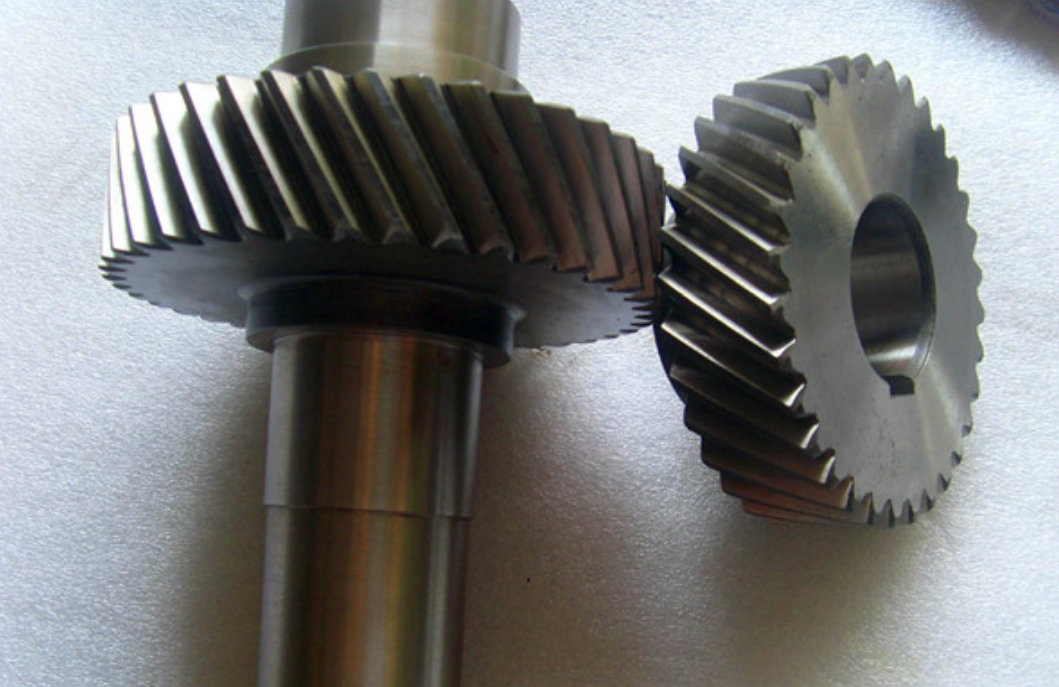
The helical gear system under study is part of a two-stage reduction gearbox in a pure electric vehicle. The high-speed input stage gear pair is analyzed, with key parameters summarized in Table 1. The helical gear design offers advantages like high load capacity and smooth engagement, but its dynamic response becomes complex at elevated speeds due to parametric excitations and transient impact events.
| Parameter | Pinion | Gear |
|---|---|---|
| Number of teeth, \(z\) | 22 | 59 |
| Hand of helix | Right | Left |
| Normal module, \(m_n\) (mm) | 2 | |
| Normal pressure angle, \(\alpha_n\) (degrees) | 18.5 | |
| Helix angle, \(\beta\) (degrees) | 32 | |
| Face width, \(b\) (mm) | 33 | |
| Profile shift coefficient, \(x\) | 0.2238 | -0.5436 |
| Torque, \(T\) (Nm) | 100 | 268.2 |
| Young’s modulus, \(E\) (GPa) | 210 | |
| Bearing radial support stiffness, \(k_{py}, k_{gy}\) (N/m) | 8.08×10⁸ | 3.98×10⁸ |
| Bearing axial support stiffness, \(k_{pz}, k_{gz}\) (N/m) | 6.85×10⁸ | 3.16×10⁸ |
Dynamic Modeling of the Helical Gear System
To capture the essential dynamics, a six-degree-of-freedom (6-DOF) lumped parameter model is developed, considering bending, torsion, and axial vibrations. The model represents the helical gear pair as masses connected by stiffness and damping elements along the gear mesh line. The coordinate system defines displacements in the transverse (\(y\)), axial (\(z\)), and rotational (\(\theta\)) directions for both pinion (subscript \(p\)) and gear (subscript \(g\)). The equations of motion are derived as follows:
The translational and rotational dynamics for the pinion are:
$$ m_p \ddot{y}_p + c_{py} \dot{y}_p + k_{py} y_p = -F_y $$
$$ m_p \ddot{z}_p + c_{pz} \dot{z}_p + k_{pz} z_p = -F_z $$
$$ I_p \ddot{\theta}_p = -F_y R_p + T_p – F_s(t) R_p $$
Similarly, for the gear:
$$ m_g \ddot{y}_g + c_{gy} \dot{y}_g + k_{gy} y_g = F_y $$
$$ m_g \ddot{z}_g + c_{gz} \dot{z}_g + k_{gz} z_g = F_z $$
$$ I_g \ddot{\theta}_g = F_y R_g – T_g + F_s(t) R_g $$
Here, \(m\) denotes mass, \(I\) moment of inertia, \(R\) base circle radius, \(T\) applied torque, \(c\) damping coefficient, and \(k\) support stiffness. The terms \(F_y\) and \(F_z\) represent the dynamic mesh forces in the transverse and axial directions, respectively, which are coupled due to the helix angle \(\beta\). \(F_s(t)\) is the meshing impact force, discussed later. The dynamic mesh forces are expressed as:
$$ F_y = \cos\beta \, \left\{ c_m \left[ \cos\beta (\dot{y}_p – \dot{y}_g + R_p \dot{\theta}_p – R_g \dot{\theta}_g) + \sin\beta (\dot{z}_p – \dot{z}_g) \right] + k(t) \left[ \cos\beta (y_p – y_g + R_p \theta_p – R_g \theta_g) + \sin\beta (z_p – z_g) \right] \right\} $$
$$ F_z = \sin\beta \, \left\{ c_m \left[ \cos\beta (\dot{y}_p – \dot{y}_g + R_p \dot{\theta}_p – R_g \dot{\theta}_g) + \sin\beta (\dot{z}_p – \dot{z}_g) \right] + k(t) \left[ \cos\beta (y_p – y_g + R_p \theta_p – R_g \theta_g) + \sin\beta (z_p – z_g) \right] \right\} $$
In these equations, \(k(t)\) is the time-varying mesh stiffness of the helical gear pair, and \(c_m\) is the mesh damping, calculated as:
$$ c_m = 2 \xi \sqrt{ \frac{k_m I_p I_g}{I_p R_g^2 + I_g R_p^2} } $$
where \(\xi = 0.1\) is the damping ratio, and \(k_m\) is the average mesh stiffness. Introducing the relative displacement along the line of action, \(q = R_p \theta_p – R_g \theta_g\), simplifies the torsional equations. The equivalent mass \(m_e\) is:
$$ m_e = \frac{I_p I_g}{I_p R_g^2 + I_g R_p^2} $$
This model forms the basis for simulating the vibration response of the high-speed helical gear system under various excitations.
Calculation of Time-Varying Mesh Stiffness for Helical Gears
The time-varying mesh stiffness \(k(t)\) is a fundamental parametric excitation in gear dynamics. For helical gear pairs, stiffness varies periodically as teeth engage and disengage due to changing contact conditions. An improved Loaded Tooth Contact Analysis (LTCA) method is employed to compute \(k(t)\) accurately. This approach integrates geometric analysis and mechanical deformation to determine the load distribution and transmission error under load.
The mesh stiffness at any instant is defined as the ratio of applied load \(P\) to the loaded static transmission error \(Z\) at that contact position:
$$ k(t) = \frac{P}{Z} $$
The transmission error \(Z\) comprises three components: geometric transmission error (from manufacturing deviations), tooth bending deflection, and contact deformation. These components relate to load \(P\) as:
$$ \delta_1(P) = c_1 $$
$$ \delta_2(P) = c_2 P $$
$$ \delta_3(P) = c_3 \sqrt[3]{P^2} $$
where \(c_1, c_2, c_3\) are coefficients determined through curve fitting. The LTCA procedure computes \(Z_j(P)\) for multiple discrete points \(j = 1, 2, \dots, n+1\) across one mesh cycle. By performing LTCA under different load levels, the coefficients are obtained, allowing calculation of stiffness at any load. For the helical gear pair in Table 1 under an input torque of 100 Nm, the time-varying mesh stiffness curve over one mesh period \(T_z\) is derived and shown in Figure 1 (conceptual). The stiffness fluctuates periodically, with peaks corresponding to multiple tooth contact and valleys to single tooth contact regions.
The average mesh stiffness \(k_m\) and variation amplitude are critical for dynamic analysis. For this helical gear pair, the stiffness varies between approximately 0.8e9 N/m and 1.2e9 N/m, reflecting the effect of contact ratio and load sharing. This stiffness excitation acts as a parametric force in the dynamic model.
Calculation of Meshing Impact Forces
Meshing impacts occur primarily during gear tooth engagement (mesh-in) and disengagement (mesh-out) due to deviations from ideal geometry, such as manufacturing errors and deformations under load. These impacts cause sudden changes in transmission ratio and mesh forces, generating impulsive excitations. For high-speed helical gear operation, impact forces become significant because the impact velocity increases with rotational speed.
The analysis focuses on mesh-in impact, as it typically dominates vibration response. The impact arises when the approaching tooth pair makes contact outside the theoretical line of action, causing geometric interference. The time duration of impact \(\Delta t\) and the impact force amplitude \(F_s\) are calculated based on kinematic and dynamic principles.
The impact time \(\Delta t\) depends on the comprehensive deformation \(\delta\) of the tooth pair at engagement, which is influenced by load. From geometric relations in the gear engagement diagram:
$$ \phi = \frac{\delta}{r_{ag}} $$
$$ \angle QEO_g = \arcsin\left( \frac{r_g \sin(\pi/2 + \alpha)}{r_{ag}} \right) $$
$$ \gamma_g = \pi/2 – \alpha – \angle QEO_g $$
$$ \angle QO_g D = \gamma_g + \phi + \Delta\phi_g $$
$$ r_{O_p D} = \sqrt{ a_c^2 + r_{ag}^2 – 2 a_c r_{ag} \cos(\angle QO_g D) } $$
$$ r_{O_p E} = \sqrt{ a_c^2 + r_{ag}^2 – 2 a_c r_{ag} \cos\gamma_g } $$
$$ \angle QO_p D – \Delta\phi_p – \angle QO_p E = \angle DO_p E’ $$
Here, \(r_{ag}\) is gear addendum radius, \(a_c\) center distance, \(\alpha\) pressure angle, and \(\Delta\phi_p\) the pinion rotation angle from initial contact to steady mesh. The impact time is:
$$ \Delta t = \frac{\Delta\phi_p}{\omega_1} $$
where \(\omega_1\) is pinion angular speed. \(\Delta t\) typically ranges from 3% to 8.4% of the mesh period \(T_z\), increasing with load but at a diminishing rate due to increased contact area.
The impact force amplitude \(F_s\) is derived from impact dynamics, considering the instantaneous velocity and tooth compliance:
$$ F_s = v_s \sqrt{ \frac{I_p I_g}{(I_p (r’_g)^2 + I_g r_p^2) (q_s + q_r \cos^2 \theta)} } $$
$$ \theta = \arccos\left( \frac{r’_g}{r_{ag}} \right) – \Delta\phi_g – \phi – \gamma_g – \alpha $$
where \(v_s\) is the impact velocity at off-line contact point, \(q_s\) is single tooth pair compliance, \(q_r\) is comprehensive compliance of other contacting pairs, and \(\theta\) is angle between instantaneous and theoretical lines of action. The compliances are obtained from LTCA results. The impact force is modeled as a sawtooth pulse during \(\Delta t\), with magnitude scaling with speed and load.
For the studied helical gear, under 100 Nm input torque, the impact force \(F_s(t)\) is computed and applied in the dynamic model as an external excitation term \(F_s(t)\) in the equations of motion.
Analysis of Vibration Characteristics Under Different Excitations
The vibration response of the high-speed helical gear system is evaluated by solving the dynamic equations numerically. The primary metric is the relative vibration acceleration along the line of action, \(a\), which synthesizes all directional vibrations:
$$ a = \cos\beta (\ddot{y}_p – \ddot{y}_g + \ddot{q}) + \sin\beta (\ddot{z}_p – \ddot{z}_g) $$
Three excitation conditions are compared: (A) time-varying mesh stiffness \(k(t)\) only (with average stiffness used for damping), (B) meshing impact \(F_s(t)\) only (with constant average mesh stiffness), and (C) combined excitation of both \(k(t)\) and \(F_s(t)\). Simulations are conducted over a speed range from low to high (e.g., 1,500 rpm to 20,000 rpm) for input torques of 80 Nm, 100 Nm, and 120 Nm. Results are analyzed in time domain, frequency domain, and via vibration-speed maps.
Response Under Time-Varying Mesh Stiffness Excitation
When only the parametric stiffness excitation is considered, the system exhibits classic parametric resonance behavior. The root mean square (RMS) of relative vibration acceleration \(a_{\text{rms}}\) is plotted against pinion speed in Figure 2. Key observations include:
- Pronounced resonance peaks occur at speeds corresponding to multiples of the natural frequency \(f_n\), specifically at \(f_n/3\), \(f_n/2\), and \(f_n\), where \(f_n\) is the system’s fundamental natural frequency (around 8,900 rpm for this helical gear system). These are super-harmonic resonances due to periodic stiffness variation.
- As load increases from 80 Nm to 120 Nm, the vibration amplitude generally rises because higher torque increases the stiffness variation amplitude and static transmission error.
- In the non-resonant regions, especially beyond the primary resonance (over-resonance zone), the vibration level does not show a significant increase with speed. In fact, \(a_{\text{rms}}\) slightly decreases as speed increases away from resonance. This is because the excitation frequency (mesh frequency) moves away from the system’s natural frequency, reducing the amplification effect of parametric excitation.
This behavior underscores that for a helical gear under stiffness excitation alone, once operating beyond critical speeds, increasing rotational speed does not markedly elevate vibration, provided the system avoids resonance conditions.
Response Under Meshing Impact Excitation
Under pure impact excitation (with constant average stiffness), the vibration characteristics differ substantially. The vibration-speed plot (Figure 3) shows:
- Resonance peaks are also present at \(f_n/4\), \(f_n/3\), \(f_n/2\), and \(f_n\), due to the periodic nature of impacts at mesh frequency.
- Vibration amplitude increases with load, similar to the stiffness case.
- Critically, in non-resonant regions, \(a_{\text{rms}}\) increases monotonically and significantly with rotational speed. This is directly attributed to the impact force \(F_s\), which scales approximately linearly with impact velocity \(v_s\), and thus with speed. The relationship aligns with the dynamic load factor \(K_v\) in gear design, which rises with pitch line velocity.
Time-domain signals at specific speeds illustrate the impact events. At 1,500 rpm (Figure 4), the acceleration waveform shows sharp negative spikes corresponding to each mesh-in impact, followed by damped oscillations at the system’s natural frequency. The period of these oscillations \(T_d\) is approximately \(1/f_n\). At the resonance speed of 8,900 rpm (Figure 5), the impact period \(T_z\) coincides with \(T_d\), leading to constructive interference and large amplitude vibrations.
This demonstrates that for high-speed helical gear operation, meshing impact forces become a dominant excitation source, driving vibration levels upward as speed increases.
Response Under Combined Excitation
When both time-varying stiffness and meshing impacts are included, the system response reflects a superposition of both effects. The vibration-speed curve (Figure 6) indicates:
- Resonance peaks at \(f_n/3\), \(f_n/2\), and \(f_n\), with amplitudes influenced by both excitations.
- Vibration increases with load, as expected.
- In the over-resonance region, \(a_{\text{rms}}\) rises with speed, but the rate of increase is somewhat attenuated compared to the impact-only case. This is because the stiffness excitation component tends to have a slight suppressing effect at high speeds, as noted earlier.
A direct comparison of the three excitation conditions at 100 Nm torque (Figure 7) reveals that at lower speeds, impact excitation produces higher vibration than stiffness excitation alone, owing to the impulsive nature. At higher speeds (e.g., above 12,000 rpm), the responses under impact and combined excitations converge, indicating that meshing impact becomes the predominant factor in high-speed helical gear vibration.
Frequency Domain Analysis
Frequency spectra at a high speed of 12,000 rpm under the three conditions (Figure 8) provide further insight:
- Under stiffness excitation alone, the spectrum shows dominant peaks at the mesh frequency \(f_m\) and its harmonics, but higher harmonics (e.g., above 3×\(f_m\)) decay rapidly.
- Under impact excitation, the spectrum contains significant energy at much higher harmonics (e.g., up to 20×\(f_m\)), due to the broad frequency content of impulsive signals.
- The combined excitation spectrum exhibits characteristics of both, with rich high-frequency components, making the vibration more complex and potentially more troublesome for noise.
This highlights that impact excitation not only increases vibration magnitude but also broadens the frequency content, which is crucial for acoustic design in helical gear transmissions for electric vehicles where noise suppression is critical.
| Excitation Type | Effect of Speed Increase (Non-resonant) | Dominant Frequency Content | Remarks for High-Speed Helical Gears |
|---|---|---|---|
| Time-varying mesh stiffness | Negligible or slight decrease | Mesh frequency and few harmonics | Less critical at high speeds if resonances avoided |
| Meshing impact | Significant increase | Broadband, up to high harmonics | Primary concern; drives vibration up with speed |
| Combined (stiffness + impact) | Moderate increase | Broadband with mesh harmonics | Impact dominates; overall vibration elevated |
Discussion and Implications for Design
The findings have direct implications for the design and optimization of high-speed helical gear transmissions in pure electric vehicles. Key points include:
- Importance of Meshing Impact Control: At high rotational speeds, meshing impact forces outweigh time-varying stiffness as the main vibration excitation. Therefore, design efforts should prioritize reducing impact severity through means such as profile modifications (tip and root relief), precision manufacturing to minimize errors, and optimizing gear geometry to smooth engagement.
- Resonance Avoidance: Both stiffness and impact excitations can excite resonances at multiples of the natural frequency. Careful system design, including tuning support stiffness and inertia, is needed to place critical speeds outside the operating range.
- Load Considerations: Higher loads increase vibration amplitudes under all excitation types, but the effect on impact duration saturates. Operating torque should be considered in dynamic analysis.
- Damping Strategies: Enhanced damping, perhaps through viscoelastic materials or specialized coatings, could mitigate impact-induced vibrations, especially in the high-frequency range.
- Modeling Fidelity: Accurate prediction of high-speed helical gear dynamics requires incorporating both time-varying stiffness and impact models, as neglecting either can lead to underestimation of vibration levels.
Future work could explore the effect of thermal conditions, lubrication, and housing interactions on the vibration of helical gear systems at extreme speeds.
Conclusion
This analysis of a high-speed helical gear transmission for pure electric vehicles reveals distinct vibration behaviors under different internal excitations. The time-varying mesh stiffness, characteristic of helical gear engagement, causes parametric resonances but does not lead to significant vibration increase with speed in over-resonance regions. In contrast, meshing impact forces, arising from geometric deviations and deformations, produce vibrations that grow substantially with rotational speed, exhibiting broad frequency content. Under combined excitation, which represents real-world conditions, the meshing impact dominates at high speeds, dictating the overall vibration level. Therefore, for the design of quiet and reliable high-speed helical gear drives in electric vehicles, particular attention must be paid to minimizing meshing impacts through tooth profile optimization, precision manufacturing, and dynamic tuning. This study provides a foundational understanding and a dynamic modeling framework to support the development of advanced helical gear systems for next-generation electric mobility.
The dynamics of helical gear pairs are complex, and as rotational speeds push beyond traditional limits, continued research into excitation mechanisms and mitigation strategies will be essential for achieving the performance and comfort standards expected in modern electric vehicles.