
In the field of power transmission, high-contact-ratio helical gear pairs are widely valued for their superior load-bearing capacity and smooth operational characteristics. The inherent design of the helical gear, with its angled teeth, promotes gradual engagement and disengagement, leading to multiple tooth pairs sharing the load simultaneously. This results in higher durability and reduced stress concentrations. However, this very advantage introduces a significant dynamic challenge. The continuous, cyclical variation in the number of contacting tooth pairs as the gears rotate causes corresponding fluctuations in the load-induced deformation of the teeth within different mesh regions. This fluctuating deformation manifests as variations in the Loaded Transmission Error (LTE), which is a primary excitation source for vibration and noise in geared systems, especially under high-speed and heavy-load conditions common in advanced applications.
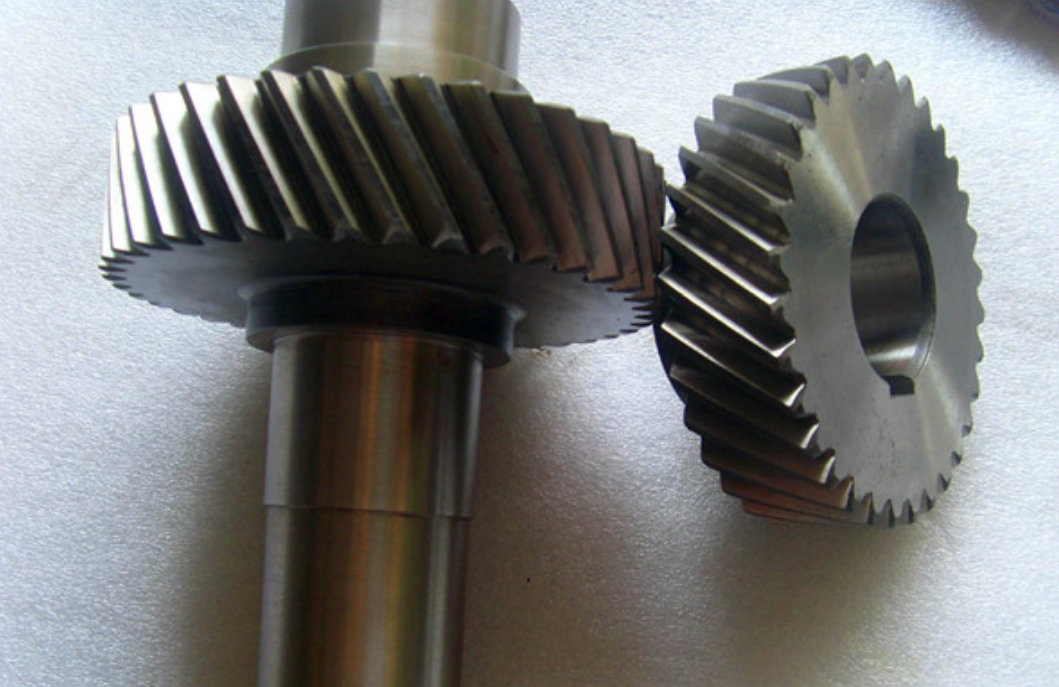
Traditional tooth modification techniques, such as profile crowning, lead crowning, or even sophisticated three-dimensional modifications, aim to pre-distort the tooth surface to compensate for elastic deformations under a specific design load. While effective for standard helical gear pairs with lower contact ratios, these methods often fall short when applied to high-contact-ratio gears. They typically do not fully account for the complex, multi-stage deformation pattern that arises from the frequent alternation between two-pair and three-pair (or more) contact zones. A more precise, compensation-based approach is required—one that tailors the modification amount directly to the deformation characteristics of each distinct mesh region throughout the complete meshing cycle of the high-contact-ratio helical gear.
This article presents a detailed methodology for the compensation modification design of pinion tooth surfaces in high-contact-ratio helical gear pairs. The core principle is to prescriptively design a geometric transmission error (TE) for the modified pinion that is the inverse of the Loaded Transmission Error Amplitude (ALTE) observed in the standard (unmodified) gear pair under its design load. By optimizing this target TE, we can precisely calculate and control the required modification amount at every point of contact, effectively “compensating” for the load-induced deformation variations. Furthermore, an enhanced longitudinal modification is superimposed to optimize load distribution and prevent edge contact. The entire process is driven by numerical optimization using the Loaded Tooth Contact Analysis (LTCA) model, with the objective of minimizing the ALTE across a range of operating loads.
Fundamental Analysis: Loaded Transmission Error in Helical Gears
The static performance of a helical gear pair, particularly its tendency to generate vibration, is critically assessed through Loaded Tooth Contact Analysis (LTCA). This technique synthesizes the geometric conditions from Tooth Contact Analysis (TCA) with the structural compliance of the teeth, typically obtained via the Finite Element Method. The core mathematical model solves for the contact pressure distribution and resulting deformations under load, governed by compatibility and equilibrium equations.
For a meshing helical gear pair, the contact problem for a given tooth pair \( k \) can be formulated as:
$$ \mathbf{F}_k \mathbf{p}_k + \mathbf{w}_k = Z \mathbf{e} + \mathbf{d}_k $$
$$ \sum_{j=1}^{n_I} p_j^I + \sum_{j=1}^{n_{II}} p_j^{II} = P $$
with the complementarity conditions:
$$ d_j^k = 0,\; p_j^k > 0 \quad \text{or} \quad d_j^k > 0,\; p_j^k = 0 $$
where:
- \( \mathbf{F}_k \) is the normal flexibility matrix for tooth pair \( k \).
- \( \mathbf{p}_k \) is the vector of normal contact loads along the potential contact line.
- \( \mathbf{w}_k \) is the vector of initial separations (including geometric transmission error and unloaded gap).
- \( Z \) is the rigid body approach of the gears due to load.
- \( \mathbf{e} \) is a unit vector.
- \( \mathbf{d}_k \) is the vector of contact deformations.
- \( P \) is the total transmitted normal load.
Solving this nonlinear system, often through mathematical programming aiming to minimize strain energy, yields the Loaded Transmission Error (LTE). The LTE, typically measured in arc-seconds, and its critical amplitude (ALTE) are calculated as:
$$ \text{LTE} = \frac{3600 \times 180}{\pi} \cdot \frac{Z}{r_{b2} \cos \beta_b} $$
$$ \text{ALTE} = \max(\text{LTE}) – \min(\text{LTE}) $$
Here, \( r_{b2} \) and \( \beta_b \) are the base radius and base helix angle of the driven gear, respectively. The ALTE is the primary metric we seek to minimize, as it directly correlates with vibratory excitation.
| Symbol | Description | Unit/Relation |
|---|---|---|
| \( \mathbf{F}_k \) | Tooth pair normal flexibility matrix | μm/N, from FEM |
| \( \mathbf{p}_k \) | Normal contact load vector | N |
| \( \mathbf{w}_k \) | Initial separation vector (\( \delta_k + b_k \)) | μm |
| \( Z \) | Rigid body approach | μm |
| LTE | Loaded Transmission Error | arc-seconds |
| ALTE | Amplitude of LTE fluctuation | arc-seconds |
The Compensation Modification Design Philosophy
The relationship between the unloaded Geometric Transmission Error (TE) and the final Loaded Transmission Error (LTE) is pivotal. For an ideal, perfectly conjugate gear pair, the TE would be zero. In practice, a small, smoothly varying TE is introduced via modification to achieve a favorable, low-amplitude LTE under load. The standard approach is to design a parabolic or higher-order TE curve. However, for a high-contact-ratio helical gear, the deformation is not uniform across the path of contact due to the changing number of contacting pairs. Consequently, a single parabolic TE function cannot optimally compensate for this staged deformation variation.
Our proposed method starts with the standard pinion and gear under the design load. We perform a full LTCA simulation over one mesh cycle to obtain its LTE curve. The key insight is to use the negative of this LTE curve’s shape (specifically, the deviation from its mean value) as the prescribed target for the Geometric TE of the modified pinion. Conceptually, if the load causes the driven gear to lag in a specific region (positive LTE), we pre-modify the pinion to cause a geometric lead (negative TE) of equal magnitude in that same region. When load is applied, the deformation “consumes” this pre-set lead, ideally resulting in near-zero net LTE at the design point.
Mathematically, we define discrete target points for the TE of the modified pair. Over a mesh cycle divided into \( n \) intervals, we have contact points defined by pinion rotation \( \phi_1^{(i)} \) and the required driven gear position error \( \delta\phi_2^{(i)} \):
$$ \delta\phi_2^{(i)} = \left( \phi_2^{(i)} – \phi_2^{(0)} \right) – \frac{N_1}{N_2} \left( \phi_1^{(i)} – \phi_1^{(0)} \right) $$
where \( N_1, N_2 \) are tooth numbers and \( \phi^{(0)} \) are initial reference angles. The values of \( \delta\phi_2^{(i)} \) are initially set based on the negative of the standard gear’s ALTE pattern and become the optimization variables.
Generating the Compensation-Modified Pinion Surface
To physically realize a pinion tooth surface that produces the target TE \( \delta\phi_2(\phi_1) \), we control the manufacturing process. Using the model of a rack-cutter generating the helical gear, we introduce a corrective motion. For the generated pinion, an additional rotation \( \Delta\theta_1 \) is imparted to the rack-cutter relative to its standard generating motion.
The surface of the modified pinion, \( \mathbf{r}_c^{(1)} \), is derived from the rack-cutter surface \( \mathbf{r}_{t} \) via the coordinate transformation \( \mathbf{M}_{1,t} \), which now includes the parameter \( \Delta\theta_1 \):
$$ \mathbf{r}_c^{(1)}(u_1, l_1, \Delta\theta_1, \theta_1) = \mathbf{M}_{1,t}(\Delta\theta_1, \theta_1) \cdot \mathbf{r}_{t}(u_1, l_1) $$
The meshing condition must also be satisfied:
$$ f_{t,1}(u_1, l_1, \Delta\theta_1, \theta_1) = \left( \frac{\partial \mathbf{r}_c^{(1)}}{\partial u_1} \times \frac{\partial \mathbf{r}_c^{(1)}}{\partial l_1} \right) \cdot \frac{\partial \mathbf{r}_c^{(1)}}{\partial \theta_1} = 0 $$
To find the specific \( \Delta\theta_1 \) required for each meshing position, we solve the system of TCA equations between the modified pinion and the standard (unmodified) gear:
$$ \mathbf{r}_f^{(1)}(u_1, l_1, \Delta\theta_1, \phi_1) = \mathbf{r}_f^{(2)}(u_2, l_2, \phi_2) $$
$$ \mathbf{n}_f^{(1)}(u_1, l_1, \Delta\theta_1, \phi_1) = \mathbf{n}_f^{(2)}(u_2, l_2, \phi_2) $$
Given \( \phi_1 \) and the target \( \delta\phi_2 \) (which defines \( \phi_2 \)), this system of five independent scalar equations is solved for the five unknowns \( u_1, l_1, \Delta\theta_1, u_2, l_2 \).
By solving across the mesh cycle, we obtain a discrete set \( \Delta\theta_1^{(i)} \) corresponding to \( \theta_1^{(i)} \). This relationship is then fitted with a high-order polynomial to define a continuous modification function:
$$ \Delta\theta_1(\theta_1) = a_0 + a_1\theta_1 + a_2\theta_1^2 + \ldots + a_{10}\theta_1^{10} $$
The actual modification amount \( \delta_{comp} \) at any point on the pinion tooth surface is the normal deviation from the standard surface:
$$ \delta_{comp}(u_1, l_1) = \left( \mathbf{r}_c^{(1)}(u_1, l_1, \Delta\theta_1, \theta_1) – \mathbf{r}^{(1)}(u_1, l_1, \theta_1) \right) \cdot \mathbf{n}^{(1)}(u_1, l_1, \theta_1) $$
where \( \mathbf{r}^{(1)} \) and \( \mathbf{n}^{(1)} \) are the position and normal vectors of the standard pinion surface.
| Step | Action | Output/Goal |
|---|---|---|
| 1 | Analyze standard gear pair under design load via LTCA. | Obtain LTE curve and ALTE. |
| 2 | Prescribe target TE curve \( \delta\phi_2(\phi_1) \) as inverse of LTE shape. | Define target kinematic behavior. |
| 3 | Solve TCA equations with target TE to find required cutter motion \( \Delta\theta_1(\theta_1) \). | Link TE target to manufacturing parameter. |
| 4 | Fit \( \Delta\theta_1(\theta_1) \) to a polynomial. | Create continuous modification function. |
| 5 | Calculate resulting pinion surface \( \mathbf{r}_c^{(1)} \) and modification map \( \delta_{comp} \). | Final compensated pinion geometry. |
Enhanced Longitudinal Modification
The compensation modification derived above primarily addresses variations along the path of contact (i.e., profile direction). To ensure optimal load distribution across the face width of the helical gear and to prevent stress concentrations at the edges, an additional longitudinal (lead) modification is superimposed. This is applied to the already compensation-modified pinion surface \( \mathbf{r}_c^{(1)} \).
The lead modification profile is defined as a piecewise function consisting of two parabolic zones at the ends and a central unmodified region. Let \( b \) be the face width on the transverse plane. The modification amount \( \xi(y) \) along the profile coordinate \( y \) (mapped from the axial coordinate) is given by:
For the left end region \( (s_1 \le y \le s_2) \):
$$ \xi(y) = y_1 \left( \frac{y – s_2}{s_1 – s_2} \right)^2 $$
For the central region \( (s_2 < y < s_3) \):
$$ \xi(y) = 0 $$
For the right end region \( (s_3 \le y \le s_4) \):
$$ \xi(y) = y_2 \left( \frac{y – s_3}{s_4 – s_3} \right)^2 $$
The parameters \( y_1 \) and \( y_2 \) are the maximum modification depths at the left and right ends, respectively, and \( y_3 \) defines the length of the central unmodified region, determining the transition points \( s_1, s_2, s_3, s_4 \).
This 2D profile \( \xi(y) \) is expanded into a smooth 3D modification surface \( \xi(x, y) \) over the tooth flank using B-spline interpolation. The final enhanced pinion surface \( \mathbf{R}_g^{(1)} \) is obtained by adding this modification normal to the compensation-modified surface:
$$ \mathbf{R}_g^{(1)}(u_1, l_1) = \mathbf{r}_c^{(1)}(u_1, l_1) + \xi(x, y) \, \mathbf{n}_c^{(1)}(u_1, l_1) $$
where \( \mathbf{n}_c^{(1)} \) is the unit normal vector of surface \( \mathbf{r}_c^{(1)} \), and \( (x, y) \) are the planar coordinates from the projection of \( \mathbf{r}_c^{(1)} \).
Optimization Framework for Minimum ALTE
The design parameters—the target TE points \( \delta\phi_2^{(i)} \) and the lead modification parameters \( (y_1, y_2, y_3) \)—are determined through numerical optimization with the objective of minimizing the ALTE. The relationship between these parameters and the ALTE is complex and implicit, defined entirely through the LTCA simulation. Therefore, a population-based global optimization algorithm, the Fast Non-Dominated Sorting Genetic Algorithm (NSGA-II), is employed.
The optimization is conducted in a focused sequence. First, the compensation modification is optimized. The design variables are the discrete TE values at the mesh points not in the central “hollow” region of the target curve (which is kept fixed to maintain a conjugate-like zone). The bounds are set relative to the initial prescribed values.
$$ \text{Find: } \boldsymbol{\zeta} = [\delta\phi_2^{(1)}, \delta\phi_2^{(2)}, \ldots, \delta\phi_2^{(n)}] $$
$$ \text{Minimize: } f = \text{ALTE}(\boldsymbol{\zeta}) $$
$$ \text{Subject to: } \boldsymbol{\zeta}_{min} \le \boldsymbol{\zeta} \le \boldsymbol{\zeta}_{max} $$
This yields the optimal cutter rotation function \( \Delta\theta_{1,opt}(\theta_1) \).
Subsequently, the lead modification parameters are optimized while keeping the core compensation modification (the hollow region of \( \Delta\theta_1 \)) fixed to preserve the deformation compensation effect. An additional constraint ensures the geometric TE remains larger than the minimum LTE to avoid edge contact.
$$ \text{Find: } \boldsymbol{\eta} = [\Delta\tilde{\theta}_1^{(i)}, y_1, y_2, y_3] $$
$$ \text{Minimize: } f = \text{ALTE}(\boldsymbol{\eta}) $$
$$ \text{Subject to: } \boldsymbol{\eta}_{min} \le \boldsymbol{\eta} \le \boldsymbol{\eta}_{max}, \quad q_{min} < y_1, y_2 < q_{max}, \quad l_{min} < y_3 < l_{max}, \quad |\max(TE)| > |\min(LTE)| $$
Here, \( \Delta\tilde{\theta}_1^{(i)} \) represents the adjustable portions of the cutter motion polynomial outside the central hollow region.
| Optimization Stage | Variables | Typical Bounds | Primary Objective | Key Constraints |
|---|---|---|---|---|
| Compensation Mod. | Target TE values \( \delta\phi_2^{(i)} \) | ±20% of initial prescription | Minimize ALTE under design load | Variable bounds |
| Enhanced Lead Mod. | Adj. cutter motion \( \Delta\tilde{\theta}_1^{(i)} \), Lead params \( y_1, y_2, y_3 \) | \( y_1, y_2 \): e.g., 13-35 μm \( y_3 \): 65-95% of face width |
No edge contact \( (|TE_{max}|>|LTE_{min}|) \) |
Analysis of Results and Performance
Applying this methodology to high-contact-ratio helical gear pairs reveals significant performance gains. For a gear pair with a contact ratio of 2.34, the compensation-modified pinion surface exhibits a modification map where the amount varies rhythmically along the diagonal contact path, corresponding to the alternation between two-pair and three-pair contact zones. This wave-like pattern is the direct geometric embodiment of the deformation compensation. Critically, under the design load, the ALTE is reduced to nearly zero. As load deviates from the design point, the ALTE increases, but remains substantially lower than that of the standard unmodified helical gear across a wide load range.
For an even higher-contact-ratio helical gear pair (e.g., contact ratio > 3.4), the modification map shows more frequent fluctuations along the contact path, accurately mirroring the more complex sequence of two-pair and three-pair contact zones. The effectiveness of the compensation is again demonstrated by the drastic reduction in ALTE at the design load. The enhanced longitudinal modification further improves robustness. While it slightly increases the ALTE at the exact design load compared to the pure compensation modification, it provides superior performance at higher loads and ensures a stable, well-distributed contact pattern free from edge contact, which is vital for the long-term reliability of the helical gear transmission.
The following table summarizes a comparative analysis of the transmission error characteristics:
| Performance Metric | Standard Helical Gear | Compensation-Modified Helical Gear | Enhanced (Lead+Comp.) Helical Gear |
|---|---|---|---|
| ALTE at Design Load | High | Very Low (~Near Zero) | Low |
| ALTE at Higher Loads | Very High | Moderate | Lower than Compensation-only |
| Contact Pattern | Prone to edge contact, uneven | Improved, but may have edge sensitivity | Optimal, centered, no edge contact |
| Modification Pattern | N/A | Wave-like, diagonal, matches mesh zone sequence | Wave-like diagonal + controlled end relief |
| Primary Benefit | Baseline | Minimizes vibration at design point | Provides robust vibration reduction & reliability |
Conclusion
The multi-pair contact characteristic of high-contact-ratio helical gears necessitates a sophisticated approach to tooth modification for vibration control. The compensation modification design method presented here directly addresses the root cause of LTE fluctuation: the varying load-sharing and deformation across different mesh zones. By prescriptively designing a geometric transmission error that is the inverse of the loaded error pattern, the pinion tooth surface is precisely sculpted to offset the deflections under operational load. The integration of a subsequent optimized longitudinal modification ensures the durability and robustness of the solution. This methodology, powered by LTCA simulation and multi-variable optimization, provides a systematic and effective path for designing high-performance, low-noise helical gear transmissions for demanding applications. The significant reduction in ALTE, particularly at the design load, translates directly into lower dynamic forces, reduced vibration, and quieter operation of the entire gear drive system.