
In modern electric drive systems, helical gears are widely employed due to their superior transmission performance and high load-bearing capacity. However, during operation, the sliding friction between meshing tooth surfaces generates significant heat, especially under high-speed and heavy-load conditions. This heat accumulation can lead to gear tooth scuffing failure and thermal deformation, which alters the involute tooth profile, affects meshing characteristics, and increases vibration and noise. Therefore, understanding the steady-state temperature field and thermal deformation field of helical gears is crucial for improving the reliability and efficiency of electric drive transmissions. In this study, we investigate the thermal behavior of helical gears through theoretical derivation and finite element analysis, focusing on the distribution of temperature and deformation under steady-state conditions.
We begin by establishing the theoretical foundation for heat generation and dissipation in helical gears. Based on the principles of gear meshing, heat transfer, and tribology, we derive the equations for average frictional heat flux density on the meshing surface and convective heat transfer coefficients on other surfaces. The steady-state temperature field of a helical gear is governed by the heat conduction differential equation derived from the energy conservation law and Fourier’s law of heat conduction:
$$ \lambda \left( \frac{\partial^2 t}{\partial x^2} + \frac{\partial^2 t}{\partial y^2} + \frac{\partial^2 t}{\partial z^2} \right) = 0 $$
where \( \lambda \) is the thermal conductivity and \( t \) is the temperature. The boundary conditions for the helical gear surfaces are classified into combined second and third types for the meshing surface, and third type for non-meshing surfaces, tooth tips, end faces, and fillets. For the meshing surface, the boundary condition is expressed as:
$$ -\lambda \frac{\partial t}{\partial n} = s_1 (t_c – t_o) – q_w $$
where \( s_1 \) is the convective heat transfer coefficient of the meshing surface, \( t_c \) and \( t_o \) are the initial temperatures of the gear surface and lubricant, respectively, and \( q_w \) is the average frictional heat flux density. For other surfaces, the boundary condition is:
$$ -\lambda \frac{\partial t}{\partial n} = s_2 (t_c – t_o) $$
where \( s_2 \) represents the convective heat transfer coefficient for those surfaces.
To determine the average frictional heat flux density, we introduce a dimensionless coordinate \( \Gamma \) to specify any point on the line of action. For an external meshing helical gear, the dimensionless coordinate at point \( N_K \) is defined as:
$$ \Gamma = \frac{\tan \alpha_{nk}}{\tan \alpha_{nc}} – 1 $$
where \( \alpha_{nk} \) is the pressure angle at the meshing point and \( \alpha_{nc} \) is the pressure angle at the pitch circle. The average frictional heat flux density \( q_j \) is calculated as:
$$ q_j = \frac{\pi k_f \gamma P_M f \tau_0 (v_1 – v_2)}{2T_1} $$
Here, \( k_f \) is the distribution coefficient of frictional heat flux between teeth, \( \gamma \) is the thermal energy conversion coefficient (taken as 0.95), \( P_M \) is the maximum Hertzian contact pressure, \( f \) is the friction coefficient, \( \tau_0 \) is the temporal contact half-width, \( v_1 \) and \( v_2 \) are the tangential velocities at the meshing point for the driving and driven gears, and \( T_1 \) is the meshing period of the driving gear. The parameters are further defined as:
$$ \tau_0 = \frac{b_0}{v_1}, \quad b_0 = \sqrt{\frac{8wR}{\pi E}}, \quad P_M = \sqrt{\frac{wE}{2\pi R}} $$
$$ v_1 = \frac{R_1 \pi n_1}{30}, \quad v_2 = \frac{R_2 \pi n_2}{30} $$
where \( E \) is the equivalent elastic modulus, \( R \) is the comprehensive curvature radius, \( w \) is the unit line load, \( R_1 \) and \( R_2 \) are the curvature radii of the driving and driven gears, and \( n_1 \) and \( n_2 \) are their rotational speeds. The unit line load \( w \) for a helical gear is given by:
$$ w = \frac{9549 P \eta K}{L r_{b1} n_1 \cos \beta_b} $$
where \( P \) is the input power, \( \eta \) is the transmission efficiency, \( K \) is the load factor, \( L \) is the contact line length, \( r_{b1} \) is the base circle radius of the driving gear, and \( \beta_b \) is the base circle helix angle.
The convective heat transfer coefficients for different surfaces of the helical gear are derived based on fluid dynamics and thermal analysis. For the tooth tip, the coefficient \( h_d \) is:
$$ h_d = 0.664 \lambda_o P_o^{0.333} \left( \frac{\omega}{\nu_o} \right)^{0.5} $$
where \( \lambda_o \) is the thermal conductivity of the lubricant, \( P_o \) is the Prandtl number of the lubricant, \( \omega \) is the angular velocity, and \( \nu_o \) is the kinematic viscosity of the lubricant. For the tooth surface and fillet, the coefficient \( h_a \) is:
$$ h_a = 0.228 Re^{0.731} P_o^{0.333} \frac{\lambda_o}{L_d} $$
with \( Re \) being the Reynolds number of the lubricant, calculated as \( Re = \omega r_{nk}^2 / \nu_o \), where \( r_{nk} \) is the radius at any meshing point. For the end faces, the convective heat transfer coefficient \( h_t \) varies with the Reynolds number, categorized into laminar, transition, and turbulent flows:
$$ h_t =
\begin{cases}
0.308 \lambda_{mix} (m_z + 2)^{0.5} \times P_{mix}^{0.5} \left( \frac{\omega}{\nu_{mix}} \right)^{0.5}, & \text{if } Re \leq 2 \times 10^5 \\
10^{-19} \lambda_{mix} \left( \frac{\omega}{\nu_{mix}} \right)^4 \times r_{nk}^7, & \text{if } 2 \times 10^5 \leq Re \leq 2.5 \times 10^5 \\
0.0197 \lambda_{mix} (m_z + 2.6)^{0.2} \times \left( \frac{\omega}{\nu_{mix}} \right)^{0.8} r_{nk}^{0.6}, & \text{if } Re \geq 2.5 \times 10^5
\end{cases} $$
Here, \( m_z = 2 \), and the properties of the oil-air mixture medium (denoted by subscript \( mix \)) are obtained by linear combination of oil and air properties based on a proportion \( \alpha_{mix} \).
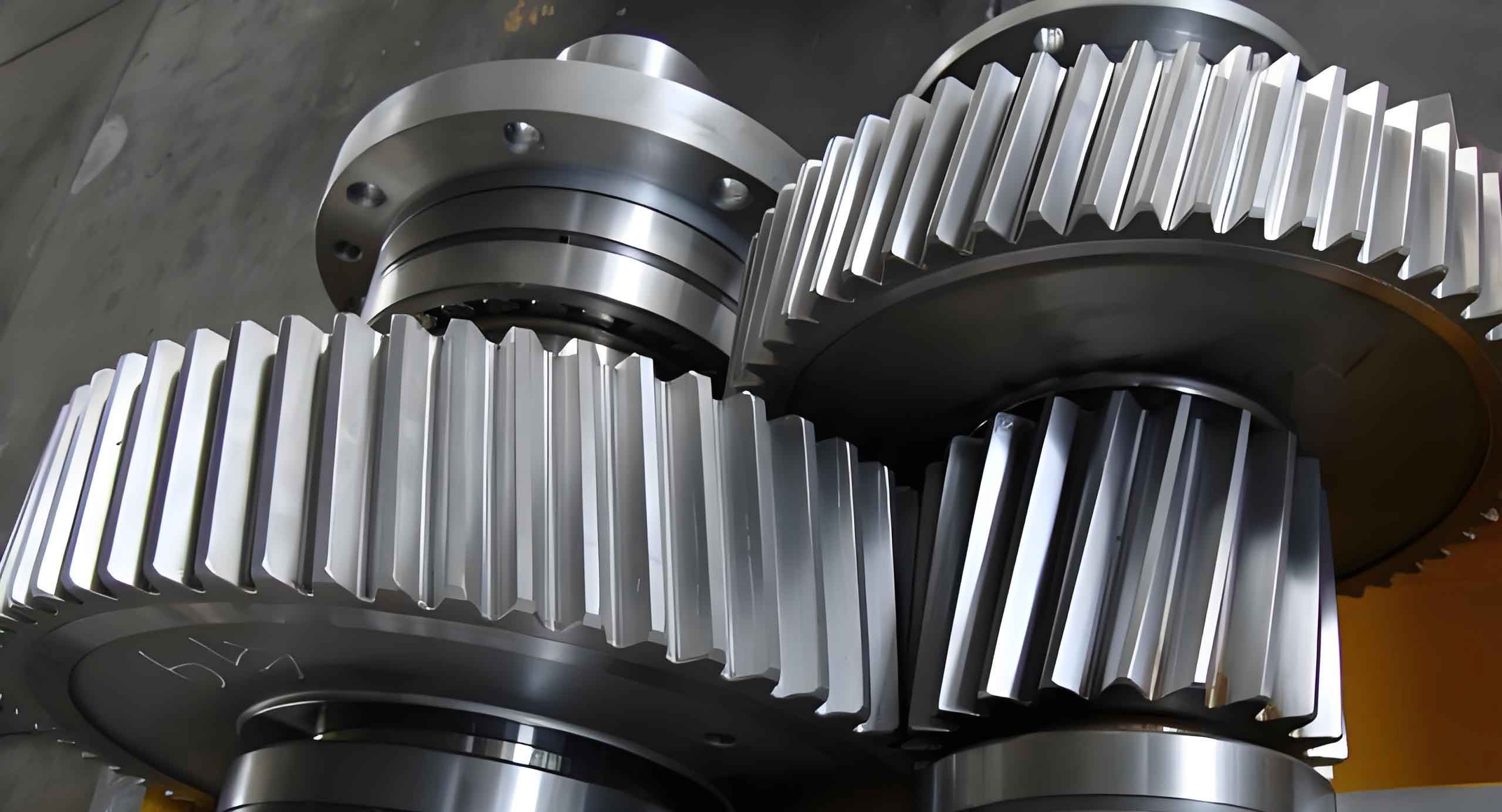
To analyze the steady-state temperature field and thermal deformation field, we developed a parametric finite element model of the helical gear using APDL (ANSYS Parametric Design Language). The model incorporates the geometric parameters and material properties of the helical gear, as summarized in Table 1. The helical gear is discretized using 8-node hexahedral elements (SOLID70) with mapped meshing. The frictional heat flux on the meshing surface is applied via surface effect elements (SURF152). The lubricant properties used in the analysis are listed in Table 2.
| Parameter | Value |
|---|---|
| Driving gear speed \( n_1 \) (rpm) | 2000 |
| Number of teeth \( z_1 / z_2 \) | 23 / 30 |
| Module \( m \) (mm) | 3 |
| Pressure angle \( \alpha \) (degrees) | 20 |
| Face width \( b \) (mm) | 20 |
| Helix angle \( \beta \) (degrees) | 8 |
| Input power \( P \) (kW) | 50 |
| Elastic modulus \( E \) (GPa) | 206 |
| Poisson’s ratio \( \nu \) | 0.3 |
| Specific heat capacity \( c \) (J·kg⁻¹·K⁻¹) | 465 |
| Thermal conductivity \( \lambda \) (W·m⁻¹·K⁻¹) | 46 |
| Thermal expansion coefficient \( k \) (K⁻¹) | 1.13 × 10⁻⁵ |
| Density \( \rho \) (kg·m⁻³) | 7850 |
| Parameter | Value |
|---|---|
| Lubricant type | SCH632 |
| Density \( \rho_o \) (kg·m⁻³) | 870 |
| Kinematic viscosity \( \nu_o \) (cSt) at 40°C / 100°C | 320 / 38.5 |
| Thermal conductivity \( \lambda_o \) (W·m⁻¹·K⁻¹) | 2000 |
| Specific heat capacity \( c_o \) (J·kg⁻¹·K⁻¹) | 0.14 |
Using the full-tooth model of the helical gear, we obtained the steady-state temperature field. The results show a gradient distribution, with the highest temperature on the meshing surface and the lowest at the hub. The maximum temperature reached 92.4488°C. On the meshing surface, two distinct high-temperature regions are observed, located within the two double-tooth meshing zones. Along the tooth height direction, the temperature distribution resembles an “M” shape. In the double-tooth meshing zone at the meshing-in side, the peak temperature is near the tooth root, while at the meshing-out side, it is near the tooth tip. Along the tooth width direction, the temperature distribution is asymmetric. For a clockwise-rotating right-hand helical driving gear, the high-temperature zone in the meshing-in double-tooth region is closer to the front end face, and that in the meshing-out double-tooth region is closer to the rear end face. This asymmetry arises due to the inclined contact line and varying friction heat flux along the tooth width caused by the helix angle.
The thermal deformation field of the helical gear is derived by applying the steady-state temperature field data as a load to the structural analysis model. All degrees of freedom on the inner cylindrical surface are constrained, and the thermal expansion coefficient is specified. The overall thermal deformation field shows that the tooth tip experiences the largest deformation, while the hub has the smallest. The maximum deformation occurs near the two end faces of the helical gear. Considering the deformation along the line of action, which is projected from the X and Y directional deformations, we calculate the normal deformation at the meshing point as:
$$ \delta_K = \delta_{xK} \cos(\omega_K) + \delta_{yK} \sin(\omega_K) $$
where \( \delta_K \) is the deformation along the line of action, \( \delta_{xK} \) and \( \delta_{yK} \) are the deformations in the X and Y directions at the meshing point, and \( \omega_K \) is the load action angle. The results indicate that along the tooth width direction, the thermal deformation at the rear end face is greater than at the front end face, consistent with the temperature distribution.
To evaluate the impact of different gear models on computational accuracy and efficiency, we also developed partial-tooth models, including single-tooth, three-tooth, and five-tooth models. The steady-state temperature fields from these models are compared with the full-tooth model. Table 3 summarizes the temperature values at selected nodes on the meshing surface for different models, showing that the single-tooth model provides high accuracy with minimal relative error.
| Node | Dimensionless Coordinate \( \Gamma \) | Full-Tooth Temp. (°C) | Single-Tooth Temp. (°C) | Three-Tooth Temp. (°C) | Five-Tooth Temp. (°C) | Relative Error (Single-Tooth) % |
|---|---|---|---|---|---|---|
| A | -0.43 | 91.48 | 91.55 | 91.78 | 91.85 | 0.08 |
| B | -0.10 | 90.49 | 90.53 | 90.76 | 90.83 | 0.04 |
| C | 0.24 | 91.26 | 91.28 | 91.51 | 91.57 | 0.02 |
| D | 0.51 | 92.32 | 92.34 | 92.56 | 92.61 | 0.02 |
However, when analyzing the thermal deformation field, the partial-tooth models exhibit significant errors compared to the full-tooth model. The deformation along the line of action for different models is compared in Table 4, indicating that only the full-tooth model yields accurate results for thermal deformation.
| Tooth Width (mm) | Full-Tooth Deformation (10⁻⁵ m) | Single-Tooth Deformation (10⁻⁵ m) | Three-Tooth Deformation (10⁻⁵ m) | Five-Tooth Deformation (10⁻⁵ m) | Relative Error (Single-Tooth) % |
|---|---|---|---|---|---|
| 4 | 1.275 | 1.415 | 1.376 | 1.430 | 10.98 |
| 10 | 1.355 | 1.615 | 1.475 | 1.507 | 19.19 |
| 16 | 1.388 | 1.614 | 1.510 | 1.542 | 16.28 |
We further examined partial-tooth models with complete hubs (i.e., single-tooth, three-tooth, and five-tooth models that include the full hub structure). The steady-state temperature fields from these models show similar distribution patterns but with lower temperatures at the tooth roots near the edges, due to the increased distance from the meshing surface. The thermal deformation fields, however, align more closely with the full-tooth model in terms of deformation patterns, but still exhibit errors in magnitude, as summarized in Table 5.
| Tooth Width (mm) | Full-Tooth Deformation (10⁻⁵ m) | Single-Tooth with Hub Deformation (10⁻⁵ m) | Three-Tooth with Hub Deformation (10⁻⁵ m) | Five-Tooth with Hub Deformation (10⁻⁵ m) | Relative Error (Single-Tooth with Hub) % |
|---|---|---|---|---|---|
| 4 | 1.275 | 1.050 | 1.130 | 1.180 | 17.32 |
| 10 | 1.355 | 1.120 | 1.210 | 1.260 | 17.03 |
| 16 | 1.388 | 1.160 | 1.250 | 1.300 | 16.54 |
The analysis reveals that for steady-state temperature field calculations, a single-tooth model of the helical gear can effectively replace the full-tooth model with high accuracy, significantly reducing computational cost. This is because the temperature distribution in a helical gear is primarily localized to the meshing region, and the single-tooth model captures the essential heat generation and dissipation mechanisms. However, for thermal deformation field analysis, the full-tooth model is necessary to obtain accurate results. The deformation in a helical gear is cumulative and influenced by the overall temperature distribution and structural constraints, which are not fully represented in partial-tooth models. The errors in deformation calculations from partial-tooth models arise from the simplified boundary conditions and the inability to account for the interconnected deformation effects across multiple teeth.
In practical applications, such as in electric drive systems, the insights from this study can guide the design and optimization of helical gears. For instance, the asymmetric temperature distribution along the tooth width suggests that cooling strategies should be tailored to the high-temperature zones, particularly near the end faces. The thermal deformation patterns highlight the need for compensation in gear tooth profiles to maintain proper meshing under operating temperatures. Future work could explore the effects of varying operational parameters, such as different speeds, loads, and lubricants, on the thermal behavior of helical gears. Additionally, advanced materials with better thermal properties could be investigated to mitigate temperature rise and deformation.
In conclusion, our comprehensive analysis of helical gears in electric drives provides a detailed understanding of their steady-state temperature and thermal deformation fields. The theoretical derivations and finite element simulations demonstrate the gradient nature of temperature distribution, with distinct high-temperature regions in double-tooth meshing zones, and the cumulative effect of thermal deformation leading to maximum deformation at the tooth tips. While partial-tooth models offer computational efficiency for temperature field analysis, the full-tooth model remains essential for accurate deformation assessment. This research underscores the importance of considering thermal effects in the design and analysis of helical gears to ensure reliability and performance in high-speed electric drive applications.
To further elaborate on the methodology, we emphasize that the APDL-based parametric model allows for rapid modification of helical gear parameters, enabling sensitivity studies. For example, varying the helix angle \( \beta \) influences the contact line length and thus the heat generation distribution. The relationship between helix angle and contact line length can be expressed as:
$$ L = \frac{b}{\cos \beta_b} $$
where \( \beta_b \) is the base circle helix angle. A larger helix angle increases the contact line length, potentially reducing the unit load but altering the friction heat flux distribution. Similarly, the gear module \( m \) affects the tooth geometry and heat dissipation area. The tooth surface area \( A_s \) for a helical gear can be approximated as:
$$ A_s \approx \pi m b z \left(1 + \frac{1}{\cos \beta}\right) $$
where \( z \) is the number of teeth. This area plays a role in convective heat transfer, as larger surface areas enhance cooling.
Moreover, the friction coefficient \( f \) in the heat flux equation is critical and often depends on the lubricant condition and surface roughness. For helical gears under mixed lubrication, \( f \) can be modeled as a function of the film thickness ratio \( \lambda \):
$$ f = f_0 + a \cdot e^{-b \lambda} $$
where \( f_0 \), \( a \), and \( b \) are constants determined experimentally. Incorporating such detailed tribological models can improve the accuracy of thermal analysis for helical gears.
In terms of computational aspects, the finite element analysis involved meshing the helical gear with approximately 500,000 elements for the full-tooth model, ensuring convergence of temperature and deformation results. The steady-state solution was obtained using an iterative solver with a tolerance of 10⁻⁶. The material properties of the helical gear, such as thermal conductivity and expansion coefficient, were assumed isotropic and temperature-independent for simplicity, but future studies could include temperature-dependent properties for more realism.
The implications of this research extend beyond electric drives to other applications like wind turbines, automotive transmissions, and industrial machinery where helical gears are prevalent. By accurately predicting thermal behavior, designers can avoid common failures such as scuffing, pitting, and excessive wear. Additionally, the thermal deformation insights can inform gear manufacturing processes, such as pre-correction of tooth profiles to compensate for thermal expansion under operating conditions.
In summary, the helical gear, with its inclined teeth, presents unique thermal challenges due to complex friction and heat transfer phenomena. Our study provides a robust framework for analyzing these challenges, combining theoretical foundations with practical finite element simulations. The repeated emphasis on helical gear throughout this work highlights its centrality in modern mechanical systems, and the findings offer valuable guidance for engineers seeking to optimize helical gear performance in thermal environments.