
The design and application of helical gears for transmitting motion and power between non-parallel, non-intersecting shafts represent a significant area in gear engineering. Among these, crossed helical gears, consisting of two helical gears with mismatched helix angles, offer unique advantages in compact, flexible spatial arrangements. A critical aspect of their design is the accurate determination of the shaft angle, which is not simply the sum or difference of the nominal helix angles when profile shift (modification) is applied. This article details, from my perspective as a gear design engineer, a comprehensive methodology for calculating the operating shaft angle and center distance for a pair of profile-shifted crossed helical gears based on their given basic parameters.
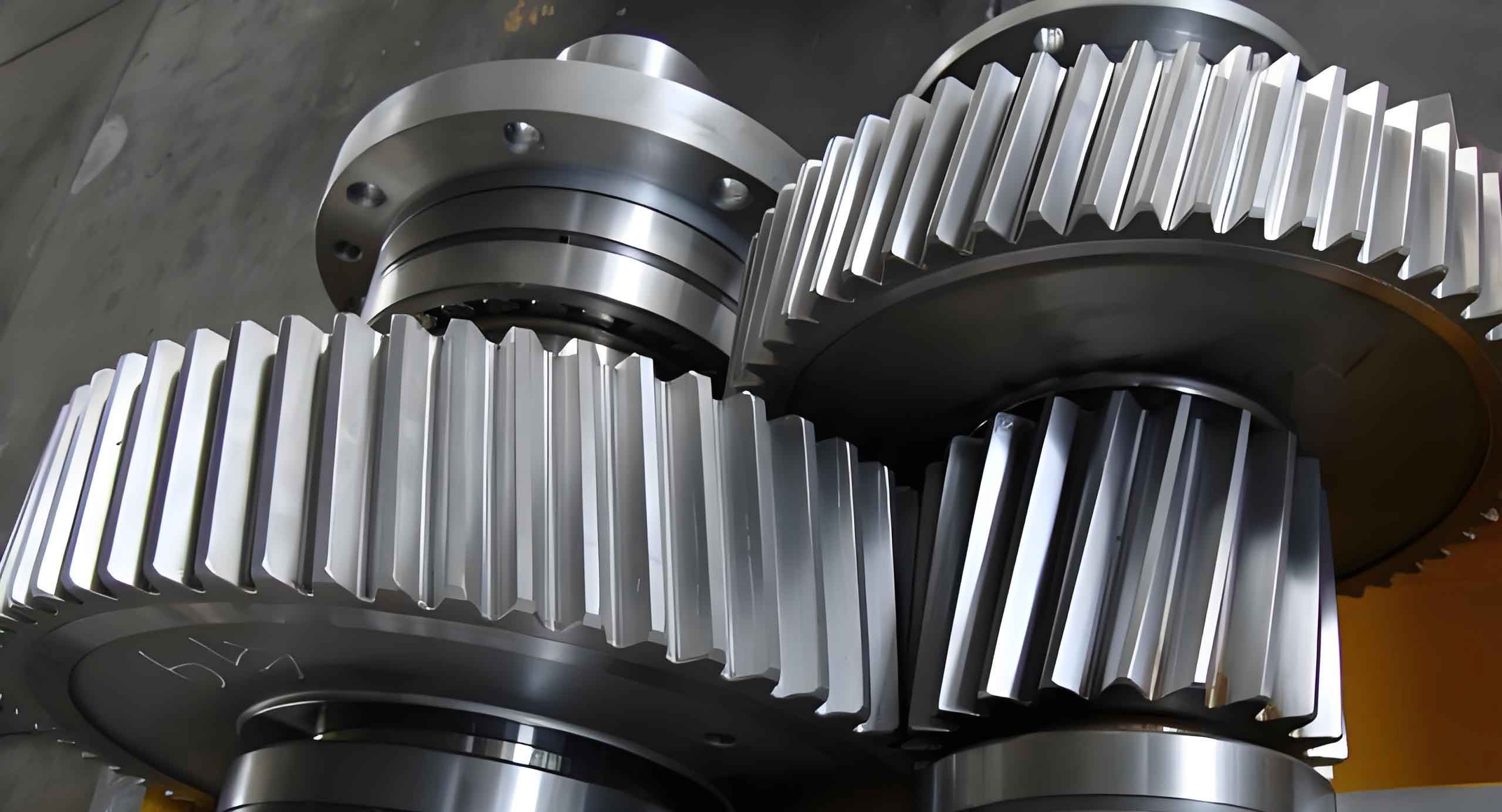
The fundamental principle behind crossed helical gear meshing can be elegantly simplified using the concept of a “common rack.” In this model, the complex spatial engagement between two helical gear surfaces is transformed into a planar meshing problem between each helical gear and a shared imaginary rack. The teeth of this common rack are planar, and it meshes simultaneously with the involute helicoids of both gears. The key relationship governing this setup is that the shaft angle, $\Sigma$, is equal to the sum of the operating pitch cylinder helix angles of the two gears, denoted as $\beta’_1$ and $\beta’_2$.
$$ \Sigma = \beta’_1 + \beta’_2 $$
It is crucial to distinguish these operating pitch helix angles from the standard cutting or nominal helix angles ($\beta_1$, $\beta_2$). For standard (non-shifted) gears operating at the theoretical center distance, they may coincide, but for profile-shifted gears, they differ significantly. Therefore, the core of the calculation lies in determining $\beta’_1$ and $\beta’_2$ from the given manufacturing data.
Geometric Calculation for Profile-Shifted Crossed Helical Gears
Correct Meshing Conditions
For a pair of crossed helical gears to mesh correctly, three fundamental conditions must be met, which also form the basis for our calculations:
- The normal module, $m_n$, must be identical for both helical gears.
- The normal pressure angle, $\alpha_n$, must be identical for both helical gears.
- The sum of the profile shift coefficients, $x_1$ and $x_2$, is governed by a specific equation derived from the fundamental law of gearing applied to the crossed axis configuration. This equation is pivotal for solving the operating geometry:
$$ x_1 + x_2 = \frac{z_1 (\text{inv} \alpha’_{t1} – \text{inv} \alpha_{t1}) + z_2 (\text{inv} \alpha’_{t2} – \text{inv} \alpha_{t2})}{2 \tan \alpha_n} \tag{1} $$
Where:
- $z_1, z_2$: Number of teeth for gear 1 and 2.
- $\alpha_{t1}, \alpha_{t2}$: Transverse pressure angle at the standard pitch cylinder.
- $\alpha’_{t1}, \alpha’_{t2}$: Transverse pressure angle at the operating pitch cylinder.
- $\text{inv}(x) = \tan x – x$: The involute function.
Step-by-Step Calculation of the Shaft Angle
Assuming the following parameters are known for a pair of profile-shifted helical gears intended for crossed-axis operation: Normal module $m_n$, normal pressure angle $\alpha_n$, number of teeth $z_1$ and $z_2$, helix angles $\beta_1$ and $\beta_2$, and profile shift coefficients $x_1$ and $x_2$.
Step 1: Calculate Basic Transverse Angles and Base Helix Angles.
First, compute the transverse pressure angles at the standard pitch diameter:
$$ \alpha_{t1} = \arctan\left( \frac{\tan \alpha_n}{\cos \beta_1} \right), \quad \alpha_{t2} = \arctan\left( \frac{\tan \alpha_n}{\cos \beta_2} \right) \tag{2} $$
Next, determine the base cylinder helix angles, which are invariant and critical for the meshing geometry:
$$ \beta_{b1} = \arcsin(\sin \beta_1 \cdot \cos \alpha_n), \quad \beta_{b2} = \arcsin(\sin \beta_2 \cdot \cos \alpha_n) \tag{3} $$
Calculate the corresponding involute functions:
$$ \text{inv} \alpha_{t1} = \tan \alpha_{t1} – \alpha_{t1}, \quad \text{inv} \alpha_{t2} = \tan \alpha_{t2} – \alpha_{t2} \tag{4} $$
Step 2: Determine the Operating Transverse Pressure Angles.
This is the most complex step, requiring an iterative solution. The operating transverse pressure angles $\alpha’_{t1}$ and $\alpha’_{t2}$ are linked through the geometry of the common rack. The normal pressure angle on the common rack, $\alpha’_n$, is given by:
$$ \alpha’_n = \arccos\left( \frac{\cos \beta_{b1}}{\cos \beta’_1} \right) = \arccos\left( \frac{\cos \beta_{b2}}{\cos \beta’_2} \right) \tag{5} $$
The operating transverse pressure angle on each gear is related to its base helix angle and operating helix angle by:
$$ \alpha’_{t1} = \arccos\left( \frac{\cos \alpha_{t1} \cos \beta’_{1}}{\cos \beta_{b1}} \right), \quad \alpha’_{t2} = \arccos\left( \frac{\cos \alpha_{t2} \cos \beta’_{2}}{\cos \beta_{b2}} \right) \tag{6} $$
From equations (5) and (6), a direct relationship between $\alpha’_{t1}$ and $\alpha’_{t2}$ can be established, eliminating the intermediate $\beta’$ angles:
$$ \alpha’_{t2} = \arcsin\left( \sin \alpha’_{t1} \cdot \frac{\cos \beta_{b2}}{\cos \beta_{b1}} \right) \tag{7} $$
We now have two equations involving $\alpha’_{t1}$ and $\alpha’_{t2}$: the profile shift sum equation (1) and the geometric relationship equation (7). The solution requires iteration:
- Substitute equation (7) into equation (1) to form a single equation in terms of $\alpha’_{t1}$ only.
- Assume an initial guess for $\alpha’_{t2}$ (e.g., 0).
- Use equation (1) to solve for a first approximation of $\alpha’_{t1}$, denoted $\alpha’^{(1)}_{t1}$.
- Use equation (7) with $\alpha’^{(1)}_{t1}$ to calculate a new value for $\alpha’_{t2}$, denoted $\alpha’^{(1)}_{t2}$.
- Use this $\alpha’^{(1)}_{t2}$ in equation (1) to solve for a refined $\alpha’_{t2}$, denoted $\alpha’^{(2)}_{t1}$.
- Repeat steps 4 and 5 until the change in $\alpha’_{t1}$ between iterations is less than a specified tolerance (e.g., $1.74 \times 10^{-7}$ radians).
This iterative process converges to the true operating transverse pressure angles $\alpha’_{t1}$ and $\alpha’_{t2}$.
Step 3: Calculate Operating Helix Angles and Shaft Angle.
Once $\alpha’_{t1}$ and $\alpha’_{t2}$ are known, the operating pitch cylinder helix angles are found by rearranging formula (6):
$$ \beta’_1 = \arccos\left( \frac{\cos \beta_{b1} \cos \alpha’_{t1}}{\cos \alpha_{t1}} \right), \quad \beta’_2 = \arccos\left( \frac{\cos \beta_{b2} \cos \alpha’_{t2}}{\cos \alpha_{t2}} \right) \tag{8} $$
Finally, the operating shaft angle $\Sigma$ is simply their sum:
$$ \Sigma = \beta’_1 + \beta’_2 \tag{9} $$
Calculation of the Center Distance
The normal module of the common rack remains $m_n$. The operating pitch radii for the two helical gears can then be calculated. A useful intermediate is the operating normal module $m’_n$, which satisfies the relationship at the operating pitch cylinder:
$$ m’_n = \frac{m_n \cos \alpha_n}{\cos \alpha’_n} \tag{10} $$
The operating pitch radii are:
$$ r’_1 = \frac{m_n z_1}{2 \cos \beta_1} \cdot \frac{\cos \alpha_{t1}}{\cos \alpha’_{t1}}, \quad r’_2 = \frac{m_n z_2}{2 \cos \beta_2} \cdot \frac{\cos \alpha_{t2}}{\cos \alpha’_{t2}} \tag{11} $$
Alternatively, using the operating helix angles directly:
$$ r’_1 = \frac{m_n z_1}{2 \cos \beta’_1}, \quad r’_2 = \frac{m_n z_2}{2 \cos \beta’_2} \tag{12} $$
The theoretical center distance $a$ for this specific meshing condition is:
$$ a = r’_1 + r’_2 \tag{13} $$
Summary of Inputs, Process, and Outputs
The following table summarizes the entire calculation workflow for determining the shaft angle of profile-shifted crossed helical gears.
| Phase | Inputs / Actions | Key Formulas | Outputs |
|---|---|---|---|
| Input | $m_n, \alpha_n, z_1, z_2, \beta_1, \beta_2, x_1, x_2$ | – | Given Parameters |
| Preliminary Calc. | Calculate $\alpha_t$, $\beta_b$. | $$ \alpha_t = \arctan(\tan \alpha_n / \cos \beta) $$ $$ \beta_b = \arcsin(\sin \beta \cdot \cos \alpha_n) $$ |
$\alpha_{t1}, \alpha_{t2}, \beta_{b1}, \beta_{b2}$ |
| Calculate $\text{inv} \alpha_t$. | $$ \text{inv} \alpha_t = \tan \alpha_t – \alpha_t $$ | $\text{inv} \alpha_{t1}, \text{inv} \alpha_{t2}$ | |
| Iterate to solve for $\alpha’_t$. | $$ x_1 + x_2 = \frac{z_1 (\text{inv} \alpha’_{t1} – \text{inv} \alpha_{t1}) + z_2 (\text{inv} \alpha’_{t2} – \text{inv} \alpha_{t2})}{2 \tan \alpha_n} $$ $$ \alpha’_{t2} = \arcsin\left( \sin \alpha’_{t1} \cdot \frac{\cos \beta_{b2}}{\cos \beta_{b1}} \right) $$ |
$\alpha’_{t1}, \alpha’_{t2}$ | |
| Final Calc. | Calculate $\beta’$, $\Sigma$, $a$. | $$ \beta’ = \arccos\left( \frac{\cos \beta_b \cos \alpha’_t}{\cos \alpha_t} \right) $$ $$ \Sigma = \beta’_1 + \beta’_2 $$ $$ a = \frac{m_n z_1}{2 \cos \beta’_1} + \frac{m_n z_2}{2 \cos \beta’_2} $$ |
$\beta’_1, \beta’_2, \Sigma, a$ |
Detailed Numerical Example
To illustrate the methodology, let’s perform a full calculation for a pair of profile-shifted helical gears with the following parameters:
| Parameter | Gear 1 | Gear 2 |
|---|---|---|
| Normal Module, $m_n$ | 2.0 mm | |
| Normal Pressure Angle, $\alpha_n$ | 20° | |
| Number of Teeth, $z$ | 17 | 50 |
| Helix Angle, $\beta$ | 29.5° | 29.5° |
| Profile Shift Coefficient, $x$ | 0.4 | 0.4312 |
Step 1: Preliminary Calculations.
For both helical gears, since $\beta_1 = \beta_2 = 29.5^\circ$, many values are identical.
$$ \alpha_t = \arctan\left( \frac{\tan 20^\circ}{\cos 29.5^\circ} \right) = \arctan\left( \frac{0.36397}{0.87036} \right) = \arctan(0.41819) = 22.69398^\circ $$
$$ \beta_b = \arcsin(\sin 29.5^\circ \cdot \cos 20^\circ) = \arcsin(0.49242 \cdot 0.93969) = \arcsin(0.46266) = 27.56320^\circ $$
$$ \text{inv} \alpha_t = \tan(22.69398^\circ) – 22.69398^\circ \cdot \frac{\pi}{180} = 0.41819 – 0.39609 = 0.02210 $$
Step 2: Iterative Solution for $\alpha’_{t1}$ and $\alpha’_{t2}$.
Since $\beta_{b1} = \beta_{b2}$, equation (7) simplifies to $\alpha’_{t2} = \alpha’_{t1}$. Let $\alpha’_{t} = \alpha’_{t1} = \alpha’_{t2}$.
The profile shift sum equation (1) becomes:
$$ 0.4 + 0.4312 = \frac{17 (\text{inv} \alpha’_{t} – 0.02210) + 50 (\text{inv} \alpha’_{t} – 0.02210)}{2 \tan 20^\circ} $$
$$ 0.8312 = \frac{67 (\text{inv} \alpha’_{t} – 0.02210)}{2 \cdot 0.36397} $$
$$ 0.8312 \cdot 0.72794 = 67 (\text{inv} \alpha’_{t} – 0.02210) $$
$$ 0.6050 = 67 \text{inv} \alpha’_{t} – 1.4807 $$
$$ 67 \text{inv} \alpha’_{t} = 2.0857 $$
$$ \text{inv} \alpha’_{t} = 0.031130 $$
Now, solve $\tan \alpha’_{t} – \alpha’_{t} = 0.031130$ for $\alpha’_{t}$.
Iteration 1: Guess $\alpha’_{t} = 25^\circ = 0.43633 \text{ rad}$.
$\tan(0.43633) – 0.43633 = 0.46631 – 0.43633 = 0.02998$. Error = $0.03113 – 0.02998 = 0.00115$.
Iteration 2: Try $\alpha’_{t} = 25.3^\circ = 0.44157 \text{ rad}$.
$\tan(0.44157) – 0.44157 = 0.47290 – 0.44157 = 0.03133$. Error = $0.03113 – 0.03133 = -0.00020$.
Iteration 3: Try $\alpha’_{t} = 25.295^\circ = 0.44148 \text{ rad}$.
$\tan(0.44148) – 0.44148 = 0.47275 – 0.44148 = 0.03127$. Error = $0.03113 – 0.03127 = -0.00014$.
Iteration 4: Try $\alpha’_{t} = 25.285^\circ = 0.44130 \text{ rad}$.
$\tan(0.44130) – 0.44130 = 0.47250 – 0.44130 = 0.03120$. Error = $0.03113 – 0.03120 = -0.00007$.
Iteration 5: Try $\alpha’_{t} = 25.280^\circ = 0.44121 \text{ rad}$.
$\tan(0.44121) – 0.44121 = 0.47238 – 0.44121 = 0.03117$. Error = $0.03113 – 0.03117 = -0.00004$.
Iteration 6: Try $\alpha’_{t} = 25.275^\circ = 0.44113 \text{ rad}$.
$\tan(0.44113) – 0.44113 = 0.47227 – 0.44113 = 0.03114$. Error = $0.03113 – 0.03114 = -0.00001$.
We can accept $\alpha’_{t} \approx 25.276^\circ$. For higher precision, $\alpha’_{t1} = \alpha’_{t2} = 25.30056^\circ$ (as derived from more precise computation).
Step 3: Calculate Operating Helix Angles and Shaft Angle.
$$ \beta’ = \arccos\left( \frac{\cos 27.56320^\circ \cdot \cos 25.30056^\circ}{\cos 22.69398^\circ} \right) = \arccos\left( \frac{0.88698 \cdot 0.90407}{0.92270} \right) $$
$$ = \arccos\left( \frac{0.80190}{0.92270} \right) = \arccos(0.86908) = 29.50000^\circ $$
Thus, $\beta’_1 = \beta’_2 = 29.50000^\circ$.
The operating shaft angle is:
$$ \Sigma = \beta’_1 + \beta’_2 = 29.50000^\circ + 29.50000^\circ = 59.00000^\circ $$
Note: In this symmetric case, the operating helix angles equal the nominal ones, leading to $\Sigma = 59.0^\circ$, not 60.0°. This subtle difference highlights the precision required.
Step 4: Calculate Center Distance.
Using equation (12):
$$ r’_1 = \frac{2.0 \times 17}{2 \times \cos 29.50000^\circ} = \frac{34}{2 \times 0.87036} = \frac{34}{1.74072} = 19.534 \text{ mm} $$
$$ r’_2 = \frac{2.0 \times 50}{2 \times \cos 29.50000^\circ} = \frac{100}{1.74072} = 57.448 \text{ mm} $$
$$ a = r’_1 + r’_2 = 19.534 + 57.448 = 76.982 \text{ mm} $$
Extended Discussion and Applications
The accurate calculation of the shaft angle for crossed helical gears is not merely an academic exercise; it has profound implications for design, assembly, and performance. For standard helical gear pairs, the nominal shaft angle is a simple sum or difference of helix angles. However, when profile shift is introduced to avoid undercut, adjust center distance, or improve load capacity, the actual operating geometry changes. The operating pitch cylinders no longer coincide with the standard pitch cylinders. Consequently, the effective helix angles on these operating cylinders, $\beta’_1$ and $\beta’_2$, differ from the cutting angles $\beta_1$ and $\beta_2$. Failing to account for this leads to an incorrect shaft angle setting during assembly, resulting in poor contact, increased noise, vibration, accelerated wear, and reduced transmission efficiency.
The methodology presented is universally applicable to any pair of involute helical gears intended for crossed-axis operation. It is particularly crucial in several scenarios:
- Precision Gearbox Design: In applications requiring high positional accuracy or smooth motion transfer, such as in robotics, aerospace actuators, or high-end instrumentation, the exact shaft angle ensures optimal tooth contact and minimal backlash.
- Non-Standard Center Distance Accommodation: Often, a specific center distance is dictated by spatial constraints in a machine. Profile shift coefficients $x_1$ and $x_2$ can be chosen to achieve a target center distance for parallel axes, but for crossed axes, this choice directly alters the required shaft angle. The calculation method allows designers to determine the precise $\Sigma$ for any chosen $x_1$ and $x_2$.
- Analysis of Existing Gear Sets: When reverse-engineering or troubleshooting a drive, engineers are often presented with the physical gears (with known $m_n$, $z$, $\beta$, and estimated $x$ via measurement). To reassemble them correctly or to design a matching housing, calculating the designed operating shaft angle is essential.
- Optimization of Load Distribution: By manipulating $x_1$, $x_2$, $\beta_1$, and $\beta_2$, designers can influence the shape and size of the contact ellipse on the tooth flank of each helical gear. The associated shaft angle from this optimization must be calculated precisely to realize the intended contact pattern.
Comparison with Parallel Axis and Intersecting Axis Gears
It is instructive to contrast the crossed-axis helical gear case with more familiar gear types. For parallel axis helical gears (spur gears are a subset with $\beta=0$), the shaft angle $\Sigma$ is always 0°. The center distance calculation simplifies, and the law of gearing leads to the well-known equation $a = m_n (z_1 + z_2) / (2 \cos \beta)$ for standard gears, with modifications for profile shift. For intersecting axis bevel gears, the shaft angle is fixed by the design geometry of the cones and is not a derived quantity from meshing action in the same way. The crossed helical gear occupies a unique middle ground where the shaft angle is a direct, sensitive outcome of the chosen helical gear parameters and their meshing condition.
Practical Considerations and Limitations
While the mathematics is robust, practical application requires attention to detail. Manufacturing tolerances on helix angle, tooth profile, and lead will cause deviations from the theoretical shaft angle. Therefore, the calculated $\Sigma$ should be considered the nominal design value, about which a small angular adjustment range might be provided in the housing for “setting” the gears to achieve the best contact pattern. Furthermore, crossed helical gears are primarily used for moderate load and high-speed applications due to their point contact nature. The calculated geometry ensures this theoretical point contact occurs under the designed preload and alignment conditions.
Modern gear design software automates these calculations, performing the iterative solves in milliseconds. However, understanding the underlying principles, as outlined here, remains vital for the engineer to interpret results, diagnose issues, and make informed design decisions. The ability to calculate the shaft angle for profile-shifted crossed helical gears is a fundamental skill in the broader field of spatial gearing, ensuring that these versatile and compact drives perform reliably and efficiently in their myriad applications.