
The pursuit of higher power density and operational efficiency in modern machinery, particularly in sectors like aerospace, transportation, and marine propulsion, has led to the widespread adoption of high-speed gear systems. Among these, helical gears are favored for their smooth engagement, high load capacity, and reduced noise compared to their spur counterparts. However, as rotational speeds increase into the thousands of revolutions per minute, a significant portion of the transmitted power is dissipated not through mechanical friction at the tooth contacts, but through aerodynamic interactions. This phenomenon, known as windage power loss, constitutes a major component of the load-independent power losses in a gearbox. Minimizing this loss is critical for enhancing overall transmission efficiency, reducing energy consumption, and managing thermal loads. This analysis delves into the aerodynamic behavior of high-speed helical gear pairs, employing Computational Fluid Dynamics (CFD) to model the complex flow fields and evaluate strategies for loss mitigation through the strategic use of shrouds or baffles.
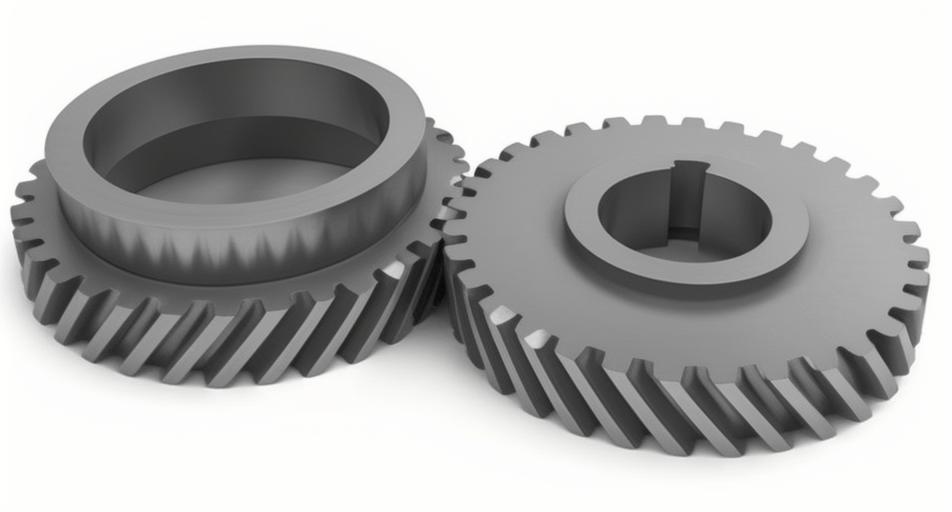
The fundamental challenge in analyzing a helical gear in motion lies in the three-dimensional, unsteady, and turbulent nature of the air flow it generates. The rotating gear acts as a centrifugal pump, drawing fluid into the tooth spaces and expelling it at high velocity, creating vortices and recirculation zones. The power required to sustain this fluid motion is drawn from the gear’s kinetic energy, manifesting as a resisting torque. To simulate this physics accurately, we start with the governing equations of fluid dynamics. For an incompressible flow, which is a valid assumption for Mach numbers (Ma) below 0.3, the continuity and momentum (Navier-Stokes) equations form the cornerstone:
Continuity Equation: $$ \nabla \cdot \vec{v} = 0 $$
Momentum Equation: $$ \frac{\partial \vec{v}}{\partial t} + (\vec{v} \cdot \nabla) \vec{v} = -\frac{1}{\rho} \nabla p + \nu \nabla^2 \vec{v} $$
where $\vec{v}$ is the velocity vector, $p$ is the pressure, $\rho$ is the fluid density, and $\nu$ is the kinematic viscosity. At the high Reynolds numbers (Re) typical of a fast-rotating helical gear, the flow is decidedly turbulent. The Reynolds number for this application is defined as:
$$ Re = \frac{\rho \cdot v_{tip} \cdot L_c}{\mu} $$
Here, $v_{tip}$ is the gear tip speed, $L_c$ is a characteristic length (often the gear module or face width), and $\mu$ is the dynamic viscosity. Values can easily exceed $10^5$, necessitating a turbulence model. The RNG $k$-$\epsilon$ model, an extension of the standard $k$-$\epsilon$ model derived using Renormalization Group theory, is well-suited for handling the high strain rates and swirling flows encountered around a rotating helical gear. It solves two transport equations for the turbulent kinetic energy $k$ and its dissipation rate $\epsilon$:
$$ \frac{\partial (\rho k)}{\partial t} + \frac{\partial (\rho k u_i)}{\partial x_i} = \frac{\partial}{\partial x_j} \left[ \alpha_k \mu_{eff} \frac{\partial k}{\partial x_j} \right] + G_k + G_b – \rho \epsilon – Y_M $$
$$ \frac{\partial (\rho \epsilon)}{\partial t} + \frac{\partial (\rho \epsilon u_i)}{\partial x_i} = \frac{\partial}{\partial x_j} \left[ \alpha_\epsilon \mu_{eff} \frac{\partial \epsilon}{\partial x_j} \right] + C_{1\epsilon} \frac{\epsilon}{k} (G_k + C_{3\epsilon} G_b) – C_{2\epsilon} \rho \frac{\epsilon^2}{k} – R_\epsilon $$
where $\mu_{eff}$ is the effective viscosity, $G_k$ represents the generation of turbulence kinetic energy due to mean velocity gradients, and the other terms are model constants and contributions.
The physical system under investigation is a high-speed, single-stage cylindrical helical gear pair. A simplified gearbox model is created, focusing on the essential fluid domain bounded by the gear chamber walls. The key parameters for the mating helical gears are summarized in the table below.
| Parameter | Driving Helical Gear | Driven Helical Gear |
|---|---|---|
| Helix Hand | Left | Right |
| Number of Teeth | 38 | 23 |
| Normal Module | 1.75 mm | 1.75 mm |
| Pressure Angle | 20° | 20° |
| Helix Angle | 18.6° | 18.6° |
| Face Width | 50 mm | 50 mm |
Modeling the meshing interface of the helical gear pair presents a meshing challenge due to the near-zero clearance. A “tooth face moving” technique is employed, where the gear teeth are slightly adjusted in the model to create a small, meshable gap without altering the overall aerodynamic interaction significantly. The fluid domain is the negative space inside the gearbox cavity excluding the gear solids. For simulations involving shrouds, additional solid volumes representing the baffles are subtracted from the fluid domain, creating separate flow regions: one inside the shroud around the gear and one in the main chamber. The computational grid is unstructured, with substantial local refinement on the gear tooth surfaces and in the meshing zone to capture boundary layers and complex flow features, resulting in a mesh of approximately 27 million cells.
The transient simulation is set up using a pressure-based solver. The motion of the helical gears is implemented via a User-Defined Function (UDF) that prescribes the rotational speed and direction. A dynamic mesh model with spring-based smoothing and local remeshing is activated to handle the deformation of the fluid cells caused by the gear rotation. The time step is chosen to correspond to a small angular increment (e.g., 0.5° per step) to ensure temporal resolution of the flow phenomena. The analysis is conducted in three sequential phases. First, the baseline windage loss for the unshrouded helical gear pair is established across a speed range of 1,500 to 2,500 rpm for the driving gear. Second, focusing solely on the driving helical gear at 2,000 rpm, various shroud configurations (radial, axial, and combinations) with different clearance sizes are tested to find an optimal local design. Finally, the knowledge gained is applied to design a shroud for the complete helical gear pair, assessing its overall effectiveness.
The windage power loss for each helical gear is calculated by integrating the pressure and shear stress forces over its tooth flanks and side faces to obtain the resisting torque. The total windage power loss $P_w$ for the gear pair is then:
$$ P_w = \sum_{i=1}^{2} \left( \frac{2\pi n_i}{60} \cdot T_i \right) = \sum_{i=1}^{2} \left( \frac{\pi n_i}{30} \cdot T_i \right) $$
where $n_i$ is the rotational speed in rpm and $T_i$ is the total aerodynamic torque on gear $i$ (driver or driven).
The initial simulations confirm the profound impact of rotational speed. The graph below synthesizes the trend, showing a sharp, non-linear increase in windage loss with speed for the unshrouded helical gear pair. This is expected, as the aerodynamic forces are approximately proportional to the square of the relative velocity. Furthermore, the flow field becomes increasingly turbulent and unsteady at higher speeds, leading to greater fluctuations in the instantaneous torque values.
| Driving Helical Gear Speed (rpm) | Driven Helical Gear Speed (rpm) | Total Windage Power Loss (W) | Flow Regime Notes |
|---|---|---|---|
| 1,500 | ~24,800 | ~1,650 | Moderate turbulence, established vortices |
| 2,000 | ~33,000 | ~2,990 | High turbulence, significant unsteadiness |
| 2,500 | ~41,300 | ~4,800 | Very high turbulence, strong pressure pulses |
The core of the optimization study begins with the driving helical gear at 2,000 rpm. The objective is to disrupt the pumping action that draws fluid into the tooth spaces. Several shroud geometries are evaluated: a radial shroud (close to the gear tip diameter), an axial shroud (close to one side face), a combined radial+axial shroud, and a radial shroud with axial shrouds on both sides. The results are decisive. While a radial-only shroud shows minor improvement and an axial-only shroud can even increase loss slightly, the combination of radial and axial shrouds on the gear’s intake side proves highly effective. This configuration impedes the primary fluid intake paths for a helical gear. The flow field analysis reveals that a rotating helical gear primarily draws fluid axially into the tooth spaces from the “inlet” side and expels it radially outward from the tooth tips; the combined shroud strategically blocks these main ingress routes.
The next step is to fine-tune the clearance gaps for the optimal radial+axial shroud configuration. The tables below summarize the findings for the driving helical gear.
| Radial Clearance | Windage Power Loss (W) | Reduction vs. No Shroud | Flow Observation |
|---|---|---|---|
| No Shroud | 987.4 | 0% | Full radial ingress/egress |
| 10 mm | ~810 | ~18% | Restricted radial flow |
| 5 mm | 753.5 | 23.7% | Highly restricted, optimal |
| 2.5 mm | ~750 | ~24% | Negligible further gain |
| Axial Clearance | Windage Power Loss (W) | Key Effect |
|---|---|---|
| 10 mm | ~770 | Moderate axial restriction |
| 5 mm | 753.5 | Effective restriction, low loss |
| 2.5 mm | ~755 | Potential flow interaction, no benefit |
The data indicates that reducing the radial clearance has a more pronounced effect on lowering the windage loss of the isolated helical gear. However, diminishing returns set in below 5 mm, likely due to manufacturing and alignment constraints becoming dominant. The axial clearance has a smaller but still important influence, with 5 mm being a robust choice. The optimal single-gear configuration achieves a 23.7% reduction in windage loss.
The final and most complex phase involves applying shrouds to both gears in the mating pair. The driving helical gear retains its optimal 5mm radial/axial shroud. For the driven helical gear, an axial shroud (5mm) is fitted, and the effect of its radial clearance is investigated. The behavior here is more nuanced than for an isolated helical gear. As the radial clearance around the driven helical gear decreases, the total windage loss first decreases, reaching a minimum, and then increases again with the smallest clearance.
| Driven Gear Radial Clearance | Total Pair Windage Loss (W) | Percent Change vs. Unshrouded Pair | Meshing Zone Flow Characteristic |
|---|---|---|---|
| No Shrouds | 2988.6 | 0% (Baseline) | Highly disturbed, high TKE |
| 10 mm | ~2817 | -5.7% | Moderated disturbance |
| 7.5 mm | 2557.3 | -14.4% | Improved flow, lower TKE |
| 5 mm | 2567.9 | -14.1% | Near-optimal condition |
| 2.5 mm | ~2584 | -13.5% | Increased local velocity, vortex interaction |
This non-monotonic relationship is critical. For a single helical gear, a smaller shroud gap almost always reduces its independent pumping action. In a meshing pair, however, the flow fields of the two helical gears interact strongly in the narrow meshing zone. An excessively tight shroud around the driven gear can amplify this interaction, potentially increasing local velocities and turbulence kinetic energy (TKE) in the gap between the shroud and the gear teeth, counteracting the benefit of restricted flow ingress. The analysis of velocity and TKE contours confirms that while shrouds lower the overall intensity of the flow field, an optimum clearance exists that balances flow restriction with the avoidance of adverse local flow acceleration and vortex generation near the meshing interface.
In conclusion, this comprehensive CFD-based investigation into high-speed helical gear aerodynamics yields several key insights for engineering design. First, windage power loss scales non-linearly with speed, becoming a dominant efficiency concern at high rotational velocities. Second, strategically placed shrouds are a highly effective countermeasure. For an individual helical gear, a combination of radial and axial shrouds on the intake side, with clearances on the order of 5 mm, can reduce windage losses by nearly 25%. This works by blocking the primary axial and radial intake paths of the helical gear’s pumping action. Third, and most importantly, optimizing a helical gear pair requires a system-level approach. The interaction of flow fields in the meshing region means that the shroud clearance on the driven gear must be carefully sized. A clearance that is too small can degrade performance by exacerbating turbulent interactions. The optimal configuration for the studied helical gear pair, featuring a 5mm radial/axial shroud on the driver and a ~7.5mm radial shroud with a 5mm axial shroud on the driven gear, achieved a total windage power loss reduction of approximately 14.4%. This work underscores that while the principle of using shrouds to minimize windage loss in helical gears is universally valid, the precise optimal geometry must be determined through a coupled analysis of the entire gear system, accounting for the complex, three-dimensional, and interactive nature of the airflow generated by high-speed helical gear rotations.