
The pursuit of enhanced dynamic performance, reduced vibration, and suppressed noise in power transmission systems is a central theme in mechanical engineering. Among various engineering solutions, micro-geometry modifications of gear tooth surfaces stand out as a highly effective and widely adopted technique. For helical gear pairs, which are prized for their high load capacity and smooth, quiet operation compared to spur gears, precise tooth modifications are even more critical to mitigate internal excitations caused by mesh stiffness variations and manufacturing errors. This article, from my research perspective, delves into the intricate relationship between deliberate tooth surface alterations and the resulting dynamic behavior of a helical gear transmission system. Furthermore, it confronts the practical reality that modification parameters are subject to inevitable manufacturing variations, thereby extending the analysis into the realm of reliability to assess the robustness of a proposed modification strategy under uncertain conditions.
The core of understanding how modifications influence dynamics lies in a sufficiently detailed mathematical model. A dynamic model for a single helical gear pair must account for the coupling between various vibration modes. I consider a model incorporating bending, torsional, axial, and tilting vibrations for both the driving and driven gears. The generalized displacement vector q for the system can be represented as:
$$ \mathbf{q} = [y_p, z_p, u_{px}, u_{pz}, y_g, z_g, u_{gx}, u_{gz}]^T $$
where, for the pinion (p) and gear (g), $y_j$ and $z_j$ are the translational vibrations of the gear center along the y and z axes, and $u_{jx}$ and $u_{jz}$ represent the torsional elastic deformations about the x and z axes, respectively. The equations of motion for this coupled system can be formulated in the standard matrix form:
$$ \mathbf{M}\ddot{\mathbf{q}} + \mathbf{C}\dot{\mathbf{q}} + \mathbf{K}\mathbf{q} = \mathbf{f} $$
Here, M, C, and K are the mass, damping, and stiffness matrices, respectively, and f is the excitation force vector primarily stemming from the fluctuating mesh stiffness and static transmission error.
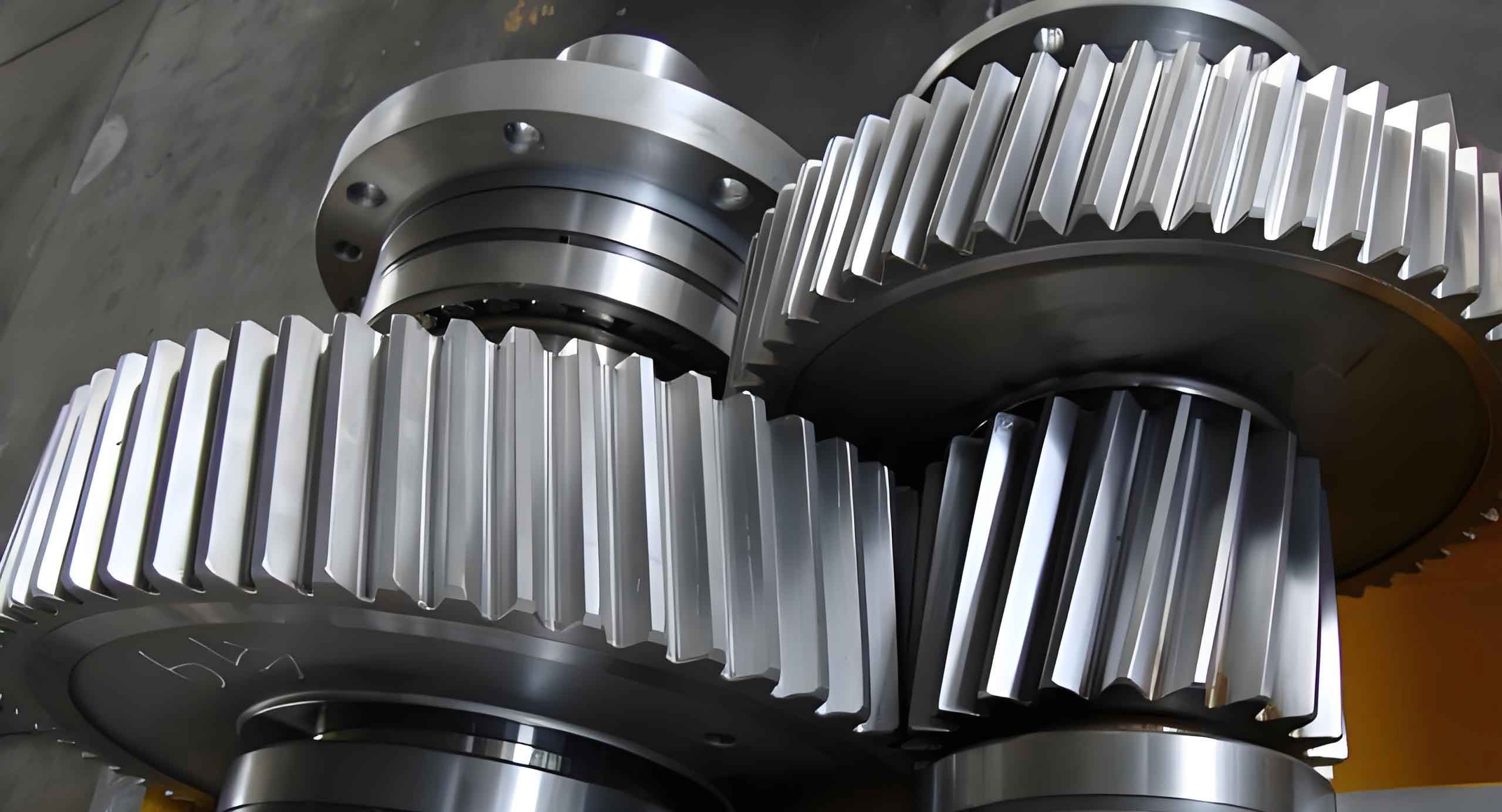
When micro-geometry modifications are introduced, they alter the nominal tooth profile, effectively creating a small, predefined deviation $h_{pg}(x, t)$ from the perfect involute surface along the path of contact. This deviation directly affects the composite mesh deformation $\delta_{pg}$. The modified elastic deformation $\bar{\delta}_{pg}$ becomes:
$$ \bar{\delta}_{pg} = \delta_{pg} – h_{pg}(x, t) $$
This change in deformation profile introduces an additional excitation term e(x, t) into the dynamic system. This term is a function of the modification geometry $h_{pg}$ and the mean mesh stiffness $k_m$. For instance, the additional excitation vector on the pinion due to modification can be derived as:
$$ \mathbf{e}_p(x, t) = k_m h_{pg} [-\cos\beta,\ \sin\beta,\ -\sin\beta,\ -\cos\beta]^T $$
where $\beta$ is the helix angle of the helical gear. A similar expression holds for the gear. The total modified dynamic equation is therefore:
$$ \mathbf{M}\ddot{\mathbf{q}} + \mathbf{C}\dot{\mathbf{q}} + \mathbf{K}\mathbf{q} = \mathbf{f} + \mathbf{e}(x, t) = \tilde{\mathbf{f}} $$
This system of nonlinear, second-order differential equations is typically solved using numerical integration methods like the Runge-Kutta algorithm to obtain the dynamic response, namely the Dynamic Transmission Error (DTE) and the Dynamic Mesh Force (DMF).
Determining the optimal modification parameters is a critical design step. The goal is to minimize excitations while ensuring even load distribution. For the case study of a high-power wind turbine gearbox intermediate-stage helical gear pair, I focused on two common types of modifications applied to the driven gear: lead crowning (or helix angle modification) and profile crowning. The objective function was the minimization of the Static Transmission Error fluctuation ($\Delta STE$), subject to the constraint of achieving uniform load distribution across the tooth face.
An analysis was conducted to map the $\Delta STE$ against different combinations of lead crowning amount ($L_c$) and profile crowning amount ($P_c$). The parametric study revealed a clear optimal region. The combination that minimized $\Delta STE$ was found to be $L_c = 42 \mu m$ and $P_c = 58 \mu m$. The effectiveness of this specific modification strategy was validated by examining the load distribution on the tooth surface. The modified gear exhibited a significantly more uniform pressure distribution across both the face width and the profile direction compared to the unmodified gear, confirming the constraint was satisfied.
| Modification Parameter | Symbol | Optimal Value ($\mu m$) |
|---|---|---|
| Lead Crowning Amount | $L_c$ | 42 |
| Profile Crowning Amount | $P_c$ | 58 |
The dynamic benefits of this deterministic optimal modification are substantial. A comparison of the frequency-domain Dynamic Mesh Force (DMF) before and after modification reveals dramatic reductions. For the first three harmonic orders, the results are summarized below:
| Harmonic Order | Unmodified DMF Peak (N) | Modified DMF Peak (N) | Reduction |
|---|---|---|---|
| 1st | 27,575.3 | 1,210.8 | 95.6% |
| 2nd | 1,490.6 | 261.6 | 82.4% |
| 3rd | 1,675.9 | 114.1 | 93.2% |
Similarly, the Dynamic Transmission Error (DTE) was greatly smoothed. The peaks of the first three DTE harmonics, which were 8.5 $\mu m$, 0.46 $\mu m$, and 0.52 $\mu m$ for the unmodified helical gear, were all suppressed to levels below 0.4 $\mu m$ after modification. This confirms the efficacy of the chosen parameters in a deterministic setting.
However, in practical manufacturing, the achieved modification amounts $L_c$ and $P_c$ are not deterministic but are random variables due to process tolerances and errors. Therefore, a reliability analysis is indispensable to evaluate the probability that the dynamic performance remains acceptable despite these variations. The key performance indicator I chose for reliability assessment is the fluctuation of the Dynamic Transmission Error ($\Delta DTE$).
The relationship between the random input variables (modification amounts) and the random output ($\Delta DTE$) is complex and nonlinear. To model this efficiently, I employed the Response Surface Method (RSM). The modification parameters were treated as normally distributed random variables: $X_1 (L_c) \sim N(\mu_1=42\mu m, \sigma_1=4.5\mu m)$ and $X_2 (P_c) \sim N(\mu_2=58\mu m, \sigma_2=4.5\mu m)$. A Central Composite Design was used to select sample points around the mean values. For each sample point $(x_1^{(i)}, x_2^{(i)})$, a full deterministic dynamic simulation was run to obtain the response $y^{(i)}$ (the $\Delta DTE$ for a specific harmonic).
| Run | $X_1$ (Coded) | $X_2$ (Coded) | $\Delta DTE_1$ ($\mu m$) | $\Delta DTE_2$ ($\mu m$) | $\Delta DTE_3$ ($\mu m$) |
|---|---|---|---|---|---|
| 1 | +$\alpha$ | 0 | 0.35 | 0.35 | 0.048 |
| 2 | -$\alpha$ | 0 | 0.21 | 0.35 | 0.041 |
| 3 | 0 | +$\alpha$ | 1.09 | 0.35 | 0.031 |
| 4 | 0 | -$\alpha$ | 0.85 | 0.32 | 0.088 |
| 5 | +1 | +1 | 0.83 | 0.35 | 0.049 |
| 6 | +1 | -1 | 0.63 | 0.33 | 0.083 |
| 7 | -1 | +1 | 0.81 | 0.36 | 0.037 |
| 8 | -1 | -1 | 0.62 | 0.33 | 0.079 |
| 9 | 0 | 0 | 0.36 | 0.055 | 0.024 |
Using the data from these simulations, a second-order polynomial with interaction terms was fitted for the $\Delta DTE$ of each harmonic ($y_1, y_2, y_3$). For example, the response surface for the first harmonic $\Delta DTE_1$ was approximated as:
$$ y_1 = 55.5595 + 0.0915 x_1 – 1.9904 x_2 + 0.0001 x_1 x_2 – 0.0011 x_1^2 + 0.0173 x_2^2 $$
These explicit, closed-form response functions serve as highly efficient metamodels, replacing the computationally expensive full dynamic simulation for subsequent probabilistic analysis.
With the input-output relationship defined via the response surface, Monte Carlo Simulation (MCS) was employed to assess reliability. The limit state function $g(\mathbf{X})$ defines failure as the event where the actual $\Delta DTE$ exceeds a critical threshold $y_{crit}$. This is formulated as:
$$ g(\mathbf{X}) = y_{crit} – y(\mathbf{X}) $$
Failure occurs when $g(\mathbf{X}) < 0$. Using MCS, 90,000 random samples of $(X_1, X_2)$ were generated according to their normal distributions. For each sample, the $\Delta DTE$ was calculated instantaneously using the RSM equations, and the value of $g(\mathbf{X})$ was evaluated. The probability of failure $P_f$ is then estimated as the ratio of failed samples to the total number of samples.
The reliability analysis yielded the following probabilities of failure for the first three DTE harmonics, considering the variability in the helical gear modification parameters:
| DTE Harmonic Order | Estimated Probability of Failure $P_f$ | Coefficient of Variation of $P_f$ |
|---|---|---|
| 1st | 0.21% | 0.0745 |
| 2nd | 0.55% | 0.0427 |
| 3rd | 2.31% | 0.0212 |
The very low probabilities of failure, all below 2.5%, demonstrate the high reliability of the proposed modification strategy. Even when the lead and profile crowning amounts vary within expected manufacturing tolerance bands, the dynamic performance, as measured by $\Delta DTE$, is highly likely to remain within acceptable limits. The low coefficients of variation for the $P_f$ estimates indicate that the Monte Carlo simulation results are statistically stable and converged.
In conclusion, this integrated study underscores the profound impact of meticulously designed tooth surface modifications on the dynamic performance of helical gear pairs. The establishment of a coupled dynamic model incorporating modification functions provides a robust framework for analysis. The deterministic optimization successfully identified a combination of lead and profile crowning that minimizes static transmission error fluctuation and ensures uniform load distribution, leading to dramatic reductions in dynamic mesh forces and transmission error. Crucially, by embracing the stochastic nature of manufacturing through Response Surface Methodology and Monte Carlo Simulation, the research transcends deterministic optimization. The reliability analysis quantitatively proves that the benefits of the proposed helical gear modification strategy are robust, maintaining a high probability of excellent dynamic performance even in the face of inherent production variations. This holistic approach, combining advanced dynamics with reliability engineering, provides a more comprehensive and practical foundation for the design of high-performance, low-noise helical gear transmissions.