
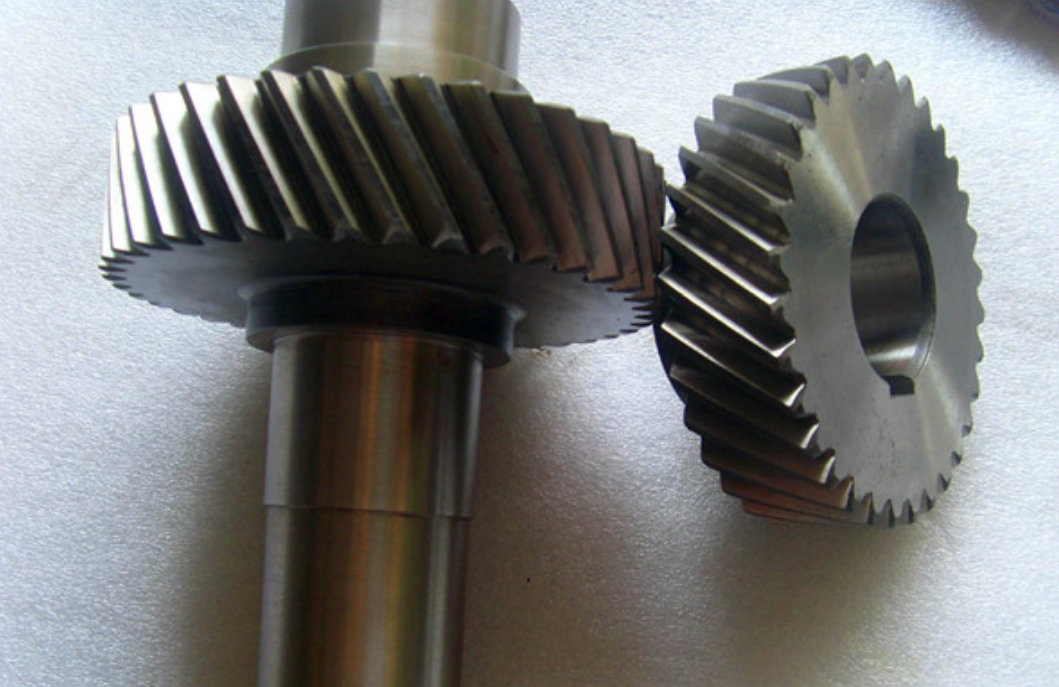
In the intricate world of automotive powertrain design, the quest for efficiency, durability, and cost-effectiveness is perpetual. One critical component in this landscape is the helical gear. Unlike their spur gear counterparts, helical gears feature teeth that are cut at an angle to the gear axis. This design offers significant advantages, such as smoother and quieter operation due to gradual tooth engagement, and the ability to transmit higher loads. They are fundamental in providing the necessary rotation, speed variation, and torque multiplication within vehicle transmissions. The efficient and reliable operation of an automotive drivetrain hinges significantly on the performance of its helical gear pairs.
However, the performance of these helical gears is inextricably linked to the behavior of their supporting elements—the bearings. During operation, forces are generated at the tooth contact interface of the meshing helical gears. These contact forces, which have both radial and axial components due to the gear’s helix angle, are transmitted through the shafts and ultimately borne by the supporting bearings. The bearings facilitate smooth rotation with minimal friction but are not immune to power losses. These bearing losses, primarily manifesting as frictional torque, are influenced by a complex interplay of factors including the applied loads (radial and axial), the properties of the lubricant, internal design of the bearing, and operational speed. Traditionally, the assessment of bearing performance, load capacity, and life prediction has relied heavily on theoretical calculations or expensive and time-consuming physical testing. This approach often leads to high costs in the design phase.
The objective of this work is to establish a simulation-based methodology to model and analyze the bearing loads and subsequent power losses in a system driven by automotive helical gear pairs. We aim to accurately simulate the axial and radial contact loads generated at the helical gear mesh, project these loads onto the supporting bearings, and quantitatively calculate the contribution of these loads to the overall bearing power loss. By creating a high-fidelity virtual prototype, we seek to reduce dependency on physical experimentation, thereby lowering development costs and accelerating the design cycle while enhancing the quality and reliability of the final product.
Mathematical Modeling of Bearing Loss and Friction
To accurately simulate bearing behavior, a robust mathematical foundation is essential. The total frictional torque or power loss in a bearing is not a single-value phenomenon but a sum of several distinct components. Our modeling approach considers these components systematically.
1. Generalized Bearing Loss Model
The total torque loss \( T \) in a bearing can be expressed as the sum of losses originating from lubricant churning, radial load, and axial load:
$$ T = T_o + T_r + T_a $$
where:
\( T_o \) = Torque loss due to lubricant (viscous drag).
\( T_r \) = Torque loss due to equivalent radial load.
\( T_a \) = Torque loss due to equivalent axial load.
The loss due to the lubricant is highly dependent on the oil’s flow regime (laminar or turbulent) and its viscosity. It can be modeled as:
$$
T_o =
\begin{cases}
f_0 \cdot 10^{-7} \cdot D^3 \cdot \omega \cdot \nu^{0.5} & \text{if } \omega \cdot D^2 / \nu < 2000 \quad \text{(Laminar)} \\
f_0 \cdot 1.25 \cdot 10^{-7} \cdot D^{2.8} \cdot \omega^{1.8} \cdot \nu^{0.2} & \text{if } \omega \cdot D^2 / \nu \ge 2000 \quad \text{(Turbulent)}
\end{cases}
$$
where \( D \) is the shaft diameter, \( \nu \) is the kinematic viscosity of the lubricant, \( \omega \) is the angular speed of the shaft, and \( f_0 \) is a friction coefficient dependent on the bearing type and lubrication method.
The losses attributable to the applied loads are given by:
$$
\begin{aligned}
T_r &= f_1 \cdot C_f \cdot (P_0 + P_1) \\
T_a &= f_2 \cdot D \cdot F_a
\end{aligned}
$$
where \( f_1 \) and \( f_2 \) are friction coefficients for radial and axial load respectively, \( C_f \) is an adjustment coefficient for radial load loss, \( P_0 \) is the equivalent static preload, \( P_1 \) is the equivalent dynamic load, and \( F_a \) is the axial load. The dynamic load \( P_1 \) is a function of the actual radial and axial forces transmitted from the helical gear mesh to the bearing.
2. Advanced Friction Modeling: The SKF Model
For higher precision in calculating the frictional torque generated within rolling bearings, we employ the SKF model. This comprehensive model accounts for all major sources of friction in a bearing:
$$ M = M_{rr} + M_{sl} + M_{seal} + M_{drag} $$
where:
\( M \) = Total frictional moment.
\( M_{rr} \) = Rolling frictional moment.
\( M_{sl} \) = Sliding frictional moment.
\( M_{seal} \) = Seal frictional moment.
\( M_{drag} \) = Drag loss moment (churning, splashing).
Rolling Frictional Moment (\( M_{rr} \)): This arises from hysteresis and viscous losses in the rolling contacts.
$$ M_{rr} = \phi_{ish} \phi_{rs} G_{rr} (\nu \cdot n)^{0.6} $$
Here, \( n \) is the rotational speed, \( G_{rr} \) is a variable dependent on bearing type, mean diameter, and load, and \( \phi_{ish} \) and \( \phi_{rs} \) are reduction factors for inlet shear heating and replenishment/starvation effects, respectively. These factors are crucial as not all lubricant participates in film formation; some is sheared, generating heat and reducing effective viscosity.
Sliding Frictional Moment (\( M_{sl} \)): This originates from sliding contacts within the bearing, such as between guiding surfaces.
$$ M_{sl} = G_{sl} \mu_{sl} $$
where \( G_{sl} \) is a load-dependent variable and \( \mu_{sl} \) is the sliding friction coefficient.
Seal Frictional Moment (\( M_{seal} \)): For bearings with integral seals.
$$ M_{seal} = K_{s1} d_s^{\beta} + K_{s2} d_s $$
where \( K_{s1}, K_{s2}, \) and \( \beta \) are constants, and \( d_s \) is the seal counterface diameter.
Drag Loss Moment (\( M_{drag} \)): This accounts for losses from lubricant churning in oil-bath lubrication, which depends on immersion depth \( H \), oil properties, and adjacent components like the helical gear itself.
$$
\begin{aligned}
M_{drag} &= \frac{V_M \cdot K_{ball} \cdot d_m^5 \cdot n^2}{10^{10}} \\
\text{with } V_M &= \left( \frac{0.0931}{f_t \cdot (H/d_m)^{1.3791}} \right) \left( \frac{R}{d_m} \right)^{0.25} \cdot \left( \frac{\nu \cdot n}{4000} \right)^{0.7} \quad \text{for } 0 \le t \le 1 \\
f_t &= \begin{cases} \sin(50^\circ \cdot t) & \text{for } 0 \le t \le 1 \\
1 & \text{for } 1 < t < \pi/2 \\
\frac{2}{\pi} \arccos\left(1 – \frac{2t_m}{\pi}\right) & \text{for } \pi/2 \le t \le \pi
\end{cases} \\
t &= \arccos(1 – 2H/d_m), \quad t_m = \min(t, \pi – t)
\end{aligned}
$$
3. Control System: PID for Speed Regulation
To implement realistic dynamic conditions in our simulation, we employ a Proportional-Integral-Derivative (PID) speed controller on the input shaft driving the pinion helical gear. This allows us to prescribe complex speed profiles and observe the transient bearing responses. The transfer function of the PID controller is:
$$ G_c(s) = \frac{U(s)}{E(s)} = k_p \left(1 + \frac{1}{T_I s} + T_D s \right) $$
where \( k_p \) is the proportional gain, \( T_I \) is the integral time constant, \( T_D \) is the derivative time constant, \( E(s) \) is the speed error, and \( U(s) \) is the control output (e.g., driving torque).
Simulation Model Development in AMESim
We developed a detailed system-level model in the AMESim multi-domain simulation environment to realize the proposed analysis. The model integrates mechanical, hydraulic, and control system components.
The core of the model is a pair of meshing helical gears. The pinion (driver) and the gear (driven) are each supported by two rolling element bearings on their respective shafts. The model is designed to calculate the dynamic tooth contact forces, which naturally include both tangential (torque-transmitting) and separating (radial) components, as well as a significant axial thrust force due to the helix angle of the helical gear teeth. These forces are resolved at the gear mesh and are automatically transmitted through the shaft models to the bearing housing connections.
Each bearing in the model is configured with the SKF friction model, allowing for a detailed calculation of the instantaneous frictional torque based on the applied radial and axial loads, speed, and specified lubricant properties.
The following tables summarize the key parameters used in the simulation model:
| Parameter | Pinion | Gear |
|---|---|---|
| Number of Teeth | 18 | 79 |
| Working Transverse Pressure Angle | 25° | |
| Helix Angle | 30° | |
| Addendum Circle Radius | 17.19 mm | Derived |
| Component | Parameter | Value |
|---|---|---|
| Bearings (All four) | Mean Diameter, \( d_m \) | 40 mm |
| Speed-dependent Friction Coeff., \( f_0 \) | 2 | |
| Load-dependent Friction Coeff., \( f_1, f_2 \) | 2.5 × 10⁻⁴ | |
| Pinion Shaft | Load Moment of Inertia | 1 kg·m² |
| Pinion Shaft | Viscous Friction Coefficient | 0.01 N·m/(r/min) |
| Setting | Value |
|---|---|
| Controller Type | PI (Derivative term set to zero) |
| Proportional Gain, \( k_p \) | 10 |
| Integral Time Constant, \( T_I \) | 0.1 s |
| Control Output Limits | -100 to 100 (arb. units) |
| Simulation Time Step | 0.01 s |
| Total Simulation Time | 12 s |
A complex speed profile was commanded to the pinion shaft to evaluate bearing behavior under acceleration, deceleration, steady-state, and reverse rotation conditions, as defined below and shown in the results.
Simulation Results and Discussion
The simulation was executed over the 12-second cycle. The PID controller effectively tracked the commanded speed profile. The tracking performance was smooth and accurate, with no significant overshoot or instability, confirming that the control loop provided a realistic dynamic input to the helical gear system.
The primary results of interest are the axial and radial forces projected onto the bearings as a consequence of the helical gear mesh forces. These forces were extracted for the two bearings on the high-speed pinion shaft and the two bearings on the low-speed gear shaft.
Forces on Pinion Shaft Bearings: The axial and radial force profiles on the pinion shaft bearings are synchronized with the speed transients. During the initial linear acceleration (0-1 s), both force components rise sharply as torque is applied to overcome system inertia and establish the gear mesh load. Once steady-state speed is reached (1-4 s), the forces settle to a relatively constant value of approximately 9 N. The deceleration phase into reverse (4-6 s) causes another sharp increase in bearing forces. During steady reverse rotation (6-8 s), forces again settle around 9 N. The final deceleration to stop (8-10 s) produces another transient peak before forces decay to zero as the system comes to rest (10-12 s). This pattern clearly demonstrates that the most significant bearing loads occur during acceleration and deceleration events, not during constant-speed operation.
Forces on Gear Shaft Bearings: The force profiles on the gear shaft bearings follow an identical temporal pattern to those on the pinion shaft. However, the magnitude of the forces is substantially higher. The steady-state force levels are between 10-20 N, and the transient peaks reach approximately 150 N. This difference is expected due to the torque multiplication across the helical gear pair. The gear shaft experiences higher torque, and consequently, higher tooth contact forces, which translate into higher bearing reaction forces. The model successfully captures this fundamental mechanical relationship.
The bearing power loss (frictional torque) can be directly calculated within the model using the SKF equations, based on these simulated load profiles, the speed, and the lubricant data. The total loss would be the sum of the losses from all four bearings. The SKF model’s advantage is evident here, as it can differentiate between the loss contributions from the heavily loaded gear shaft bearings and the less-loaded pinion shaft bearings, and further break down the loss into rolling, sliding, and drag components based on the specific operational conditions.
Conclusion
This work successfully developed and demonstrated a comprehensive simulation methodology for analyzing bearing loads and associated power losses in automotive drivetrains employing helical gear pairs. By integrating a detailed SKF-based bearing friction model within a dynamic multi-body system simulation in AMESim, we created a virtual test bench capable of predicting forces and losses with high fidelity.
The key outcomes are: 1) The model accurately simulates the radial and axial bearing loads generated from helical gear contact forces under dynamic speed conditions. 2) It clearly shows that transient operational phases (acceleration/deceleration) induce significantly higher bearing loads compared to steady-state operation. 3) The load differential between the pinion and gear shafts, stemming from gear ratio and torque multiplication, is correctly captured. 4) The integration of the advanced SKF model provides a pathway to a precise, physics-based calculation of bearing power loss, moving beyond simplified empirical formulas.
This simulation-based approach offers a powerful tool for design engineers. It enables the virtual evaluation of different helical gear parameters (helix angle, pressure angle), bearing types, and lubrication strategies on the resulting system efficiency and component loads. By identifying critical load scenarios early in the design process, engineers can make informed decisions about bearing selection, size, and arrangement, ultimately leading to more robust, efficient, and cost-effective automotive transmission designs without the immediate need for costly physical prototypes and testing.