
The precise alignment of a single keyway relative to the tooth flank of a helical gear presents a unique and significant challenge in transmission manufacturing. Unlike spur gears, where the keyway’s symmetry can be ensured relative to any tooth cross-section along the face width, helical gears require the keyway to be symmetrically aligned with a specific, designated tooth space at a precise axial location. This requirement, often found in dual countershaft transmission designs, is critical for ensuring proper load distribution and smooth assembly. Traditional alignment methods, adapted from spur gear or shaft processing, proved inadequate for high-volume production of precision-ground or shaved helical gears. This article details the development of a novel alignment process and an inline inspection method, specifically engineered to overcome these limitations and enable the efficient, stable, and quantifiable batch production of helical gears with single keyways.
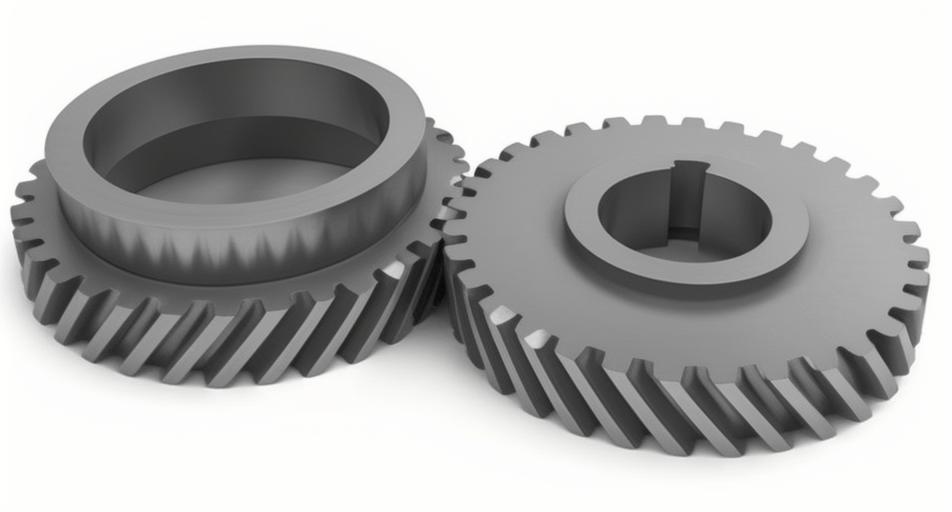
The core of the problem lay in the inherent complexity of the helical gear geometry. The conventional fixture used a spherical probe (ball-point) to locate against the tooth flank for orientation before keyway broaching or milling. This method had several critical flaws when applied to shaved or ground helical gears. Firstly, the point contact between the spherical probe and the finished tooth surface created extremely high contact pressure, often resulting in indentation or damage to the precise tooth flank. Secondly, adjusting the fixture to achieve the required keyway-to-tooth symmetry was a purely empirical process. Technicians relied on experience and manual tapping with a copper hammer, making it impossible to perform quantitative adjustments. Each adjustment attempt required subsequent validation via a Coordinate Measuring Machine (CMM), leading to prolonged setup times, high scrap rates during debugging, and inconsistent results during production runs. Finally, the absence of a quick, shop-floor inspection tool meant that process stability could not be monitored effectively, relying entirely on offline CMM checks which disrupted production flow.
| Challenge Category | Description | Consequence |
|---|---|---|
| Fixturing & Damage | Spherical probe causing point contact on finished tooth flank. | Indentation and damage to the critical tooth surface of the helical gear. |
| Adjustment Process | Empirical adjustment via manual tapping; non-quantitative. | Long setup times, high debug scrap, and non-repeatable alignment. |
| Inspection Bottleneck | Dependence on offline CMM for symmetry measurement. | No in-process control, inability to monitor process stability, production delays. |
The new process was developed to systematically address each of these shortcomings. The solution is built upon three interconnected innovations: a dedicated alignment gauge for helical gears, a quantifiable adjustment mechanism, and a novel inline inspection methodology.
The first innovation replaces the damaging spherical probe with a custom-designed helical gear alignment gauge. This gauge is contoured to match the profile and helix angle of the specific gear tooth. Instead of point contact, it establishes a controlled line or area contact along the tooth flank, distributing the clamping force and completely eliminating the risk of surface indentation on the precision-finished helical gear.
The second and most crucial innovation is the introduction of an adjustable mounting block integrated into the broaching fixture’s slide plate. The alignment gauge is mounted onto a movable positioning block. This block is lowered onto the new adjustable mounting block, which features two pairs of precision set screws on opposite sides. Dial indicators are mounted on the positioning block, contacting reference surfaces on the adjustable block. By selectively turning the set screws, the positioning block (and thus the alignment gauge) can be shifted laterally with micrometer precision. The amount of adjustment required can be calculated directly from the measured symmetry error, transforming the process from an art to a science.
The adjustment amount $\Delta S$ required at the fixture is related to the measured symmetry error $\Delta m$ on the gear and the helical gear‘s helix angle $\beta$. The relationship can be derived from the gear’s geometry, considering the axial shift between the reference cross-section and the fixture contact point. A simplified formula for the necessary lateral shift at the fixture is:
$$
\Delta S = \frac{\Delta m}{2 \tan(\beta)}
$$
Where $\Delta m$ is the measured symmetry error (e.g., from CMM), and $\beta$ is the helix angle. This allows for direct, quantitative correction.
| Feature | Traditional Spherical Probe Fixture | New Dedicated Gauge with Adjustable Block |
|---|---|---|
| Tooth Contact | Point contact, high pressure. | Line/area contact, distributed pressure. |
| Adjustment Method | Empirical, manual tapping. | Quantitative, using calculated screw adjustment. |
| Setup Time | Long and unpredictable. | Short, predictable, and repeatable. |
| Risk of Damage | High risk of tooth flank indentation. | Effectively eliminated. |
| Process Capability | Low, unstable. | High, stable, suitable for batch production. |
The third innovation solves the inspection bottleneck. A dedicated inline inspection fixture was developed to monitor keyway symmetry without needing a CMM. The method is based on a comparative measurement principle. The gear is mounted on a mandrel, and the single keyway is engaged with a cylindrical pin. A dial indicator is fixed and positioned to probe the tooth space at the exact axial location specified in the drawing (the K-basis cross-section). A measurement is taken. Then, the gear is flipped 180 degrees on the mandrel, and a second measurement is taken at the same axial cross-section (ensured by using a spacer block). If the keyway is perfectly symmetric to the designated tooth space, the difference between the two dial indicator readings will be zero. Any asymmetry manifests as a difference in these readings.
This raw difference ($R_d$) is not the direct symmetry error ($S_e$). It must be converted using a symmetry conversion factor ($C_f$) derived from the geometry of the helical gear. The factor accounts for the fact that the probe contact point traverses along the helix when the gear is flipped. The conversion formula is:
$$
S_e = \frac{R_d}{C_f}
$$
Where the conversion factor $C_f$ is a function of the gear’s normal pressure angle ($\alpha_n$), helix angle ($\beta$), and the nominal tooth thickness at the probe diameter. For a standard probe placed at the pitch diameter, it can be approximated as:
$$
C_f \approx \frac{1}{\cos(\beta) \cdot \cos(\alpha_n)}
$$
A sample calculation for a helical gear with $\beta = 23^\circ$ and $\alpha_n = 20^\circ$ yields $C_f \approx 1.15$. Therefore, a dial indicator difference ($R_d$) of 0.058 mm would indicate an actual symmetry error ($S_e$) of approximately 0.050 mm.
| Step | Parameter | Value | Description |
|---|---|---|---|
| 1 | Dial Reading (Side A), $R_a$ | +0.512 mm | Measurement before flipping gear. |
| 2 | Dial Reading (Side B), $R_b$ | +0.570 mm | Measurement after flipping gear (with spacer). |
| 3 | Raw Difference, $R_d = |R_a – R_b|$ | 0.058 mm | Observed dial indicator variation. |
| 4 | Conversion Factor, $C_f$ | 1.15 | Calculated from gear geometry (e.g., $\beta=23^\circ$, $\alpha_n=20^\circ$). |
| 5 | Calculated Symmetry Error, $S_e = R_d / C_f$ | 0.050 mm | Actual keyway symmetry error relative to tooth space. |
| 6 | Drawing Specification Limit | 0.051 mm | Maximum allowable symmetry error. |
| 7 | Judgment | OK (0.050 ≤ 0.051) | The produced helical gear is within specification. |
This integrated approach—combining the dedicated alignment gauge, the quantifiable adjustment mechanism, and the inline inspection method—has fundamentally transformed the production of helical gears with single keyways. The process is now characterized by rapid, predictable setup times where adjustments are calculated and applied precisely, eliminating trial-and-error. The risk of damaging expensive finished helical gears during fixturing is eradicated. Most importantly, the ability to perform frequent, simple inline checks provides immediate feedback on process stability, enabling true statistical process control and ensuring consistent quality throughout long batch production runs. This development provides a robust, reliable, and scalable methodology for manufacturing this critical class of transmission components, resolving a key bottleneck and setting a new standard for precision and efficiency in gear machining.