
In modern high-speed and high-load transmission systems, the vibration and noise reduction of helical gears remains a critical challenge. As a key component in applications such as aerospace, marine propulsion, and electric vehicles, the dynamic performance of helical gears directly impacts overall system reliability and comfort. Traditional modification techniques, like profile and lead crowning, have shown limitations in balancing load capacity and vibration excitation. Therefore, I explore an advanced method known as triangular end relief for helical gears, which focuses on modifying only the engagement and disengagement zones of the tooth flank. This approach minimizes material removal while maintaining high contact ratio and load-bearing area. In this article, I delve into the design principles, optimization strategies, and grinding implementation using a large plane wheel, aiming to reduce the fluctuation of loaded transmission error—a primary source of vibration. Through detailed mathematical modeling, simulation analysis, and practical insights, I demonstrate how this method enhances the performance of helical gears in precision transmissions.
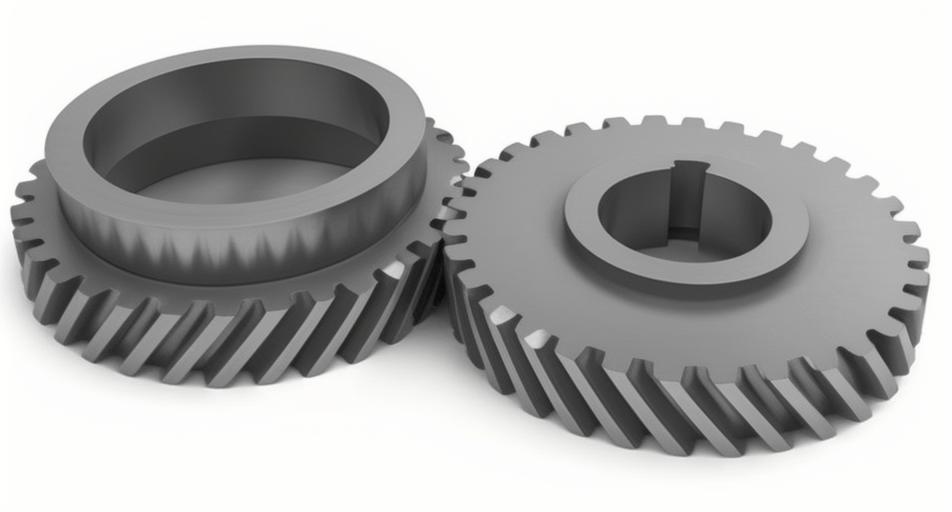
The helical gear is renowned for its smooth and quiet operation due to the gradual engagement of teeth along a helical path. However, under high-speed and heavy-load conditions, factors such as manufacturing errors, assembly misalignments, and time-varying mesh stiffness can lead to significant vibration and noise. The loaded transmission error, which combines geometric deviations and elastic deformations, serves as a direct excitation source in gear dynamics. To mitigate this, tooth flank modifications are employed to optimize contact patterns and reduce stress concentrations. Triangular end relief, specifically, targets the ends of the tooth where engagement impacts occur, applying controlled modifications to dampen vibrations without compromising the helical gear’s inherent advantages. In my analysis, I emphasize the helical gear’s role in modern machinery and the need for tailored modification techniques that address both static and dynamic loads.
Triangular end relief for a helical gear involves modifying the tooth flank at the entry and exit regions, while leaving the central portion unmodified or lightly modified. This design is defined by key parameters, as illustrated in standards like ISO 21771:2007. For a right-hand helical gear’s left flank, the modification parameters include the relief height at the tooth top (L_Ea), maximum relief amount at the tooth top (C_Ea), relief height at the tooth root (L_Ef), and maximum relief amount at the tooth root (C_Ef). The starting lines of modification, which separate the modified zones from the unmodified zone, are critical and correspond to instantaneous contact lines. To calculate these, I begin with the standard involute helicoid surface equation of the helical gear. The position vector and unit normal vector of the standard flank can be expressed as:
$$ \mathbf{r}_1(u_1, \theta_1) = \begin{bmatrix} x_1(u_1, \theta_1) \\ y_1(u_1, \theta_1) \\ z_1(u_1, \theta_1) \end{bmatrix}, \quad \mathbf{n}_1(u_1, \theta_1) = \frac{\partial \mathbf{r}_1 / \partial u_1 \times \partial \mathbf{r}_1 / \partial \theta_1}{|\partial \mathbf{r}_1 / \partial u_1 \times \partial \mathbf{r}_1 / \partial \theta_1|}, $$
where \( u_1 \) and \( \theta_1 \) are surface parameters. The starting points for modification at the tooth top (e.g., points B and C) are determined by solving nonlinear equations based on geometric constraints. For instance, for point B, the equations are:
$$ \begin{cases} x_{1B}^2(u_{1B}, \theta_{1B}) + y_{1B}^2(u_{1B}, \theta_{1B}) = R_B, \\ z_{1B}(u_{1B}, \theta_{1B}) = L_B, \end{cases} $$
where \( R_B \) and \( L_B \) are coordinates on the rotational projection plane. Similar calculations apply to the tooth root starting points (e.g., points E and F). The termination of modification at the tooth top is typically the tip circle, accounting for chamfers, while at the root, it is based on the minimum engagement length to ensure meshing integrity. The radius for the root modification termination \( r_{k1} \) is given by:
$$ r_{k1} = \sqrt{ r_{b1}^2 + \left[ (r_{p1} + r_{p2}) \sin \alpha_t – \sqrt{r_{a2}^2 – r_{b2}^2} \right]^2 }, $$
where \( r_{b1} \) and \( r_{b2} \) are base circle radii, \( r_{p1} \) and \( r_{p2} \) are pitch circle radii, \( r_{a2} \) is the driven gear’s tip radius, and \( \alpha_t \) is the transverse pressure angle. Once the starting lines are obtained, the relief lengths \( b_{Ea} \) and \( b_{Ef} \) are computed from the geometric constraints on the rotational projection plane. In practice, these starting lines are approximated as straight lines for simplicity, with spiral angles \( \beta_a \) and \( \beta_f \) defined for the top and root regions, respectively.
The modification amount \( \delta(x, y) \) at any point P in the relief zones depends on the distance to the starting line and the order of the modification curve. For the tooth top zone \( \triangle ABC \), the relief amount increases from zero at the starting line to the maximum \( C_{Ea} \) at the termination, following a power-law function. Similarly, for the tooth root zone \( \triangle DEF \), it follows a comparable pattern. The general expression is:
$$ \delta(x, y) = \begin{cases} C_{Ea} \left( \frac{l_p}{l_a} \right)^{k_a}, & \text{if } P \in \triangle ABC, \\ C_{Ef} \left( \frac{l_p}{l_f} \right)^{k_f}, & \text{if } P \in \triangle DEF, \\ 0, & \text{otherwise}, \end{cases} $$
where \( l_p \) is the distance from point P to the starting line, \( l_a \) and \( l_f \) are the total relief lengths at top and root, and \( k_a \) and \( k_f \) are the orders of the modification curves (e.g., linear, parabolic). The modified flank of the helical gear is then obtained by superimposing this relief amount in the normal direction onto the standard involute helicoid:
$$ \mathbf{r}_{1m}(u_1, \theta_1) = \mathbf{r}_1(u_1, \theta_1) + \delta(x, y) \mathbf{n}_1(u_1, \theta_1), $$
$$ \mathbf{n}_{1m}(u_1, \theta_1) = \left( \frac{\partial \mathbf{r}_1}{\partial u_1} + \frac{\partial \delta}{\partial u_1} \mathbf{n}_1 \right) \times \left( \frac{\partial \mathbf{r}_1}{\partial \theta_1} + \frac{\partial \delta}{\partial \theta_1} \mathbf{n}_1 \right). $$
This formulation ensures a smooth transition between modified and unmodified zones, preserving the helical gear’s contact characteristics. To illustrate the parameters involved, I summarize typical design variables for triangular end relief in a helical gear:
| Parameter | Symbol | Description |
|---|---|---|
| Tooth Top Relief Height | L_Ea | Height from pitch line to start of top relief |
| Tooth Top Max Relief Amount | C_Ea | Maximum modification at tooth top edge |
| Tooth Root Relief Height | L_Ef | Height from pitch line to start of root relief |
| Tooth Root Max Relief Amount | C_Ef | Maximum modification at tooth root edge |
| Relief Curve Order (Top) | k_a | Order of polynomial for top relief (1=linear, 2=quadratic, etc.) |
| Relief Curve Order (Root) | k_f | Order of polynomial for root relief |
| Spiral Angle at Top | β_a | Spiral angle of top relief starting line |
| Spiral Angle at Root | β_f | Spiral angle of root relief starting line |
Optimizing these parameters is crucial to minimize the loaded transmission error fluctuation, which directly affects the helical gear’s vibration performance. I employ a genetic algorithm due to the nonlinear relationship between design variables and the objective function. The optimization model aims to reduce \( \Delta T_e \), the amplitude of loaded transmission error, defined as:
$$ \Delta T_e = \max(T_e) – \min(T_e), $$
where \( T_e \) is the loaded transmission error over a mesh cycle. The design variables include \( L_{Ea} \), \( C_{Ea} \), \( L_{Ef} \), and \( C_{Ef} \), with bounds based on gear geometry. The optimization process integrates tooth contact analysis (TCA) and loaded tooth contact analysis (LTCA) to compute \( T_e \) iteratively. TCA determines the geometric contact pattern and unloaded transmission error, while LTCA incorporates tooth compliance and load distribution to simulate real operating conditions. The genetic algorithm steps involve encoding parameters into chromosomes, generating an initial population, evaluating fitness via \( \Delta T_e \), and applying selection, crossover, and mutation over multiple generations. This approach efficiently explores the solution space, avoiding local minima and converging to an optimal set of relief parameters for the helical gear.
The grinding of helical gears with triangular end relief requires precise implementation, and I focus on using a large plane wheel for high efficiency. This method simulates the generation process of an imaginary helical rack cutter, where the wheel’s flat working face corresponds to one side of the rack tooth. For grinding a right-hand helical gear’s left flank, the setup involves coordinating multiple axes to achieve the required relief. First, the minimum diameter of the large plane wheel must be calculated to ensure full coverage of the working flank without interference. The wheel’s working face is oriented to match the rack’s tool surface, with a transition arc at the tip to avoid sharp edges. The minimum wheel diameter \( d_0 \) is derived from geometric constraints, ensuring that the chord length on the wheel’s face exceeds the projected length of the relief zone along the helical path. Based on the rack geometry, the wheel’s outer radius \( r_M \) is:
$$ r_M = \frac{d_0}{2} – r_f \frac{1 – \sin \alpha_n}{\cos \alpha_n}, $$
where \( r_f \) is the transition arc radius, and \( \alpha_n \) is the normal pressure angle. The condition for complete grinding is \( PQ \geq B / \cos \beta \), with \( PQ \) being the chord length and \( B \) the face width. Solving these equations yields the minimum \( d_0 \), typically around 500 mm for common helical gear sizes.
The grinding kinematics involve the wheel rotating about its axis as the primary motion, while the workpiece rotates and translates tangentially to generate the helical flank. For triangular end relief, an additional tangential motion \( \Delta L(\theta) \) is superimposed on the workpiece during grinding of the relief zones. This motion varies with the rotation angle \( \theta \) of the workpiece, following the relief curve order. For instance, during tooth top relief grinding, the additional displacement is:
$$ \Delta L(\theta) = \begin{cases} \frac{C_{Ea} r_{p1}}{r_{b1}} \left( \frac{\theta – \theta_B}{\theta_A – \theta_B} \right)^{k_a}, & \text{for } \theta > \theta_B, \\ 0, & \text{for } \theta_E \leq \theta \leq \theta_B, \\ \frac{C_{Ef} r_{p1}}{r_{b1}} \left( \frac{\theta – \theta_E}{\theta_D – \theta_E} \right)^{k_f}, & \text{for } \theta < \theta_E, \end{cases} $$
where \( \theta_B \) and \( \theta_A \) are rotation angles at the start and end of top relief, and \( \theta_E \) and \( \theta_D \) are for root relief. This incremental motion adjusts the grinding depth, creating the desired relief profile on the helical gear tooth. To derive the ground flank equation, I define coordinate systems for the wheel and workpiece. Let \( \mathbf{R}_t(r_t, \theta_t) \) and \( \mathbf{N}_t \) be the position and normal vectors of the wheel in its frame \( S_t \):
$$ \mathbf{R}_t(r_t, \theta_t) = \begin{bmatrix} -r_t \cos \theta_t \\ 0 \\ r_t \sin \theta_t \end{bmatrix}, \quad \mathbf{N}_t = \begin{bmatrix} 0 \\ 1 \\ 0 \end{bmatrix}, $$
with \( r_t \) and \( \theta_t \) as wheel parameters. Transforming to the rack cutter frame \( S_c \) via homogeneous matrices \( \mathbf{M}_{ct} \) gives the rack surface \( \mathbf{R}_c \) and \( \mathbf{N}_c \). Then, in the workpiece frame \( S_1 \), the family of surfaces generated during grinding is:
$$ \mathbf{R}_1(r_t, \theta_t, \theta_1) = \mathbf{M}_{1c}(\theta_1, \Delta L(\theta_1)) \mathbf{R}_c(r_t, \theta_t), $$
$$ \mathbf{N}_1(r_t, \theta_t, \theta_1) = \mathbf{L}_{1c}(\theta_1, \Delta L(\theta_1)) \mathbf{N}_c(r_t, \theta_t), $$
where \( \mathbf{M}_{1c} \) includes the workpiece rotation \( \theta_1 \) and additional translation \( \Delta L \). The envelope condition, or meshing equation, ensures tangency between the wheel and workpiece:
$$ f(r_t, \theta_t, \theta_1) = \mathbf{N}_1(r_t, \theta_t, \theta_1) \cdot \frac{\partial \mathbf{R}_1(r_t, \theta_t, \theta_1)}{\partial \theta_1} = 0. $$
Solving this equation jointly with the surface equations yields the mathematical model of the ground helical gear flank with triangular end relief. This approach enables precise CNC programming, as the additional motion can be integrated into standard grinding cycles.
To validate the design and grinding method, I conduct a numerical example with a helical gear pair typical of industrial applications. The basic parameters are summarized below:
| Parameter | Pinion | Gear |
|---|---|---|
| Number of Teeth | 30 | 72 |
| Module (mm) | 5 | 5 |
| Pressure Angle (°) | 20 | 20 |
| Helix Angle (°) | 33.273 | 33.273 |
| Handedness | Right | Left |
| Face Width (mm) | 40 | 40 |
The applied torque is 1500 Nm, and the large plane wheel has a transition arc radius \( r_f = 0.25 \) mm, yielding a minimum diameter of approximately 496.6 mm. Using genetic algorithm optimization with a population size of 50, 30 generations, crossover probability 0.6, and mutation probability 0.1, I obtain optimal relief parameters for different curve orders. The results are presented in the following table:
| Relief Parameter | Linear (k=1) | Quadratic (k=2) | Quartic (k=4) |
|---|---|---|---|
| L_Ea (mm) | 2.366 | 4.887 | 6.818 |
| b_Ea (mm) | 8.272 | 18.050 | 26.555 |
| C_Ea (μm) | 15.98 | 9.32 | 11.15 |
| β_a (°) | 15.96 | 15.15 | 14.40 |
| L_Ef (mm) | 2.541 | 2.923 | 6.352 |
| b_Ef (mm) | 13.155 | 14.888 | 28.766 |
| C_Ef (μm) | 16.27 | 9.62 | 17.57 |
| β_f (°) | 10.93 | 11.11 | 12.45 |
The relief distribution across the flank shows that modifications are concentrated at the ends, with the central zone intact. For instance, with linear relief, the top relief zone spans about 8 mm along the face width, while quartic relief extends further, up to 26 mm, indicating more gradual transitions. The grinding simulation reveals tooth surface deviations between the theoretical relief flank and the ground flank due to approximations in starting line geometry. These deviations, however, are within 2 μm for all cases, as shown below:
| Relief Curve Order | Max Deviation at Top (μm) | Max Deviation at Root (μm) |
|---|---|---|
| Linear (k=1) | 1.7 | 1.8 |
| Quadratic (k=2) | 1.2 | 0.85 |
| Quartic (k=4) | 1.2 | 1.9 |
Such minor deviations are acceptable for high-precision helical gears, ensuring that the grinding process maintains accuracy. The additional tangential displacement curves for grinding exhibit smooth profiles, with quartic curves showing steeper gradients near the relief boundaries. For example, at the tooth top, the displacement increases nonlinearly from 0 to about 0.03 mm over a rotation angle range of 20 degrees.
Performance evaluation via TCA and LTCA demonstrates the effectiveness of triangular end relief. The contact patterns on the helical gear flank remain largely unchanged, covering the central region as designed. However, the geometric transmission error curves vary significantly with relief order. Linear relief produces a gradual error curve, while quartic relief results in sharper transitions, better accommodating elastic deformations under load. The loaded transmission error fluctuations, computed under the rated torque, show substantial reductions:
| Condition | Loaded Transmission Error Fluctuation ΔT_e (arc-sec) | Reduction vs. Unmodified |
|---|---|---|
| Unmodified Helical Gear | 2.587 | — |
| Linear Relief (k=1) | 0.9483 | 63.4% |
| Quadratic Relief (k=2) | 0.9049 | 65.0% |
| Quartic Relief (k=4) | 0.4507 | 82.58% |
The quartic relief achieves the highest reduction, up to 82.58%, highlighting the importance of curve order in optimizing helical gear dynamics. This aligns with the goal of minimizing vibration excitation, as lower fluctuation in loaded transmission error correlates with smoother operation and reduced noise. The grinding method using a large plane wheel proves feasible, as the additional tangential motion can be easily programmed into CNC systems, enabling efficient production of precision helical gears with tailored relief.
In conclusion, triangular end relief offers a targeted approach to enhance the performance of helical gears in demanding applications. By modifying only the engagement zones, it balances load capacity and vibration reduction effectively. The optimization process, driven by genetic algorithms and LTCA, yields relief parameters that significantly lower loaded transmission error fluctuations, with higher-order curves providing superior results. The large plane wheel grinding method, based on simulating a helical rack cutter, achieves high accuracy with deviations under 2 μm, making it suitable for industrial implementation. For future work, exploring combined modifications, such as integrating profile relief with triangular end relief, could further optimize helical gear performance. Additionally, experimental validation on actual gear test rigs would solidify these findings, ensuring reliability in real-world scenarios. As transmission systems evolve towards higher speeds and loads, advanced modification techniques like this will remain essential for achieving quiet and efficient helical gear operation.