
In the field of marine propulsion systems, the gearbox plays a critical role, and studying the temperature field of helical gears is essential to prevent scuffing failure. We focus on the analysis of spray lubrication processes for marine helical gears, aiming to evaluate the cooling effects under different spray configurations. This article presents a comprehensive investigation using computational fluid dynamics (CFD) modeling, thermal analysis, and steady-state temperature field simulations for helical gears. The helical gear is a key component in such systems, and its performance under high-speed and heavy-load conditions heavily depends on effective lubrication and cooling. We explore how spray lubrication from the engaging-in side, engaging-out side, or both sides influences the heat transfer coefficients and, consequently, the steady temperature field of helical gear tooth surfaces. Through this work, we aim to provide insights into optimizing spray lubrication strategies for helical gears in marine applications.
The helical gear operates under conditions where friction generates significant heat, leading to elevated temperatures that can cause thermal damage. To address this, spray lubrication is employed, but the choice of spray direction—whether from the engaging-in side, engaging-out side, or both—remains debated. We delve into this by first establishing a CFD model for the spray process, based on the Volume of Fluid (VOF) multiphase flow approach. This model accounts for the interaction between lubricant oil and air, simulating the flow dynamics and heat transfer in the meshing zone of helical gears. We then compute the friction-induced heat generation on tooth surfaces under dry conditions to derive instantaneous temperatures, which serve as boundary conditions for our CFD simulations. Subsequently, we analyze the heat transfer coefficients on meshing surfaces under different spray methods and velocities, and we correlate these with the steady temperature field of helical gears. The results highlight the advantages of simultaneous spray from both sides for enhanced cooling, with specific velocity recommendations. Throughout this article, we emphasize the importance of helical gear design and operation, and we incorporate multiple tables and equations to summarize key findings. The helical gear’s geometry and working parameters are central to our analysis, as detailed below.
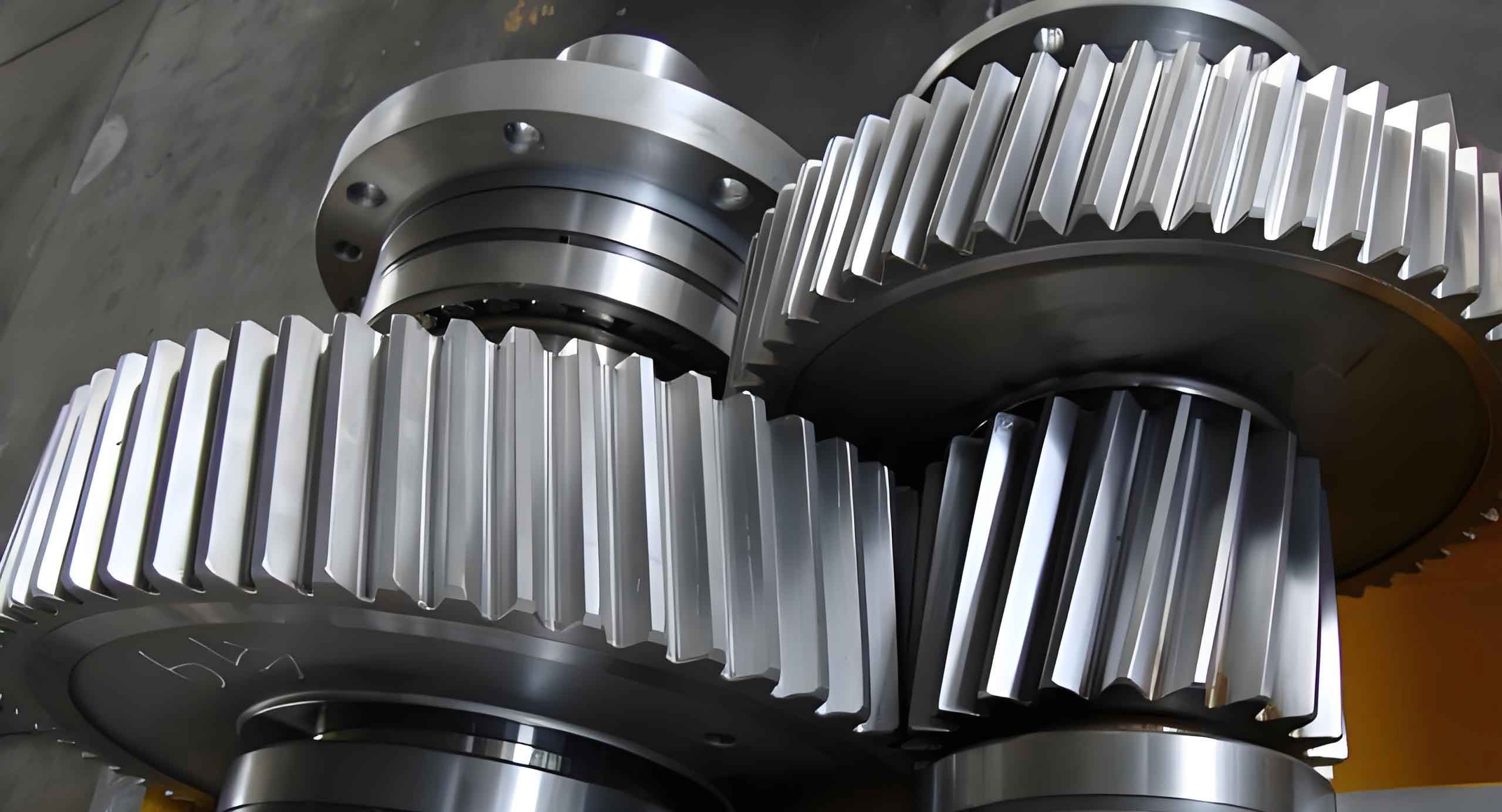
We begin by describing the mathematical model for the spray lubrication process. The VOF method is used to track the interface between oil and air, assuming a homogeneous mixture without gravity effects. The governing equations include the volume fraction normalization, continuity, momentum, energy, and turbulence models. For a two-phase system (oil and air), the volume fraction for each phase sums to one:
$$ \sum_{\alpha=1}^{N} r_{\alpha} = 1 $$
where \( r_{\alpha} \) is the volume fraction of phase \( \alpha \), and \( N = 2 \) for oil and air. The continuity equation ensures mass conservation:
$$ \frac{\partial \rho}{\partial t} + \nabla \cdot (\rho \mathbf{U}) = 0 $$
Here, \( \rho \) is the density, and \( \mathbf{U} \) is the velocity vector. The momentum conservation equation accounts for forces and stresses:
$$ \frac{\partial}{\partial t} (\rho U_i) + \frac{\partial}{\partial x_j} (\rho U_i U_j) = -\frac{\partial p}{\partial x_i} + \frac{\partial \tau_{ij}}{\partial x_j} + \rho g_i + F_i $$
where \( p \) is pressure, \( \tau_{ij} \) is the stress tensor, \( g_i \) is gravity, and \( F_i \) represents external forces. The stress tensor is defined as:
$$ \tau_{ij} = \mu \left( \frac{\partial U_i}{\partial x_j} + \frac{\partial U_j}{\partial x_i} \right) – \frac{2}{3} \mu \frac{\partial U_l}{\partial x_l} \delta_{ij} $$
with \( \mu \) as the dynamic viscosity. The energy equation models heat transfer, considering convection and conduction:
$$ \frac{\partial (\rho T)}{\partial t} + \nabla \cdot (\rho \mathbf{u} T) = \nabla \cdot \left( \frac{k}{c_p} \nabla T \right) + S_T $$
where \( T \) is temperature, \( k \) is thermal conductivity, \( c_p \) is specific heat, and \( S_T \) is the viscous dissipation term. For turbulence, we use the standard \( k-\epsilon \) model, where the turbulent viscosity is:
$$ \mu_t = C_\mu \rho \frac{k^2}{\epsilon} $$
with \( C_\mu = 0.09 \), \( k \) as turbulent kinetic energy, and \( \epsilon \) as dissipation rate. The heat transfer from the tooth surface is governed by Newton’s law of cooling:
$$ q = \alpha \Delta T $$
where \( q \) is heat flux, \( \alpha \) is the heat transfer coefficient, and \( \Delta T \) is the temperature difference between the surface and fluid. These equations form the basis for our CFD simulations of helical gear spray lubrication.
To apply this model, we develop a CFD setup for the helical gear meshing region. The helical gear parameters are critical: normal module \( m_n = 8 \) mm, normal pressure angle \( \alpha_n = 20^\circ \), helix angle \( \beta = 30^\circ \), number of teeth \( z_1 = z_2 = 57 \), face width \( b = 130 \) mm, profile shift coefficient \( x_n = -0.0891 \), addendum coefficient \( h_{an}^* = 1 \), dedendum coefficient \( c_n^* = 0.4 \), driving gear speed \( n_1 = 50 \) r/s, and transmitted torque \( T = 60,000 \) N·m. We create a fluid domain around the meshing teeth by slightly increasing the center distance by 0.1 mm to avoid discontinuities. The domain is meshed with unstructured tetrahedral cells, refined near the meshing zone and spray nozzles. Boundary conditions include no-slip walls for tooth surfaces, open boundaries for the domain, and initial conditions of air at rest. The lubricant oil has a dynamic viscosity of 0.556 Pa·s and density of 883 kg/m³, while air is at ambient conditions. We simulate three spray configurations: engaging-in side spray, engaging-out side spray, and simultaneous spray from both sides, with nozzle diameters of 5 mm and varying velocities. The simulations are run as quasi-steady-state, capturing the stabilized flow after several gear rotations.
Before analyzing the spray effects, we compute the instantaneous temperature field of the helical gear tooth surfaces under dry conditions. This serves as input for the CFD model. The heat generation due to friction is calculated based on Hertzian contact theory and tribological principles. For a given meshing point, the frictional heat flux \( q \) is:
$$ q = \mu p v $$
where \( \mu \) is the friction coefficient (taken as dry friction value), \( p \) is contact pressure, and \( v \) is sliding velocity. We use MATLAB to compute \( q \) across the meshing cycle for a helical gear with a contact ratio of \( \epsilon_\gamma = 4.036 \), implying up to five tooth pairs in contact, but mostly four. The heat flux distribution shows higher values at engagement and disengagement points, as summarized in Table 1.
| Meshing Point | Relative Sliding Velocity (m/s) | Contact Pressure (MPa) | Heat Flux (W/m²) |
|---|---|---|---|
| Engaging-in (Point A) | 2.5 | 150 | 9,375 |
| Mid-meshing (Point B) | 1.0 | 200 | 5,000 |
| Engaging-out (Point D) | 3.0 | 180 | 13,500 |
Using ANSYS transient thermal analysis, we apply this heat flux cyclically over four meshing periods to teeth labeled A through H, representing a full engagement cycle. The average instantaneous temperatures for these surfaces are extracted, as shown in Table 2. The helical gear tooth surfaces exhibit a temperature rise from engagement to disengagement, with the engaging-out surface reaching the highest temperature.
| Tooth Surface | Average Temperature (°C) |
|---|---|
| A (Engaging-in) | 48 |
| B | 65 |
| C | 90 |
| D (Engaging-out) | 120 |
With these temperatures as boundary conditions, we proceed to CFD simulations for spray lubrication. We evaluate the heat transfer coefficients \( \alpha \) on the engaging-in and engaging-out surfaces under different spray methods and velocities. The results are compiled in Table 3 for engaging-in side spray, Table 4 for engaging-out side spray, and Table 5 for simultaneous spray. The helical gear’s geometry causes distinct flow patterns; for instance, engaging-in spray primarily cools the engaging-in surface, while engaging-out spray favors the engaging-out surface.
| Spray Velocity (m/s) | Heat Transfer Coefficient on Engaging-in Surface (W/(m²·K)) | Heat Transfer Coefficient on Engaging-out Surface (W/(m²·K)) |
|---|---|---|
| 10 | 150 | 50 |
| 20 | 300 | 80 |
| 30 | 500 | 120 |
| 40 | 650 | 200 |
| 50 | 750 | 230 |
| 60 | 800 | 240 |
| Spray Velocity (m/s) | Heat Transfer Coefficient on Engaging-in Surface (W/(m²·K)) | Heat Transfer Coefficient on Engaging-out Surface (W/(m²·K)) |
|---|---|---|
| 10 | 60 | 200 |
| 20 | 100 | 400 |
| 30 | 180 | 600 |
| 40 | 250 | 750 |
| 50 | 280 | 800 |
| 60 | 270 | 820 |
| Engaging-in Spray Velocity (m/s) | Engaging-out Spray Velocity (m/s) | Heat Transfer Coefficient on Engaging-in Surface (W/(m²·K)) | Heat Transfer Coefficient on Engaging-out Surface (W/(m²·K)) |
|---|---|---|---|
| 5 | 35 | 200 | 500 |
| 10 | 40 | 350 | 700 |
| 15 | 45 | 400 | 800 |
| 20 | 50 | 420 | 850 |
| 25 | 55 | 430 | 870 |
From these tables, we observe that for helical gears, simultaneous spray yields higher heat transfer coefficients on both surfaces at lower velocities compared to single-side sprays. For example, with engaging-in spray at 60 m/s, the engaging-in surface coefficient reaches 800 W/(m²·K), but the engaging-out surface remains at 240 W/(m²·K). With engaging-out spray at 50 m/s, the engaging-out surface achieves 800 W/(m²·K), while the engaging-in surface is only 280 W/(m²·K). In contrast, simultaneous spray at 15 m/s (engaging-in) and 45 m/s (engaging-out) gives 400 W/(m²·K) and 800 W/(m²·K), respectively, offering balanced cooling. This underscores the efficiency of dual-side spray for helical gear applications.
Next, we investigate how these heat transfer coefficients affect the steady temperature field of the helical gear. Under continuous operation, the gear reaches a thermal equilibrium where heat generation from friction is balanced by conduction into the gear body and convection to the fluid. We model a single helical gear tooth made of 17CrNiMo6 steel in ANSYS steady-state thermal analysis. The heat flux from friction is applied as a boundary condition, along with ambient temperature at 22°C. By varying the convection coefficient \( \alpha \) on the tooth surface, we compute the maximum steady-state temperature. The relationship is summarized in Table 6 and can be expressed empirically as:
$$ T_{\text{max}} = T_{\text{amb}} + \frac{q}{\alpha} \cdot f(\text{geometry}) $$
where \( T_{\text{max}} \) is the maximum temperature, \( T_{\text{amb}} \) is ambient temperature, \( q \) is average heat flux, and \( f(\text{geometry}) \) is a factor accounting for helical gear tooth shape. For our helical gear, the results show that as \( \alpha \) increases, \( T_{\text{max}} \) decreases nonlinearly.
| Heat Transfer Coefficient (W/(m²·K)) | Maximum Steady-State Temperature (°C) |
|---|---|
| 100 | 150 |
| 200 | 110 |
| 400 | 80 |
| 600 | 65 |
| 800 | 60 |
| 1000 | 58 |
This table indicates that for effective cooling of helical gears, a heat transfer coefficient above 800 W/(m²·K) is desirable to keep temperatures below 60°C, mitigating scuffing risks. Combining this with our spray analysis, simultaneous spray can achieve such coefficients on both engaging-in and engaging-out surfaces with moderate velocities, whereas single-side sprays require higher velocities and still result in uneven cooling.
We further analyze the underlying fluid dynamics. The VOF simulations reveal that for helical gears, the oil-air mixture flow is significantly affected by gear rotation and tooth geometry. In engaging-in spray, the lubricant is directed toward the incoming teeth but tends to be deflected by centrifugal forces, limiting reach to the engaging-out side. Conversely, engaging-out spray impinges directly on the hot disengagement zone, but splashing reduces oil penetration to the engaging-in side. Simultaneous spray creates a more uniform oil film, enhancing heat transfer on both sides. The turbulence intensity, derived from the \( k-\epsilon \) model, also plays a role; higher spray velocities increase turbulence, boosting heat transfer, but beyond optimal points, splashing dominates, reducing effectiveness. This is captured in the Reynolds number \( Re = \frac{\rho v d}{\mu} \), where \( d \) is nozzle diameter, and its impact on \( \alpha \) can be approximated as:
$$ \alpha \propto Re^{0.8} Pr^{0.4} $$
for forced convection, with \( Pr \) as the Prandtl number. For our helical gear setup, we estimate that velocities around 15-45 m/s for dual-side spray balance \( Re \) to avoid excessive splashing while maintaining high \( \alpha \).
In discussion, we compare the three spray methods for helical gears. Engaging-in spray is beneficial for cooling the initial contact area, but it neglects the hotter engaging-out region. Engaging-out spray effectively targets the high-temperature disengagement zone, yet it may leave the engaging-in side undercooled. Simultaneous spray, however, provides comprehensive coverage, ensuring both sides are adequately cooled. This is particularly important for helical gears due to their gradual engagement characteristics, which spread heat generation across multiple teeth. Our CFD results confirm that dual-side spray yields the highest overall heat transfer coefficients, aligning with the need for uniform temperature distribution in helical gears. Moreover, the velocity combination of 15 m/s (engaging-in) and 45 m/s (engaging-out) emerges as efficient, minimizing pump power while achieving coefficients of 400 W/(m²·K) and 800 W/(m²·K), respectively. This strategy can be adapted based on specific helical gear parameters like helix angle, module, and load, but the principle remains: simultaneous spray optimizes cooling for marine helical gears.
To generalize, we propose a design equation for spray lubrication in helical gears. The required heat transfer coefficient \( \alpha_{\text{req}} \) to limit temperature rise can be derived from energy balance:
$$ q_{\text{gen}} = \alpha_{\text{req}} A (T_s – T_f) + k_{\text{gear}} \nabla T $$
where \( q_{\text{gen}} \) is generated heat flux, \( A \) is surface area, \( T_s \) is surface temperature, \( T_f \) is fluid temperature, and \( k_{\text{gear}} \) is gear thermal conductivity. For helical gears, \( A \) depends on tooth geometry and contact ratio. From our data, we fit a correlation for \( \alpha \) as a function of spray velocity \( v \) and spray configuration \( C \):
$$ \alpha = K_C v^{n_C} $$
where \( K_C \) and \( n_C \) are constants for each spray method. For simultaneous spray, \( K_C \approx 50 \) and \( n_C \approx 0.7 \) for the engaging-in surface, and \( K_C \approx 100 \) and \( n_C \approx 0.8 \) for the engaging-out surface, based on curve fitting from Table 5. This helps in designing spray systems for helical gears.
In conclusion, our study demonstrates the critical role of spray lubrication in managing the steady temperature field of marine helical gears. Through CFD modeling and thermal analysis, we show that simultaneous spray from both engaging-in and engaging-out sides offers superior cooling for helical gears compared to single-side sprays. This method achieves high heat transfer coefficients on both meshing surfaces, effectively reducing steady-state temperatures below critical levels. For the helical gear example studied, spray velocities of 15 m/s on the engaging-in side and 45 m/s on the engaging-out side are recommended. These findings can guide the design of lubrication systems for helical gears in high-speed, heavy-duty marine applications, enhancing reliability and preventing scuffing failure. Future work could explore variations in helical gear parameters, such as helix angle or pressure angle, to refine these recommendations. Ultimately, optimizing spray lubrication is key to the performance and longevity of helical gears in demanding environments.