
In modern mechanical transmission systems, helical gears are widely used due to their smooth operation, high load capacity, and reduced noise compared to spur gears. However, transmission error remains a critical factor that induces vibration and noise, impacting the overall performance and reliability of gear systems. Gear modification, which involves altering the tooth profile and tooth direction, is a proven technique to improve load distribution and minimize transmission error fluctuations. In this study, we investigate the effects of gear modification on the dynamic transmission error of a helical gear pair, employing two fitting methods—Response Surface Method (RSM) and Kriging method—to model the relationship between modification parameters and transmission error. Our goal is to optimize modification parameters for minimizing dynamic transmission error fluctuation, thereby enhancing gear performance. We focus on a helical gear pair from a planetary stage in a wind turbine gearbox, as helical gears are prevalent in such high-power applications due to their efficiency and durability.
The importance of helical gears in industrial applications cannot be overstated; their helical teeth allow for gradual engagement, reducing impact forces and noise. Nonetheless, manufacturing inaccuracies, assembly errors, and load-induced deformations lead to transmission error, which is the deviation between the theoretical and actual positions of the output gear. This error excites vibrations, contributing to premature wear and failure. Gear modification, including tooth profile modification (e.g., crowning) and tooth direction modification (e.g., linear modification), compensates for these imperfections by redistributing contact loads. However, determining the optimal modification parameters is challenging due to the nonlinear dynamics of gear systems. Traditional trial-and-error approaches are time-consuming and costly, necessitating efficient modeling techniques. In this work, we address this by comparing RSM and Kriging method for fitting the mapping function between modification parameters and dynamic transmission error fluctuation, aiming to identify a more accurate approach for guiding helical gear design.
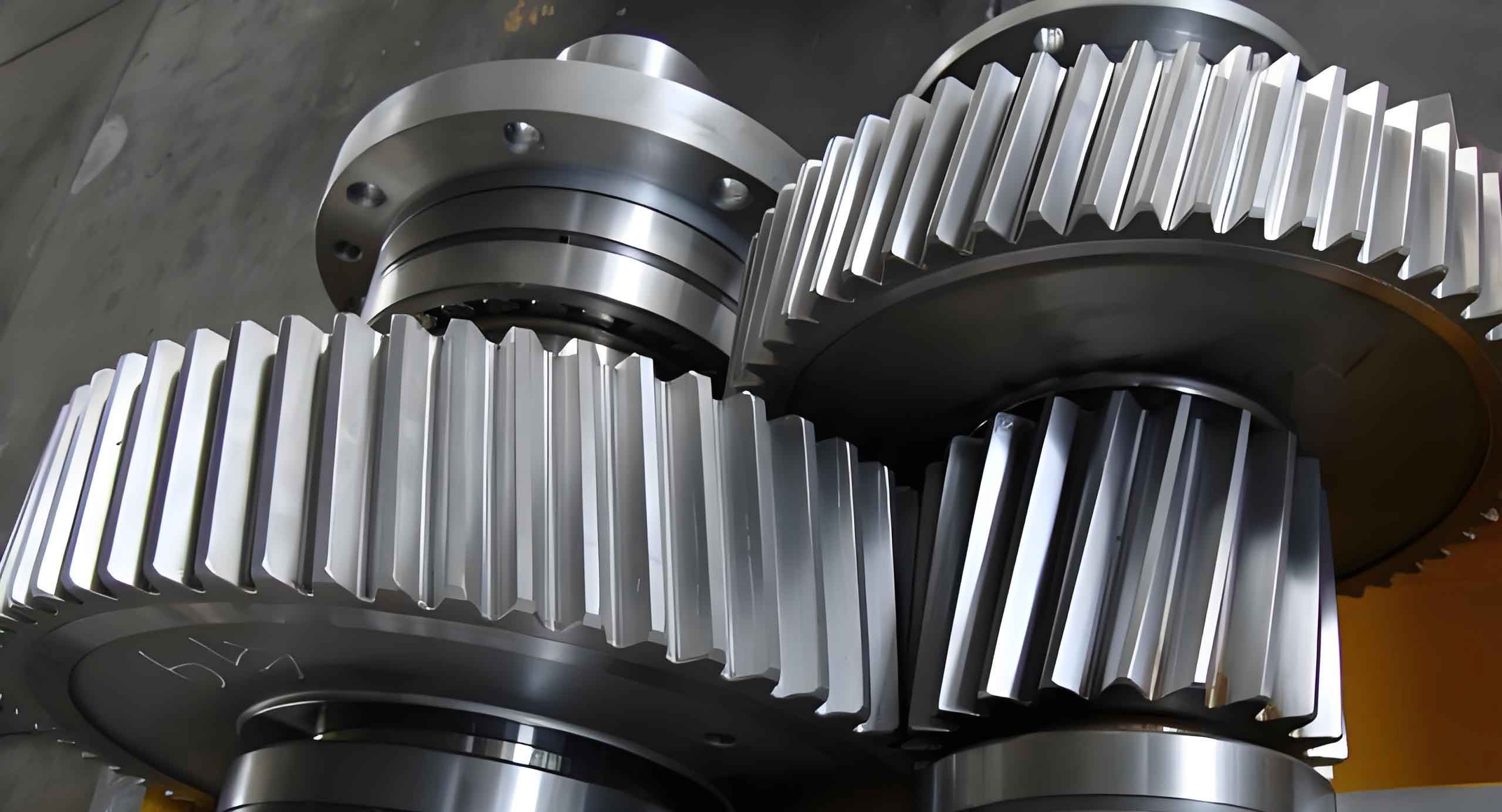
Our study begins with establishing baseline modification parameters for the helical gear pair. The gear pair consists of a sun gear and a planet gear from a planetary transmission, with key parameters summarized in Table 1. These parameters include module, pressure angle, helix angle, and width, which are typical for helical gears in wind turbine applications. We performed load tooth contact analysis (LTCA) using simulation software to obtain the comprehensive misalignment along the line of action and the unit load distribution on the tooth surface. The initial modification amounts were derived based on empirical formulas: tooth direction linear modification was set equal to the misalignment, and tooth profile crowning modification was calculated from the elastic deformation under load. For our helical gear pair, this resulted in baseline values of 110.79 μm for tooth direction modification and 64.50 μm for tooth profile modification. However, preliminary analysis showed that while these values improved load distribution, further optimization was needed to minimize transmission error fluctuation.
| Parameter | Symbol | Value | Unit |
|---|---|---|---|
| Normal Module | \(m_n\) | 10 | mm |
| Normal Pressure Angle | \(\alpha_n\) | 20 | ° |
| Helix Angle | \(\beta\) | 7.493 | ° |
| Face Width | \(B\) | 220 | mm |
| Number of Teeth (Sun) | \(z_s\) | — | — |
| Number of Teeth (Planet) | \(z_p\) | — | — |
| Profile Shift Coefficient (Sun) | \(x_s\) | 0.186 | — |
| Profile Shift Coefficient (Planet) | \(x_p\) | 0.39 | — |
| Input Torque | \(T_o\) | 18990 | N·m |
| Input Speed | \(n\) | 29 | r/min |
To explore the relationship between modification parameters and dynamic transmission error fluctuation, we defined the design variables as tooth direction modification amount \(x_1\) and tooth profile modification amount \(x_2\). The response variable is the dynamic transmission error fluctuation \(\Delta DTE\), denoted as \(y\). We selected a search range of \([\mu – 3\sigma, \mu + 3\sigma]\) around the baseline values, where \(\sigma\) is derived from gear accuracy grade. For this helical gear pair, \(\sigma\) was set to 4.50 μm based on the cumulative pitch tolerance. We then applied two fitting methods: RSM and Kriging method. RSM uses a quadratic polynomial with cross-terms to approximate the response, while Kriging method combines a global regression model with a local stochastic process. Both methods require sample points; we used central composite design for RSM and Latin hypercube sampling for Kriging, each with 9 sample points within the specified range. The sample data and corresponding \(\Delta DTE\) values from simulations are shown in Table 2 for RSM and Table 3 for Kriging.
| Sample | Tooth Direction Modification \(x_1\) (μm) | Tooth Profile Modification \(x_2\) (μm) | \(\Delta DTE\) \(y\) (μm) |
|---|---|---|---|
| 1 | 124.29 | 78.00 | 8.95 |
| 2 | 97.29 | 51.00 | 0.67 |
| 3 | 124.29 | 51.00 | 7.08 |
| 4 | 97.29 | 78.00 | 4.58 |
| 5 | 129.88 | 64.50 | 9.37 |
| 6 | 91.70 | 64.50 | 2.22 |
| 7 | 110.79 | 83.59 | 7.01 |
| 8 | 110.79 | 45.41 | 3.80 |
| 9 | 110.79 | 64.50 | 4.26 |
Using RSM, we fitted a quadratic response function. The general form for RSM with two variables is:
$$ \hat{y}_1 = C_0 + C_1 x_1 + C_2 x_2 + C_{11} x_1^2 + C_{22} x_2^2 + C_{12} x_1 x_2 $$
Applying least squares regression to the data in Table 2, we obtained the coefficients, resulting in the following fitted function for the helical gear pair:
$$ \hat{y}_1 = 15.3221 – 0.4773 x_1 + 0.0487 x_2 + 0.0038 x_1^2 + 0.0028 x_2^2 – 0.0028 x_1 x_2 $$
This function models the dynamic transmission error fluctuation as a function of tooth direction and tooth profile modification amounts. To analyze sensitivity, we computed partial derivatives. The sensitivity of \(\Delta DTE\) to tooth direction modification is:
$$ \frac{\partial \hat{y}_1}{\partial x_1} = -0.4773 + 0.0076 x_1 – 0.0028 x_2 $$
And to tooth profile modification:
$$ \frac{\partial \hat{y}_1}{\partial x_2} = 0.0487 + 0.0056 x_2 – 0.0028 x_1 $$
These sensitivity equations indicate how changes in modification parameters affect transmission error in helical gears. For instance, a negative sensitivity to \(x_1\) suggests that increasing tooth direction modification reduces \(\Delta DTE\) within certain ranges, highlighting the importance of precise modification for helical gear performance.
| Sample | Tooth Direction Modification \(x_1\) (μm) | Tooth Profile Modification \(x_2\) (μm) | \(\Delta DTE\) \(y\) (μm) |
|---|---|---|---|
| 1 | 97.29 | 74.63 | 3.82 |
| 2 | 100.67 | 54.38 | 1.03 |
| 3 | 104.04 | 71.25 | 3.67 |
| 4 | 107.42 | 61.13 | 3.10 |
| 5 | 110.79 | 57.75 | 3.81 |
| 6 | 114.17 | 67.88 | 5.43 |
| 7 | 117.54 | 78.00 | 7.41 |
| 8 | 120.92 | 64.50 | 6.96 |
| 9 | 124.29 | 51.00 | 7.08 |
For the Kriging method, the fitted function is more complex, incorporating a correlation structure. The Kriging model is expressed as:
$$ \hat{y}_2(\mathbf{x}) = \mathbf{f}^T(\mathbf{x}) \boldsymbol{\beta} + \mathbf{r}^T(\mathbf{x}) \boldsymbol{\hat{\alpha}} $$
where \(\mathbf{f}(\mathbf{x})\) is the regression basis, \(\boldsymbol{\beta}\) is the regression coefficient vector, \(\mathbf{r}(\mathbf{x})\) is the correlation vector, and \(\boldsymbol{\hat{\alpha}}\) is the estimated weight vector. For our helical gear data, using Gaussian correlation function, we derived the following fitted function:
$$ \hat{y}_2 = \mathbf{f}^T(\mathbf{x}) [1.4251, -0.2974]^T + \mathbf{r}^T(\mathbf{x}) \boldsymbol{\hat{\alpha}} $$
with \(\boldsymbol{\hat{\alpha}} = [35.4634, -31.6497, -57.2487, 27.5108, 43.0060, -22.1600, 19.4582, -3.7520, -10.7342]^T\). The correlation function is defined as:
$$ R(\mathbf{x}^i, \mathbf{x}^j) = \exp\left(-\sum_{k=1}^{m} \theta_k (x_k^i – x_k^j)^2\right) $$
where \(\theta_k\) are parameters optimized via maximum likelihood. The sensitivity analysis for Kriging involves partial derivatives of the correlation function. For tooth direction modification:
$$ \frac{\partial R(\mathbf{x}^i, \mathbf{x}^j)}{\partial x_1} = -2\theta (x_1 – x_1^j) \exp\left(-\sum_{k=1}^{m} \theta (x_k – x_k^j)^2\right) $$
And for tooth profile modification:
$$ \frac{\partial R(\mathbf{x}^i, \mathbf{x}^j)}{\partial x_2} = -2\theta (x_2 – x_2^j) \exp\left(-\sum_{k=1}^{m} \theta (x_k – x_k^j)^2\right) $$
These derivatives are used to compute the overall sensitivity of \(\Delta DTE\) to modification parameters in helical gears. The Kriging method provides a more flexible fit, capturing nonlinear interactions that might be missed by RSM.
To compare the accuracy of RSM and Kriging, we evaluated both fitted functions against simulation results from additional sample points. We selected 16 validation points using Latin hypercube sampling within the same range and computed \(\Delta DTE\) from simulations, RSM predictions, and Kriging predictions. The results are summarized in Table 4. The relative errors between predicted and simulated values were calculated, showing that Kriging method generally achieved lower errors, often below 5%, while RSM errors were around 10%. This indicates that Kriging offers higher precision in modeling the relationship between modification parameters and transmission error for helical gears. The improved accuracy is attributed to Kriging’s ability to model local variations and correlations, which is crucial for complex gear dynamics.
| Sample | Tooth Direction \(x_1\) (μm) | Tooth Profile \(x_2\) (μm) | RSM Prediction \(\hat{y}_1\) (μm) | Kriging Prediction \(\hat{y}_2\) (μm) | Simulation \(Y\) (μm) | Relative Error RSM (%) | Relative Error Kriging (%) |
|---|---|---|---|---|---|---|---|
| 1 | 97.29 | 63.60 | 1.95 | 1.79 | 1.47 | 32.65 | 21.77 |
| 2 | 99.09 | 76.20 | 4.17 | 4.15 | 4.20 | 0.71 | 1.19 |
| 3 | 100.89 | 52.80 | 1.31 | 0.92 | 1.13 | 15.93 | 18.58 |
| 4 | 102.69 | 78.00 | 4.79 | 4.69 | 4.85 | 1.24 | 3.30 |
| 5 | 104.49 | 67.20 | 3.19 | 3.14 | 3.08 | 3.57 | 1.95 |
| 6 | 106.29 | 61.80 | 2.83 | 2.89 | 2.86 | 1.05 | 1.05 |
| 7 | 108.09 | 56.40 | 2.71 | 2.96 | 3.02 | 10.26 | 1.99 |
| 8 | 109.89 | 54.60 | 2.97 | 3.38 | 3.44 | 13.66 | 1.74 |
| 9 | 111.69 | 69.00 | 4.53 | 4.90 | 4.93 | 8.11 | 0.61 |
| 10 | 113.49 | 74.40 | 5.58 | 6.00 | 6.03 | 7.46 | 0.50 |
| 11 | 115.29 | 60.00 | 4.44 | 5.23 | 5.15 | 13.79 | 1.55 |
| 12 | 117.09 | 70.80 | 5.80 | 6.48 | 6.46 | 10.22 | 0.31 |
| 13 | 118.89 | 65.40 | 5.68 | 6.51 | 6.48 | 12.35 | 0.46 |
| 14 | 120.69 | 58.20 | 5.72 | 6.63 | 6.49 | 11.86 | 2.16 |
| 15 | 122.49 | 72.60 | 7.27 | 7.89 | 8.00 | 9.13 | 1.38 |
| 16 | 124.29 | 51.00 | 6.72 | 7.08 | 7.08 | 5.08 | 0.00 |
Based on the Kriging fitted function, we optimized the modification parameters to minimize dynamic transmission error fluctuation for the helical gear pair. The optimization problem is formulated as:
$$ \min \hat{y}_2(x_1, x_2) \quad \text{subject to} \quad x_1 \in [97.29, 124.29], \quad x_2 \in [51.00, 78.00] $$
Using numerical search methods, we found the optimal values at \(x_1 = 97.29 \, \mu m\) and \(x_2 = 51.00 \, \mu m\), yielding a minimum \(\Delta DTE\) of 0.67 μm. This represents a significant reduction compared to the unmodified case, where \(\Delta DTE\) was 26.19 μm—a decrease of over 97%. The optimized modification also improved load distribution on the tooth surface, reducing the maximum unit load from 1290.0 N/mm to 923.1 N/mm, a 28.45% reduction. These results underscore the effectiveness of gear modification in enhancing the performance of helical gears, particularly in high-load applications like wind turbines.
The sensitivity analysis further revealed that dynamic transmission error fluctuation is more sensitive to tooth direction modification than to tooth profile modification in helical gears. For RSM, the sensitivity to \(x_1\) is generally negative and larger in magnitude, indicating that increases in tooth direction modification tend to reduce \(\Delta DTE\) more significantly. For Kriging, the sensitivity patterns are more nuanced, but overall, tooth direction modification shows greater influence. This insight is valuable for designers focusing on critical parameters when modifying helical gears. Additionally, the comparison of fitting methods highlights that Kriging is superior for capturing the complex nonlinearities in gear systems, making it a recommended tool for helical gear optimization studies.
In conclusion, our study demonstrates the importance of gear modification in minimizing transmission error for helical gears. By comparing Response Surface Method and Kriging method, we found that Kriging provides higher accuracy in fitting the relationship between modification parameters and dynamic transmission error fluctuation. The optimized modification parameters, derived from Kriging, significantly reduce transmission error and improve load distribution, contributing to quieter and more reliable helical gear transmissions. Future work could extend this approach to multi-stage gearboxes or incorporate additional factors like thermal effects and wear. Ultimately, this research supports the advancement of helical gear design, ensuring efficient operation in demanding industrial environments.