
In the field of mechanical component reverse engineering and metrology, accurately measuring angles presents a significant challenge compared to linear dimensions. This is particularly true for two common yet critical parameters: the pressure angle of involute external splines and the helix angle of helical gears. From my extensive experience in workshop practices and precision measurement, I have encountered numerous instances where traditional methods fall short—either due to inadequate accuracy, reliance on specialized tools like high-precision pins, cumbersome calculations prone to errors, or the need for expensive measuring equipment. The persistent question has been: how can we utilize the most common gauges or machines to achieve simple, fast, and accurate angular measurements? This article, drawn from my firsthand involvement in practical测绘 scenarios, details robust methodologies I have developed and applied for the precise determination of these angles, focusing particularly on techniques accessible in standard manufacturing environments.
Angle measurement in gears and splines is fundamental for ensuring proper mating, load distribution, and operational longevity. Inaccurate determination of the pressure angle or helix angle can lead to premature wear, noise, and even catastrophic failure in power transmission systems. While linear dimensions such as diameters and lengths can be measured with calipers or micrometers to high precision, angles, especially spatial ones like the helix angle in a helical gear, require indirect methods. Many existing approaches, such as the “rolling impression” method for helix angles, lack the necessary precision for reliable part interchangeability. Others involve complex trigonometric derivations that must account for potential modifications like profile shifting, increasing the risk of computational mistakes. Therefore, my goal has been to devise methods that transform these angular measurements into linear measurements, which can be performed with standard, readily available tools, yielding results of sufficient accuracy for most repair, maintenance, and replication tasks.
Precise Measurement of the Involute Spline Pressure Angle (α)
The pressure angle (α) of an involute spline, standardized typically at 30°, 37.5°, or 45°, defines the shape of its tooth flank. A fundamental property of the involute curve is that its pressure angle varies at every point; thus, direct measurement on the curve is impossible. The method I employ relies on measuring the base pitch (p_b), which is uniquely related to the module (m) and the pressure angle, irrespective of profile shift or tooth count.
The core principle is that the difference in span measurement over two different numbers of teeth (the base tangent length) yields the base pitch. For an involute spline, the base pitch is given by:
$$p_b = \pi m \cos \alpha$$
Therefore, by accurately measuring the base pitch, the pressure angle can be solved as:
$$\alpha = \arccos\left(\frac{p_b}{\pi m}\right)$$
The practical procedure I follow is straightforward and requires only a gear tooth caliper (span micrometer) capable of measuring across k teeth.
- Estimate the Number of Teeth to Span (k): An initial estimate is useful to ensure the caliper contacts the tooth flanks near the pitch line. A common approximation formula is:
$$k \approx \frac{z}{180^\circ} \times \alpha + 0.5$$
where z is the number of teeth. For a spline with z=20, the approximate k for different standard angles would be as shown in the table below. The actual k chosen should allow the caliper jaws to contact the flanks properly; often, two or three adjacent k values are measured.
| Pressure Angle α (deg) | Approximate Span Count k |
|---|---|
| 30 | 3.83 |
| 37.5 | 4.67 |
| 45 | 5.5 |
Thus, practical span counts to try are k=3, 4, and 5.
- Measure Span Lengths (W_k): Using the gear tooth caliper, I meticulously measure the span length over k teeth and over (k+1) teeth. It is crucial to ensure the caliper contacts homologous points on the tooth flanks. For the example spline (z=20, m=2 mm), I obtained the following measurements:
| Span Measurement | Measured Length W_k (mm) |
|---|---|
| W_3 (over 3 teeth) | 15.23 |
| W_4 (over 4 teeth) | 20.65 |
| W_5 (over 5 teeth) | 25.95 |
- Calculate Base Pitch and Pressure Angle: The base pitch is the difference between span measurements for consecutive k values: p_b = W_{k+1} – W_k. Using the measurements from Table 2:
$$p_{b1} = W_4 – W_3 = 20.65 – 15.23 = 5.42 \text{ mm}$$
$$p_{b2} = W_5 – W_4 = 25.95 – 20.65 = 5.30 \text{ mm}$$
Substituting into the base pitch formula (with m=2 mm):
$$\alpha_1 = \arccos\left(\frac{5.42}{\pi \times 2}\right) = \arccos\left(\frac{5.42}{6.2832}\right) \approx \arccos(0.8627) \approx 30.388^\circ$$
$$\alpha_2 = \arccos\left(\frac{5.30}{\pi \times 2}\right) = \arccos\left(\frac{5.30}{6.2832}\right) \approx \arccos(0.8436) \approx 32.486^\circ$$
| Base Pitch p_b (mm) | Calculated Pressure Angle α (deg) |
|---|---|
| 5.42 | 30.388 |
| 5.30 | 32.486 |
The calculated angles cluster closer to 30° than to 37.5° or 45°. Considering manufacturing tolerances and measurement slight variations, I conclude the spline has a standard pressure angle of α = 30°. This method’s elegance lies in its insensitivity to tooth wear; since wear on both flanks of a tooth is typically uniform, the difference W_{k+1} – W_k, and hence p_b, remains largely unaffected. This is a significant advantage when dealing with used components.
The advantages I have observed with this method over alternatives are substantial. First, it uses only a standard gear tooth caliper, a tool ubiquitous in gear shops, requiring no special cylinders or pins. Second, the calculation is minimal and hinges on the fundamental involute geometry, avoiding error-prone corrections for profile shift. Third, the result is inherently accurate because the base pitch is a defining geometric constant of the involute. This technique is not limited to splines; it applies equally to any involute spur or helical gear tooth profile for pressure angle verification, though for helical gears, the measurement must be taken in the transverse plane, which introduces additional considerations related to the helix angle—a parameter we will address next in the context of helical gear metrology.
Precise Measurement of the Helical Gear Helix Angle (β)
The helix angle (β) of a helical gear is a non-standardized, spatial angle that critically influences its meshing characteristics, axial thrust, and smooth operation. Direct measurement is impractical. In my work, I often encounter situations where a single helical gear needs replacement, and the original helix angle is unknown or deliberately made non-standard to complicate replication. Precise knowledge of β is essential for machining a compatible replacement gear. While dedicated instruments like gear testers or lead measuring machines exist, many workshops, including those I have worked in, do not possess them. However, most facilities involved in gear manufacturing have gear hobbing or grinding machines. The method I describe leverages the capabilities of a precision gear grinder, such as a YK7380 form grinding machine, to measure the lead (p_z), from which the helix angle is derived.
The fundamental relationship for a helical gear is that the lead, the axial distance for one complete revolution of the helix, is constant across the tooth flank and is related to the helix angle by:
$$p_z = \frac{\pi m_n z}{\sin \beta}$$
where \(m_n\) is the normal module, z is the number of teeth, and β is the helix angle. Therefore, accurately measuring p_z allows calculation of β:
$$\beta = \arcsin\left(\frac{\pi m_n z}{p_z}\right)$$
The measurement setup on a gear grinder is intuitive, as these machines are designed to precisely coordinate rotary (C-axis) and linear (Z-axis) motions to generate the helix. Here is the step-by-step procedure I use:
- Mount the helical gear on the machine mandrel and indicate it to run true, typically using the bore or a trusted reference diameter.
- Mount a dial indicator (or preferably a dial test indicator) on the machine table or a rigid post, positioning its stylus to contact a tooth flank on the unworn portion of the gear face width.
- Set the indicator to a predefined preload or “zero” reading at a specific depth of contact. Record the initial axial machine coordinate Z1 (in mm) and the rotary angular coordinate C1 (in degrees).
- Move the machine table axially (Z-direction) by a convenient distance ΔZ (e.g., 50-100 mm) while keeping the radial (X) coordinate unchanged to ensure the stylus follows a path parallel to the gear axis.
- Rotate the gear (C-axis) until the dial indicator again shows the exact same reading at the new axial location, meaning the stylus is contacting the same relative point on the helical tooth flank. Record the new angular coordinate C2.
- The angular difference ΔC = |C2 – C1| corresponds to the axial travel ΔZ. The lead is then: $$p_z = \Delta Z \times \frac{360^\circ}{|\Delta C|}$$ This formula derives from the proportion: lead for 360° rotation is to ΔZ as 360° is to ΔC.
- Repeat the measurement on different tooth flanks to average out potential errors and confirm consistency.
To illustrate, consider a helical gear with known parameters: normal module m_n = 5 mm, tooth count z = 65, and normal pressure angle α_n = 20°. The helix angle β is unknown. Using the grinder method, I obtained the following dataset from three separate tooth flanks:
| Measurement Pair | Axial Coord. Z (mm) | Angular Coord. C (deg) | ΔZ (mm) | ΔC (deg) | Calculated Lead p_z (mm) | Calculated Helix Angle β (deg) |
|---|---|---|---|---|---|---|
| 1 (Start) | 312.825 | 357.329 | 65.9 | 5.228 | 4537.873 | 13.003 |
| 1 (End) | 246.925 | 2.557* | ||||
| 2 (Start) | 246.925 | 129.984 | 65.9 | 5.227 | 4538.741 | 13.000 |
| 2 (End) | 312.825 | 124.757 | ||||
| 3 (Start) | 312.825 | 246.631 | 65.9 | 5.230 | 4536.138 | 13.008 |
| 3 (End) | 246.925 | 251.861 |
* Note: Angular coordinates wrap around 360°; ΔC is calculated considering this wrap (e.g., 2.557° + 360° – 357.329° = 5.228°).
The calculation for the first measurement pair is:
$$p_z = 65.9 \times \frac{360}{5.228} \approx 4537.873 \text{ mm}$$
$$\beta = \arcsin\left(\frac{\pi \times 5 \times 65}{4537.873}\right) = \arcsin\left(\frac{1021.017}{4537.873}\right) \approx \arcsin(0.2250) \approx 13.003^\circ$$
The results from all three measurements are remarkably consistent and very close to 13.0°. Therefore, I can confidently specify the helix angle as β = 13° for manufacturing the replacement helical gear. This level of precision is more than adequate for ensuring proper meshing in most industrial applications.
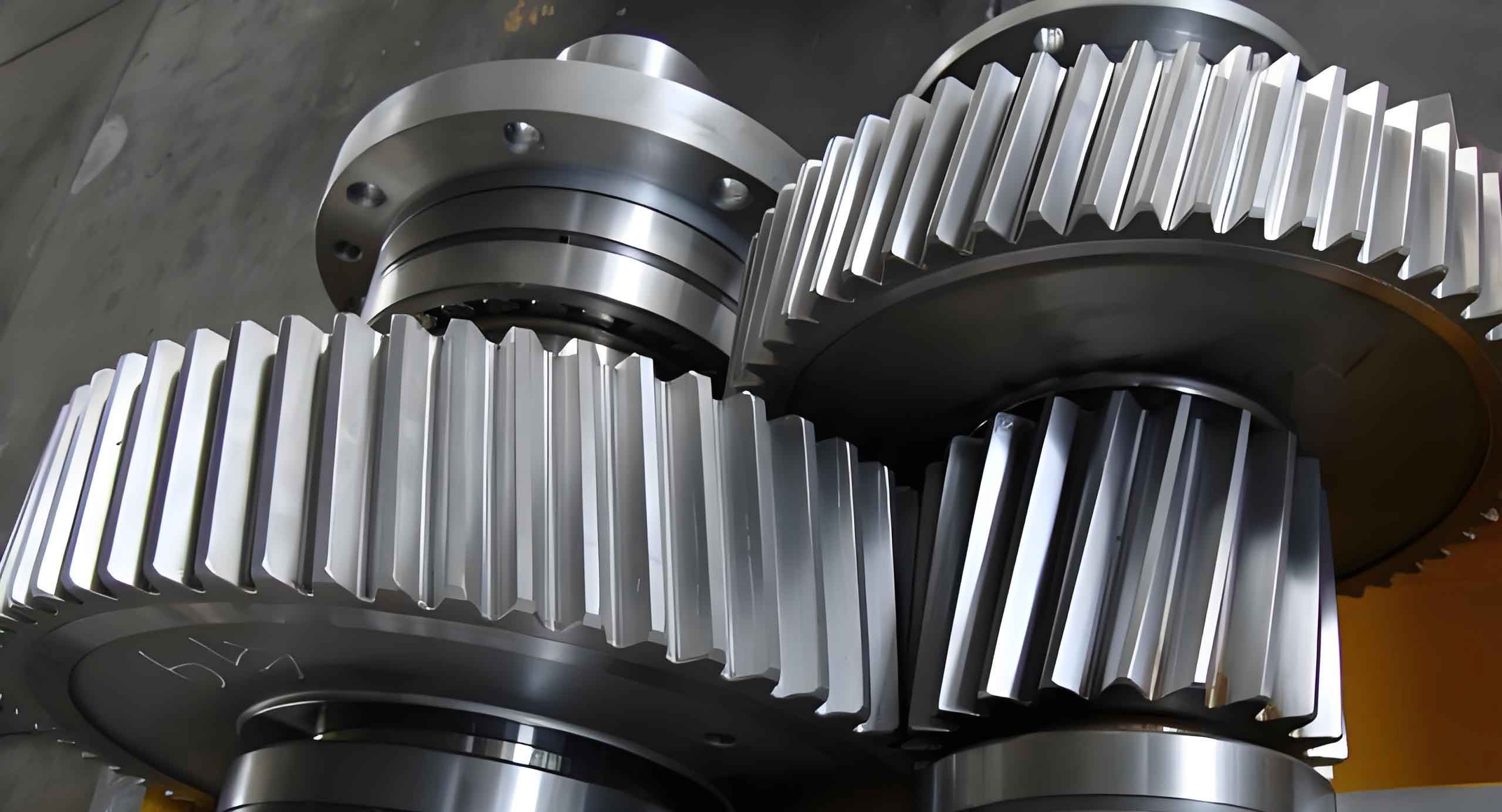
The advantages of this method for determining the helical gear helix angle are compelling. First, it requires no special investment beyond the existing machine tool, which in many cases is a gear grinder or a CNC hobbing/milling machine capable of precise C and Z axis control. Second, the procedure is simple and direct, involving basic machine movements and a dial indicator. Third, it achieves high accuracy because it essentially replicates the kinematic relationship used to generate the helix on the machine; the measurement accuracy is on par with the machine’s positioning capability. If higher precision is needed, a digital dial gauge or even a laser interferometer system can be employed, though a standard dial indicator often suffices. Fourth, the method is robust against localized tooth wear, as measurements can be taken at the ends of the tooth face where wear is minimal. The constant lead property means we do not need to measure precisely at the pitch diameter, eliminating the need to know or account for the profile shift coefficient—a common source of error in other calculation-heavy methods. This technique has proven indispensable in my work for reverse engineering and repairing complex helical gear assemblies.
Comparative Analysis and Practical Implementation
Reflecting on both methods, their common strength is the transformation of an angular measurement problem into a linear displacement measurement, leveraging fundamental geometric identities of the involute and the helix. For the involute spline or gear, the key is the base pitch, a linear invariant. For the helical gear, it is the lead, another linear invariant. This philosophical approach significantly simplifies field metrology.
When implementing these methods, several practical tips I have gathered are worth noting. For span measurement, ensure the gear tooth caliper is properly calibrated and that its jaws are parallel and make full contact. For the helical gear measurement on a machine, the dial indicator’s stylus should be as thin as possible to reach the root area if necessary, and the gear must be securely clamped to avoid deflection. It is also good practice to take multiple sets of readings and calculate the average to mitigate random errors. Environmental factors like temperature can affect dimensional measurements but are generally secondary for the differential measurements involved here.
The universality of these techniques should be emphasized. The spline pressure angle method applies to any involute profile. The helical gear helix angle method can be adapted to any machine tool with coordinated rotary and linear axes, not just gear grinders. For instance, a CNC milling machine with a rotary table can be used in a similar fashion. This flexibility makes these methods highly valuable in diverse workshop settings.
Conclusion
Through years of hands-on experience in component测绘 and precision measurement, I have refined and validated these techniques for the precise determination of the involute spline pressure angle and the helical gear helix angle. Both methods successfully circumvent the inherent difficulties of direct angular measurement by exploiting invariant linear properties of the geometries—base pitch and lead, respectively. They require only common workshop tools: a gear tooth caliper for the former and a standard machine tool with a dial indicator for the latter. The calculations are straightforward, rooted in first principles, and are insensitive to common confounding factors like tooth wear or profile shift. The result is a reliable, accurate, and accessible approach that fulfills the demanding requirements of part interchangeability in repair, maintenance, and reverse engineering. I have successfully applied these methods to numerous projects, and the manufactured components have performed flawlessly in service, confirming the practical efficacy of this metrological strategy. For any engineer or technician faced with the challenge of characterizing an unknown spline or helical gear, these procedures offer a practical path to confident and precise measurement.