
The reliable and efficient operation of modern aerospace transmissions, such as those found in helicopter main gearboxes, places extreme demands on their components. Among these, helical gears are favored for their smooth engagement, high load capacity, and stable transmission ratios. However, their performance and longevity are critically dependent on the lubrication conditions within the tooth contact interfaces. Under severe operational regimes characterized by high loads, speeds, and consequently, high slide-to-roll ratios, and when employing advanced lubricants that exhibit non-Newtonian rheological behavior, classical lubrication theories become insufficient. A comprehensive understanding requires a coupled thermal elastohydrodynamic lubrication (TEHL) analysis that accounts for transient loading, finite line contact geometry, non-Newtonian fluid effects, and significant heat generation. This article develops and solves a finite line contact TEHL model specifically for helical gear transmissions operating under such demanding conditions, providing detailed insights into their pressure, film thickness, temperature, and friction characteristics.
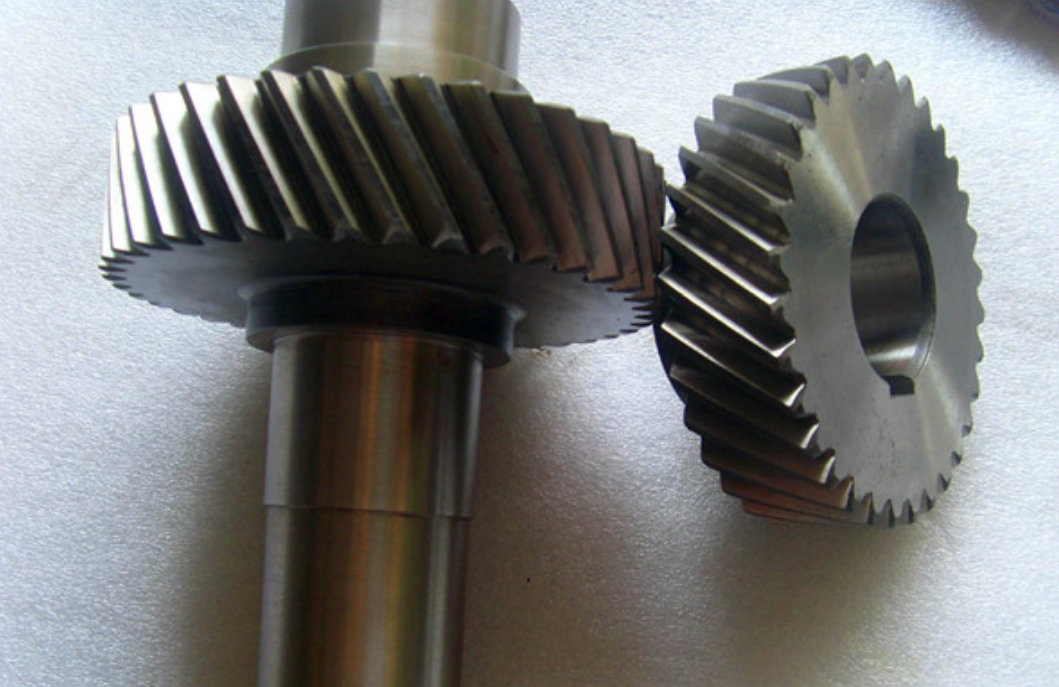
1. Geometric and Kinematic Modeling of Helical Gear Contact
The analysis begins with an accurate representation of the contact between mating helical gear teeth. At any instant during meshing, the contact occurs along a slanted line on the tooth flanks. This complex three-dimensional contact can be effectively modeled as the contact between two equivalent, opposing conical rollers. The axes of these cones coincide with the lines of tangency between the theoretical plane of action and the base cylinders of the two helical gears. The common generator of these cones represents the instantaneous contact line.
For a point K located at coordinate y along the contact line of length l, the equivalent radius of curvature in the direction transverse to the contact line is given by:
$$ r_K(y) = \frac{[r_{aK1} + (y + l/2)\sin\beta_b] [r_{bK1} – (y + l/2)\sin\beta_b]} {(r_{aK1} + r_{bK1})\cos\beta_b} $$
where \( r_{aK1} \) and \( r_{bK1} \) are the radii of curvature of the pinion and gear at the start point of the contact line, and \( \beta_b \) is the base helix angle. The surface velocities of the two gears at point K in the entrainment direction (x-axis) are:
$$ U_a(y) = \omega_a [r_{aK1} + (y + l/2)\sin\beta_b] $$
$$ U_b(y) = \omega_b [r_{bK1} – (y + l/2)\sin\beta_b] $$
The entrainment velocity \( U_e \), sliding velocity \( U_s \), and slide-to-roll ratio \( SRR \) are then:
$$ U_e(y) = \frac{U_a(y) + U_b(y)}{2} $$
$$ U_s(y) = |U_a(y) – U_b(y)| $$
$$ SRR(y) = \frac{U_s(y)}{U_e(y)} $$
The load per unit length varies along the contact line and changes with time as different tooth pairs engage and disengage. For simplicity in this model, the load on the i-th contact line, \( F_i \), is distributed proportionally to its length relative to the total contact length, calculated from the total normal force \( F_n \):
$$ F_i = \frac{l_i}{L_{total}} F_n, \quad \text{where} \quad F_n = \frac{2T}{d \cos\alpha_t \cos\beta_b} $$
Here, \( T \) is the input torque, \( d \) is the pitch diameter, and \( \alpha_t \) is the transverse pressure angle.
2. Finite Line Contact Thermal EHL Model for Helical Gears
2.1 Governing Equations
The core of the analysis is a set of coupled governing equations that describe the formation of a lubricating film under high pressure, elastic deformation, and thermal effects for a non-Newtonian fluid.
Generalized Reynolds Equation: For a non-Newtonian fluid under thermal conditions, the generalized Reynolds equation is employed:
$$ \frac{\partial}{\partial x}\left( \frac{\bar{\rho}}{\bar{\eta}_e} h^3 \frac{\partial p}{\partial x} \right) + \frac{\partial}{\partial y}\left( \frac{\bar{\rho}}{\bar{\eta}_e} h^3 \frac{\partial p}{\partial y} \right) = 12 \frac{\partial}{\partial x}(\bar{\rho}^* \bar{U}_e h) + 12 \frac{\partial}{\partial t}(\bar{\rho}_e h) $$
where \( p \) is pressure, \( h \) is film thickness, \( \bar{U}_e \) is entrainment velocity, and \( \bar{\rho}^* \), \( \bar{\rho}_e \), and \( (\bar{\rho}/\bar{\eta})_e \) are integral viscosity-density equivalents.
Film Thickness Equation: The film thickness comprises the rigid body separation, the initial geometric gap (Hertzian profile), and the elastic deformation:
$$ h(x,y,t) = h_{00}(t) + \frac{x^2}{2 r_K(y,t)} + \frac{2}{\pi E’} \iint \frac{p(x’,y’,t)}{\sqrt{(x-x’)^2 + (y-y’)^2}} dx’ dy’ $$
where \( E’ \) is the effective elastic modulus.
Load Balance Equation: The integrated pressure must balance the instantaneous applied load on the helical gear tooth pair:
$$ F(t) = \iint p(x,y,t) \, dx \, dy $$
Energy Equation: Heat is generated within the film due to viscous shear and compression. The three-dimensional energy equation for the fluid is:
$$ \rho c \left( \frac{\partial T}{\partial t} + u \frac{\partial T}{\partial x} + v \frac{\partial T}{\partial y} + w \frac{\partial T}{\partial z} \right) – k \frac{\partial^2 T}{\partial z^2} = -\frac{T}{\rho} \frac{\partial \rho}{\partial T} \left( \frac{\partial p}{\partial t} + u \frac{\partial p}{\partial x} + v \frac{\partial p}{\partial y} \right) + \eta^* \left[ \left( \frac{\partial u}{\partial z} \right)^2 + \left( \frac{\partial v}{\partial z} \right)^2 \right] $$
Solid Heat Conduction Equations: Heat flows into the contacting helical gear teeth. Their temperature fields are governed by:
$$ \rho_a c_a \left( \frac{\partial T}{\partial t} + U_a \frac{\partial T}{\partial x} \right) = k_a \frac{\partial^2 T}{\partial z_a^2}, \quad \rho_b c_b \left( \frac{\partial T}{\partial t} + U_b \frac{\partial T}{\partial x} \right) = k_b \frac{\partial^2 T}{\partial z_b^2} $$
Friction Coefficient: The interfacial friction coefficient \( \mu \) is calculated from the ratio of the average shear force on the surfaces to the normal load:
$$ \mu = \frac{(F_{f,a} + F_{f,b}) / 2}{F}, \quad \text{where} \quad F_{f,a/b} = \iint \tau_{a/b}(x,y) \, dx \, dy $$
Constitutive and Property Relations:
Ree-Eyring Non-Newtonian Model:
$$ \frac{\partial u}{\partial z} = \frac{\tau_0}{\eta} \sinh\left( \frac{\tau}{\tau_0} \right) $$
where \( \tau_0 \) is the characteristic shear stress.
Roelands Viscosity-Pressure-Temperature Relation:
$$ \eta(p, T) = \eta_0 \exp \left\{ (\ln \eta_0 + 9.67) \left[ (1 + 5.1 \times 10^{-9} p)^{Z_0} \left( \frac{T – 138}{T_0 – 138} \right)^{-S_0} – 1 \right] \right\} $$
Dowson-Higginson Density-Pressure-Temperature Relation:
$$ \rho(p, T) = \rho_0 \left( 1 + \frac{0.6 \times 10^{-9} p}{1 + 1.7 \times 10^{-9} p} – 0.0007 (T – T_0) \right) $$
2.2 Numerical Solution Methodology
The highly nonlinear, coupled system of equations is solved using a robust numerical procedure. The helical gear meshing cycle is discretized into a series of quasi-static instants. At each instant, for a given contact line position, the following steps are performed iteratively until convergence:
- Pressure Solve: The generalized Reynolds equation is solved for pressure distribution using the Multi-Grid Method, combining Gauss-Seidel iteration in low-pressure regions and Jacobi iteration in the high-pressure central region for stability.
- Deformation & Film Thickness: The pressure field is used to calculate elastic deformation and update the film thickness profile.
- Temperature Solve: With the updated pressure and film profiles, the energy equations for the fluid and the solids are solved using the Column-by-Column Scanning Method to obtain the three-dimensional temperature field.
- Property Update: Lubricant viscosity and density are updated based on the new pressure and temperature fields.
- Load Check: The integrated pressure is checked against the applied load for the helical gear tooth pair, and the rigid film thickness \( h_{00} \) is adjusted accordingly.
- Convergence: The loop (steps 1-5) continues until the relative errors in load, pressure, and temperature between successive iterations fall below specified tolerances.
The computational domain is discretized with a fine mesh, typically 257×33 nodes in the contact plane after multi-grid refinement. Across the film thickness, 9 equally spaced nodes are used within the lubricant, and 5 unequally spaced nodes are used within each solid body to capture the thermal boundary layer. Boundary conditions assume ambient temperature at the inlets, outlets, and sides of the solids, and full-film formation at the inlet.
3. Helical Gear Parameters and Operating Conditions
The analysis is performed on a representative aerospace helical gear pair. The geometric, material, and lubricant properties are summarized in the tables below.
| Parameter | Symbol | Value |
|---|---|---|
| Number of teeth (Pinion/Gear) | \( z_a / z_b \) | 25 / 40 |
| Normal module | \( m_n \) | 5 mm |
| Normal pressure angle | \( \alpha_n \) | 20° |
| Helix angle | \( \beta \) | 20° |
| Face width | \( B \) | 20 mm |
| Density | \( \rho_s \) | 7850 kg/m³ |
| Elastic modulus | \( E \) | 206 GPa |
| Poisson’s ratio | \( \nu \) | 0.3 |
| Specific heat capacity | \( c_s \) | 470 J/(kg·K) |
| Thermal conductivity | \( k_s \) | 46 W/(m·K) |
| Parameter | Symbol | Value |
|---|---|---|
| Ambient dynamic viscosity | \( \eta_0 \) | 0.075 Pa·s |
| Ambient density | \( \rho_0 \) | 870 kg/m³ |
| Pressure-viscosity coefficient | \( \alpha \) | 2.2e-8 Pa⁻¹ |
| Temperature-viscosity coefficient | \( \beta_T \) | 0.042 K⁻¹ |
| Specific heat capacity | \( c_f \) | 2000 J/(kg·K) |
| Thermal conductivity | \( k_f \) | 0.14 W/(m·K) |
| Ambient temperature | \( T_0 \) | 313 K (40°C) |
| Characteristic shear stress (Ree-Eyring) | \( \tau_0 \) | Variable (e.g., 5 MPa) |
Three characteristic contact line positions during the meshing cycle of the helical gear are analyzed in detail to understand the transient behavior: Position A (initial engagement), Position B (mid-mesh, near the pitch point), and Position C (final disengagement).
4. Analysis of Thermal-Friction Characteristics for Helical Gears
4.1 Pressure, Film Thickness, and Temperature under Non-Newtonian Conditions
Under a representative operating condition (Input Power = 50 kW, Pinion Speed = 1000 rpm), the TEHL solutions for the three helical gear contact positions reveal distinct features. The pressure distributions show a central Hertzian-like plateau with pronounced pressure spikes at the ends of the contact line due to side leakage effects. A corresponding necking of the film thickness is observed in these end regions. The central region of the contact exhibits relatively uniform pressure and film thickness, similar to an infinite line contact solution.
The temperature field is significantly influenced by the non-Newtonian rheology of the lubricant. For contact Positions A and C (engagement and disengagement), the maximum temperature zone correlates with the high-pressure region. However, for Position B, where the contact line passes near the pitch point, the temperature distribution takes on a characteristic “V” shape along the contact line (y-direction). The temperature is highest at the two ends and drops towards the middle of the contact line. This is a direct consequence of the slide-to-roll ratio (\( SRR \)) variation. At the pitch point, \( SRR \approx 0 \) (pure rolling), leading to minimal shear heating and thus lower temperature. Moving away from the pitch point towards the ends of the contact line, the \( SRR \) increases, generating more frictional heat and raising the temperature.
A comparison between Non-Newtonian thermal (TEHL) and Newtonian isothermal (EHL) solutions at the mid-section of the contact line further highlights these effects. The non-Newtonian thermal solution shows a pressure spike that is slightly higher and shifted towards the inlet compared to the isothermal case. The minimum film thickness is also slightly reduced when thermal and non-Newtonian effects are considered. The most dramatic difference is in the temperature, where the isothermal solution, by definition, shows no rise, while the TEHL solution predicts significant localized heating, especially in high-slip regions of the helical gear contact.
4.2 Influence of Operating Parameters on Friction
The friction coefficient for the helical gear pair varies significantly along the path of contact and is strongly dependent on operating conditions.
- Effect of Speed: Holding input power constant, an increase in rotational speed leads to a substantial decrease in the friction coefficient across the entire meshing cycle. Higher speeds promote the formation of a thicker lubricant film in the helical gear contact, reducing the shear stress required and thus the friction. At the pitch point, the friction coefficient approaches zero regardless of speed due to the near-pure rolling condition.
- Effect of Load (Power): Holding speed constant, an increase in input power (and thus transmitted torque and contact load) causes a significant increase in the friction coefficient. Higher loads compress the film, increasing the shear rate and the effective viscosity of the non-Newtonian lubricant, leading to higher friction losses in the helical gear mesh.
- Engagement vs. Disengagement: The friction coefficient is generally higher on the approach path (engagement side of the pitch point) than on the recess path (disengagement side). This asymmetry is attributed to the fact that the oil film is typically thinner at the initial engagement point of the helical gear tooth, leading to higher shear stresses under load.
- Non-Newtonian vs. Newtonian Friction Prediction: Under high-load conditions, a comparison starkly reveals the importance of the correct fluid model. A Newtonian isothermal EHL analysis predicts an almost constant, low friction coefficient along the contact path. In contrast, the non-Newtonian TEHL model predicts a friction coefficient that varies considerably: it is near zero at the pitch point and rises towards the ends of the contact line and the ends of the path of contact, providing a much more realistic depiction of helical gear friction behavior.
4.3 The Critical Role of High Slide-to-Roll Ratio
The slide-to-roll ratio (\( SRR \)) is a pivotal parameter governing frictional losses in helical gear contacts. Analysis shows a direct correlation: as the \( SRR \) increases—for example, moving from the pitch point towards the tip or root of the helical gear tooth during engagement/disengagement—the friction coefficient increases markedly. Operating helical gears under conditions that inherently produce high \( SRR \) (e.g., high reduction ratios, heavily loaded, high-speed operations) can therefore lead to significantly elevated friction. This not only reduces mechanical efficiency but also generates more heat, which can accelerate lubricant degradation, increase operating temperatures, and potentially lead to adhesive wear or scuffing failures, ultimately threatening the helical gear’s fatigue life.
4.4 Effect of the Characteristic Shear Stress (\( \tau_0 \))
The Ree-Eyring parameter \( \tau_0 \) governs the onset of shear-thinning behavior in the non-Newtonian lubricant. Analysis of the helical gear contact with different \( \tau_0 \) values shows that this parameter has a negligible effect on the predicted pressure profile and minimum film thickness. However, its influence on the temperature rise is significant. As \( \tau_0 \) increases, the predicted maximum flash temperature within the contact also increases. This can be understood from the constitutive model: a higher \( \tau_0 \) implies that a higher stress is required to induce the same shear rate, effectively increasing the apparent viscosity under high shear conditions within the helical gear contact, which in turn leads to greater viscous dissipation and heating.
5. Conclusion
This detailed analysis of thermal elastohydrodynamic lubrication for helical gears operating under non-Newtonian fluid conditions and high slide-to-roll ratios provides critical insights for advanced transmission design. The finite line contact model, solved with robust numerical techniques, accurately captures the transient and three-dimensional nature of the problem. Key findings are:
- The non-Newtonian behavior of advanced lubricants has a profound impact on the thermal field within a helical gear contact, leading to significant localized temperature rises, particularly in high-slip regions, while its effect on pressure and film thickness is more modest.
- The temperature distribution in a helical gear mesh is highly non-uniform. When the contact line passes near the pitch point, it exhibits a distinct “V”-shaped profile along its length due to the variation in slide-to-roll ratio, with minimum temperature at the pure-rolling pitch point.
- The friction coefficient for a helical gear pair is not constant. It varies along the path of contact, reaching a minimum (near zero) at the pitch point and increasing towards the tips and roots. It is highly sensitive to operating conditions, increasing with load and decreasing with speed.
- High slide-to-roll ratio conditions, common in demanding helical gear applications, dramatically increase the friction coefficient and associated power losses. This elevates operating temperatures and can be a critical factor in surface durability and fatigue life.
- A comprehensive TEHL analysis that incorporates non-Newtonian rheology is essential for obtaining realistic predictions of friction and temperature in heavily loaded helical gear contacts, surpassing the limitations of classical Newtonian isothermal models.
This modeling framework serves as a valuable tool for predicting the performance, efficiency, and thermal limits of helical gear transmissions in aerospace and other high-performance applications, guiding the selection of lubricants, the optimization of gear geometry, and the establishment of safe operating regimes.