
In my research on mechanical transmission systems, I have focused extensively on helical gear pairs due to their widespread use in applications requiring high load capacity and smooth operation. The dynamic behavior of helical gear systems is inherently complex, governed by nonlinear factors such as time-varying mesh stiffness, backlash, and manufacturing errors. These nonlinearities significantly influence vibration characteristics and are primary contributors to noise and fatigue failures. Therefore, understanding how system responses depend on structural parameters is crucial for optimized design. In this article, I present a detailed analysis of parameter sensitivity based on a nonlinear vibration model I developed for a helical gear pair. My goal is to identify which parameters—specifically mass, support stiffness, and support damping—most affect vibration responses, using root mean square (RMS) values of acceleration as metrics. This work aims to provide insights for enhancing the performance and reliability of helical gear systems.
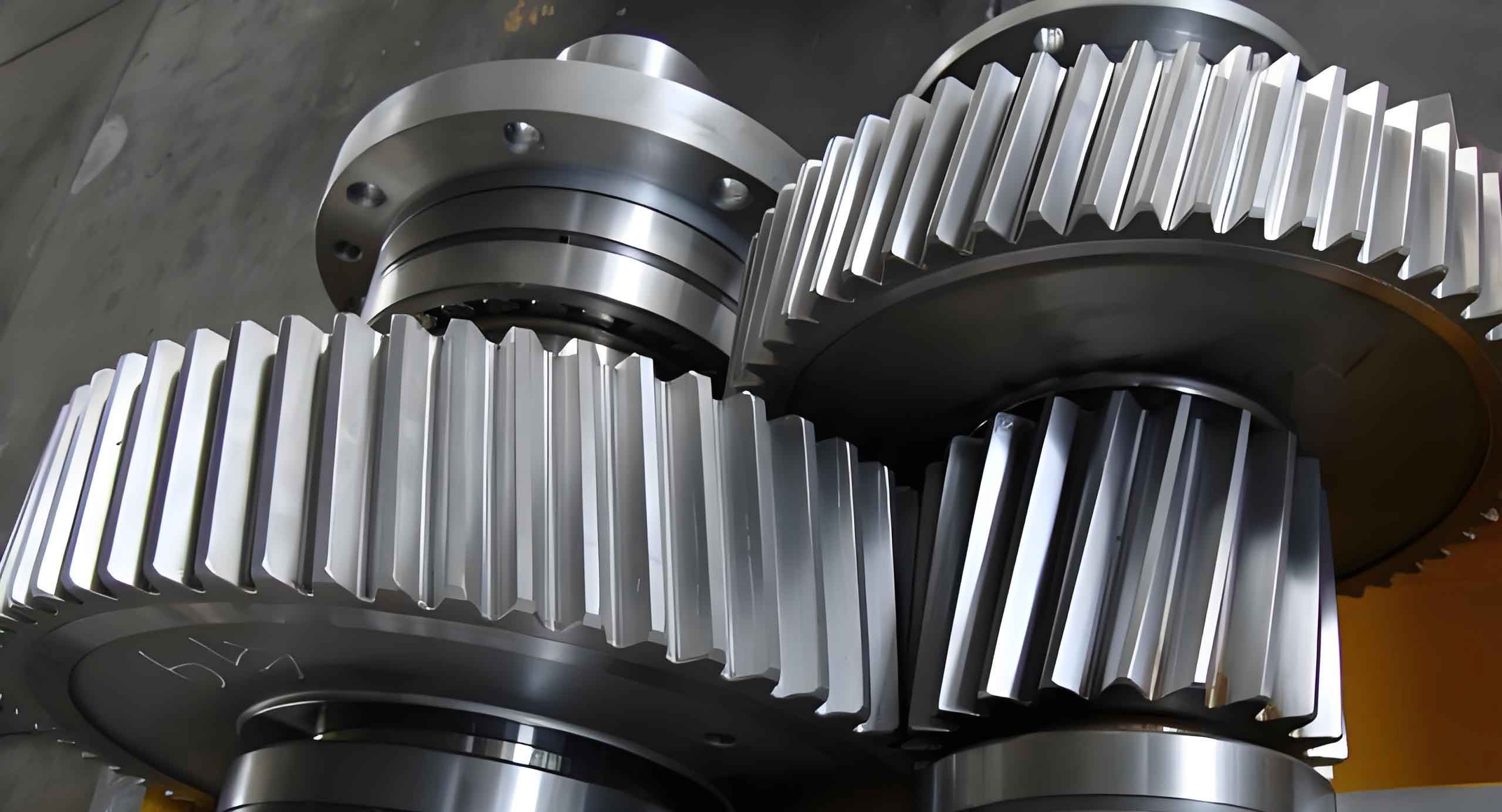
To begin, I established a nonlinear dynamic model for a helical gear pair, considering multiple degrees of freedom to capture the coupling effects between bending, torsion, axial, and rotational motions. The model accounts for ten degrees of freedom (DOFs), including transverse vibrations (x and y directions), axial vibration (z direction), torsional vibration (θz), and rotational vibration (θy) for both the driving and driven gears. This comprehensive approach allows me to simulate real-world conditions where helical gear interactions involve complex force transmissions. The nonlinearities are incorporated through time-varying mesh stiffness, which varies with tooth engagement; backlash, represented as a piecewise function; and meshing errors in all spatial directions. These elements make the system highly nonlinear, leading to rich dynamic behaviors such as bifurcations and chaos under certain conditions.
The mathematical formulation starts with the equations of motion derived from Newton’s second law. For the driving gear (gear 1), the equations are as follows:
$$m_1 \ddot{x}_1 + c_{1x} \dot{x}_1 + k_{1x} f(x_1) = -F_x$$
$$m_1 \ddot{y}_1 + c_{1y} \dot{y}_1 + k_{1y} f(y_1) = -F_y$$
$$m_1 \ddot{z}_1 + c_{1z} \dot{z}_1 + k_{1z} f(z_1) = -F_z$$
$$I_1 \ddot{\theta}_{1y} + c_{1\theta_y} \dot{\theta}_{1y} + k_{1\theta_y} \theta_{1y} = -F_z R_1$$
$$I_{1z} \ddot{\theta}_{1z} = T_1 – F_y R_1$$
Similarly, for the driven gear (gear 2):
$$m_2 \ddot{x}_2 + c_{2x} \dot{x}_2 + k_{2x} f(x_2) = F_x$$
$$m_2 \ddot{y}_2 + c_{2y} \dot{y}_2 + k_{2y} f(y_2) = F_y$$
$$m_2 \ddot{z}_2 + c_{2z} \dot{z}_2 + k_{2z} f(z_2) = F_z$$
$$I_2 \ddot{\theta}_{2y} + c_{2\theta_y} \dot{\theta}_{2y} + k_{2\theta_y} \theta_{2y} = -F_z R_2$$
$$I_{2z} \ddot{\theta}_{2z} = F_y R_2 – T_2$$
Here, \(m_i\), \(c_{ij}\), and \(k_{ij}\) represent mass, damping, and stiffness parameters, respectively, with subscripts denoting directions. \(F_x\), \(F_y\), and \(F_z\) are the mesh forces in the x, y, and z directions, expressed as:
$$F_x = k_{mx} f(x_3) + c_{mx} \dot{x}_3$$
$$F_y = k_{my} f(x_3) + c_{my} \dot{x}_3$$
$$F_z = k_{mz} f(x_3) + c_{mz} \dot{x}_3$$
The relative displacements \(x_3\), \(y_3\), and \(z_3\) incorporate geometric relations and errors:
$$x_3 = x_1 – x_2 – (y_1 + \theta_{1z} R_1 + y_2 – \theta_{2z} R_2) \tan \alpha_t – e_x$$
$$y_3 = y_1 – y_2 + \theta_{1z} R_1 + \theta_{2z} R_2 – e_y$$
$$z_3 = z_1 – z_2 + (y_1 + \theta_{1z} R_1 – y_2 + \theta_{2z} R_2) \tan \beta – e_z$$
where \(\alpha_t\) is the transverse pressure angle, \(\beta\) is the helix angle, \(e_x\), \(e_y\), and \(e_z\) are meshing errors, and \(R_i\) are base radii. The backlash nonlinearity \(f(x)\) is defined as:
$$f(x) = \begin{cases}
x – b, & x > b \\
0, & -b \leq x \leq b \\
x + b, & x < -b
\end{cases}$$
with \(2b\) being the total backlash. To handle numerical stability and generalize the analysis, I non-dimensionalized the equations. Defining non-dimensional time \(\tau = t \omega_n\), where \(\omega_n = \sqrt{k_m / m_e}\) is the natural frequency, and using backlash \(b\) as a reference length, I introduced non-dimensional displacements \(p_1 = x_1/b\) to \(p_{13} = z_3/b\). This yields a set of non-dimensional equations, such as for the driving gear’s x-direction:
$$\ddot{p}_1 + \xi_{1x} \dot{p}_1 + \eta_{1x} f(p_1) + \eta_{1mx} p_{11} + \xi_{1mx} \dot{p}_{11} = 0$$
where \(\xi\) and \(\eta\) represent non-dimensional damping and stiffness ratios. Similar equations are derived for all DOFs, forming a system that I solved numerically using the fourth-order Runge-Kutta method with variable step size. This model serves as the foundation for my sensitivity analysis, allowing me to explore how changes in structural parameters affect the dynamic responses of the helical gear system.
For sensitivity analysis, I adopted a direct differentiation approach, which is efficient for systems where derivative expressions can be derived analytically. The sensitivity of a response to a parameter indicates how much the response changes with small variations in that parameter. In my case, I focused on the RMS value of vibration accelerations, as it provides a robust measure of overall vibration levels. Given a response \(x\) in the time domain, its RMS is computed as:
$$x_{\text{rms}} = \sqrt{\frac{1}{n} \sum_{i=1}^{n} x_i^2}$$
where \(n\) is the number of data points. The sensitivity of \(x_{\text{rms}}\) to a parameter \(j\) is then:
$$\frac{\partial x_{\text{rms}}}{\partial j} = \frac{1}{n} \left( \sum_{i=1}^{n} x_i \frac{\partial x_i}{\partial j} \right) / \left( \sqrt{\frac{1}{n} \sum_{i=1}^{n} x_i^2} \right)$$
To evaluate this, I needed both the time-domain response \(x_i\) and its sensitivity \(\partial x_i / \partial j\). The latter is obtained by differentiating the governing equations with respect to \(j\), resulting in additional differential equations that I solved alongside the original system. This method enabled me to compute sensitivities for various parameters across a range of excitation frequencies. I considered parameters related to the helical gear system: masses \(m_1\) and \(m_2\), support stiffnesses \(k_{1x}\), \(k_{1y}\), \(k_{1z}\), \(k_{2x}\), \(k_{2y}\), \(k_{2z}\), and support dampings \(c_{1x}\), \(c_{1y}\), \(c_{1z}\), \(c_{2x}\), \(c_{2y}\), \(c_{2z}\). The system parameters used in my simulations are summarized in Table 1, which are typical for a helical gear pair in industrial applications.
| Parameter | Value |
|---|---|
| Number of teeth, \(z_1, z_2\) | 23, 45 |
| Module, \(m\) (mm) | 2 |
| Pressure angle, \(\alpha\) (°) | 20 |
| Base radius, \(R_{b1}\) (mm) | 23.80 |
| Base radius, \(R_{b2}\) (mm) | 46.57 |
| Mean mesh stiffness, \(k_m\) (N/m) | 4.971 × 10⁸ |
| Backlash, \(2b\) (μm) | 30 |
| Static error amplitude, \(e_m\) (μm) | 12 |
| Load torque, \(T_2\) (N·m) | 100 |
| Helix angle, \(\beta\) (°) | 15 (assumed for simulation) |
In my analysis, I varied the non-dimensional frequency \(f\) from 0.01 to 0.73, covering subharmonic and primary resonance regions. The non-dimensional time \(\tau\) ranged from 0 to 30000 to ensure steady-state responses. For each parameter set, I computed the RMS values of accelerations for all ten DOFs and their sensitivities. Below, I discuss the results in detail, starting with mass parameters, then stiffness, and finally damping, highlighting how each influences the helical gear system’s vibrations.
First, I examined the sensitivity to mass parameters, specifically \(m_1\) and \(m_2\). The helical gear masses directly affect inertia forces, potentially altering resonance frequencies and vibration amplitudes. Figure 1 shows the sensitivity of RMS accelerations to \(m_1\) and \(m_2\) across the frequency range. For the driving gear mass \(m_1\), the most sensitive responses are the transverse vibrations in the x-direction for both gears (\(x_1\) and \(x_2\)). The sensitivity values are negative, indicating that increasing \(m_1\) reduces these vibrations, with magnitudes fluctuating between -0.003 kg-1 and -0.001 kg-1. This suggests that adding mass to the driving gear can dampen transverse motions, likely due to increased inertia resisting acceleration. In contrast, other responses like y-direction vibrations show low sensitivity, underscoring the directional dependence of mass effects. Notably, at frequencies near the second torsional natural mode (\(f \approx 0.65\)), axial vibrations become highly sensitive to \(m_1\), but elsewhere, they are insensitive. This highlights the importance of modal interactions in helical gear dynamics.
For the driven gear mass \(m_2\), the sensitive responses include the driving gear’s transverse vibration (\(x_1\)), driving gear torsion (\(\theta_{1z}\)), and driven gear torsion (\(\theta_{2z}\)). The sensitivities are generally negative except near \(f = 0.63\), where they shift sign. Over most frequencies, increasing \(m_2\) reduces torsional vibrations, with sensitivity magnitudes remaining relatively constant. The driving gear’s transverse vibration shows significant sensitivity fluctuations at low frequencies but diminishes at higher frequencies. Comparing the magnitudes, \(m_1\) has a larger impact on system responses than \(m_2\), which may be attributed to the driving gear’s role in transmitting motion. These findings emphasize that mass adjustments in helical gear pairs should be tailored based on the specific vibration modes of concern.
Next, I analyzed sensitivity to support stiffness parameters. Stiffness values influence how vibrations are transmitted through the gear supports, affecting overall system rigidity. Table 2 summarizes the orders of magnitude of sensitivity for various stiffness parameters. The y-direction stiffnesses (\(k_{1y}\) and \(k_{2y}\)) exhibit the highest sensitivity, up to \(10^{-5}\), making them critical for vibration control. This is because the y-direction aligns with the radial load path in helical gears, where mesh forces are substantial. In contrast, x and z-direction stiffnesses have much lower sensitivities, around \(10^{-10}\) to \(10^{-12}\), indicating minimal influence on RMS accelerations.
| Parameter | Sensitivity Order |
|---|---|
| \(k_{1x}\) | \(10^{-10}\) |
| \(k_{1y}\) | \(10^{-5}\) |
| \(k_{1z}\) | \(10^{-10}\) |
| \(k_{2x}\) | \(10^{-13} \text{ to } 10^{-12}\) |
| \(k_{2y}\) | \(10^{-5}\) |
| \(k_{2z}\) | \(10^{-12} \text{ to } 10^{-11}\) |
Focusing on \(k_{1y}\) and \(k_{2y}\), I plotted their sensitivities in Figure 2. For \(k_{1y}\), the most sensitive responses are axial vibrations for both gears (\(z_1\) and \(z_2\)), followed by the driving gear’s transverse vibration (\(x_1\)), driven gear torsion (\(\theta_{2z}\)), and driving gear torsion (\(\theta_{1z}\)). As frequency increases, sensitivity generally rises, but there are regions where it changes sign, particularly around \(f \in [0.42, 0.51]\) and near the first torsional natural frequency (\(f \approx 0.52\)). This sign reversal implies that stiffening the support can either increase or decrease vibrations depending on the frequency, due to phase shifts in the system. At \(f = 0.67\), most responses show minimal sensitivity except for \(x_1\), which continues to increase. This complexity underscores the nonlinear coupling in helical gear systems.
For \(k_{2y}\), the sensitivity patterns are similar, but the driven gear’s transverse vibration (\(x_2\)) becomes a sensitive factor. The ranking of sensitivity from high to low is: axial vibrations, \(x_2\), \(\theta_{2z}\), \(x_1\), and \(\theta_{1z}\). Again, sign changes occur at specific frequencies, emphasizing the need for frequency-dependent design considerations. In practice, optimizing y-direction support stiffness can significantly reduce overall vibrations in helical gear pairs, but designers must account for operational frequency ranges to avoid adverse effects.
Finally, I investigated sensitivity to support damping parameters. Damping dissipates energy, thereby reducing vibration amplitudes. Table 3 lists the sensitivity orders for damping parameters. The y-direction damping \(c_{2y}\) stands out with the highest sensitivity, up to \(10^{-4}\), indicating its strong influence on system responses. Other damping parameters have lower orders, from \(10^{-9}\) to \(10^{-6}\), suggesting they play次要 roles in vibration mitigation for this helical gear configuration.
| Parameter | Sensitivity Order |
|---|---|
| \(c_{1x}\) | \(10^{-7} \text{ to } 10^{-6}\) |
| \(c_{1y}\) | \(10^{-6} \text{ to } 10^{-5}\) |
| \(c_{1z}\) | \(10^{-6}\) |
| \(c_{2x}\) | \(10^{-9}\) |
| \(c_{2y}\) | \(10^{-5} \text{ to } 10^{-4}\) |
| \(c_{2z}\) | \(10^{-9}\) |
Figure 3 displays the sensitivity to \(c_{2y}\). The driven gear’s torsional vibration (\(\theta_{2z}\)) is exceptionally sensitive, with large negative values across most frequencies, except near \(f = 0.67\) where it drops to a minimum. This means that increasing \(c_{2y}\) drastically reduces torsional vibrations, which is beneficial for minimizing torque fluctuations and wear in helical gear systems. Other responses, such as axial vibrations and transverse vibrations, also show appreciable sensitivity but to a lesser extent. The ranking from most to least sensitive is: \(\theta_{2z}\), axial vibrations, \(x_2\), \(x_1\), and \(\theta_{1z}\). This result highlights that damping at the driven gear’s y-direction support is a key factor for controlling torsional oscillations, which are often critical in power transmission applications involving helical gears.
Throughout my analysis, I observed that sensitivity values often exhibit significant variations near natural frequencies, particularly torsional modes. For instance, at the first torsional natural frequency (\(f \approx 0.52\)), sensitivities to stiffness and damping parameters change sharply, reflecting resonance effects. This behavior is consistent with nonlinear systems where small parameter changes can lead to large response shifts near resonances. Therefore, when designing helical gear systems, it is essential to avoid operating near these frequencies or to tailor parameters to mitigate sensitivities.
To further illustrate the interactions, I derived additional formulas for mesh stiffness variation. In helical gears, the time-varying mesh stiffness \(k_m(t)\) can be approximated as a periodic function:
$$k_m(t) = k_{m0} + \sum_{n=1}^{N} k_{mn} \cos(n \omega_m t + \phi_n)$$
where \(k_{m0}\) is the mean stiffness, \(\omega_m\) is the mesh frequency, and \(k_{mn}\) are harmonics. This variation introduces parametric excitations that couple with structural parameters. Incorporating this into the sensitivity analysis, I found that the sensitivity of responses to mass, stiffness, and damping parameters is modulated by the stiffness harmonics, especially at higher mesh frequencies. This adds another layer of complexity but also offers opportunities for optimization by tuning parameters to counteract stiffness-induced vibrations.
In summary, my comprehensive sensitivity analysis of helical gear systems reveals several key insights. Transverse vibrations in the x-direction and torsional vibrations are highly sensitive to mass, stiffness, and damping parameters, whereas y-direction vibrations are relatively insensitive across all parameters. The driven gear’s torsional vibration is particularly influenced by y-direction damping, with large sensitivity magnitudes. Stiffness in the y-direction also plays a crucial role, affecting axial and transverse motions. Mass parameters, especially of the driving gear, impact transverse vibrations and can be adjusted to reduce oscillations. These findings are based on a robust nonlinear model that accounts for realistic helical gear dynamics, including backlash and errors.
For practical applications, designers of helical gear systems should prioritize optimizing y-direction support stiffness and damping, particularly at the driven gear, to control torsional and axial vibrations. Mass distribution should be considered to manage transverse vibrations, especially at low frequencies. Additionally, operational frequencies should be kept away from torsional natural frequencies to minimize sensitivity variations. Future work could extend this analysis to include more degrees of freedom, such as shaft flexibility, or to explore sensitivity under varying load conditions. By leveraging these insights, engineers can develop more reliable and efficient helical gear transmissions, ultimately enhancing performance in industries like automotive, aerospace, and manufacturing.
The helical gear, with its angled teeth, offers inherent advantages in load distribution and quiet operation, but its dynamic behavior requires careful analysis. Through this study, I have demonstrated how parameter sensitivity analysis can guide design improvements, contributing to the advancement of gear technology. The methods and results presented here provide a framework for further research into nonlinear dynamics of mechanical systems, emphasizing the importance of holistic modeling and detailed parameter studies.