
In mechanical transmission systems, helical gears play a critical role due to their high load capacity and smooth operation. However, during operation, helical gear systems often generate significant vibration and noise, which can compromise the performance and longevity of equipment. As a key component in power transmission, helical gears are susceptible to issues like tooth surface wear, leading to increased dynamic loads and exacerbated vibration. To address these challenges, passive vibration control methods have gained attention, with damping devices being a promising solution. In this study, we explore the application of a novel G-type Integral Squeeze Film Damper (GISFD) for vibration suppression in helical gear shafting. The GISFD is designed to provide both damping and stiffness characteristics, aiming to reduce vibration amplitudes and isolate transmission paths. Through experimental investigations, we evaluate the effectiveness of GISFD across various operating conditions, including different rotational speeds and simulated wear scenarios. This article presents a comprehensive analysis, incorporating theoretical models, experimental setups, and results, with an emphasis on helical gear dynamics.
The vibration in helical gear systems primarily stems from meshing forces, misalignments, and external excitations. Traditional rigid supports often amplify these vibrations, necessitating the use of elastic or damped supports. The GISFD, as an advanced damper, integrates a squeeze film mechanism with a segmented design to avoid nonlinearities associated with conventional dampers. Its structure includes an outer ring, inner ring, G-shaped elastic elements, and segmented oil film chambers. When vibration occurs, the relative motion between rings squeezes the oil film, dissipating energy through viscous damping. This mechanism is particularly effective for helical gear systems, where high-frequency meshing vibrations dominate. Below, we detail the theoretical foundation, experimental methodology, and findings, highlighting the role of GISFD in enhancing the stability of helical gear transmissions.
To understand the vibration isolation capability of GISFD, we develop a simplified model of the helical gear system. The system is represented as a mass-spring-damper system, where the gearbox mass \( M \) is supported by a combination of stiffness \( K \) and damping \( C \) elements, accounting for the GISFD and bearings. The excitation force from helical gear meshing is denoted as \( F_0 e^{j\omega t} \), where \( \omega \) is the excitation frequency. The equation of motion is given by:
$$ M\ddot{x} + C\dot{x} + Kx = F_0 e^{j\omega t} $$
The natural frequency of the system is \( \omega_0 = \sqrt{K/M} \), and the frequency ratio is \( z = \omega/\omega_0 \). The displacement response amplitude is:
$$ x_0 = \left| \frac{F_0}{K} \frac{1}{1 – z^2 + j2\zeta z} \right| $$
where \( \zeta = C/(2\sqrt{KM}) \) is the damping ratio. The force transmitted to the base, \( P = C\dot{x} + Kx \), has an amplitude:
$$ P_0 = |j\omega C x_0 + K x_0| $$
The vibration transmissibility coefficient \( T_f \) is derived as:
$$ T_f = \left| \frac{P_0}{F_0} \right| = \sqrt{ \frac{1 + (2\zeta z)^2}{(1 – z^2)^2 + (2\zeta z)^2} } $$
For effective vibration isolation in helical gear systems, \( T_f < 1 \) is desired, which typically occurs at high frequency ratios (i.e., \( z > \sqrt{2} \)). Since helical gear meshing generates high-frequency components, reducing \( K \) and increasing \( C \) can lower \( T_f \), thereby isolating vibration. The GISFD provides tunable stiffness and damping, making it suitable for this purpose. This theoretical insight guides our experimental design for evaluating GISFD in helical gear applications.
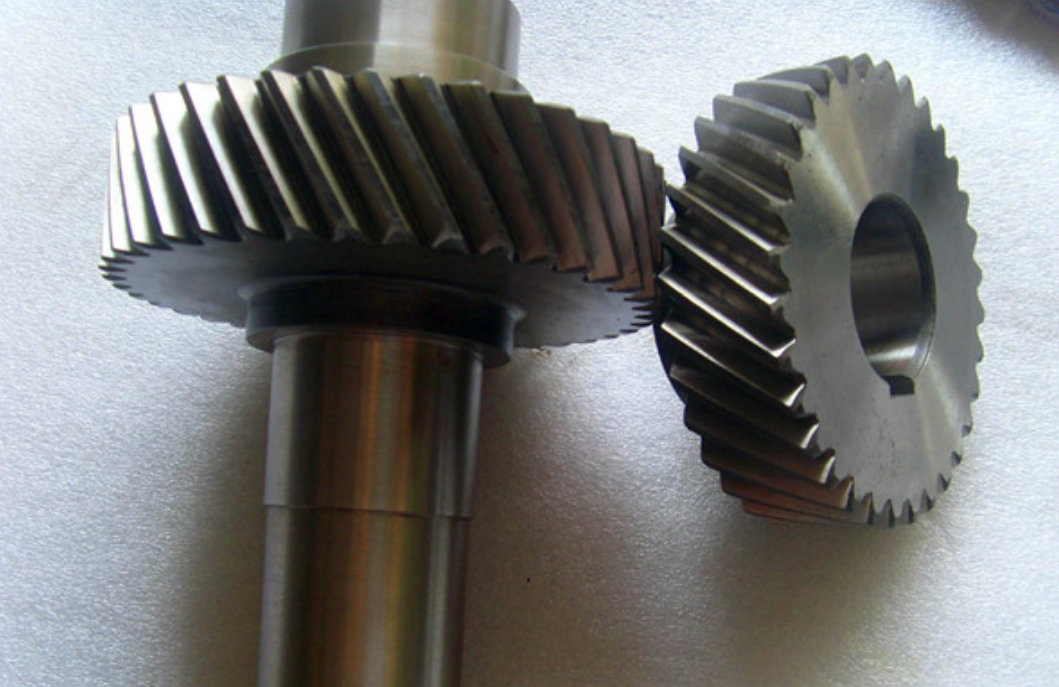
Our experimental setup consists of an open-type single-stage helical gear test rig, designed to simulate real-world operating conditions. The helical gear pair has specific parameters, as summarized in Table 1, which influence the dynamic behavior. The gears are mounted on shafts supported by either rigid bearings or GISFD assemblies. The drive system includes a DC servo motor with speed control, and vibration measurements are taken using piezoelectric accelerometers placed at bearing housings in horizontal and vertical directions. Data acquisition is performed using an M+P SO Analyzer system, capturing time-domain and frequency-domain responses.
| Parameter | Value |
|---|---|
| Number of teeth (drive gear) | 20 |
| Number of teeth (driven gear) | 32 |
| Transmission ratio | 1.6 |
| Normal module (mm) | 3 |
| Pressure angle (degrees) | 20 |
| Helix angle (degrees) | 16 |
| Face width of drive gear (mm) | 30 |
| Face width of driven gear (mm) | 28 |
The GISFD used in this study features a unique G-shaped elastic element design, with structural parameters listed in Table 2. This design enhances damping by creating segmented oil film chambers, preventing circumferential flow and ensuring linear damping forces. The damper is integrated into bearing housings, forming a sealed oil cavity filled with lubricant. Comparative tests are conducted under identical conditions—same center distance, lubrication viscosity, and load—to isolate the effect of GISFD on helical gear vibration.
| Parameter | Value (mm) |
|---|---|
| Outer ring diameter | 95 |
| Oil film radius | 26.35 |
| Inner ring diameter | 30 |
| Oil film clearance | 0.2 |
| G-shaped element height | 10.8 |
| Axial length | 10 |
We first examine the vibration response of the helical gear system under two support conditions: rigid support and GISFD support. At a rotational speed of 1200 rpm (drive gear speed), time-domain and frequency-domain data are collected. The time-domain results show periodic impacts characteristic of helical gear meshing. With rigid supports, peak vibration accelerations reach high values, such as 33.60 m/s² in the horizontal direction of the drive shaft. In contrast, GISFD supports significantly reduce these peaks, e.g., to 22.60 m/s², demonstrating effective vibration attenuation. Table 3 summarizes the peak vibration reductions across measurement points, highlighting the efficacy of GISFD for helical gear shafting.
| Measurement Point | Rigid Support (m/s²) | GISFD Support (m/s²) | Reduction (%) |
|---|---|---|---|
| Drive shaft, horizontal | 33.60 | 22.60 | 32.71 |
| Drive shaft, vertical | 11.60 | 5.58 | 51.90 |
| Driven shaft, horizontal | 22.46 | 13.76 | 38.74 |
| Driven shaft, vertical | 8.79 | 3.55 | 59.61 |
Frequency-domain analysis reveals that helical gear vibration is concentrated at the meshing frequency and its harmonics. For instance, at 1200 rpm, the meshing frequency \( f_m \) is calculated as:
$$ f_m = \frac{n_1 \times z_1}{60} = \frac{1200 \times 20}{60} = 400 \, \text{Hz} $$
where \( n_1 \) is the drive gear speed in rpm, and \( z_1 \) is the number of teeth. With rigid supports, prominent peaks are observed at \( f_m \) and \( 2f_m \) (800 Hz), accompanied by sidebands due to modulation effects. GISFD supports suppress these peaks, as shown in Table 4 and Table 5, indicating reductions up to 85.71% at the meshing frequency. This suppression extends to sidebands, mitigating modulation and improving overall gear dynamics. The damping provided by GISFD effectively dissipates energy at these critical frequencies, which is crucial for helical gear systems operating under varying loads.
| Measurement Point | Rigid Support (m/s²) | GISFD Support (m/s²) | Reduction (%) |
|---|---|---|---|
| Drive shaft, horizontal | 0.66 | 0.20 | 69.70 |
| Drive shaft, vertical | 0.10 | 0.06 | 40.00 |
| Driven shaft, horizontal | 0.76 | 0.24 | 68.42 |
| Driven shaft, vertical | 0.28 | 0.04 | 85.71 |
| Measurement Point | Rigid Support (m/s²) | GISFD Support (m/s²) | Reduction (%) |
|---|---|---|---|
| Drive shaft, horizontal | 0.87 | 0.53 | 39.08 |
| Drive shaft, vertical | 0.28 | 0.11 | 60.71 |
| Driven shaft, horizontal | 0.34 | 0.09 | 73.53 |
| Driven shaft, vertical | 0.13 | 0.07 | 46.15 |
To assess the broadband performance of GISFD, we conduct experiments across a speed range from 300 rpm to 1200 rpm (drive gear speed). Peak vibration amplitudes are recorded for both support types, and the results are plotted to show trends. With rigid supports, vibration peaks increase with speed, reaching a maximum at 1000 rpm due to resonance near the system’s natural frequency. For example, at 1000 rpm, the drive shaft horizontal vibration peaks at 56.13 m/s². With GISFD supports, vibrations are reduced across all speeds, with the highest reduction of 69.80% at 1000 rpm. This demonstrates that GISFD provides effective vibration control over a wide operational range, which is essential for helical gear systems used in variable-speed applications. The damping mechanism of GISFD, combining squeeze film action and elastic support, contributes to this broadband efficacy.
We further investigate the impact of GISFD on a helical gear pair with simulated tooth surface wear. Wear is introduced by damaging the tooth roots and tips, mimicking severe operating conditions. Vibration measurements are taken under the same speed range. As expected, worn helical gears exhibit higher vibration levels with rigid supports, peaking at 54.47 m/s² at 1200 rpm in the drive shaft horizontal direction. With GISFD supports, vibrations are significantly suppressed, with reductions up to 83.99% at 1200 rpm. This highlights the robustness of GISFD in managing vibration even under fault conditions, making it a valuable component for enhancing the reliability of helical gear transmissions in harsh environments.
Theoretical analysis of the transmissibility coefficient \( T_f \) explains these results. For helical gear systems, the meshing frequency often exceeds the natural frequency, leading to \( z > 1 \). By reducing stiffness \( K \) and increasing damping \( C \), GISFD lowers \( T_f \), thereby isolating vibration. The experimental data align with this model, showing reduced transmitted forces. Additionally, the segmented design of GISFD avoids nonlinear oil film behaviors, ensuring stable damping across frequencies. This linearity is crucial for helical gear applications, where predictable performance is needed.
In conclusion, our experimental study demonstrates that the G-type Integral Squeeze Film Damper (GISFD) effectively reduces vibration in helical gear shafting. Key findings include significant peak vibration reductions (up to 59.61% under normal conditions and 83.99% under wear conditions), suppression of meshing frequency harmonics (up to 85.71%), and broadband efficacy across speeds. The GISFD’s design, featuring G-shaped elastic elements and segmented oil films, provides both damping and stiffness tuning, making it a versatile solution for helical gear systems. Future work could explore optimization of GISFD parameters for specific helical gear configurations or integration into multi-stage gearboxes. Overall, this research contributes to passive vibration control strategies, enhancing the performance and durability of helical gear transmissions in industrial applications.