
In my research, I focus on the critical issue of tooth surface wear in helical gears, which are widely used in various industrial applications due to their high load-bearing capacity and smooth transmission. Wear is a common failure mode that can lead to increased vibration and noise, potentially causing other faults such as pitting, spalling, or even tooth breakage, ultimately reducing system precision and causing economic losses. Most existing studies rely on traditional Archard wear models without considering lubrication effects, and they predominantly examine spur gears, leaving a gap in understanding helical gears. To address this, I numerically simulate the wear process of helical gears under mixed elastohydrodynamic lubrication (EHL) conditions, develop an eight-degree-of-freedom dynamics model to analyze how wear affects dynamic characteristics, and validate the results through experimental fatigue tests on a helical gear test rig. This work aims to provide a reliable theoretical basis for predicting wear and diagnosing faults in helical gears, emphasizing the importance of lubrication and time-varying meshing properties.
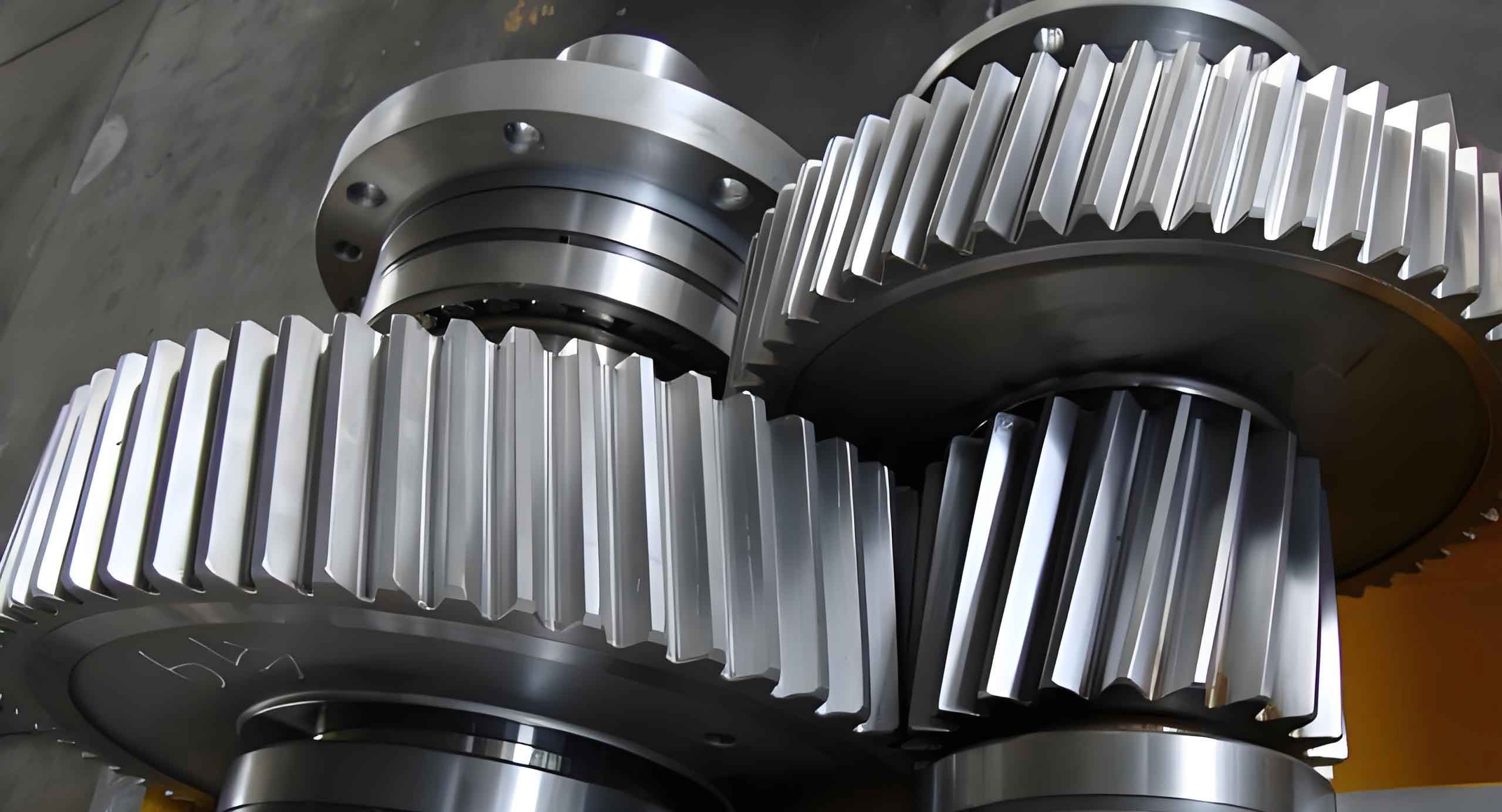
The wear model for helical gears must account for lubrication, as most industrial helical gears operate under mixed EHL conditions where the contact load is shared by the oil film and surface asperities. I start with the traditional Archard wear formula, which is expressed as:
$$ V = K \frac{W}{H} S $$
where \( V \) is the wear volume, \( K \) is the dimensionless wear coefficient, \( W \) is the contact load, \( H \) is the surface hardness, and \( S \) is the sliding distance. However, this model is based on dry contact and does not consider lubrication. To improve accuracy, I adopt a modified Archard model that incorporates mixed EHL effects, given by:
$$ V = K \psi \left( \frac{L_a}{100} \right) \frac{W}{H} S $$
Here, \( \psi \) is the oil film breakdown ratio, and \( L_a \) is the asperity load ratio. The oil film breakdown ratio is defined as:
$$ \psi = 1 – \exp \left[ – \frac{X}{u_s t_0} \exp \left( – \frac{E_a}{R_g T_s} \right) \right] $$
and the asperity load ratio is:
$$ L_a = 0.005W^{-0.408}U^{-0.088}G^{0.103} \times \ln \left(1 + 4,470 \bar{\sigma}^{6.015} V^{1.168} W^{0.485} U^{-3.741} G^{-2.898} \right) $$
where \( X \), \( u_s \), \( t_0 \), \( E_a \), \( R_g \), \( T_s \), \( U \), \( G \), \( \bar{\sigma} \), and \( V \) are parameters related to lubrication and surface properties, as detailed in prior studies. By differentiating with respect to time, the wear rate per unit time is:
$$ \frac{V}{t} = K \psi \left( \frac{L_a}{100} \right) \frac{W}{H} u_s $$
where \( u_s \) is the relative sliding velocity. Rearranging this, the wear depth rate becomes:
$$ \frac{h}{u_s} = K \psi \left( \frac{L_a}{100} \right) \frac{p}{H} $$
with \( h \) as the wear depth per unit time and \( p \) as the average contact pressure. For helical gears, the meshing line length varies over time, so contact pressure and sliding speed differ at each point on the tooth surface. To accurately model wear, I discretize the tooth surface into an \( m \times n \) grid, where each point \( P_{ij} \) enters the meshing zone sequentially. The wear depth at any point \( P_{ij} \) is integrated over the sliding distance:
$$ h_{ij} = \int_0^S k \psi_{ij} \left( \frac{L_a}{100} \right) p_{ij} dS $$
where \( k = K/H \) is the wear coefficient. The contact pressure \( p_{ij} \) and sliding distance \( S \) are derived from Hertzian contact theory and gear meshing analysis. The Hertzian contact half-width is:
$$ a_h = \sqrt{\frac{4 F_t \rho}{\pi b E}} $$
and the contact pressure is:
$$ p = \frac{2 F_t}{\pi a_h b} $$
Here, \( F_t \) is the tangential force at the meshing point, \( \rho \) is the composite curvature radius, \( b \) is the face width, and \( E \) is Young’s modulus. The sliding distances for the driving and driven helical gears are:
$$ S_g = 2a_h \frac{u_g – u_p}{u_g} \quad \text{and} \quad S_p = 2a_h \frac{u_p – u_g}{u_p} $$
where \( u_g \) and \( u_p \) are the linear velocities at point \( P_{ij} \) for the driving and driven helical gears, respectively. This approach allows for a detailed simulation of wear distribution on helical gear teeth.
Wear alters the tooth profile of helical gears, thereby affecting the mesh stiffness, which is crucial for dynamic behavior. For an equivalent spur gear slice \( i \) from the helical gear, the worn tooth profile is described by:
$$ \begin{cases} x = r_b (\sin \alpha – \alpha \cos \alpha) – h_{ij} \sin \alpha_{ij} \\ y = r_b (\cos \alpha + \alpha \sin \alpha) – h_{ij} \cos \alpha_{ij} \end{cases} $$
where \( r_b \) is the base radius, \( \alpha \) is the pressure angle, and \( h_{ij} \) is the wear depth at point \( ij \). To compute the mesh stiffness, I model each gear tooth as a cantilever beam with variable cross-section. The deformations include bending deflection \( \delta_b \), fillet foundation deflection \( \delta_f \), and contact deflection \( \delta_h \), with corresponding stiffness values \( k_b \), \( k_f \), and \( k_h \). The formulas for these calculations are summarized in the table below, where parameters such as \( d_{ij} \), \( e_{ij} \), \( I_{ij} \), \( A_{ij} \), \( u_{fij} \), \( S_f \), and others are defined based on gear geometry and material properties, as referenced in standard gear dynamics literature.
| Parameter | Expression | Stiffness Formula |
|---|---|---|
| Bending Deflection \( \delta_b \) | \( \delta_{bij} = F_{ij} \cos^2 \alpha_{ij} \sum_{j=1}^m e_{ij} \left\{ \frac{d_{ij} – e_{ij}}{d_{ij}} + \frac{1}{3} \left( \frac{e_{ij}}{d_{ij}} \right)^2 \frac{1}{E’I_{ij}} + \frac{\tan^2 \alpha_{ij}}{A_{ij}E’} \right\} \) | \( k_{bij} = \frac{F_{ij}}{\delta_{bij}} \) |
| Fillet Foundation Deflection \( \delta_f \) | \( \delta_{fij} = \frac{F_{ij} \cos^2 \alpha_{ij}}{bE} \left\{ L^* \left( \frac{u_{fij}}{S_f} \right)^2 + M^* \left( \frac{u_{fij}}{S_f} \right) + P^* (1 + Q^* \tan^2 \alpha_{ij}) \right\} \) | \( k_{fij} = \frac{F_{ij}}{\delta_{fij}} \) |
| Contact Deflection \( \delta_h \) | \( \delta_{hij} = \frac{F_{ij}}{k_{hij}} \) with \( k_{hij} = \frac{\pi E b}{4(1 – \nu^2)} \) | \( k_{hij} = \frac{\pi E b}{4(1 – \nu^2)} \) |
For any spur gear slice \( i \) at meshing point \( j \), the mesh stiffness \( k_{mij} \) is:
$$ k_{mij} = \frac{1}{ \frac{1}{k_{bij}^g} + \frac{1}{k_{fij}^g} + \frac{1}{k_{bij}^p} + \frac{1}{k_{fij}^p} + \frac{1}{k_{hij}} } $$
where superscripts \( g \) and \( p \) denote driving and driven helical gears. The total mesh stiffness \( k_m \) for the helical gear is obtained by summing the stiffness of all equivalent spur gear slices in contact at any given time, accounting for the time-varying engagement of helical gears.
To investigate the impact of wear on dynamic characteristics, I develop an eight-degree-of-freedom dynamics model for helical gears. This model includes rotational motions \( \theta_g \) and \( \theta_p \) for the driving and driven gears, and translational motions in the x, y, and z directions for both gears, resulting in eight degrees of freedom. The governing equations are:
$$ \begin{cases}
m_g \ddot{y}_g + c_{by} \dot{y}_g + k_{by} y_g = F_{my} \\
m_g \ddot{z}_g + c_{bz} \dot{z}_g + k_{bz} z_g = F_{mz} \\
m_g \ddot{x}_g + c_{bx} \dot{x}_g + k_{bx} x_g = F_f \\
I_g \ddot{\theta}_g = T_d – F_{my} r_{bg} \\
m_p \ddot{y}_p + c_{by} \dot{y}_p + k_{by} y_p = -F_{my} \\
m_p \ddot{z}_p + c_{bz} \dot{z}_p + k_{bz} z_p = -F_{mz} \\
m_p \ddot{x}_p + c_{bx} \dot{x}_p + k_{bx} x_p = -F_f \\
I_p \ddot{\theta}_p = -T_L + F_{my} r_{bp}
\end{cases} $$
Here, \( m_i \) and \( I_i \) are the mass and moment of inertia for gear \( i \) (with \( i = g, p \)), \( c_{bi} \) and \( k_{bi} \) are bearing damping and stiffness in each direction, \( T_d \) and \( T_L \) are the driving and load torques, \( r_{bi} \) are base radii, and \( F_{my} \), \( F_{mz} \), and \( F_f \) are the meshing forces and friction force. The meshing forces in the y and z directions are:
$$ F_{my} = (c_m \cos \beta) \dot{\delta}_y + (k_m \cos \beta) \delta_y $$
$$ F_{mz} = (c_m \sin \beta) \dot{\delta}_z + (k_m \sin \beta) \delta_z $$
where \( k_m \) is the time-varying mesh stiffness of the helical gear, \( c_m = 2\xi \sqrt{k_m m_e} \) is the mesh damping with damping ratio \( \xi \) and equivalent mass \( m_e \), and \( \beta \) is the helix angle. The dynamic transmission errors are:
$$ \delta_y = (y_g + r_{bg} \theta_g) – (y_p – r_{bp} \theta_p) + e $$
$$ \delta_z = [z_g – \tan \beta (y_g + r_{bg} \theta_g)] – [z_p – \tan \beta (y_p – r_{bp} \theta_p)] $$
with \( e \) as static transmission error. The friction force is:
$$ F_f = \mu(t) F_m $$
where \( F_m = \sqrt{F_{my}^2 + F_{mz}^2} \) is the total meshing force, and \( \mu(t) \) is the time-varying friction coefficient, calculated using a fitted formula from literature:
$$ \mu(t) = e^{f(SR_{ij}(t), Ph_{ij}(t), v_0, S)} Ph_{ij}(t)^{b_2} \times |SR_{ij}(t)|^{b_3} \times V_{eij}(t)^{b_6} v_0^{b_7} R_{ij}(t)^{b_8} $$
where \( SR_{ij}(t) \) is the slide-to-roll ratio, \( Ph_{ij}(t) \) is the contact pressure, and other terms are constants or variables from lubrication models. I solve these equations using the ODE15s solver in MATLAB, a multi-step solver suitable for stiff systems, as illustrated in the simulation flowchart that integrates wear calculation and dynamics analysis iteratively.
For numerical simulation, I use parameters consistent with experimental helical gear tests to ensure validity. The helical gear parameters include number of teeth, helix angle, center distance, normal pressure angle, face width, normal module, elastic modulus, Poisson’s ratio, surface roughness, and Vickers hardness. A summary is provided in the table below:
| Parameter | High-Speed Stage | Low-Speed Stage |
|---|---|---|
| Number of Teeth \( z \) | 49/55 | 13/59 |
| Helix Angle \( \beta \) (°) | 27 | 36 |
| Center Distance \( a \) (mm) | 74 | 25 |
| Normal Pressure Angle \( \alpha_n \) (°) | 20 | 20 |
| Face Width \( b \) (mm) | 25 | 25 |
| Normal Module \( m_n \) (mm) | 1.25 | 1.25 |
| Elastic Modulus \( E \) (GPa) | 200 | 200 |
| Poisson’s Ratio \( \nu \) | 0.28 | 0.28 |
| Surface Roughness \( \sigma \) (μm) | 0.8 | 0.8 |
| Vickers Hardness \( H_d \) (Pa) | 6.865 × 10⁹ | 6.865 × 10⁹ |
First, I compute the wear depth distribution on helical gear teeth after 200 hours of operation (approximately 2.47 × 10⁶ cycles). The results show that wear primarily occurs near the tooth root and tip regions, with maximum wear at the root due to higher slide-to-roll ratios. Along the face width, wear depth varies with the number of contacting tooth pairs, influenced by load distribution. This pattern highlights the time-varying meshing nature of helical gears.
Next, I analyze the vibration response using the dynamics model. The simulated vibration signals in the x, y, and z directions for worn helical gears after 200 hours reveal that vibration is highest in the y-direction (meshing line direction), followed by the x-direction (friction direction). Frequency spectra show distinct peaks at the meshing frequency \( f_m \) and its harmonics. To assess overall vibration levels, I combine the frequency-domain signals from all directions using the root mean square (RMS) value:
$$ E = \sqrt{\frac{E_x^2 + E_y^2 + E_z^2}{3}} $$
where \( E_x \), \( E_y \), and \( E_z \) are the vibration energies in each direction. I simulate wear progression at 200, 400, 600, and 800 hours (corresponding to 2.47 × 10⁶, 4.95 × 10⁶, 7.42 × 10⁶, and 9.89 × 10⁶ cycles, respectively) and extract the amplitudes of the meshing frequency and its first four harmonics. The results, summarized in the table below, demonstrate that as wear depth increases with operating time, the amplitudes of these frequencies rise, indicating heightened vibration due to wear in helical gears.
| Operating Time (hours) | Cycles | 1× \( f_m \) Amplitude (m/s²) | 2× \( f_m \) Amplitude (m/s²) | 3× \( f_m \) Amplitude (m/s²) | 4× \( f_m \) Amplitude (m/s²) |
|---|---|---|---|---|---|
| 200 | 2.47 × 10⁶ | 0.15 | 0.08 | 0.05 | 0.03 |
| 400 | 4.95 × 10⁶ | 0.18 | 0.10 | 0.06 | 0.04 |
| 600 | 7.42 × 10⁶ | 0.22 | 0.12 | 0.07 | 0.05 |
| 800 | 9.89 × 10⁶ | 0.26 | 0.14 | 0.09 | 0.06 |
To validate the numerical findings, I conduct experimental tests on a helical gear test rig. The setup consists of two identical two-stage gearboxes back-to-back, with the test gearbox being the second one, which includes high-speed and low-speed helical gear stages. The driving motor operates at 70% rated speed (1500 rpm), and the load motor applies 100% rated power. Vibration signals are acquired using an accelerometer mounted on the gearbox housing and processed with time-synchronous averaging (TSA) to reduce noise and enhance signal quality. The TSA-processed signals clearly show the meshing frequency and its harmonics in the frequency spectrum. I extract the amplitudes of these components over time, and the results align with the simulation trends: as wear progresses, the amplitudes increase, confirming that wear in helical gears leads to elevated vibration. The consistency between experimental and numerical results validates the proposed models for helical gears.
In conclusion, my research provides a comprehensive analysis of progressive wear effects on vibration characteristics in helical gears. By incorporating mixed EHL conditions into the wear model, I achieve a more realistic simulation of the wear process in helical gears. The dynamics model demonstrates that wear increases vibration, as evidenced by rising amplitudes of the meshing frequency and its harmonics, offering a basis for condition monitoring and fault diagnosis in helical gear systems. Experimental results corroborate the numerical simulations, highlighting the model’s effectiveness. Future work could explore the interaction between wear and other faults in helical gears or optimize lubrication strategies to mitigate wear in helical gear applications. This study underscores the importance of considering lubrication and time-varying properties when analyzing helical gears, contributing to improved reliability and performance in industrial systems that rely on helical gears.