
In mechanical transmission systems, helical gears are widely used due to their high load capacity, smooth operation, and reduced noise compared to spur gears. However, tooth surface wear remains a critical issue that can lead to vibration, noise, and eventual failure. As a researcher focused on gear dynamics, I have investigated the impact of axis misalignment on tooth surface wear in helical gear pairs. Axis misalignment, arising from manufacturing errors, assembly inaccuracies, or operational deformations, significantly alters the load distribution along the tooth face, exacerbating wear processes. This study aims to develop a comprehensive wear prediction model that incorporates axis misalignment, using numerical simulations and finite element analysis. By integrating the Archard wear formula and exploring modification strategies like helix angle and crowning modifications, I seek to mitigate wear effects and enhance gear longevity. The findings provide insights into optimal design parameters for helical gears under misaligned conditions.
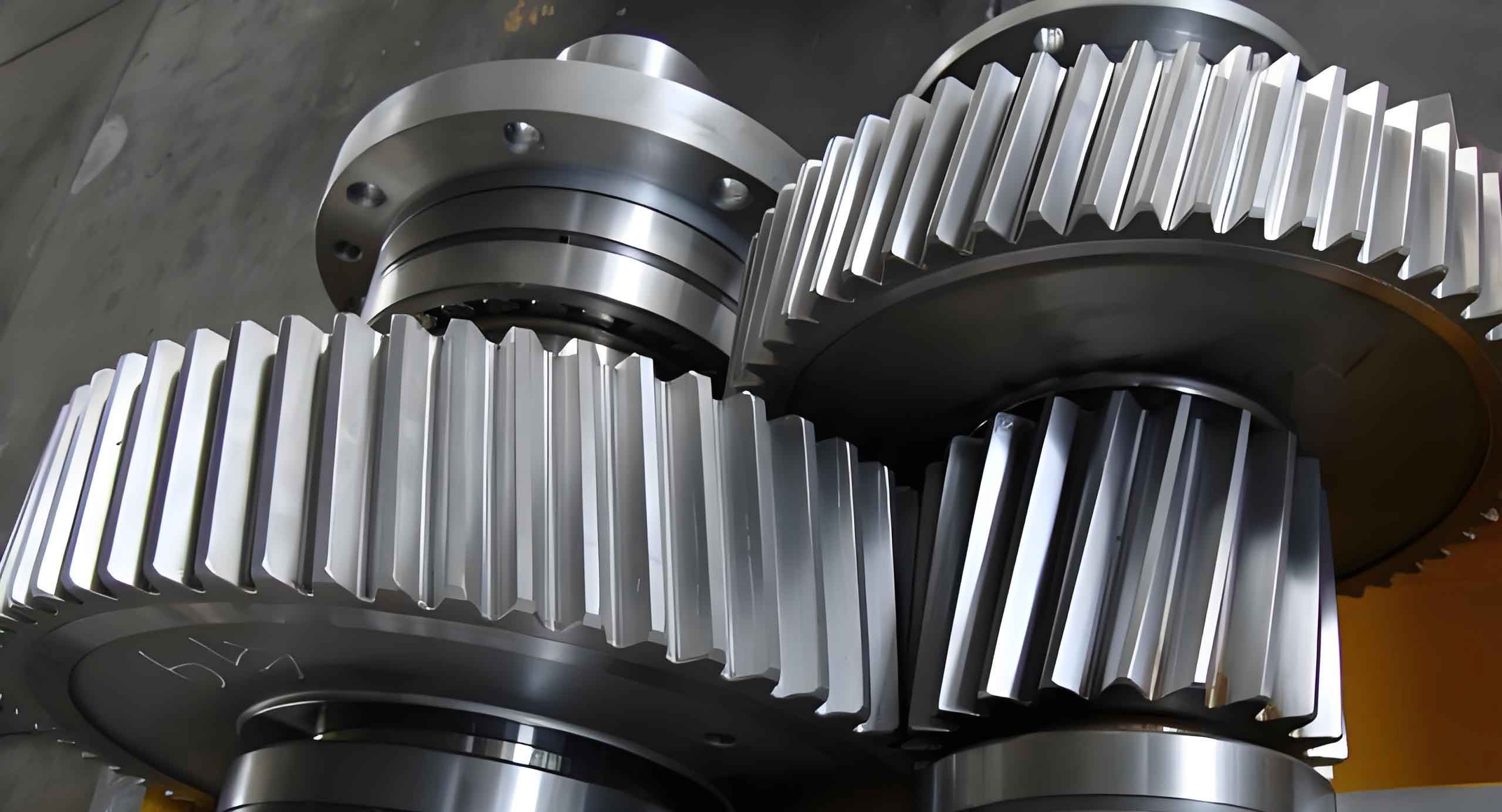
Helical gears operate with a slanted tooth geometry, which introduces complex contact patterns and sliding motions. Wear in these gears is influenced by factors such as contact pressure, sliding distance, and lubrication conditions. The Archard wear model serves as a foundational tool for quantifying wear depth, expressed as:
$$ h = \int_{0}^{s} k P ds $$
where \( h \) is the wear depth in micrometers, \( P \) is the contact pressure in N/m, \( k \) is the wear rate in m²/N, and \( s \) is the relative sliding distance in meters. For helical gears, the wear rate \( k \) is derived from empirical regression, accounting for material properties, load, and surface roughness:
$$ k = 3.981 \times 10^{29} E’ L^{1.219} G^{-7.377} S^{1.589} $$
Here, \( L \) represents the dimensionless load, \( G \) is the dimensionless lubrication pressure, \( S \) denotes the dimensionless composite roughness, and \( E’ \) is the equivalent elastic modulus. These parameters are calculated as:
$$ L = \frac{W’}{E’ R’}, \quad G = \alpha E’, \quad S = \frac{R_c}{\alpha R’}, \quad \frac{1}{E’} = \frac{1 – \nu_1^2}{2E_1} + \frac{1 – \nu_2^2}{2E_2} $$
with \( W’ \) as the unit load per contact length, \( R’ \) as the equivalent radius, \( \alpha \) as the pressure-viscosity coefficient, \( R_c \) as the composite roughness, and \( E_1, E_2, \nu_1, \nu_2 \) as the elastic moduli and Poisson’s ratios of the gear materials. The sliding distance \( s \) for a point on the tooth surface is obtained by integrating the relative sliding velocity over the contact duration, which varies with gear rotation and mesh cycles.
Axis misalignment in helical gears is categorized into two types: vertical plane deviation \( f_\beta \) and axial plane deviation \( f_\delta \). Vertical plane deviation occurs perpendicular to the common plane of the axes, while axial plane deviation lies within that plane. These deviations induce non-uniform load distribution across the tooth width, leading to localized high wear. In my analysis, I consider both deviations to assess their combined effect on wear in helical gears. The total axis misalignment \( f_{\Sigma\beta} \) is a vector sum, influencing the contact pattern and stress concentrations.
To simulate wear in helical gears, I employed a finite element method (FEM) combined with numerical iterations. The gear pair model was discretized into mesh nodes, with contact pressures computed using ANSYS software. The wear depth at each node was updated iteratively based on the Archard formula, and tooth profile reconstruction was performed when wear exceeded a threshold (e.g., 2 μm). This process continued until the maximum allowable wear depth was reached, allowing for the analysis of cumulative wear over multiple cycles. The basic parameters for the helical gear pair used in this study are summarized in Table 1, which includes material properties, geometric dimensions, and operational conditions.
| Parameter | Pinion (p) | Gear (g) |
|---|---|---|
| Material | 45 Steel | 45 Steel |
| Density (kg/m³) | 7800 | 7800 |
| Surface Roughness (μm) | 0.6 | 0.6 |
| Number of Teeth, \( z \) | 25 | 75 |
| Module, \( m \) (mm) | 6.0 | 6.0 |
| Normal Pressure Angle, \( \alpha_n \) (deg) | 20 | 20 |
| Helix Angle, \( \beta_n \) (deg) | 5 | 5 |
| Profile Shift Coefficient (mm) | -0.0304 | 0.0304 |
| Face Width, \( F \) (mm) | 44 | 43 |
| Input Torque, \( T_p \) (N·m) | 3360 | – |
| Wear Rate, \( k \) (m²/N) | 1 × 10⁻¹⁸ | 1 × 10⁻¹⁸ |
Under ideal conditions without axis misalignment, wear in helical gears exhibits a characteristic distribution: maximum wear occurs near the tooth root due to higher sliding velocities and contact stresses, while minimal wear is observed at the pitch point where relative sliding is negligible. For the pinion, wear is more severe than for the gear because of its higher rotational cycles. The wear depth \( h \) can be expressed for discrete nodes after \( \zeta \) wear cycles as:
$$ (\Delta h_{ij}^q)^{p,g}_\zeta = k (\bar{P}_{ij}^q)^{p,g}_\zeta (s_{ij})^{p,g}_\zeta $$
where \( (\bar{P}_{ij}^q)^{p,g}_\zeta \) is the average contact pressure at node \( ij \) during cycle \( \zeta \), and \( (s_{ij})^{p,g}_\zeta \) is the sliding distance. Cumulative wear after \( Q \) profile reconstructions is given by:
$$ h^{p,g}_{ij} = \sum_{q=1}^{Q} (h_{ij}^q)^{p,g} $$
This model was validated against known wear patterns, confirming its accuracy for helical gears.
When axis misalignment is introduced, the wear distribution changes significantly. For instance, with a vertical plane deviation \( f_\beta = 5 \) μm and an axial plane deviation \( f_\delta = 20 \) μm, the pinion shows more uniform wear across the face width, but the gear experiences increased wear concentration. The maximum wear depth for the pinion decreases by about 10.5%, while for the gear, it increases by 13.6%. This indicates that certain misalignments can redistribute loads, potentially reducing wear in one gear at the expense of the other. However, excessive misalignment universally accelerates wear in both helical gears. The sensitivity of wear to misalignment is summarized in Table 2, which compares the effects of vertical and axial plane deviations on maximum wear depth.
| Misalignment Type | Pinion Wear Change | Gear Wear Change | Overall Trend |
|---|---|---|---|
| Vertical Plane \( f_\beta \) Increase | Decreases initially, then increases | Increases monotonically | More sensitive than axial plane |
| Axial Plane \( f_\delta \) Increase | Decreases slightly | Increases moderately | Less impact than vertical plane |
| Combined \( f_\beta \) and \( f_\delta \) | Non-linear variation | Similar non-linearity | Complex interaction |
To mitigate the adverse effects of axis misalignment on helical gears, tooth modifications such as helix angle modification and involute crowning are employed. Helix angle modification involves adjusting the lead of the tooth along the face width, while crowning adds a slight barrel shape to the tooth profile. These modifications optimize load distribution and reduce stress concentrations. For the helical gear pair studied, a combined modification strategy was evaluated. The helix angle modification amounts \( H_p \) and \( H_g \) for the pinion and gear, respectively, were varied, and their impact on wear was analyzed using the formula for wear depth with modifications integrated into the contact pressure calculations. The optimal modification was found when \( H_p + H_g = T \), a constant, with \( T \) in the range of 20 to 25 μm. For instance, setting \( H_p = 12 \) μm and \( H_g = 12 \) μm minimized wear asymmetry.
Involute crowning further reduces wear by compensating for misalignment-induced edge loading. The crowning amounts \( L_p \) and \( L_g \) were optimized through iterative simulations. The results showed that with \( L_p = 20 \) μm and \( L_g = 12 \) μm, along with the helix angle modifications, the maximum wear depth in the pinion dropped from 9.44 μm to 4.77 μm, a reduction of nearly 50%. This demonstrates the efficacy of combined modifications in helical gears. The wear reduction mechanism can be described by modifying the contact pressure distribution \( P \) in the Archard equation, where modifications alter the effective contact area and sliding distance. The relative sliding distance \( s \) is also affected, as modifications change the meshing kinematics. For helical gears, the sliding distance calculation incorporates the helix angle and modification parameters:
$$ s = \int_{t_I}^{t_O} |v_{ij}(t) – v_{uv}(t)| dt $$
where \( v_{ij}(t) \) and \( v_{uv}(t) \) are tangential velocities at corresponding points on the pinion and gear, and \( t_I \) and \( t_O \) are the entry and exit times of contact. With modifications, these velocities are adjusted, leading to reduced sliding in critical regions.
The numerical simulations involved multiple wear cycles, with profile reconstructions triggered at a threshold of 2 μm. The total number of cycles \( \zeta_t \) until the allowable wear depth (e.g., 10 μm) was reached provided insights into gear life. For helical gears under misalignment, the cycle count decreased, but with optimal modifications, it increased significantly. This highlights the importance of proactive design adjustments. A summary of key equations used in the analysis is presented in Table 3, emphasizing the interplay between wear parameters and gear geometry.
| Equation Name | Formula | Parameters |
|---|---|---|
| Archard Wear Depth | $$ h = \int_{0}^{s} k P ds $$ | \( h \): wear depth, \( k \): wear rate, \( P \): pressure, \( s \): sliding distance |
| Wear Rate | $$ k = 3.981 \times 10^{29} E’ L^{1.219} G^{-7.377} S^{1.589} $$ | \( E’ \): equivalent modulus, \( L \): load parameter, \( G \): lubrication, \( S \): roughness |
| Sliding Distance | $$ s = \int_{t_I}^{t_O} |v_{ij}(t) – v_{uv}(t)| dt $$ | \( v_{ij}, v_{uv} \): velocities, \( t_I, t_O \): contact times |
| Cumulative Wear | $$ h^{p,g}_{ij} = \sum_{q=1}^{Q} (h_{ij}^q)^{p,g} $$ | \( Q \): reconstructions, \( (h_{ij}^q)^{p,g} \): wear per cycle |
| Axis Misalignment Effect | $$ f_{\Sigma\beta} = \sqrt{f_\beta^2 + f_\delta^2} $$ | \( f_\beta \): vertical deviation, \( f_\delta \): axial deviation |
In practice, helical gears often operate under varying misalignments due to thermal expansions, dynamic loads, or mounting errors. Therefore, a robust modification strategy must account for a range of misalignment values. My analysis extended to different scenarios, such as \( f_\beta = -5 \) μm and \( f_\delta = -20 \) μm, where combined modifications still yielded wear reductions. The vertical plane deviation \( f_\beta \) was found to have a more pronounced impact on wear than axial plane deviation \( f_\delta \), as it directly affects the contact line orientation in helical gears. For every micron increase in \( f_\beta \), wear depth changes were approximately 2-3 times greater than for \( f_\delta \). This underscores the need for precise alignment control in helical gear systems.
Furthermore, the wear process in helical gears is influenced by lubrication conditions. The dimensionless parameter \( G \) in the wear rate equation captures this effect. For helical gears operating with oil lubrication, \( G \) depends on the pressure-viscosity coefficient \( \alpha \), which varies with temperature and oil type. Integrating lubrication effects into the wear model enhances accuracy, especially for high-speed helical gears where elastohydrodynamic lubrication (EHL) films form. The composite roughness \( S \) also plays a role, as helical gears with smoother surfaces exhibit lower wear rates. In my simulations, standard roughness values were used, but real-world variations can be incorporated by adjusting \( S \) in the wear rate formula.
To summarize, axis misalignment in helical gears significantly accelerates tooth surface wear, but through careful modification design, its effects can be mitigated. Helix angle modification and involute crowning work synergistically to redistribute contact pressures and reduce sliding distances, thereby extending gear life. The Archard-based model, combined with finite element analysis, provides a reliable tool for predicting wear in helical gears under misaligned conditions. Future work could explore dynamic wear effects, thermal influences, and more complex gear geometries like double-helical gears. For engineers designing helical gear systems, considering axis misalignment upfront and implementing appropriate modifications is crucial for durability and performance.
In conclusion, this study highlights the importance of axis misalignment in wear analysis for helical gears. By using numerical simulations and analytical models, I have shown that vertical plane deviations are particularly critical, and combined tooth modifications offer an effective solution. The methodologies developed here can be applied to optimize helical gear designs in automotive, aerospace, and industrial applications, ensuring reliable operation even under imperfect alignment conditions. As helical gears continue to be integral to power transmission systems, advancing wear prediction techniques will contribute to more efficient and longer-lasting machinery.