
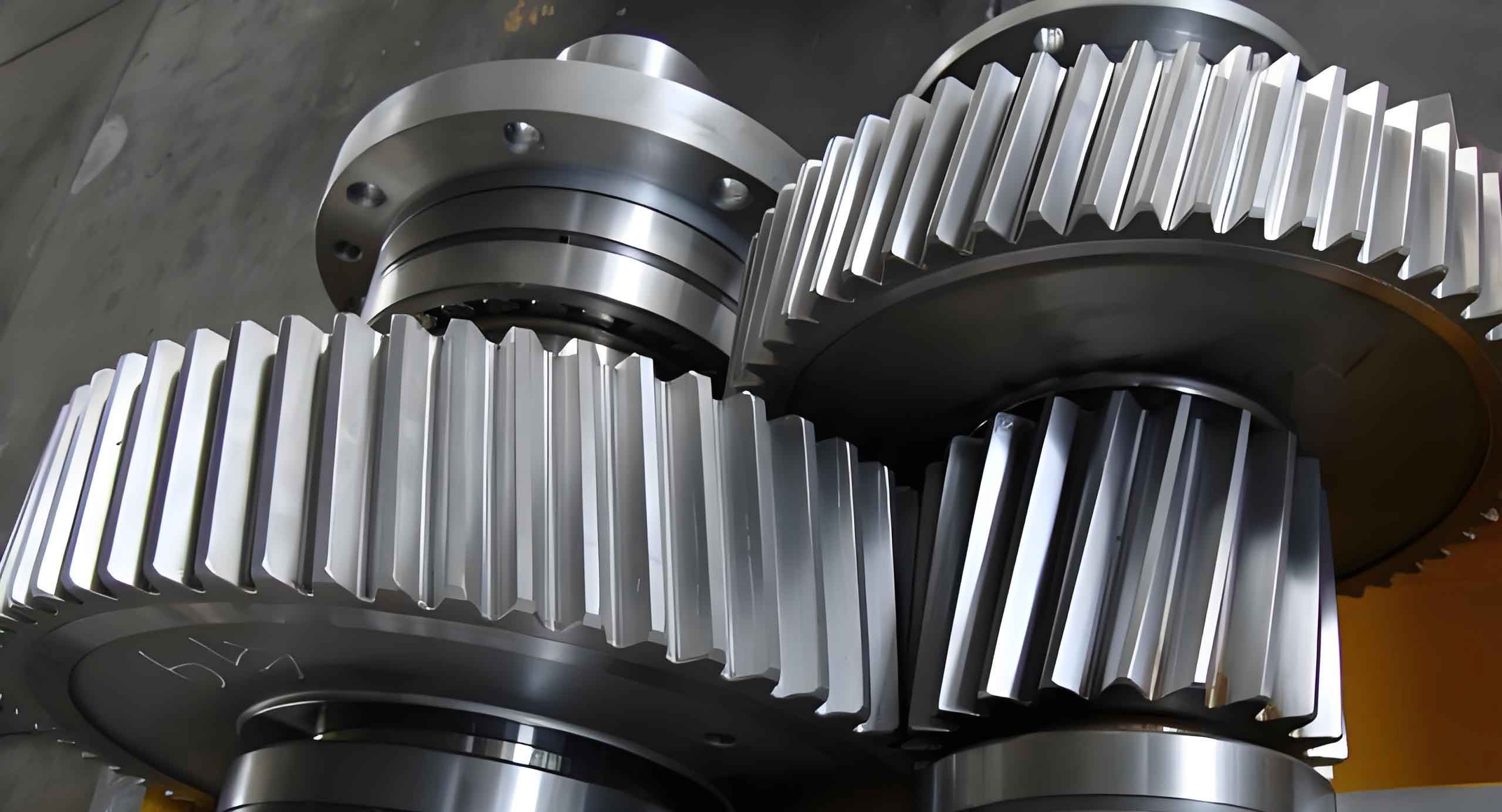
The study of nonlinear dynamics in gear transmission systems is crucial for ensuring operational stability, reducing noise, and enhancing reliability in modern machinery. Among various gear types, helical gears are extensively employed in automotive, aerospace, marine, and wind power industries due to their superior characteristics compared to spur gears. These advantages include smoother engagement, higher contact ratio, reduced operational noise, and more compact structural design. The complex dynamic behavior of helical gear systems arises from inherent nonlinear factors such as time-varying mesh stiffness, gear backlash, and manufacturing errors. In practical engineering applications, these systems are invariably subjected to various internal and external random disturbances. External random factors primarily involve fluctuations in input torque, while internal random factors encompass stochastic variations in parameters like damping ratio, backlash, excitation frequency, and mesh stiffness. This work focuses specifically on the random perturbations associated with time-varying mesh stiffness. Such perturbations originate from the fact that the actual contact during gear meshing is not a single theoretical point but occurs over a small, variable area surrounding the nominal contact point. Investigating the influence of these stochastic variations on the bifurcation and chaotic characteristics of the system is essential for optimal design and robust performance.
Extensive research has been conducted on the nonlinear vibrations of gear systems and the effects of random factors. Studies on spur gear systems have explored the impact of random transmission errors, parameter uncertainties using methods like Monte Carlo simulation, reliability analysis under stochastic conditions, and nonlinear vibrations under combined deterministic and random excitations. However, the dynamic modeling and analysis of helical gears are more complex due to the additional axial vibration component induced by the helix angle. While some research has addressed the bifurcation behavior of helical gear systems considering deterministic parameter variations, a comprehensive investigation incorporating the random perturbation of key nonlinear parameters like mesh stiffness remains less explored. This paper aims to bridge this gap by establishing a six-degree-of-freedom nonlinear dynamic model for a helical gear pair, explicitly incorporating the random perturbation of time-varying mesh stiffness. Through numerical simulation and nonlinear dynamics theory, the bifurcation routes and transition to chaos are analyzed in detail.
Mathematical Modeling of the Helical Gear System
The dynamic model considers the spatial motion of a single pair of helical gears. Using the lumped mass method, a six-degree-of-freedom model is established, accounting for translational vibrations along the line-of-action direction (Y-axis) and the axial direction (Z-axis), as well as torsional vibration around the gear axis. The schematic of the dynamic model is shown below, illustrating the coordinate system and forces.
The governing equations of motion are derived based on Newton’s second law. The model includes time-varying mesh stiffness \( K_h(\tau) \), damping \( C_h \), gear backlash \( 2b \), static transmission error \( e(\tau) \), and bearing support forces. The input torque \( T_1 \) is considered to have a mean component and a fluctuating component, while the output torque \( T_2 \) is assumed constant.
The equations for the pinion (gear 1) and gear (gear 2) are as follows:
Pinion (Gear 1):
$$ m_1 \ddot{y}_1 + C_{1y} \dot{y}_1 + C_h \dot{p} \cos\beta + K_{1y} y_1 + K_h p \cos\beta = -F_{b1} $$
$$ m_1 \ddot{z}_1 + C_{1z} \dot{z}_1 + C_h \dot{p} \sin\beta + K_{1z} z_1 + K_h p \sin\beta = 0 $$
$$ I_1 \ddot{\theta}_1 + r_1 C_h \dot{p} \cos\beta + r_1 K_h p \cos\beta = -T_1(\tau) $$
Gear (Gear 2):
$$ m_2 \ddot{y}_2 + C_{2y} \dot{y}_2 – C_h \dot{p} \cos\beta + K_{2y} y_2 – K_h p \cos\beta = F_{b2} $$
$$ m_2 \ddot{z}_2 + C_{2z} \dot{z}_2 – C_h \dot{p} \sin\beta + K_{2z} z_2 – K_h p \sin\beta = 0 $$
$$ I_2 \ddot{\theta}_2 + r_2 C_h \dot{p} \cos\beta + r_2 K_h p \cos\beta = T_2 $$
In these equations, \( p \) represents the relative displacement along the line of action, defined as:
$$ p = \frac{(r_1 \theta_1 – r_2 \theta_2 + y_2 – y_1)}{\cos\beta} – e(\tau) $$
where \( r_1, r_2 \) are base circle radii, \( \theta_1, \theta_2 \) are angular displacements, \( y_1, y_2 \) are translational displacements, and \( \beta \) is the helix angle. The static transmission error is modeled as a sinusoidal function: \( e(\tau) = e \sin(\omega_e \tau + \phi_e) \).
The time-varying mesh stiffness \( K_h(\tau) \) is expressed as a Fourier series, with its mean value and harmonic components:
$$ K_h(\tau) = K_{hm} + \sum_{r=1}^{\infty} k_{ar} \cos(r \omega_h \tau + \phi_{hr}) $$
For simplification in dynamic analysis, often the first harmonic is retained:
$$ K_h(\tau) = K_{hm} + K_a \cos(\omega’_h t + \phi_h) $$
where \( \omega’_h \) is the dimensionless meshing frequency.
The backlash nonlinearity \( f(x) \) is defined as:
$$ f(x) = \begin{cases}
x – b, & x > b \\
0, & |x| \le b \\
x + b, & x < -b
\end{cases} $$
where \( 2b \) is the total gear backlash.
Dimensionless System Dynamics
To mitigate numerical ill-conditioning and generalize the analysis, the equations of motion are non-dimensionalized. The half-backlash \( b \) is used as the characteristic length, and the system’s natural frequency \( \omega_n = \sqrt{K_{hm}/m_c} \) is used for time scaling, where \( m_c = I_1 I_2/(I_1 r_2^2 + I_2 r_1^2) \) is the equivalent mass. Defining dimensionless time \( t = \omega_n \tau \) and dimensionless displacements \( f_1 = y_1/b, f_2 = z_1/b, f_3 = y_2/b, f_4 = z_2/b, f_5 = Q/b \) (where \( Q = p \cos\beta \)), the state-space equations are derived.
Let the state vector be \( \mathbf{X} = [x_1, x_2, …, x_{10}]^T = [f_1, \dot{f}_1, f_2, \dot{f}_2, f_3, \dot{f}_3, f_4, \dot{f}_4, f_5, \dot{f}_5]^T \). The resulting dimensionless state equations are:
$$
\begin{aligned}
\dot{x}_1 &= x_2 \\
\dot{x}_2 &= -2\zeta_{11}x_2 – 2\zeta_{15}x_{10} – k_{11}x_1 – k_{15} f(x_9) – F’_{b1} \\
\dot{x}_3 &= x_4 \\
\dot{x}_4 &= -2\zeta_{22}x_4 – 2\zeta_{25} \tan\beta x_{10} – k_{22}x_3 – k_{25} \tan\beta f(x_9) \\
\dot{x}_5 &= x_6 \\
\dot{x}_6 &= -2\zeta_{33}x_6 + 2\zeta_{35}x_{10} – k_{33}x_5 + k_{35} f(x_9) + F’_{b2} \\
\dot{x}_7 &= x_8 \\
\dot{x}_8 &= -2\zeta_{44}x_8 + 2\zeta_{45} \tan\beta x_{10} – k_{44}x_7 – k_{45} \tan\beta f(x_9) \\
\dot{x}_9 &= x_{10} \\
\dot{x}_{10} &= \dot{x}_2 – \dot{x}_6 – 2\zeta_{55}x_{10} – k_{55} f(x_9) + F’_T + F’_e \omega_h’^2 \sin(\omega’_h t + \phi_h)
\end{aligned}
$$
Here, \( f(x_9) \) is the dimensionless backlash function, \( \zeta_{ij} \) are dimensionless damping ratios, \( k_{ij} \) are dimensionless stiffness coefficients, \( F’_{b1}, F’_{b2} \) are dimensionless bearing forces, \( F’_T \) is the dimensionless mean tangential force, and \( F’_e \) is the dimensionless error amplitude.
The dimensionless time-varying mesh stiffness is central to the analysis. It is modeled as:
$$ k_{55}(t) = \frac{K_h(t)}{K_{hm}} = 1 – (\varepsilon + \varepsilon_\Delta) \cos(\omega’_h t) $$
where \( \varepsilon = K_a / K_{hm} \) is the deterministic dimensionless stiffness fluctuation amplitude, treated as the primary bifurcation parameter. The term \( \varepsilon_\Delta \) represents the random perturbation superimposed on this amplitude. In this study, \( \varepsilon_\Delta \) is modeled as a normally distributed random variable with zero mean and a specified variance: \( \varepsilon_\Delta \sim N(0, \sigma^2) \). Its values are constrained within \( \pm 3\sigma \) based on the Pauta criterion to exclude large outliers.
| Parameter | Symbol | Value |
|---|---|---|
| Dimensionless Backlash | $\bar{b}$ | 1.0 |
| Error Amplitude | $F’_e$ | 0.05 |
| Mean Tangential Force | $F’_T$ | 0.01 |
| Bearing Force (Pinion) | $F’_{b1}$ | 0.2 |
| Bearing Force (Gear) | $F’_{b2}$ | 0.2 |
| Damping Ratios ($\zeta_{11}, \zeta_{22}, \zeta_{33}, \zeta_{44}$) | – | 0.01 |
| Mesh Damping Ratio | $\zeta_{55}$ | 0.05 |
| Coupling Damping Ratios ($\zeta_{15}, \zeta_{25}, \zeta_{35}, \zeta_{45}$) | – | 0.012 |
| Bearing Stiffness Ratios ($k_{11}, k_{22}, k_{33}, k_{44}$) | – | 1.5 |
| Dimensionless Meshing Frequency | $\omega’_h$ | 0.35 |
| Helix Angle | $\beta$ | $15^\circ$ |
Bifurcation and Chaos Analysis Without Random Perturbation
First, the deterministic system behavior (with \( \varepsilon_\Delta = 0 \)) is analyzed to establish a baseline. The dimensionless stiffness fluctuation amplitude \( \varepsilon \) is varied as the control parameter. The system of equations is integrated numerically using a 4th-5th order Runge-Kutta algorithm. The dynamic response is characterized using bifurcation diagrams, Poincaré maps, phase portraits, time histories, and Lyapunov exponent spectra.
The bifurcation diagram, plotting the local maxima of the dimensionless displacement \( x_9 \) against \( \varepsilon \), reveals a complex route to chaos. The system exhibits rich nonlinear dynamics:
- For \( \varepsilon < 0.32 \), the system performs a stable single-period motion.
- At \( \varepsilon \approx 0.32 \), a sudden jump phenomenon occurs.
- In the range \( 0.32 < \varepsilon < 0.5 \), the motion becomes quasi-periodic.
- For \( 0.5 < \varepsilon < 0.63 \), the system reverts to a periodic motion.
- Beyond \( \varepsilon = 0.63 \), the system undergoes a sequence of period-doubling bifurcations leading to a chaotic attractor.
- Subsequent windows of periodic motion (e.g., period-2, period-4) reappear via inverse period-doubling (e.g., near \( \varepsilon = 0.74 \)) before returning to chaos.
- For \( \varepsilon > 0.92 \), the system settles into a persistent chaotic state.
Poincaré maps (sampling at the period of the meshing frequency) provide a cross-sectional view of the attractor. For periodic motion, the map shows a finite number of discrete points (e.g., one point for period-1, two for period-2). For quasi-periodic motion, it displays a closed curve. For chaotic motion, the points scatter in a seemingly random yet structured fractal set, confirming the complex, sensitive nature of the dynamics in the helical gear system.
The Influence of Random Mesh Stiffness Perturbation
Introducing the random perturbation \( \varepsilon_\Delta \) significantly alters the system’s dynamic characteristics. Initially, a perturbation with a relatively small variance (\( \sigma^2 = 0.03^2 \), i.e., \( \varepsilon_\Delta \sim N(0, 0.03^2) \)) is considered. The bifurcation diagram becomes “smeared” or more diffuse compared to the deterministic case. The sharp bifurcation points are softened, and regions previously showing periodic motion now exhibit band-like structures, indicating a stochastic response.
To quantify the impact, a comparison at a fixed \( \varepsilon = 0.2 \) (originally a periodic regime) is made:
- Time History: The deterministic response is perfectly periodic. With random perturbation, each cycle varies slightly, though the periodicity is largely preserved for small \( \sigma \).
- Phase Portrait: The deterministic trajectory forms a clean, closed orbit. The stochastic phase portrait retains a similar shape but appears as a “thickened” or fuzzy band, reflecting the continuous injection of random energy.
- Lyapunov Exponent (LE): The Largest Lyapunov Exponent (LLE) remains negative for both cases at this \( \varepsilon \) value, indicating that the motion is not chaotic but a noisy limit cycle. The random perturbation causes minor fluctuations in the computed LLE value.
The key observation is that under small random perturbations, periodic motions transition to “quasi-periodic” or more accurately, stochastic limit cycles, where the trajectory is confined but no longer strictly repetitive.
The effect becomes more profound when examining the bifurcation structure under different intensities of random perturbation. The following table summarizes the observations from bifurcation diagrams for increasing variance \( \sigma^2 \).
| Perturbation Variance ($\sigma^2$) | Range of $\varepsilon_\Delta$ | Key Observed Effects on Bifurcation Diagram |
|---|---|---|
| 0 (Deterministic) | 0 | Clear bifurcation points: period-doubling route to chaos, periodic windows. |
| 0.012 | (-0.03, 0.03) | Initial smearing of bifurcation points. Low-ε periodic regions become diffuse bands. |
| 0.022 | (-0.06, 0.06) | Increased diffuseness. The onset of bifurcation (near ε≈0.63) begins to shift slightly. |
| 0.032 | (-0.09, 0.09) | Significant smearing. Periodic windows start to diminish. The threshold for chaotic-like behavior decreases. |
| 0.042 | (-0.12, 0.12) | Period-doubling cascade structure becomes obscured. System transitions earlier from quasi-periodic bands to a scattered, chaotic-like state. |
| 0.052 | (-0.15, 0.15) | Bifurcation diagram is highly scattered. The “critical” ε value for entering complex dynamics is noticeably lower than in the deterministic case. The system bypasses the clear period-doubling sequence. |
The core findings from this parametric study are:
- In regions where the deterministic system exhibits stable periodic or quasi-periodic motion (approximately \( \varepsilon < 0.60 \)), the introduction of random perturbation transforms it into a stochastic, non-periodic oscillation. However, the overall amplitude and general “order” of the response remain largely constrained, as the inherent system stability is high for these lower stiffness fluctuation levels.
- In the critical region where complex dynamics occur (\( \varepsilon > 0.63 \)), the random perturbation has a destabilizing effect. The well-defined period-doubling bifurcation sequence, a hallmark of deterministic chaos, gradually disappears as \( \sigma \) increases. Instead, the system appears to transition more abruptly from a noisy periodic state to a widely scattered, chaotic-like state.
- Advancement of Bifurcation: A crucial effect is the advancement of the bifurcation point. In the deterministic model, the first major period-doubling occurs around \( \varepsilon \approx 0.63 \). As the random perturbation intensity increases, the value of \( \varepsilon \) at which the system’s response becomes highly complex and scattered decreases. For instance, with \( \sigma = 0.04 \), significant scattering begins around \( \varepsilon \approx 0.60 \). This indicates that random perturbations can induce premature chaotic behavior in the helical gear system, effectively reducing the stability margin.
This phenomenon can be interpreted through the lens of stochastic dynamics. The random perturbation \( \varepsilon_\Delta \cos(\omega’_h t) \) acts as a continuous source of broadband excitation. It not only adds noise to the response but can also interact with the system’s natural frequencies and nonlinearities. When the system is near a deterministic bifurcation boundary (e.g., a period-doubling point), the random perturbations can provide the necessary “kick” to push the trajectory across the stability boundary, causing an earlier transition to a more complex or chaotic state than predicted by the deterministic model. This underscores the importance of considering parameter uncertainties in the design phase.
Discussion on Mechanisms and Design Implications
The nonlinear dynamic response of helical gears is governed by the interplay between several factors: the parametric excitation from time-varying mesh stiffness, the discontinuous nonlinearity from backlash, and the external/internal excitations from errors and torque fluctuations. The helix angle introduces axial vibration coupling, enriching the system’s modal structure and potential interaction patterns. The primary bifurcation parameter, the dimensionless stiffness fluctuation amplitude \( \varepsilon \), essentially controls the strength of the parametric excitation. Higher \( \varepsilon \) means a greater variation in the system’s effective stiffness during each mesh cycle, promoting parametric instabilities that lead to period-doubling and chaos.
The introduction of randomness in \( \varepsilon \) modifies this fundamental mechanism. It transforms a deterministic parametric excitation into a stochastic parametric excitation. The system is no longer driven by a perfectly periodic stiffness variation but by one with a randomly modulated amplitude. This has several consequences:
- Blurring of Resonance Conditions: Deterministic bifurcations often occur at precise parameter resonances. Randomness “smears” these precise conditions, making transitions more gradual and regions of instability broader.
- Stochastic Resonance/Bifurcation: In nonlinear systems, noise can sometimes induce ordered motion, but more commonly, as observed here, it has a destabilizing effect, lowering the threshold for chaotic response.
- Erosion of Periodic Attractors: The random kicks prevent the trajectory from settling into a precise limit cycle, even in formerly periodic zones. The attractor in phase space becomes a “fuzzy” set, widening the potential amplitude range of vibration.
From an engineering design perspective for helical gear systems, these findings are highly relevant:
- Parameter Selection: Designers should select operational parameters (like gear geometry, contact ratio, and tooth modification) and system parameters (like torsional stiffness and damping) not only to avoid deterministic resonances but also to provide a robustness margin against expected levels of parameter randomness. Operating in a low \( \varepsilon \) regime (i.e., designs that minimize stiffness fluctuation) is beneficial for stability.
- Safety and Reliability: Chaotic and high-amplitude stochastic vibrations lead to increased dynamic loads, accelerated fatigue, higher noise levels, and reduced reliability. The fact that random perturbations can induce premature chaos means that a gear pair predicted to be stable by a deterministic analysis might exhibit unstable behavior in real-world conditions where manufacturing variations and wear-induced changes are present.
- Analysis Methodology: The results advocate for the use of stochastic nonlinear dynamic analysis in addition to traditional deterministic methods during the design and validation phases of high-performance helical gear drives, especially in critical applications like aerospace, wind turbines, and high-speed vehicles.
Conclusions
This investigation into the bifurcation characteristics of a helical gear transmission system under random perturbations of time-varying mesh stiffness leads to the following principal conclusions:
- A six-degree-of-freedom nonlinear dynamic model for a helical gear pair was successfully established and transformed into a dimensionless state-space formulation. The model incorporates essential nonlinearities such as backlash and time-varying mesh stiffness, with a specific focus on introducing a normally distributed random perturbation to the amplitude of the stiffness variation.
- Numerical analysis of the deterministic system (\( \varepsilon_\Delta = 0 \)) using bifurcation diagrams, Poincaré maps, and Lyapunov exponents reveals a complex route to chaos as the stiffness fluctuation amplitude \( \varepsilon \) increases. The system undergoes sequences of period-doubling bifurcations, inverse period-doubling, and windows of periodic motion within chaotic zones, demonstrating the rich nonlinear dynamics inherent to helical gear systems.
- The introduction of random perturbation significantly alters the system’s dynamic characteristics. For small perturbation intensities, periodic motions are transformed into stochastic limit cycles, evident from smeared bifurcation diagrams and thickened phase portraits. The Largest Lyapunov Exponent remains negative in originally periodic zones, indicating the absence of true chaos but the presence of stochasticity.
- The intensity of the random perturbation has a profound impact. As the variance \( \sigma^2 \) of \( \varepsilon_\Delta \) increases:
- The clear period-doubling bifurcation structure becomes increasingly obscured.
- The system transitions more abruptly from a quasi-periodic state to a chaotic-like scattered state.
- Most critically, the effective “critical value” of \( \varepsilon \) at which the system enters complex, high-amplitude dynamics decreases. This represents an advancement or premature triggering of bifurcation events due to stochastic influences.
- The results emphasize that deterministic models may overestimate the stability region of helical gear drives. Real-world uncertainties in mesh stiffness, stemming from manufacturing tolerances, assembly errors, and progressive wear, can act as a catalyst for early onset of chaotic vibrations, thereby compromising system stability and reliability. Therefore, during the design stage, it is imperative to select parameters conservatively, aiming for operational points with lower inherent stiffness fluctuation (\( \varepsilon \)) and incorporating adequate damping, to ensure robust performance against inevitable random perturbations encountered in practical helical gear applications.