
In the realm of automotive steering systems, the precision assembly of helical gears and racks within rack-and-pinion electric power steering (EPS) machines is a critical manufacturing challenge. As an engineer specializing in automation, I have dedicated significant effort to researching and designing robust automatic assembly processes for these components. The transition from manual to automated assembly is driven by the need for higher efficiency, consistent quality, and reduced labor intensity in mass production. Manual assembly of helical gears and racks is not only time-consuming but also prone to inconsistencies, such as gear-tooth collisions, excessive assembly forces, and misalignment, leading to increased noise, wear, and potential failure in vehicles. Therefore, developing a reliable automated process is essential for modern manufacturing.
The core of the assembly lies in the helical gear and rack mechanism, where the helical gear transmits rotational motion from the steering column to the linear motion of the rack, enabling vehicle turning. The helical design offers smoother and quieter operation compared to spur gears, but it introduces complexities in assembly due to the angled teeth. The primary goal is to achieve a seamless meshing of the helical gear with the rack while ensuring the gear shaft is properly seated in supporting bearings, all without any physical damage or excessive force. This requires a synchronized motion control strategy that accounts for the helical angles and tolerances.
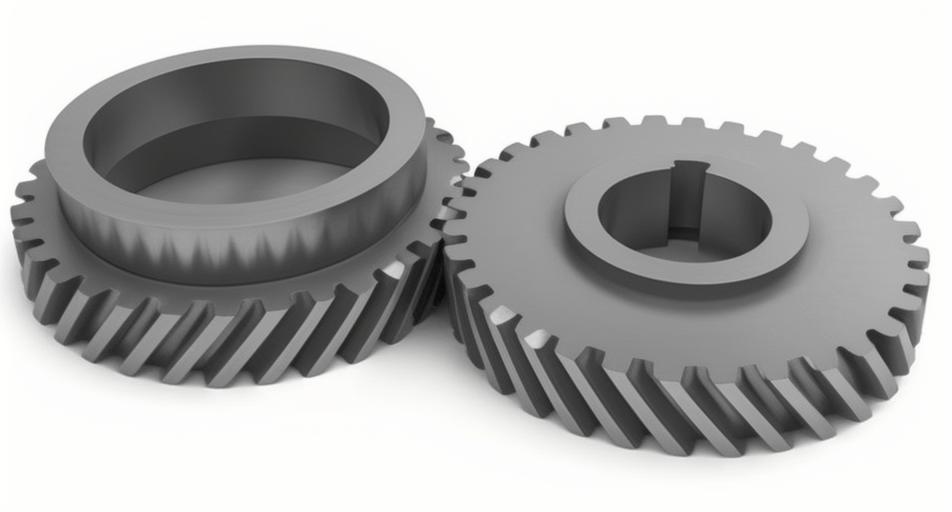
Analyzing the assembly process, I first consider the initial state: the rack is horizontally placed inside the steering machine housing, and the helical gear is positioned above the housing, aligned with the bearing. The helical gear must be inserted vertically without rotation to maintain a unique angular orientation, which is crucial for ensuring the rack ends up centered and the steering wheel angle is consistent post-assembly. If the rack remains fixed, the helical gear’s angled teeth would cause increasing interference as it descends. Thus, simultaneous motion of both components is necessary—the helical gear moves downward while the rack moves horizontally—to avoid collisions and ensure proper meshing. Through 3D simulation, I observed that interference occurs near the rack’s pitch circle radius, which can be mitigated by rotating the rack circumferentially to create clearance. As the helical gear continues downward, the rack must rotate back to its theoretical position to eliminate interference, culminating in the gear seating fully against the bearing. The helical gear shaft typically has a clearance or transition fit with the bearings (e.g., H7/g6), demanding high coaxiality; any misalignment or collision during meshing can increase resistance, affecting quality.
The process can be summarized as: (1) load the rack horizontally into the housing with end-face positioning, (2) use displacement sensors to locate the rack tooth surface and rotate it to a predefined angular position, (3) return the rack and helical gear to a critical starting position for synchronized assembly, and (4) drive the helical gear into the housing while synchronizing rack movement. After assembly, the gear-rack backlash is minimal and consistent, allowing for subsequent adjustment and testing. This process hinges on precise control of displacement and force.
Locating the rack tooth surface position is a fundamental step. The helical rack has distinct features: the tooth surface is a series of planes, while the tooth back is a cylindrical surface, with a distance difference exceeding 3 mm from the rack axis. I employ contacting displacement sensors to detect these features. Two potentiometric displacement sensors are used in a setup where they touch the rack surface. By rotating the rack over 370°, both sensors will register a concave point—a decrease followed by an increase in displacement—indicating the tooth surface’s vertical position. Returning to this concave point allows precise angular positioning. For assembly, the rack is then rotated an additional 5° to create clearance for the helical gear insertion. This ensures the helical gear teeth can enter the rack space without collision.
The starting position for synchronized assembly is critical to prevent tooth-on-tooth contact. Based on the rack’s tooth pitch, the horizontal tooth pitch $$L_2$$ is derived from the parallel pitch and helical angle. For instance, with a parallel pitch of 5.96885 mm and a helical angle of 5°49’12”, the horizontal pitch calculates to 6 mm. Before meshing, the rack must be retracted horizontally by multiple pitches from its theoretical position. The helical gear’s starting point is defined where its tooth tip just enters the rack tooth space. Let $$L_1$$ be the distance from the helical gear end face to the bearing, and $$L_2$$ be the rack retraction distance. Their relationship depends on the helical angles, which I will detail in the synchronization process.
The synchronized meshing process is the heart of the assembly. I model the motion using a particle approach, where the contact point between the helical gear and rack is treated as a moving point. The displacement vector is given by:
$$\Delta \mathbf{r} = \Delta x \mathbf{i} + \Delta y \mathbf{j} + \Delta z \mathbf{k}$$
Since there is no motion in the Y-direction, $$\Delta y = 0$$, simplifying to:
$$\Delta \mathbf{r} = \Delta x \mathbf{i} + \Delta z \mathbf{k}$$
Here, $$\Delta x$$ is the rack’s horizontal displacement, and $$\Delta z$$ is the helical gear’s vertical displacement. The relationship between $$\Delta x$$ and $$\Delta z$$ depends on the helical angles of the gear and rack.
I categorize the systems into two combinations based on rack helix direction. For a right-hand helical rack (Combination 1), let $$\alpha$$ be the angle between the helical gear axis and the vertical direction, and $$\beta$$ be the right-hand helix angle of the rack. The mathematical model is:
$$L_2 = \frac{L_1 \sin(\alpha + \beta)}{\sin(90^\circ – \beta)}$$
Simplifying:
$$\frac{L_1}{L_2} = \frac{\cos \beta}{\sin(\alpha + \beta)}$$
For a left-hand helical rack (Combination 2), with a left-hand helix angle $$\gamma$$, the model is:
$$L_2 = L_1 \sin \alpha – L_1 \cos \alpha \tan \gamma$$
Or:
$$\frac{L_1}{L_2} = \frac{1}{\sin \alpha – \cos \alpha \tan \gamma}$$
These equations govern the synchronized motion, ensuring the helical gear and rack move in harmony to avoid interference.
Modern steering systems, especially for electric and autonomous vehicles, demand higher precision with reduced backlash. This has led to the use of variable-angle helical racks, where the helix angle gradually changes along the tooth profile to minimize clearance. These racks present greater assembly challenges due to tighter tolerances and localized interference. For such racks, the initial assembly starts with the rack rotated to a 5° angle for clearance. After the helical gear descends about 12 mm, near the rack’s pitch circle, the rack must be rotated back to 0° to prevent collisions. The variable-angle design features a convex tooth profile that reduces backlash, effectively widening the tooth tips by over 0.1 mm per side compared to standard helical racks. This can cause increased assembly forces, leading to higher scrap rates. To address this, I introduced a passive adaptation mechanism: the helical gear shaft is loosely clamped with a reduced force (20-50 N), allowing it to rotate slightly under the rack’s push during assembly. This reduces the meshing resistance from 500 N to 100-150 N, significantly improving yield rates to below 0.4% in production.
Key guiding functions are essential for aligning the helical gear shaft with the bearings. Due to cumulative tolerances from multiple positioning stages, relying solely on machining accuracy is insufficient. A guiding support mechanism is incorporated, which centers on the helical gear shaft end face and provides alignment during the pressing operation. This mechanism acts as a secondary positioning device, ensuring smooth entry into the bearing bore without scratching, thereby relaxing the precision requirements for the assembly equipment and reducing costs.
Displacement and pressure control are implemented to monitor the assembly process. Displacement is controlled via synchronized servo motors, while pressure sensors provide real-time feedback on assembly force. The helical gear shaft typically has a major diameter of φ26 mm h5 (25.991–26 mm) and a minor diameter of φ17 mm g5 (16.986–16.994 mm), mating with a needle bearing (inner diameter φ26 mm, 26.005–26.026 mm) and a deep-groove ball bearing (inner diameter φ17 mm, 16.992–17 mm). The fit with the deep-groove ball bearing is a transition fit, with a maximum interference of 0.002 mm in worst-case scenarios. The pressing force $$F$$ can be estimated using the formula for interference fits:
$$F = P_{fmax} \pi d_f l_f \mu$$
where $$P_{fmax}$$ is the maximum contact pressure, calculated as:
$$P_{fmax} = \frac{\delta}{d_f \left( \frac{C_a}{E_a} + \frac{C_i}{E_i} \right)}$$
Here, $$\delta$$ is the maximum interference, $$d_f$$ is the joint diameter, $$l_f$$ is the joint length, $$\mu$$ is the friction coefficient, $$E_a$$ and $$E_i$$ are the elastic moduli of the hole and shaft materials, and $$C_a$$ and $$C_i$$ are diameter change coefficients dependent on diameter ratios and Poisson’s ratio. For steel-on-steel with no lubrication, $$\mu = 0.1$$, $$E_a = E_i = 200 \text{ GPa}$$, and Poisson’s ratio $$\nu = 0.3$$. Given $$d_f = 17 \text{ mm}$$, $$l_f = 13 \text{ mm}$$, $$\delta = 0.002 \text{ mm}$$, and diameter ratios $$q_a = d_f / d_a = 0.57$$ (where $$d_a = 29.8 \text{ mm}$$ is the outer diameter of the bearing inner ring) and $$q_i = 0$$ (solid shaft), we find $$C_a = 2.214$$ and $$C_i = 0.7$$ from standard tables. Plugging in values:
$$P_{fmax} = \frac{0.002}{17 \left( \frac{2.214}{200 \times 10^3} + \frac{0.7}{200 \times 10^3} \right)} \approx 8.075 \text{ MPa}$$
$$F = 8.075 \times \pi \times 17 \times 13 \times 0.1 \approx 560 \text{ N}$$
Thus, the assembly force threshold is set above 560 N to ensure proper seating while preventing damage. This force monitoring is integrated into the human-machine interface for real-time validation.
To summarize the key parameters and formulas, I present the following tables:
| Parameter | Symbol | Description | Typical Value |
|---|---|---|---|
| Helical gear axis angle | $$\alpha$$ | Angle from vertical | Depends on design |
| Rack helix angle (right-hand) | $$\beta$$ | Right-hand helix angle | e.g., 5°49’12” |
| Rack helix angle (left-hand) | $$\gamma$$ | Left-hand helix angle | e.g., 6°46’30” |
| Vertical displacement | $$L_1$$ | Helical gear travel | Calculated from model |
| Horizontal displacement | $$L_2$$ | Rack travel | Calculated from model |
| Synchronization ratio (right-hand) | $$L_1/L_2$$ | $$\frac{\cos \beta}{\sin(\alpha + \beta)}$$ | Derived from geometry |
| Synchronization ratio (left-hand) | $$L_1/L_2$$ | $$\frac{1}{\sin \alpha – \cos \alpha \tan \gamma}$$ | Derived from geometry |
| Parameter | Symbol | Value | Unit |
|---|---|---|---|
| Joint diameter | $$d_f$$ | 17 | mm |
| Joint length | $$l_f$$ | 13 | mm |
| Max interference | $$\delta$$ | 0.002 | mm |
| Hole material modulus | $$E_a$$ | 200 | GPa |
| Shaft material modulus | $$E_i$$ | 200 | GPa |
| Diameter ratio (hole) | $$q_a$$ | 0.57 | – |
| Diameter ratio (shaft) | $$q_i$$ | 0 | – |
| Diameter change coeff. (hole) | $$C_a$$ | 2.214 | – |
| Diameter change coeff. (shaft) | $$C_i$$ | 0.7 | – |
| Friction coefficient | $$\mu$$ | 0.1 | – |
| Max contact pressure | $$P_{fmax}$$ | 8.075 | MPa |
| Calculated press force | $$F$$ | 560 | N |
The automation of helical gear and rack assembly offers substantial benefits in terms of repeatability, quality, and cost-effectiveness. By implementing sensor-based positioning, synchronized motion control, passive adaptation for variable-angle racks, and force monitoring, the process achieves high yields and consistency. The mathematical models provide a foundation for setting parameters across different steering machine designs. This approach not only enhances the production of electric power steering systems but also serves as a reference for other applications involving helical gears, such as industrial machinery and robotics. Future advancements may incorporate machine learning for adaptive control and digital twins for simulation, further optimizing the assembly of helical gears.
In conclusion, the automatic assembly of helical gears and racks is a sophisticated process that demands careful attention to geometry, synchronization, and force management. Through systematic analysis and innovation, we can overcome the challenges posed by helical angles and tight tolerances, ensuring reliable and efficient manufacturing. The insights gained from this work underscore the importance of helical gears in modern automotive systems and highlight the value of automation in achieving precision at scale.