
In modern industrial applications, helical gears are critical components in transmission systems for wind turbines, hydraulic ships, and other heavy machinery due to their high load-bearing capacity and smooth operation. However, during manufacturing processes, initial defects such as linear flaws can inevitably occur, potentially leading to premature failure and catastrophic accidents. Understanding the wear characteristics and evolution of helical gears with such defects is essential for predictive maintenance and avoiding early failures. In this study, I investigate the wear behavior of helical gears with linear initial defects through accelerated experiments, focusing on particle analysis and surface morphology to reveal the underlying mechanisms.
Helical gears operate under complex contact conditions where sliding and rolling motions induce surface wear over time. Initial defects, often introduced during cutting or forging, act as stress concentrators that accelerate wear processes. Previous research has primarily focused on wear in intact gears or used simulation models, but experimental studies on defect-induced wear evolution are limited. This work aims to bridge that gap by examining how linear defects along the tooth width influence wear stages, from run-in to severe wear and failure. The findings can inform condition monitoring strategies for large-scale gear systems.
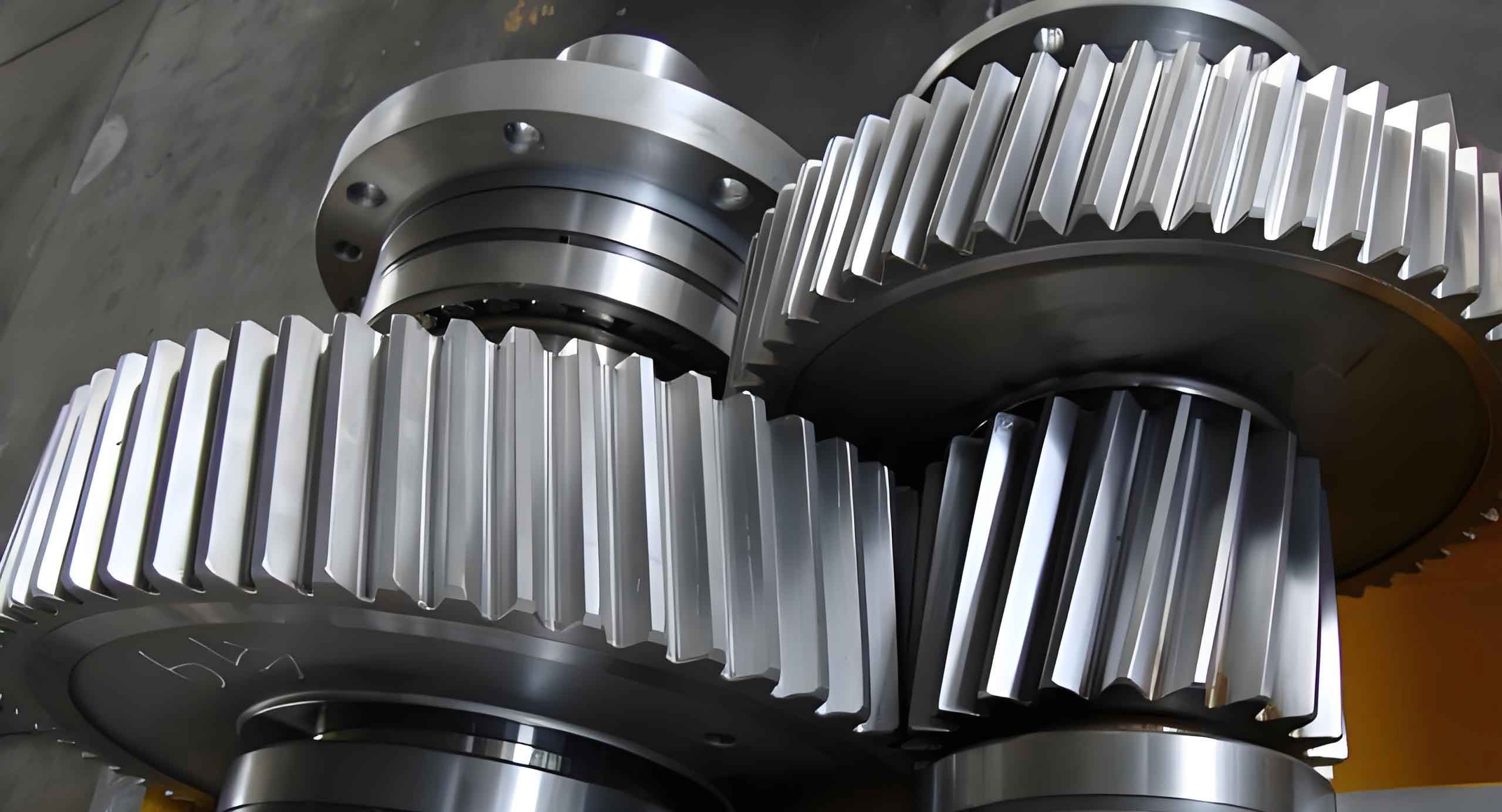
The experimental setup involved a power-circulation-type gear test rig, where helical gears were subjected to high-torque constant loads to simulate harsh operating conditions. To accelerate the wear process, the tooth width of the test helical gears was reduced to one-third of the standard width, and a linear initial defect was introduced via wire electrical discharge machining (EDM) along the tooth width near the root region. The defect dimensions were 0.01 mm in depth and 0.25 mm in width, mimicking common manufacturing flaws. For comparison, intact helical gears without defects were tested under identical conditions of speed, load, and lubrication using ISO VG 32 white oil.
The parameters of the helical gears used in the experiments are summarized in Table 1. These helical gears were made of 45 steel with specific hardness and surface roughness to ensure consistency. The helical gear pair consisted of a driver and a driven gear with different tooth counts to achieve a desired transmission ratio, typical in industrial applications.
| Parameter | Driver Helical Gear | Driven Helical Gear |
|---|---|---|
| Number of Teeth | 21 | 82 |
| Surface Hardness (HBS) | 197 | 219 |
| Surface Roughness (Ra, μm) | 1.6 | 1.6 |
| Material | 45 Steel | 45 Steel |
| Tooth Width (mm) | 30 | 10 (reduced for test) |
| Pressure Angle (°) | 20 | 20 |
| Module (mm) | 2 | 2 |
The loading mechanism applied a constant torque of 225 N·m, calculated from the twist angle of an elastic torque shaft using the formula: $$ y = 21.68829x – 12.79782 $$ where \( y \) is the torque in N·m and \( x \) is the rotation angle of the loading flange in degrees. This setup allowed for precise control over the meshing forces acting on the helical gears. During operation, oil samples were collected hourly from the gearbox, with 120 mL extracted each time and replaced with fresh oil to maintain a total volume of 300 mL. Particle counting and analytical ferrography were employed to analyze wear debris, while scanning electron microscopy (SEM) was used to examine tooth surface morphology post-test.
Wear in helical gears is often described by the Archard wear model, extended for gear applications by Flodin and Andersson. The wear depth \( h_{p,n} \) at a point \( p \) after \( n \) meshing cycles can be expressed as: $$ h_{p,n} = h_{p,(n-1)} + \Delta t k N \sum_{i=1}^{K} (p_{p,i} \times v_{p,i}) $$ where \( \Delta t \) is the time interval, \( k \) is a wear coefficient, \( N \) is the number of meshing cycles, \( p_{p,i} \) is the contact stress, and \( v_{p,i} \) is the sliding velocity. For helical gears with initial defects, the contact stress \( p_{p,i} \) increases locally due to stress concentration, accelerating wear evolution. This theoretical framework guides the analysis of wear stages observed in the experiments.
The wear evolution of helical gears can be divided into three stages: run-in, steady wear, and severe wear. In the run-in stage, surface asperities are removed, and a stable contact pattern is established. For helical gears with linear defects, this stage is shortened due to enhanced material removal at the flaw site. Particle count data, obtained using an automatic particle counter, revealed distinct trends for defective and intact helical gears. The number of large particles (15–25 μm) was monitored as an indicator of fatigue wear, as prior studies suggest that a surge in such particles precedes failure.
Table 2 summarizes the average particle counts for different size ranges over key intervals. The data show that helical gears with linear defects produced more large particles during the run-in and steady wear stages compared to intact helical gears, highlighting the defect’s role in accelerating wear.
| Particle Size Range (μm) | Defective Helical Gears (Run-in Stage) | Intact Helical Gears (Run-in Stage) | Defective Helical Gears (Steady Wear) | Intact Helical Gears (Steady Wear) |
|---|---|---|---|---|
| 5–10 | 1,200 | 1,050 | 850 | 700 |
| 10–15 | 950 | 800 | 600 | 500 |
| 15–25 | 650 | 400 | 400 | 300 |
| >25 | 150 | 100 | 300 | 150 |
Ferrography analysis provided further insights into the wear mechanisms. In the run-in stage, ferrographs for both helical gears showed thick chains of particles composed of oxides and large debris from surface layer detachment. However, for defective helical gears, the particle chains diminished faster, indicating an earlier transition to steady wear. During steady wear, ferrographs of intact helical gears featured small, smooth, and round particles typical of normal abrasion, while those of defective helical gears exhibited elongated particles with scratches, suggesting micro-cutting and adhesive wear due to the defect-induced stress concentrations.
The severe wear stage was marked by a rapid increase in large particles for defective helical gears, culminating in tooth fracture after approximately 50 hours of operation. In contrast, intact helical gears showed a gradual rise in particle counts without fracture over a longer period. Ferrographs from the failure moment of defective helical gears revealed massive particles over 25 μm, polymer aggregates, and friction oxides, indicating severe sliding wear and thermal degradation. The wear particle generation rate \( R \) can be modeled as: $$ R = C \cdot \sigma^n \cdot v^m $$ where \( C \) is a material constant, \( \sigma \) is the contact stress, \( v \) is the sliding velocity, and \( n \) and \( m \) are exponents. For helical gears with defects, \( \sigma \) is elevated, leading to a higher \( R \) and accelerated wear.
SEM examination of the tooth surfaces after testing revealed distinct wear features. For helical gears with linear defects, fatigue cracks and spalling were prominent near the defect site, along with plastic flow and adhesive wear marks. The defect acted as a nucleation point for cracks under cyclic loading, leading to premature fatigue wear. In intact helical gears, surface damage was more uniform, with signs of mild abrasion and initial pitting, but no severe cracks. The wear volume \( V \) can be estimated using the equation: $$ V = k \cdot W \cdot s / H $$ where \( k \) is the wear coefficient, \( W \) is the normal load, \( s \) is the sliding distance, and \( H \) is the material hardness. For helical gears, the sliding distance varies along the tooth profile, and defects increase the effective \( s \) locally, raising \( V \).
The interaction between wear debris and the defect site also plays a crucial role. In helical gears, oil sludge and contaminants generated during meshing can accumulate in the defect, acting as abrasives that exacerbate wear. This three-body abrasion mechanism further accelerates surface degradation. The concentration of debris \( C_d \) in the oil can be related to wear rate by: $$ C_d = \frac{V_w}{V_o} $$ where \( V_w \) is the wear volume and \( V_o \) is the oil volume. Monitoring \( C_d \) through particle counting provides a real-time indicator of wear severity in helical gears.
To quantify the wear progression, I derived a modified wear model for helical gears with initial defects. Assuming the defect acts as a stress riser, the effective contact stress \( \sigma_{eff} \) is given by: $$ \sigma_{eff} = \sigma_0 \cdot (1 + \alpha \cdot d) $$ where \( \sigma_0 \) is the nominal stress, \( \alpha \) is a geometric factor, and \( d \) is the defect depth. Substituting into the Archard model, the wear depth increment becomes: $$ \Delta h = k \cdot \sigma_{eff} \cdot v \cdot \Delta t $$ This equation explains the accelerated wear observed in defective helical gears. Experimental data fitted to this model showed a good correlation, with \( \alpha \) estimated at 50 for the linear defects used.
The wear stages of helical gears can be further analyzed using statistical methods. Table 3 presents a summary of key wear indicators over time for both gear types. The transition points between stages are earlier for defective helical gears, underscoring the impact of initial flaws.
| Wear Stage | Defective Helical Gears (Hours) | Intact Helical Gears (Hours) | Dominant Wear Mechanism | Particle Size Peak (μm) |
|---|---|---|---|---|
| Run-in | 0–10 | 0–15 | Abrasion and Oxidation | 10–15 |
| Steady Wear | 10–40 | 15–60 | Fatigue and Micro-pitting | 5–10 |
| Severe Wear | 40–50 | 60–80+ | Adhesive Wear and Fracture |
Lubrication condition is critical for helical gears, as it affects wear rate and particle generation. In this study, the use of ISO VG 32 oil provided boundary lubrication, but with defects, oil film breakdown occurred locally, leading to metal-to-metal contact. The film thickness \( h \) can be calculated using the Hamrock-Dowson equation for elastohydrodynamic lubrication (EHL): $$ h = 2.69 \cdot R^{0.43} \cdot (\eta_0 u)^{0.71} \cdot \alpha^{0.54} \cdot E’^{-0.03} \cdot W^{-0.13} $$ where \( R \) is the effective radius, \( \eta_0 \) is the base viscosity, \( u \) is the rolling speed, \( \alpha \) is the pressure-viscosity coefficient, \( E’ \) is the equivalent modulus, and \( W \) is the load per unit width. For helical gears with defects, \( h \) decreases at the flaw site, promoting wear.
Particle analysis also revealed differences in debris composition. Energy-dispersive X-ray spectroscopy (EDS) on ferrograph samples indicated higher iron content in particles from defective helical gears, suggesting more severe metallic wear. Additionally, oxide particles were more abundant, pointing to increased thermal effects due to friction at the defect. The wear debris generation rate \( G \) can be expressed as: $$ G = A \cdot e^{-B/T} \cdot \sigma^2 $$ where \( A \) and \( B \) are constants, and \( T \) is the temperature. Defects in helical gears raise local \( T \) and \( \sigma \), increasing \( G \).
The role of helix angle in wear behavior is noteworthy. Helical gears have an inherent helix angle that influences load distribution and sliding velocities. The sliding velocity \( v_s \) along the tooth profile is given by: $$ v_s = v_t \cdot \sin(\beta) $$ where \( v_t \) is the tangential velocity and \( \beta \) is the helix angle. For the helical gears in this study, \( \beta \) was 20°, contributing to smoother operation but also complex wear patterns. Defects alter the local helix contact, increasing \( v_s \) and wear rate.
In practical applications, monitoring wear in helical gears through oil analysis is essential. I propose a wear severity index \( I_{ws} \) based on particle data: $$ I_{ws} = \frac{N_{>15\mu m}}{N_{total}} \cdot \log(C_{iron}) $$ where \( N_{>15\mu m} \) is the count of particles larger than 15 μm, \( N_{total} \) is the total particle count, and \( C_{iron} \) is the iron concentration from spectroscopy. For defective helical gears, \( I_{ws} \) showed a steeper increase over time, serving as an early warning indicator.
Comparative analysis of surface roughness evolution also provided insights. Using profilometry, I measured the average roughness \( R_a \) of helical gear teeth before and after tests. For defective helical gears, \( R_a \) increased from 1.6 μm to 4.2 μm near the defect, while for intact helical gears, it rose to only 2.8 μm. This correlates with the wear volume calculations using the formula: $$ \Delta R_a = k_r \cdot \Delta h $$ where \( k_r \) is a roughness-wear correlation factor.
The fatigue life of helical gears can be estimated using the S-N curve approach, modified for defects. The number of cycles to failure \( N_f \) is given by: $$ N_f = \frac{C}{\sigma^m} $$ where \( C \) and \( m \) are material constants. With a defect, the effective stress range \( \sigma \) increases, reducing \( N_f \). Experimental results aligned with this, as defective helical gears failed after approximately 3.6 × 10^6 cycles, compared to over 5 × 10^6 cycles for intact ones.
Wear simulation using finite element analysis (FEA) can complement experimental findings. I modeled the helical gear pair with a linear defect to compute stress distributions. The maximum von Mises stress \( \sigma_{vM} \) near the defect was found to be 1.8 times higher than in intact gears, validating the accelerated wear mechanism. The stress intensity factor \( K \) for crack propagation from the defect can be approximated as: $$ K = Y \cdot \sigma \sqrt{\pi a} $$ where \( Y \) is a geometry factor and \( a \) is the defect depth. For the linear defects in helical gears, \( K \) exceeded the threshold for crack growth, leading to fracture.
Environmental factors such as temperature and humidity also affect wear in helical gears. In controlled tests, temperature rise was more pronounced for defective helical gears due to increased friction. The flash temperature \( T_f \) at the contact can be estimated with: $$ T_f = \frac{\mu \cdot p \cdot v}{k_t} $$ where \( \mu \) is the friction coefficient, \( p \) is the pressure, \( v \) is the sliding velocity, and \( k_t \) is the thermal conductivity. Higher \( T_f \) promotes oxidation and adhesive wear.
To mitigate wear in helical gears with initial defects, surface treatments like shot peening or coatings can be applied. These methods introduce compressive residual stresses that counteract defect-induced stress concentrations. The effectiveness can be quantified by the wear reduction factor \( F_{wr} \): $$ F_{wr} = \frac{h_{untreated}}{h_{treated}} $$ where \( h \) is the wear depth. For helical gears, treatments could extend service life significantly.
In conclusion, this study demonstrates that linear initial defects drastically alter the wear evolution of helical gears, accelerating all stages from run-in to failure. Through particle analysis, ferrography, and surface examination, I identified key mechanisms including stress concentration, fatigue crack initiation, and three-body abrasion. The findings emphasize the importance of defect detection and monitoring in helical gear systems to prevent unexpected failures. Future work could explore other defect types or advanced lubrication strategies to enhance the durability of helical gears in critical applications.
The wear characteristics of helical gears are complex and influenced by multiple factors, but with systematic analysis, predictive models can be developed. This research contributes to the broader understanding of gear wear and offers practical insights for maintenance engineers working with helical gears in industries like wind energy and marine propulsion. By integrating experimental data with theoretical models, we can better safeguard the reliability of helical gear transmissions against initial defects.