
In this article, I present a comprehensive analysis of the effects of crack faults on the time-varying mesh stiffness and dynamic response of helical gear transmission systems. Helical gears are widely used in various mechanical applications due to their smooth operation and high load capacity. However, under severe working conditions, helical gears are prone to developing cracks, which can significantly impact their performance and lead to system failures. Understanding the influence of crack parameters on the mesh stiffness and vibration characteristics is crucial for early fault diagnosis and reliability improvement. Here, I propose a modified algorithm for calculating the time-varying mesh stiffness of helical gears with crack faults, considering factors such as tooth contact, bending, shear, axial compression, and foundation elasticity. I then integrate this into a coupled dynamic model of a gear-shaft-bearing system to analyze the vibration response under different crack conditions. The findings provide valuable insights for the design and maintenance of helical gear transmissions.
Helical gears are essential components in power transmission systems, commonly found in industries like aerospace, automotive, and marine engineering. Their helical tooth design allows for gradual engagement, reducing noise and vibration compared to spur gears. Nonetheless, helical gears are susceptible to fatigue cracks, often originating at the tooth root due to stress concentration. These cracks can propagate over time, altering the gear’s stiffness and dynamic behavior. The time-varying mesh stiffness is a key internal excitation source in gear dynamics, and accurate computation is vital for predicting system response. Previous studies have focused on spur gears, but helical gears present additional complexities due to their inclined teeth and varying contact lines. In this work, I address these challenges by developing an improved analytical method for mesh stiffness calculation in cracked helical gears and investigating how crack parameters affect the overall system dynamics.
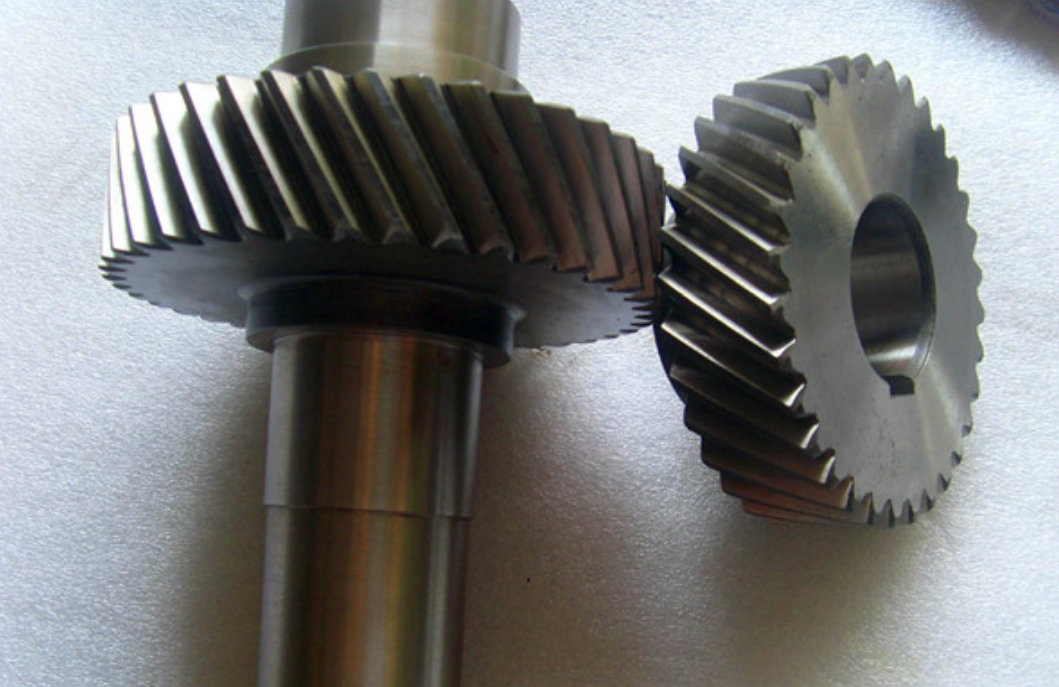
The time-varying mesh stiffness of helical gears is influenced by the number of teeth in contact and the changing contact positions along the tooth face. For helical gears, the contact line length varies during meshing, requiring an integral approach where the tooth is sliced into thin segments along the face width. Each segment is treated as a spur gear, and the total stiffness is obtained by summing contributions from all segments. The overall mesh stiffness \( k_t \) for a gear pair can be expressed as a combination of Hertzian contact stiffness \( k_h \), bending stiffness \( k_b \), shear stiffness \( k_s \), axial compression stiffness \( k_a \), and foundation stiffness \( k_f \). The formula is given by:
$$ k_t = \frac{1}{\frac{1}{k_h} + \frac{1}{k_{b1}} + \frac{1}{k_{s1}} + \frac{1}{k_{a1}} + \frac{1}{k_{f1}} + \frac{1}{k_{b2}} + \frac{1}{k_{s2}} + \frac{1}{k_{a2}} + \frac{1}{k_{f2}}} $$
where subscripts 1 and 2 refer to the driving and driven gears, respectively. For helical gears, the Hertzian contact stiffness is derived from elastic contact theory and depends on the material properties and contact line length. The bending, shear, and axial compression stiffnesses are calculated based on energy methods, considering the tooth as a cantilever beam fixed at the root circle. This approach improves accuracy by accounting for the deformation energy between the base circle and root circle, which is often neglected in simplified models.
To compute the stiffness components, I consider the geometry of helical gears. The tooth profile above the base circle is an involute curve, while the root region is approximated with straight lines for simplicity. The bending stiffness for a helical gear segment can be expressed through integration over the tooth height. For a segment of thickness \( dy \), the bending energy is:
$$ dU_b = \frac{F^2}{2dk_b} = \int_0^{d(y)} \frac{[F_b (d(y) – x) – F_a h(y)]^2}{2E dI_x} dx $$
Here, \( F \) is the meshing force, \( E \) is Young’s modulus, \( dI_x \) is the area moment of inertia at distance \( x \) from the root, \( d(y) \) is the distance from the meshing point to the root along the tooth height, and \( h(y) \) is the distance from the meshing point to the gear centerline. By solving this integral and summing over all segments, the bending stiffness \( k_b \) is obtained. Similar derivations yield the shear stiffness \( k_s \) and axial compression stiffness \( k_a \). The foundation stiffness \( k_f \) accounts for the elasticity of the gear body and is calculated using empirical formulas based on gear dimensions.
When a crack is present at the tooth root, the bending and shear stiffnesses are affected, while the Hertzian contact, axial compression, and foundation stiffnesses remain unchanged. I model the crack using parameters such as crack angle \( v \), crack depth at the front face \( q \), crack depth at the back face \( q_0 \), and crack length along the tooth width \( L_c \). The cracked tooth is treated as a cantilever beam with reduced cross-sectional area and modified effective length. The stiffness calculations are updated to include the deformation energy in the cracked region. For instance, the bending stiffness for a cracked helical gear segment, when the load point is outside the crack-affected zone, is given by:
$$ k_b = \sum_{i=1}^N \frac{1}{\int_{\alpha_3}^{\alpha_r} \frac{A}{2E[\sin \alpha + (\alpha_2 – \alpha) \cos \alpha]^3 \Delta y} d\alpha + \frac{B}{E \cos \alpha_1′ (2\sin \alpha_2 – \frac{q_1}{R_b} \sin v)^3 \Delta y} + \int_{-\alpha_a}^{-\alpha_1′} \frac{A}{2E[\sin \alpha + (\alpha_2 – \alpha) \cos \alpha]^3 \Delta y} d\alpha + \int_{-\alpha_a}^{\alpha_2} \frac{4A}{E G^3 \Delta y} d\alpha} $$
where \( N \) is the number of slices, \( \Delta y \) is the slice thickness, \( \alpha \) parameters are gear angles, and \( G \) is a geometric function. This modified algorithm ensures more accurate results by incorporating the crack’s influence on tooth flexibility. I validated this method using finite element analysis, showing good agreement with numerical simulations.
The impact of crack parameters on the time-varying mesh stiffness of helical gears is significant. I analyzed variations in crack angle, depth, and length to understand their effects. For example, with a crack depth \( q = 2 \, \text{mm} \), length \( L_c = 30 \, \text{mm} \), and angle \( v = 45^\circ \), the mesh stiffness decreases noticeably when the cracked tooth enters meshing. As shown in Table 1, different crack angles have minimal effect on stiffness, whereas increases in crack depth or length lead to substantial reductions. This is because deeper or longer cracks reduce the tooth’s load-bearing capacity, altering the stiffness profile over the meshing cycle.
| Crack Parameter | Value | Effect on Mesh Stiffness |
|---|---|---|
| Angle \( v \) | 30°, 45°, 60° | Minor decrease; stiffness slightly increases with angle |
| Depth \( q \) | 1 mm, 2 mm, 3 mm | Significant decrease; stiffness reduces with depth |
| Length \( L_c \) | 10 mm, 20 mm, 30 mm | Pronounced decrease; stiffness drops sharply with length |
To study the dynamic response, I developed a coupled dynamic model of a single-stage helical gear transmission system with crack faults. The model includes shafts, bearings, and gears, considering transverse, axial, and torsional vibrations. Using the shaft element method, each shaft is discretized into Timoshenko beam elements with six degrees of freedom per node. The equations of motion for a shaft element \( i \) are:
$$ M_i \ddot{q}_i + (C_i + G_i) \dot{q}_i + K_i q_i = 0 $$
where \( M_i \), \( K_i \), \( C_i \), and \( G_i \) are the mass, stiffness, damping, and gyroscopic matrices, respectively. The damping matrix uses Rayleigh damping: \( C_i = \alpha M_i + \beta K_i \). The helical gear pair is modeled as a meshing element connecting two rigid disks, with stiffness and damping representing the tooth interaction. The mesh stiffness \( k_t(t) \) is time-varying and computed from the modified algorithm. The bearing supports are incorporated as stiffness matrices at the corresponding nodes. The overall system equation is:
$$ M \ddot{q} + (C + G) \dot{q} + K q = F(t) $$
where \( q \) is the displacement vector, and \( F(t) \) includes external loads and internal excitations such as static transmission error \( e(t) = e_r \sin(2\pi f_m t + \phi) \), with \( f_m \) as the mesh frequency.
I applied this model to a helical gear system with parameters listed in Table 2. The driving gear has a crack, while the driven gear is healthy. The input power is 40 kW, and the speed is 1500 rpm. I used the Newmark-β method to solve the dynamic equations numerically and analyze the vibration response.
| Parameter | Value |
|---|---|
| Number of teeth (driver/driven) | 32/40 |
| Module \( m_n \) (mm) | 3 |
| Pressure angle \( \alpha_n \) (°) | 20 |
| Helix angle \( \beta \) (°) | 15 |
| Face width \( L \) (mm) | 30 |
| Young’s modulus \( E \) (Pa) | 2.1 × 10¹¹ |
| Density \( \rho \) (kg/m³) | 7850 |
| Bearing stiffness \( k_{xx}, k_{yy} \) (N/m) | 2 × 10⁸ |
| Bearing stiffness \( k_{zz} \) (N/m) | 1 × 10⁸ |
The results show that crack faults introduce periodic impulses in the time-domain vibration signals. For instance, the acceleration response at a bearing node exhibits sharp peaks every 0.04 seconds, corresponding to the rotational period of the cracked gear. In the frequency domain, sidebands appear around the mesh frequency \( f_m \) and its harmonics, with spacing equal to the fault gear’s rotational frequency \( f_r = 25 \, \text{Hz} \). This modulation is a key indicator of crack presence in helical gears. As crack depth or length increases, the impulse amplitudes and sideband magnitudes grow, reflecting the severity of the fault. Table 3 summarizes the dynamic characteristics under different crack sizes.
| Crack Condition | Time-Domain Response | Frequency-Domain Response |
|---|---|---|
| No crack | Smooth periodic peaks | Mesh frequency and harmonics only |
| Crack depth \( q = 1 \, \text{mm} \) | Visible impulses at fault period | Sidebands at \( f_m \pm f_r \) |
| Crack depth \( q = 3 \, \text{mm} \) | Strong impulses with higher amplitude | Enhanced sideband amplitudes |
| Crack length \( L_c = 10 \, \text{mm} \) | Minor impulses | Weak sidebands |
| Crack length \( L_c = 30 \, \text{mm} \) | Pronounced impulses | Prominent sidebands |
The influence of crack parameters on helical gears’ dynamic behavior is further illustrated through stiffness variations. The time-varying mesh stiffness for a cracked helical gear pair is plotted over one meshing cycle. When the cracked tooth engages, the stiffness drops locally, causing increased dynamic loads. This stiffness reduction is more pronounced for deeper cracks, as shown by the formula for bending stiffness with crack depth \( q \):
$$ k_b \propto \frac{1}{\int \frac{d\alpha}{E (\sin \alpha + (\alpha_2 – \alpha) \cos \alpha – \frac{q}{R} \sin v)^3}} $$
This relationship highlights how crack geometry directly affects the stiffness and, consequently, the vibration response. For helical gears, the helical angle adds complexity, but the integral approach effectively captures these effects.
In practical applications, monitoring the vibration signals of helical gear systems can help detect crack faults early. The presence of sidebands in the frequency spectrum, especially around the mesh frequency, is a reliable diagnostic feature. My analysis shows that even small cracks can generate detectable changes, but severe cracks produce more obvious signatures. For example, with a crack length spanning the entire face width (\( L_c = 30 \, \text{mm} \)), the vibration acceleration amplitude increases by over 50% compared to a healthy gear. This underscores the importance of regular inspection and maintenance for helical gear transmissions operating under heavy loads.
To conclude, I have presented a detailed study on the impact of crack faults on helical gears. The modified algorithm for time-varying mesh stiffness calculation improves accuracy by considering crack-induced deformations. The coupled dynamic model effectively simulates the vibration response, revealing that crack depth and length are critical parameters affecting stiffness and dynamic behavior. Helical gears with cracks exhibit periodic impulses in time-domain signals and modulated sidebands in frequency-domain spectra, which can be used for fault diagnosis. Future work could extend this analysis to multi-stage gear systems or incorporate nonlinear effects. Overall, this research provides a foundation for enhancing the reliability and performance of helical gear transmissions in various industrial settings.
Throughout this article, I have emphasized the significance of helical gears in mechanical systems and how their integrity can be compromised by cracks. By understanding the relationship between crack parameters and dynamic response, engineers can develop better predictive maintenance strategies. The methods and results discussed here are applicable to a wide range of helical gear applications, from wind turbines to vehicle transmissions. Continued research in this area will further advance the field of gear dynamics and fault detection.