
The pursuit of high efficiency, low noise, and reliable power transmission in modern machinery, such as electric vehicle drivetrains and high-speed industrial gearboxes, places stringent demands on gear design. Among various gear types, helical gears are extensively favored due to their superior characteristics of smooth engagement, high load capacity, and reduced acoustic emission compared to spur gears. However, in high-performance applications, the interaction between the dynamic response of the gear system and the tribological conditions at the tooth contact becomes critically important. The dynamic loads, resulting from time-varying mesh stiffness and transmission errors, directly influence the elastohydrodynamic lubrication (EHL) film separating the teeth. Conversely, the friction forces generated within this lubricated contact significantly affect the vibrational behavior of the helical gear pair. Traditional analyses often decouple these phenomena, either studying dynamics with an assumed constant friction coefficient or analyzing lubrication under a static load assumption. This decoupling can lead to inaccurate predictions of gear noise, vibration, efficiency, and fatigue life. Therefore, a comprehensive tribo-dynamic model that captures the intricate coupling between the system-level dynamics and the micro-scale lubrication physics is essential for the accurate design and analysis of modern helical gear transmissions.
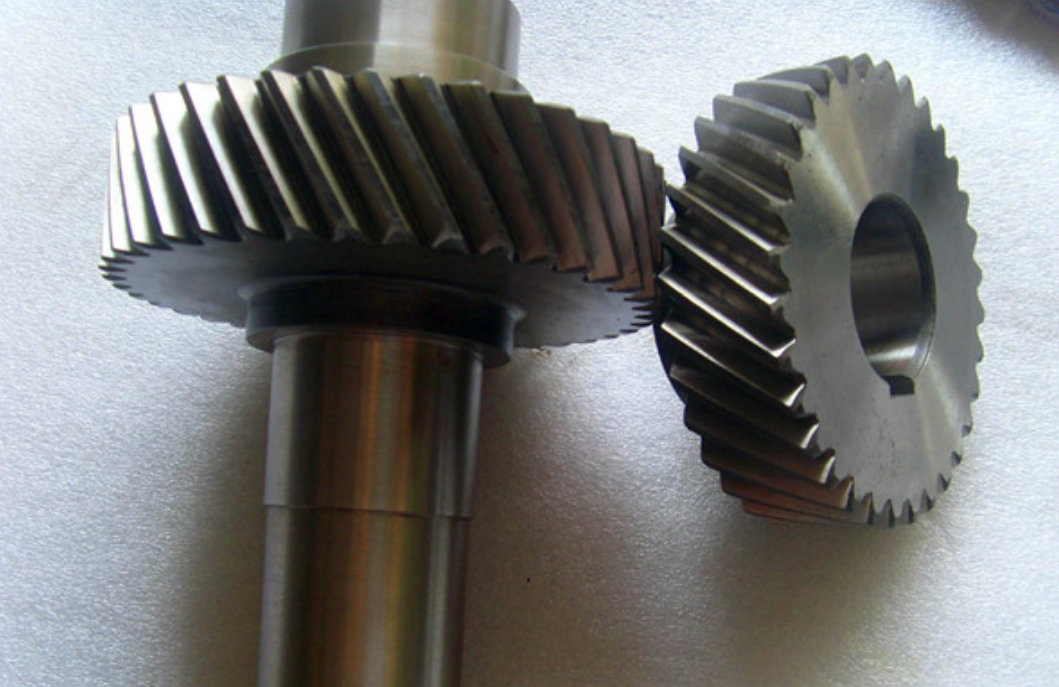
Integrated Tribo-Dynamic Model for Helical Gears
The core of this analysis is a 12-degree-of-freedom (DOF) lumped-parameter dynamic model coupled with a mixed thermal elastohydrodynamic lubrication model, specifically formulated for helical gears. The model simultaneously accounts for the time-varying mesh stiffness, bearing/shaft compliances, sliding friction, and the load-sharing between the lubricant film and surface asperities.
Multi-DOF Dynamic Model of Helical Gear Pair
The dynamic model considers six DOFs for each gear: three translational displacements (x, y, z) and three rotational displacements (θx, θy, θz). The coordinate system is defined with the x-axis along the line of action, the z-axis along the gear axis, and the y-axis perpendicular to both. For a generic point \( M_i \) on the instantaneous contact line, the relative displacement normal to the surface, accounting for all DOFs and the static transmission error \( \delta_e \), is derived. The dynamic tooth force and friction force at this point are then expressed. Integrating these forces along the total contact line length \( L_z(t) \) yields the total mesh and friction forces and moments acting on the gear bodies. The equations of motion for the helical gear system are formulated as:
$$ [M]\{\ddot{q}\} + [C]\{\dot{q}\} + [K]\{q\} = \{F_0\} + \{F_{e1}\} + \{F_{e2}\} $$
where \( \{q\} \) is the generalized displacement vector, \( [M] \) is the mass/inertia matrix, \( [C] \) is the damping matrix (combining mesh, friction, and bearing damping), and \( [K] \) is the stiffness matrix (combining mesh stiffness \( K_m \), friction-induced stiffness \( K_f \), and bearing stiffness \( K_{SB} \)). \( \{F_0\} \) is the external torque vector, while \( \{F_{e1}\} \) and \( \{F_{e2}\} \) are excitation vectors related to the static transmission error and its derivative, modulated by the mesh and friction parameters, respectively. A critical component is the calculation of the helical gears‘ time-varying mesh stiffness per unit length, \( k_0(t) \), which follows a modified empirical formula accounting for the helical angle and tooth geometry.
| Parameter Group | Symbol | Description |
|---|---|---|
| Mass & Inertia | \( m_p, m_g \) | Mass of pinion and gear |
| \( I_{px}, I_{gx}, I_{py}, I_{gy} \) | Mass moments of inertia | |
| – | – | |
| Stiffness | \( k_0(t) \) | Time-varying mesh stiffness per unit length |
| \( k_{xj}, k_{yj}, k_{zj}, k_{\theta x j}, k_{\theta y j} \) | Bearing/Shaft stiffness (j=1,2 for pinion/gear) | |
| – | – | |
| Geometry | \( \beta_b, r_{b1}, r_{b2} \) | Base helix angle, base circle radii |
| Excitation | \( \delta_e(M_i) \) | Static transmission error at point \( M_i \) |
Mixed Thermal Elastohydrodynamic Lubrication Model
The lubrication model treats the contact between helical gears as a transient, rough, line contact under conditions of mixed lubrication. It is built upon the following key pillars:
1. Load Sharing Concept: The total dynamic load \( F_d \) is shared between the fluid film (\( F_h \)) and the asperity contacts (\( F_a \)).
$$ F_d = F_h + F_a = \frac{F_d}{\gamma_1} + \frac{F_d}{\gamma_2} $$
where \( 1/\gamma_1 \) and \( 1/\gamma_2 \) represent the load proportion carried by the oil film and asperities, respectively.
2. Asperity Contact Pressure: The pressure due to rough surface contact is modeled using the Greenwood-Tripp theory, linking it to surface roughness parameters and the composite surface separation.
3. Fluid Film Thickness: The central film thickness for the rough contact is calculated using modified regression formulas based on the Moes parameters for an isothermal Newtonian fluid, followed by corrections for non-Newtonian shear-thinning (using the Carreau-Yasuda model) and thermal effects.
$$ \frac{h_{ct}}{R} = C_{nt} \cdot C_t \cdot H_{RI} $$
Here, \( H_{RI} \) is the dimensionless Newtonian isothermal central film thickness for rough surfaces, \( C_{nt} \) is the non-Newtonian correction factor, and \( C_t \) is the thermal correction factor.
4. Lubricant Rheology and State: The pressure-viscosity-temperature relationship is described by the Doolittle-Tait free-volume model, and the density variation is given by the Tait equation of state.
$$ \mu(p,T) = \mu_0 \exp\left[ \frac{B_0 R_0 \left( \frac{V_0}{V(p,T)} -1 \right)}{R_0 + \frac{V_0}{V(p,T)} -1} \right], \quad \text{where } \frac{V_0}{V} = 1 + \frac{\ln(1+\frac{p}{K_0})}{1+K_0′} – \alpha_v (T-T_0) $$
5. Energy Equation and Friction: The temperature distribution within the lubricant film is solved using a simplified energy equation, considering heat generation from viscous shearing of the fluid and asperity contact. The total friction coefficient \( f \) is the sum of the fluid and asperity contributions, weighted by their load share.
$$ f = \frac{F_{fh} + F_{fa}}{F_d} = \frac{ \int_{x_{in}}^{x_{out}} \tau_{fh} \, dx + f_a \cdot \frac{F_d}{\gamma_2} }{F_d} $$
where \( \tau_{fh} \) is the fluid shear stress and \( f_a \) is the boundary friction coefficient.
| Category | Parameters |
|---|---|
| Operating Conditions | Dynamic Load \( F_d(t) \), Roll Velocity \( u_r \), Slide/Roll Ratio \( \xi \) |
| Contact Geometry | Effective Radius \( R(t) \), Contact Length \( L_z(t) \) |
| Surface Topography | RMS Roughness \( \sigma_s \), Asperity Radius \( \beta_s \), Asperity Density \( \eta_s \) |
| Lubricant Properties | Base Viscosity \( \mu_0 \), Pressure-Viscosity Coeff. \( \alpha \), Non-Newtonian parameters (n, \( G_{cr} \)), Thermal properties (\( k_f, c_f, \rho_f \)) |
Coupling Methodology and Solution Procedure
The coupling between the dynamic and tribological models is achieved through an iterative, time-marching numerical procedure. The dynamic model provides the essential inputs for the lubrication analysis at each time step: the instantaneous dynamic load \( F_d(t) \), the effective radius of curvature \( R(t) \), and the rolling and sliding velocities. The lubrication model then solves for the detailed pressure, film thickness, and temperature fields, ultimately outputting the spatially-averaged, time-varying friction coefficient \( f(t) \) for that specific meshing condition. This updated \( f(t) \) is fed back into the dynamic model for the next iteration or time step, replacing any assumed constant value. This loop continues until the dynamic response (e.g., dynamic load) converges. This method ensures that the damping and excitation effects from the friction force are consistent with the actual lubricated state of the helical gears.
Results and Analysis of the Coupled System Behavior
The coupled model reveals significant interactions that are absent in decoupled analyses. Two primary aspects are examined: the influence of dynamic loads on lubrication performance and the effect of time-varying friction on the system’s dynamic response.
Impact of Dynamic Loads on Lubrication Characteristics
Under a moderate speed of 3,000 rpm, the general trends of film thickness, temperature rise, and friction coefficient along the path of contact for the helical gears are similar between the steady-load and dynamic-load analyses. However, the coupled dynamic load introduces fluctuations. More pronounced effects are observed near resonance conditions. At 8,000 rpm, close to a system resonance, the dynamic load exhibits large amplitude variations, especially near the pitch point.
$$ F_{d,\text{dynamic}}(t) = F_{\text{mean}} + \Delta F \cdot \sin(\omega_m t + \phi) $$
where \( \Delta F \) becomes significantly large near resonance.
This severely impacts the lubrication:
1. Film Thickness (\( h_{ct} \)): The minimum film thickness fluctuates synchronously with the load. High instantaneous loads cause temporary film thinning.
2. Load Sharing (\( 1/\gamma_1 \)): The proportion of load carried by the oil film decreases during load peaks, increasing the risk of asperity contact.
3. Friction Coefficient (\( f \)): The friction coefficient shows higher and more erratic peaks under dynamic loading due to the combined effect of thinner films and increased asperity interaction during high-load phases.
4. Temperature Rise (\( \Delta T \)): The flash temperature rises correlate strongly with the friction power loss (\( F_f \cdot v_s \)), leading to higher and more variable temperatures under dynamic conditions.
This demonstrates that using a steady load to evaluate the lubrication performance of helical gears operating under dynamic conditions, particularly near critical speeds, can lead to non-conservative estimates of film thickness and optimistic predictions of friction and wear.
| Parameter | Steady Load Analysis | Coupled Dynamic Load Analysis | Remarks |
|---|---|---|---|
| Min. Film Thickness \( h_{min} \) (μm) | ~0.25 (constant) | 0.15 – 0.35 (fluctuating) | Dynamic load causes ~40% variation. |
| Avg. Friction Coeff. \( f_{avg} \) | ~0.035 | ~0.045 | Higher due to increased asperity contact during load peaks. |
| Max. Film Temp. Rise \( \Delta T_{max} \) (°C) | ~40 | ~60 | Higher friction power loss under dynamic conditions. |
| Load on Asperities \( (F_a/F_d)_{max} \) | ~15% | Up to 30% | Significant increase in boundary lubrication incidence. |
Impact of Time-Varying Friction on Dynamic Response
The effect of coupling the tribological model back into the dynamics is studied by comparing the system response using a constant friction coefficient (e.g., f=0.035) versus the time-varying \( f(t) \) from the mixed EHL model. The differences are substantial:
1. Displacement in y-direction (perpendicular to line of action): This lateral vibration is most sensitive to friction forces. The time-varying friction introduces additional damping and excitation components that alter the vibration spectrum. The amplitude, particularly of the first harmonic, is often reduced compared to the constant-friction case.
$$ \ddot{y} + 2\zeta_y \omega_{ny} \dot{y} + \omega_{ny}^2 y = F_{y,\text{mesh}} + F_{y,\text{friction}}(f(t)) $$
2. Displacement in z-direction (axial): The axial vibration of helical gears is inherently linked to the helix angle and friction. The time-varying friction coefficient modulates the axial force component, affecting both the mean axial shift and the amplitude of higher harmonics.
$$ \ddot{z} + 2\zeta_z \omega_{nz} \dot{z} + \omega_{nz}^2 z = F_{z,\text{mesh}}(\beta) + F_{z,\text{friction}}(f(t), \beta) $$
3. Dynamic Mesh Force: The fluctuating friction force acts as a parametric excitation on the mesh stiffness, altering the amplitude and phase of the dynamic transmission error and the resulting mesh force. The waveform under coupled analysis can differ noticeably from the decoupled prediction.
These findings underscore that assuming a constant friction coefficient for dynamic analysis of helical gears overlooks important modulation effects that friction imposes on the system’s vibrational signature, potentially leading to errors in noise and vibration prediction.
Conclusion
This study establishes and demonstrates the significance of a fully coupled tribo-dynamic model for analyzing helical gears. The model integrates a 12-DOF nonlinear dynamic representation with a sophisticated mixed thermal elastohydrodynamic lubrication model based on load-sharing theory. The key conclusions are:
1. The lubrication performance of helical gears is profoundly influenced by dynamic operating conditions. Using a static load for EHL analysis can be insufficient, especially near system resonances where load fluctuations are severe. The dynamic load causes significant variation in oil film thickness, increases the proportion of load carried by asperities, raises the friction coefficient, and elevates contact temperatures.
2. The dynamic response of helical gears is notably affected by the time-varying nature of the sliding friction force. A constant friction coefficient assumption fails to capture the additional damping and excitation components that the friction introduces, particularly for vibrations perpendicular to the line of action and along the axial direction. This coupling effect can alter the predicted vibration spectrum and amplitudes.
3. The proposed iterative coupling methodology provides a more physically accurate framework for the design and analysis of high-performance helical gear transmissions. It enables concurrent optimization for dynamic quietness and tribological efficiency, which is crucial for applications like electric vehicles where gear whine is a dominant noise source and energy loss directly impacts range.
Future work could extend this model to include gear tooth wear evolution, micro-pitting fatigue analysis under these coupled conditions, and the effect of various surface treatments or coatings on the long-term tribo-dynamic performance of helical gears.