
Helical gears are fundamental and critical components in modern mechanical transmission systems. Compared to their spur gear counterparts, helical gears offer superior performance characteristics, including smoother meshing, higher load-bearing capacity, improved transmission stability, and reduced operational noise. These advantages stem directly from their inherent geometry, where the teeth are cut at an angle to the gear axis. However, this very geometry introduces significant complexity into their manufacturing process, demanding high precision and advanced machining techniques to achieve the required surface quality and dimensional accuracy. Traditional methods for producing helical gears, such as hobbing, shaping, and grinding, while effective for standard production, often encounter limitations with large-module gears, special profiles like double-helical or curved teeth, or small-batch prototypes. These methods can be slow, costly, and lack flexibility. The advent and maturation of multi-axis Computer Numerical Control (CNC) machining centers present a powerful alternative, enabling efficient, precise, and flexible manufacturing of helical gears. This article delves into the detailed process design for machining helical gears using five-axis CNC machining centers, encompassing gear geometry, process planning, toolpath generation, and parameter optimization.
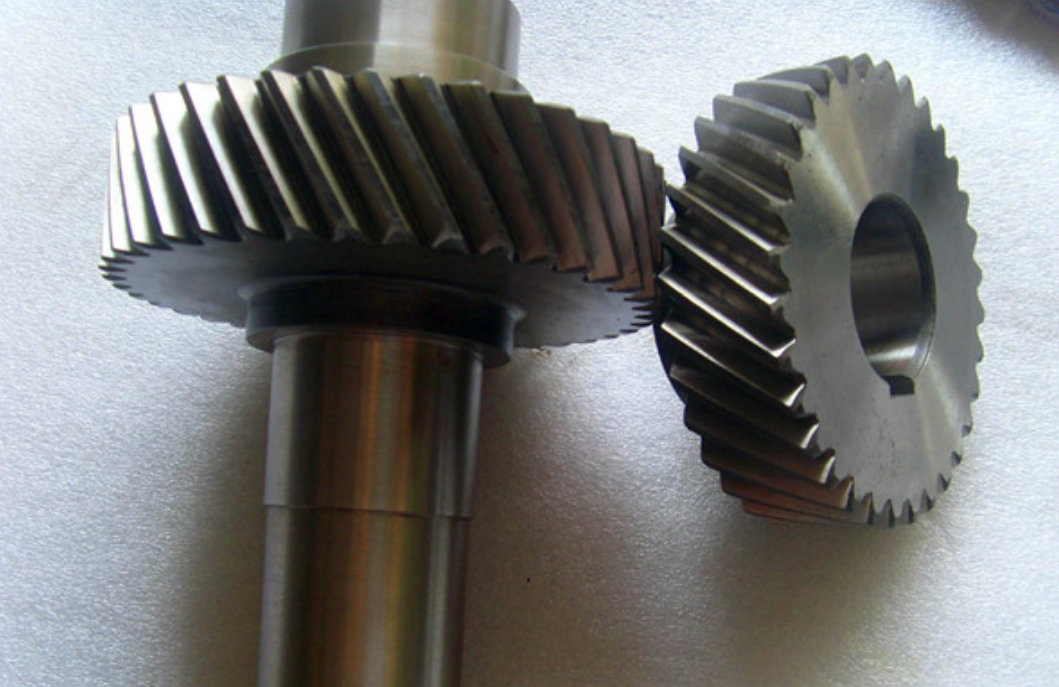
Fundamental Geometry and Tooth Generation of Helical Gears
The defining feature of a helical gear is its teeth, which are oriented at an angle, known as the helix angle, relative to the gear’s axis of rotation. The tooth flank of a helical gear is a three-dimensional surface known as an involute helicoid. This surface can be conceptually generated by a straight line (the generatrix) that is tangent to a base cylinder and inclined at the base helix angle, $$ \beta_b $$. As this line rolls without slipping on the base cylinder, it traces out the involute helicoid.
The intersection of this helicoidal surface with any cylinder coaxial with the gear is a helix. The intersection with a plane perpendicular to the gear axis (the transverse plane) is an involute curve. The relationship between the transverse parameters (measured in the cross-section) and the normal parameters (measured perpendicular to the tooth) is crucial for machining and tool design. Key geometric parameters include:
- Normal Module ($$ m_n $$): The module in a plane normal to the tooth.
- Transverse Module ($$ m_t $$): The module in the transverse plane. They are related by the helix angle $$ \beta $$: $$ m_t = \frac{m_n}{\cos \beta} $$.
- Helix Angle ($$ \beta $$): The angle between the tooth trace and an element of the pitch cylinder.
- Base Helix Angle ($$ \beta_b $$): The angle on the base cylinder, related by: $$ \sin \beta_b = \sin \beta \cos \alpha_n $$, where $$ \alpha_n $$ is the normal pressure angle.
When the helix angle $$ \beta $$ is zero, the gear becomes a spur gear. As $$ \beta $$ increases, the axial overlap of the teeth increases, leading to the aforementioned benefits but also introducing axial thrust forces during operation.
General Machining Workflow for Helical Gears
The complete manufacturing of a helical gear from a blank involves several sequential operations. A typical high-level process flow is outlined below:
- Blank Preparation: Turning, facing, and boring to create the gear blank with accurate outer dimensions and mounting features (e.g., hub, bore).
- Gear Tooth Machining (Primary Forming): This is the core operation where the involute helicoid tooth spaces are generated. This stage is our primary focus for five-axis CNC application.
- Heat Treatment: Processes like carburizing and hardening are applied to achieve the required surface hardness and core toughness for durability.
- Finishing Operations: Post-heat-treatment processes such as gear grinding, honing, or skiving to correct distortions and achieve the final precision and surface finish.
Within the tooth machining stage (Step 2), the five-axis CNC milling process offers a versatile solution, especially for prototypes, custom gears, or small-to-medium batch production. It replaces traditional dedicated gear-cutting machines with a flexible, programmable system.
Five-Axis CNC Machining Process Design for Helical Gears
Machining helical gears on a five-axis CNC center requires meticulous planning. The process typically follows a staged material removal strategy to ensure efficiency, tool life, and final accuracy. A standard sequence is: Roughing -> Semi-Finishing -> Finishing -> Root Cleaning (Deburring/Blending). Each stage has distinct objectives and parameter sets.
1. Machine Tool Selection and Configuration
The fundamental requirement for machining helical gears is the ability to simultaneously control the tool’s position and orientation relative to the rotating workpiece. A minimum of four axes is required: three linear axes (X, Y, Z) to position the tool, and one rotary axis (typically the A or C axis on the machine table) to rotate the gear blank for indexing between teeth. However, a five-axis configuration offers significant advantages for helical gears.
Five-axis machines provide two additional rotary motions, which can be arranged in various configurations (table-table, head-table, head-head). For helical gear milling, the most common setup involves fixing the gear blank on a tilting-rotary table (e.g., A-axis tilt and C-axis rotation). This configuration allows the tool axis to be optimally oriented relative to the inclined tooth flank, enabling the use of shorter, more rigid tools, better chip evacuation, and improved surface finish. The synchronized motion of all five axes allows the tool to follow the helical path of the tooth space accurately.
2. Cutting Tool Selection and Analysis
The choice of cutting tool is critical for productivity, accuracy, and avoiding tool-workpiece interference (gouging). Common tool types for gear milling include:
| Tool Type | Advantages | Disadvantages | Recommended Application |
|---|---|---|---|
| End Mill (Finger Type) | Good accessibility to narrow tooth spaces and root fillets. Simple geometry. | Lower rigidity, limiting depth of cut and feed rates. Prone to deflection and breakage. Potential for toolholder interference with gear teeth. | Small-module helical gears, finishing operations, prototype work. |
| Disc-Type Cutter (Shell Mill) | High rigidity due to large diameter, allowing aggressive roughing cuts. High material removal rate. | Critical diameter selection to avoid gouging tooth flanks. Risk of collision between tool arbor and adjacent teeth or gear body. | Roughing and semi-finishing of medium to large-module helical gears. |
| Formed Cutter (Gear Hob Simulation) | Can generate accurate involute profile theoretically in a continuous process. High productivity potential. | Complex toolpath generation (true hob simulation requires specialized CAM). Tool wear affects profile accuracy across all teeth. | Production runs when dedicated hobbing is not available. |
| Ball-Nose End Mill | Excellent for 3D contouring and finishing complex surfaces. No issue with corner radius. | Cutting speed at tip is zero, affecting surface finish. Requires precise toolpath spacing (scallop height control). | Finishing of tooth flanks, especially for crowned or modified helical gear profiles. |
The selection is governed by gear parameters (module $$ m_n $$, number of teeth $$ z $$, helix angle $$ \beta $$, face width), required accuracy, and machine power/rigidity. A hybrid approach is often best: using a large-diameter disc mill for roughing and a smaller, precise ball-nose or end mill for finishing.
3. Workholding and Fixturing
Secure and accurate workholding is paramount. A dedicated indexing fixture mounted on the machine’s rotary table is essential. The fixture must:
- Provide rigid clamping to withstand intermittent cutting forces.
- Ensure precise concentricity and perpendicularity of the gear blank relative to the rotary axes.
- Incorporate a reliable indexing mechanism (often controlled by the CNC’s C-axis) to accurately rotate the blank by the tooth spacing angle ($$ 360^\circ / z $$) after each tooth space is machined.
- Allow sufficient clearance for the tool and toolholder to move without collision, especially during the machining of the first and last teeth.
The setup is as follows: the fixture is mounted and centered on the C-axis table. The gear blank is then clamped onto the fixture. A precision mandrel or a custom clamp that engages the gear’s bore and a face is typically used. The initial workpiece coordinate system (WCS) is established, often with the Z-zero point on the face of the gear and the X/Y-zero at the center of rotation.
4. Toolpath Generation and Strategy
This is the core of the CNC process, translating the 3D model of the helical gear into machine motions. Modern CAM (Computer-Aided Manufacturing) software is indispensable for generating efficient, gouge-free toolpaths for five-axis machining of helical gears. The strategy is broken down by operation:
4.1 Roughing
Objective: To remove the bulk of material from the tooth spaces as quickly as possible while leaving a uniform stock allowance for semi-finishing.
Strategy: 2.5D or 3D adaptive clearing strategies are commonly used. The tool (often a disc mill) moves in layers (Z-levels) following the contour of the tooth space. The rotary C-axis is locked during this operation for a single tooth slot; the tool relies on its side-cutting edges and linear axis interpolation to create the helical shape approximately. After one slot is roughed, the C-axis indexes, and the process repeats.
Key Parameters: Large depth of cut ($$ a_p $$), high feed per tooth ($$ f_z $$), and stepover ($$ a_e $$) up to 50-70% of tool diameter. The stock left on walls and floor is typically 0.5-1.0 mm.
4.2 Semi-Finishing
Objective: To remove the remaining stock from roughing more precisely, correcting any geometrical errors and preparing a near-net shape for finishing.
Strategy: A more precise contouring strategy is used, often engaging all five axes. The tool follows the helical path more accurately. This step helps equalize cutting loads for the finishing tool.
Key Parameters: Reduced $$ a_p $$ and $$ a_e $$ compared to roughing. Stock allowance for finishing is reduced to 0.1-0.3 mm.
4.3 Finishing
Objective: To achieve the final dimensions, involute profile accuracy, and required surface roughness on the tooth flanks.
Strategy: This requires full five-axis simultaneous machining. The tool (ball-nose or tapered ball-nose end mill) is oriented to maintain an optimal lead/tilt angle relative to the tooth surface, ensuring the cutting is performed by the effective part of the ball’s radius. The toolpath is typically a spiral or series of parallel passes along the tooth flank.
Key Parameters: Very small stepover ($$ a_e $$) determined by the required scallop height $$ h_{scallop} $$. For a ball-nose mill of radius $$ R $$, the stepover distance $$ d $$ for a given scallop height is approximately: $$ d \approx 2 \sqrt{2 R h_{scallop}} $$. High cutting speed ($$ V_c $$) and low feed per tooth ($$ f_z $$) are used for best finish.
4.4 Toolpath Equations and Kinematics
The tool center point (TCP) must follow a path that accounts for the tool radius offset from the desired surface. For a helical gear tooth surface defined by a parametric equation $$ \vec{S}(u, v) $$, the TCP location $$ \vec{P}(t) $$ and tool axis orientation $$ \vec{O}(t) $$ are computed such that the tool is tangent to the surface at the contact point. A simplified kinematic model for machining a single tooth space involves synchronizing linear motion along the gear axis (Z) with rotary motion (C). The relationship is given by the helix lead $$ L $$:
$$ \Delta Z = \frac{L}{360^\circ} \cdot \Delta C $$
where $$ L = \frac{\pi d \cos \alpha_t}{\tan \beta} $$, with $$ d $$ as the reference diameter and $$ \alpha_t $$ as the transverse pressure angle. In full five-axis finishing, the A-axis (tilt) is also dynamically coordinated to maintain the tool orientation.
4.5 Root Cleaning
Objective: To remove cusps or leftover material at the tooth root fillet where the finishing tool could not reach.
Strategy: A small-diameter tool (e.g., a lollipop end mill) is used with a dedicated “pencil milling” or “clean-corner” toolpath that follows the root curve precisely.
5. Machining Parameter Optimization
Selecting optimal cutting parameters is vital for economic production. Parameters depend on workpiece material (e.g., steel, cast iron, aluminum), tool material (solid carbide, coated carbide), and machine capability. The following table provides generalized starting recommendations for milling steel helical gears with coated carbide tools.
| Operation | Cutting Speed $$ V_c $$ (m/min) | Feed per Tooth $$ f_z $$ (mm/tooth) | Axial Depth $$ a_p $$ (mm) | Radial Depth $$ a_e $$ (mm) |
|---|---|---|---|---|
| Roughing | 120 – 180 | 0.08 – 0.15 | Up to 5-10% of tool dia. | 40-70% of tool dia. |
| Semi-Finishing | 150 – 220 | 0.05 – 0.10 | 2 – 5 | 10-20% of tool dia. |
| Finishing | 200 – 300 | 0.01 – 0.05 | 0.5 – 2 | Set by scallop height |
The spindle speed $$ N $$ (rpm) is calculated from $$ V_c $$: $$ N = \frac{1000 V_c}{\pi D} $$, where $$ D $$ is the tool diameter. The feed rate $$ V_f $$ (mm/min) is: $$ V_f = N \cdot z_t \cdot f_z $$, with $$ z_t $$ being the number of teeth on the cutter.
Accuracy Considerations and Error Control
Machining helical gears on a five-axis center introduces several potential error sources that must be managed:
- Machine Geometric Errors: Inaccuracies in the linear and rotary axes (pitch, yaw, roll, straightness, squareness) directly affect the tooth geometry. Regular volumetric error compensation is essential.
- Tool Deflection: Particularly for long, slender tools used in finishing. This can cause profile errors. Using the shortest possible tool, reducing cutting forces (lower $$ a_p $$, $$ a_e $$), and employing tool deflection compensation in CAM are mitigation strategies.
- Thermal Effects: Heat generated during cutting and from machine components can cause thermal expansion, shifting the tool position relative to the workpiece. Effective cooling and warm-up cycles are important.
- Fixture/Workpiece Rigidity: Any vibration or movement during cutting degrades surface finish and accuracy. Ensuring maximum rigidity in the setup is crucial.
- CNC Interpolation Error: The approximation of the complex helical path by linear/circular interpolations can leave minute cusps. Using high-resolution settings and NURBS interpolation can improve path fidelity.
Comparison with Traditional Methods and Application Scope
The five-axis CNC milling process for helical gears is not intended to replace high-volume production methods like hobbing for standard gears. Its value lies in flexibility and capability for:
- Prototyping and R&D: Fast iteration of gear designs, including non-standard profiles or modifications (tip/root relief, lead crowning).
- Small-Batch and Custom Production: Economical for producing gears where the cost of a dedicated hob or form cutter is prohibitive.
- Large-Module Gears: Where large hobbing machines are not available or are prohibitively expensive to run.
- Repair and Aftermarket: Manufacturing replacement gears for legacy equipment where original tooling is unavailable.
- Integrated Manufacturing: Machining the gear teeth as part of a complete component (e.g., a shaft with an integral helical gear) in a single setup, improving overall concentricity.
Advanced Techniques and Future Trends
The field continues to evolve with several advanced techniques enhancing the five-axis machining of helical gears:
- Trochoidal Milling for Roughing: Using a constant engagement, circular toolpath to reduce cutting forces, heat, and tool wear, allowing higher feed rates.
- On-Machine Probing: Using a touch-trigger probe to measure the machined gear tooth geometry in-situ, enabling adaptive offset compensation for tool wear or thermal drift.
- Hybrid Additive-Subtractive Manufacturing: Building near-net-shape gear blanks via Directed Energy Deposition (DED) and then finish-milling the teeth on the same five-axis machine, ideal for high-value, complex components.
- AI-Optimized Toolpaths: Using machine learning algorithms to generate toolpaths that minimize cycle time, tool wear, or vibration based on historical machining data.
Conclusion
The application of five-axis CNC machining centers for the production of helical gears represents a significant advancement in flexible, precision manufacturing. By carefully selecting the appropriate machine configuration, cutting tools, fixturing, and employing sophisticated CAM-driven toolpath strategies—encompassing roughing, semi-finishing, finishing, and cleaning—high-quality helical gears can be manufactured efficiently. This process overcomes many limitations of traditional dedicated gear-cutting machines, particularly for complex profiles, small batches, and large-module components. While challenges related to accuracy control and production economics for very high volumes remain, the versatility, speed, and precision of the five-axis CNC approach make it an indispensable technology in the modern manufacturing landscape for helical gears. Continuous advancements in machine tool accuracy, cutting tool materials, CAM software, and process monitoring will further solidify its role, enabling the production of next-generation transmission components with enhanced performance and reliability.