
The Electric Power Steering (EPS) system represents a cornerstone of modern automotive technology, offering superior fuel efficiency, enhanced driver feel, and advanced integration capabilities compared to traditional hydraulic systems. A critical component within the EPS mechanism is the final reduction stage that transmits torque from the assist motor to the steering column or rack. For this application, a transmission pairing consisting of a steel worm driving a polymer helical gear has gained significant traction in the industry. This configuration offers compelling advantages: the helical gear provides smoother engagement and lower noise than a spur gear, while the use of engineering plastics like PA66 for the gear reduces weight, dampens vibration, and lowers manufacturing cost. However, this material asymmetry—a high-strength steel worm meshing with a relatively compliant nylon helical gear—renders conventional worm and gear design methodologies obsolete. Traditional rules for geometry, load distribution, and failure analysis are predicated on metal-to-metal contact and are not directly applicable. This necessitates a specialized design approach focused on optimizing the helical gear’s performance and durability within this unique system.
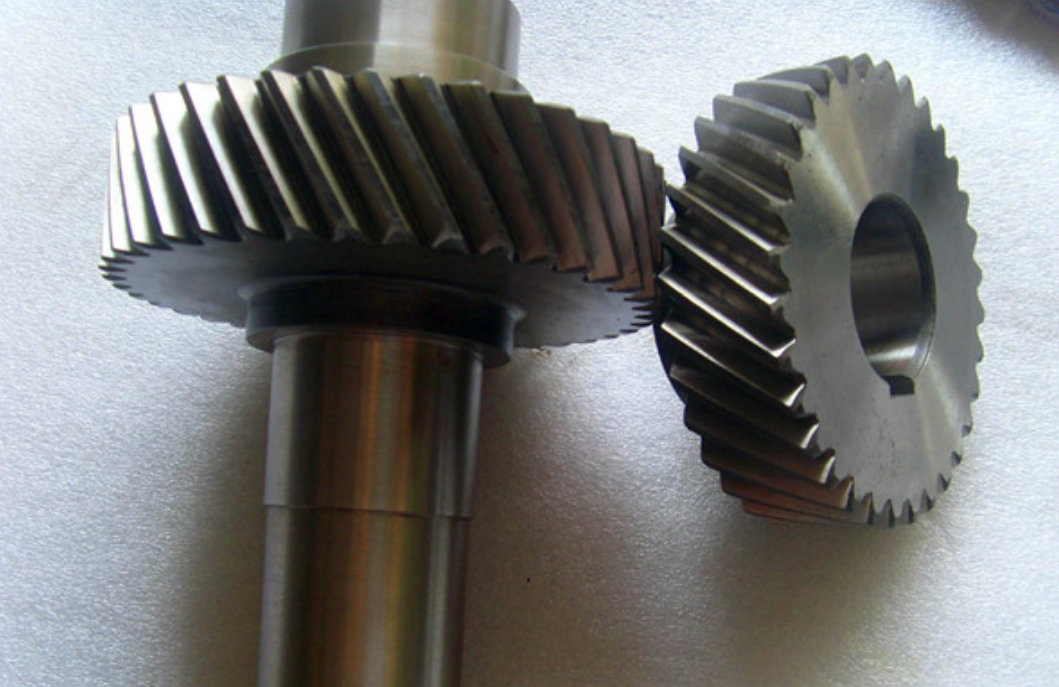
Fundamentally, a worm drive with a helical gear can be analyzed as a crossed-axis helical gear pair. The worm is essentially a helical gear with a very low number of teeth (equal to its number of starts) and an extremely high helix angle, often approaching 90°. The meshing action is a complex interplay of sliding and rolling contact, with significant stress concentrations at the tooth root of the driven helical gear. The primary failure mode for the nylon helical gear is bending fatigue at the fillet, making the minimization of root bending stress the paramount design objective. The core bending stress equation for helical gears, according to standardized calculations, is given by:
$$
\sigma_F = \frac{F_t}{b m_n} K_A K_V K_{F\beta} K_{F\alpha} Y_F Y_S Y_{\beta} Y_{B} Y_{DT}
$$
Where:
- $\sigma_F$ is the tooth root bending stress.
- $F_t = \frac{2T}{d_1}$ is the nominal tangential load at the reference cylinder.
- $T$ is the input torque on the worm.
- $d_1$ is the reference diameter of the helical gear.
- $b$ is the face width of the helical gear.
- $m_n$ is the normal module.
- $K_A$, $K_V$, $K_{F\beta}$, $K_{F\alpha}$ are application, dynamic, face load, and transverse load distribution factors.
- $Y_F$ is the form factor (stress concentration factor).
- $Y_S$ is the stress correction factor.
- $Y_{\beta}$ is the helix angle factor.
- $Y_B$ is the rim thickness factor.
- $Y_{DT}$ is the deep tooth factor.
For a polymer gear, factors like thermal softening and long-term creep also play a role, but the initial mechanical design focuses on the peak bending stress under load. The geometry of the tooth, encapsulated in the form factor $Y_F$, is heavily influenced by the number of teeth and the profile shift coefficient (modification coefficient). This is where strategic optimization of the helical gear becomes crucial.
Theoretical Foundation and Profile Shift Strategy
The central challenge in designing a steel worm and nylon helical gear pair is balancing the strength of both components. An unmodified (zero profile shift) design typically results in a weak polymer tooth and an excessively robust steel worm, which is suboptimal for cost and weight. Profile shifting, or applying a positive addendum modification to the helical gear and a corresponding negative shift to the worm, is a powerful tool. It effectively re-distributes material, thickening the root of the nylon helical gear while thinning the tip of the steel worm, without altering the center distance or the gear’s outer diameter.
The amount of profile shift is quantified by the coefficient $x$. For a standard gear, the reference circle tooth thickness $s$ is:
$$ s = \frac{\pi m_n}{2} $$
For a modified helical gear and worm pair, the tooth thicknesses become:
$$ s_{gear} = \frac{\pi m_n}{2} + 2x m_n \tan(\alpha_n) $$
$$ s_{worm} = \frac{\pi m_n}{2} – 2x m_n \tan(\alpha_n) $$
where $\alpha_n$ is the normal pressure angle.
A key constraint for the steel worm is preventing a sharp, weak tooth tip. The worm tip thickness $s_{a,worm}$ should not fall below a practical minimum, often defined as $0.4m_n$ to $0.6m_n$. The worm tip thickness after negative shift is:
$$ s_{a,worm} = s_{worm} – 2h_{a,worm} \tan(\alpha_n) = \frac{\pi m_n}{2} – 2x m_n \tan(\alpha_n) – 2 m_n \tan(\alpha_n) $$
Setting $s_{a,worm} = 0.4m_n$ as the limit and solving for the profile shift coefficient $x$ yields the proposed design criterion based on worm tip integrity:
$$ x_{proposed} = \frac{\pi}{4\tan(\alpha_n)} – \frac{0.8}{4\tan(\alpha_n)} – 1 \approx \frac{\pi – 0.8}{4\tan(\alpha_n)} – 1 $$
This formula ensures the worm remains robust. Concurrently, this significant positive shift dramatically strengthens the root of the helical gear.
Previous research has suggested alternative criteria, such as allocating tooth thickness in a specific ratio (e.g., 7:3) between the polymer gear and metal worm for equal strength. This leads to a different shift coefficient:
$$ x_{literature} = \frac{\pi}{10\tan(\alpha_n)} $$
A comparative analysis shows that for common pressure angles (e.g., 13.5° to 20°), the coefficient $x_{proposed}$ derived from the worm-tip-thickness constraint is generally larger than $x_{literature}$. This results in an even thicker root section for the nylon helical gear, offering a higher potential safety factor against bending fatigue, which is the dominant failure mode.
Case Study: Design and Analysis via Kisssoft
To validate the proposed methodology, a detailed design case for an automotive EPS system is performed using specialized gear design software, Kisssoft. The initial requirements are summarized below.
| Parameter | Helical Gear (Target) | Worm (Input) |
|---|---|---|
| Normal Module, $m_n$ | 2 mm | 2 mm |
| Number of Teeth / Starts | 41 | 2 |
| Transmission Ratio | 20.5 : 1 | – |
| Normal Pressure Angle, $\alpha_n$ | 13.5° | 13.5° |
| Center Distance, $a$ | 50 mm | – |
| Input Power | – | 0.3 kW |
| Input Speed | – | 1000 rpm |
The materials are defined as PA66 (GF30) for the helical gear and case-hardened steel (e.g., 16MnCr5 or similar) for the worm. Their essential properties are critical for accurate analysis.
| Material Property | PA66 (Helical Gear) | Case-Hardened Steel (Worm) |
|---|---|---|
| Young’s Modulus, $E$ | 1.4 GPa | 206 GPa |
| Poisson’s Ratio, $\nu$ | 0.38 | 0.3 |
| Density, $\rho$ | 1140 kg/m³ | 7850 kg/m³ |
| Yield Strength, $\sigma_y$ | ~83 MPa | >785 MPa |
Using the crossed helical gear module in Kisssoft, the initial unmodified geometry is calculated. The worm helix angle is derived to meet the center distance constraint. The key outcomes of the baseline design are:
| Calculated Parameter | Helical Gear Value | Worm Value |
|---|---|---|
| Reference Diameter, $d$ | 85.145 mm | 15.455 mm |
| Tip Diameter, $d_a$ | 89.145 mm | 18.855 mm |
| Helix Angle, $\beta$ | 15.6205° | 74.3795° |
| Transverse Contact Ratio, $\epsilon_{\alpha}$ | 2.184 | |
| Tooth Root Safety Factor, $S_F$ | 1.600 | 10.701 |
The results clearly show the imbalance: the steel worm has a very high safety factor ($S_F > 10$), while the nylon helical gear is the weak link with a marginal $S_F$ of 1.6. This confirms the need for profile shift optimization focused on the helical gear.
Applying the profile shift principles, two scenarios are analyzed. First, with the coefficient from prior literature ($x_{literature} = \pi/(10\tan(13.5°)) \approx 1.3086$). Second, with the proposed coefficient based on worm tip thickness ($x_{proposed} \approx 1.4383$). The shift is applied symmetrically, maintaining the tip and root diameters of both components (effectively只 changing tooth thickness). The recalculated safety factors demonstrate the impact.
| Design Scenario | Profile Shift Coeff. ($x$) | Helical Gear Root Safety $S_F$ | Worm Root Safety $S_F$ |
|---|---|---|---|
| Baseline (Unmodified) | 0.0 | 1.600 | 10.701 |
| Literature Method | +1.3086 | 2.431 | 5.345 |
| Proposed Method | +1.4383 | 2.514 | 4.897 |
The improvement is substantial. Both shift strategies successfully transfer “strength” from the over-designed worm to the critical helical gear. The proposed method yields the highest safety factor for the nylon helical gear (2.514), a 57% increase over the baseline, while still maintaining a very comfortable safety factor for the steel worm (4.897). This validates the hypothesis that a larger, carefully calculated positive profile shift for the helical gear is beneficial for this specific material combination.
Detailed Verification via Finite Element Analysis (FEA)
While Kisssoft provides excellent system-level analysis, a detailed finite element analysis (FEA) offers a more granular view of stress distribution, particularly in the complex root fillet of the helical gear. A static structural analysis is conducted using Ansys Workbench to corroborate the bending stress calculations.
Three-dimensional models of the helical gear and worm pair are created for the three scenarios: unmodified, and with the two profile shift values. The models are assembled with the correct center distance. The material properties from Table 2 are assigned. A bonded contact is established between the two or three pairs of teeth in simultaneous mesh, corresponding to the calculated contact ratio of ~2.2. The boundary conditions simulate a static output torque load:
- The worm shaft is fixed in all degrees of freedom.
- A moment of 60 Nm is applied to the helical gear’s hub, simulating a high-load condition at the steering output.
The mesh is refined in the contact regions and particularly at the root fillets of the helical gear. The equivalent (von-Mises) stress contours for the helical gear teeth under load are extracted. The maximum stress consistently occurs at the root fillet on the loaded side.
| Design Scenario | Max. Root Bending Stress (FEA) | Calculated Safety Factor vs. $\sigma_y=83$ MPa |
|---|---|---|
| Baseline ($x=0$) | 62.24 MPa | ~1.33 |
| Literature Method ($x=1.3086$) | 41.12 MPa | ~2.02 |
| Proposed Method ($x=1.4383$) | 38.18 MPa | ~2.17 |
The FEA results show a clear and quantifiable reduction in peak bending stress with profile shifting. The stress values are in a reasonable ballpark compared to the Kisssoft calculations, though direct numerical comparison is complex due to different calculation models (simplified tooth form factor vs. exact geometry in FEA). The key takeaway is the trend: the proposed shift coefficient yields the lowest maximum stress in the helical gear, confirming its superiority in enhancing bending strength. The FEA-calculated safety factors are slightly lower than the Kisssoft values, which is expected as FEA captures localized stress concentrations more precisely, especially in the complex root geometry of the helical gears.
Conclusion and Design Recommendations
This study addresses the specialized design requirements for nylon helical gear and steel worm drives in automotive EPS applications. The significant material property mismatch necessitates a departure from standard worm gear design rules. The core optimization strategy involves the application of a substantial positive profile shift to the polymer helical gear, coupled with a corresponding negative shift to the steel worm.
The primary findings and design guidelines are:
- Dominant Failure Mode: The root bending fatigue of the nylon helical gear is the life-limiting factor. Design efforts must prioritize minimizing bending stress in these helical gears.
- Profile Shift Criterion: A practical and effective method for determining the shift coefficient is to base it on maintaining a minimum acceptable tooth tip thickness on the steel worm (e.g., $s_{a,worm} \ge 0.4m_n$). This leads to the proposed formula: $$ x \approx \frac{\pi – 0.8}{4\tan(\alpha_n)} – 1 $$ This approach typically results in a larger shift than other empirical rules, providing greater reinforcement to the helical gear root.
- Performance Gain: Applying this optimized profile shift can increase the calculated bending safety factor of the helical gear by over 50% compared to an unmodified design, while the worm’s safety factor remains more than adequate.
- Verification: The design methodology should be validated through a combination of specialized gear software (like Kisssoft or Romax) for system-level analysis and detailed Finite Element Analysis (FEA) for local stress verification of the helical gear teeth.
Furthermore, designers must consider additional factors specific to polymer helical gears:
- Thermal Effects: The strength and modulus of nylon decrease with temperature rise due to internal friction. The operating temperature must be estimated, and material properties at that temperature should be used for a conservative design.
- Creep and Long-term Behavior: Under sustained load, polymers exhibit creep. This can affect backlash and mesh alignment over time. Factors of safety should account for long-term deformation.
- Moisture Absorption: Nylons absorb moisture, which can plasticize the material, reducing stiffness but increasing toughness. The equilibrium moisture content in the operating environment should be considered.
- Molding Considerations: The optimized tooth root thickness must be checked for manufacturability via injection molding, ensuring proper material flow and avoiding sink marks.
In conclusion, by adopting a helical-gear-centric design philosophy, employing the proposed profile shift strategy based on worm tip integrity, and rigorously verifying the design through modern engineering tools, it is possible to develop highly reliable, efficient, and cost-effective nylon helical gear and steel worm drives that meet the demanding performance requirements of modern automotive EPS systems.