
In modern mechanical transmission systems, helical gears are widely adopted due to their superior load-carrying capacity, smooth operation, and reduced noise compared to spur gears. However, the internal excitations generated during meshing remain a critical source of vibration and acoustic emissions, ultimately affecting the reliability and performance of gearboxes. In this study, I embark on a detailed investigation into the internal excitation phenomena within helical gear pairs, focusing on a specific constant-meshing pair from an 8-speed automatic transmission. The analysis encompasses static and dynamic contact behavior, time-varying mesh stiffness, error excitations including transmission errors, and meshing impact dynamics. Employing a combination of theoretical formulations and finite element simulation techniques, I aim to elucidate the complex interactions that define the dynamic response of helical gears. The findings provide a foundational framework for optimizing helical gear design, particularly in applications demanding high precision and low noise, such as automotive transmissions.
The helical gears under investigation are characterized by their geometric and material properties, which are essential for accurate modeling. The parameters for the driving and driven helical gears are summarized in Table 1. These parameters form the basis for all subsequent finite element models and theoretical calculations.
| Parameter | Driving Gear | Driven Gear |
|---|---|---|
| Module (mm) | 1.3 | 1.3 |
| Number of Teeth | 61 | 132 |
| Pressure Angle (°) | 17.5 | 17.5 |
| Helix Angle (°) | 18 (Left-hand) | 18 (Right-hand) |
| Backlash (mm) | 0.075 | 0.075 |
| Profile Shift Coefficient | -0.077 | 0.150 |
| Tip Diameter (mm) | 86.3 | 184.38 |
| Root Diameter (mm) | 77.72 | 176.8 |
| Face Width (mm) | 15 | 14 |
| Bore Diameter (mm) | 67.5 | 63 |
| Ultimate Torque (N·mm) | 178,000 | – |
| Ultimate Speed (r/min) | 3,000 | – |
| Density (kg/mm³) | 7.8 × 10⁻⁶ | |
| Poisson’s Ratio | 0.3 | |
| Young’s Modulus (MPa) | 2.1 × 10⁵ | |
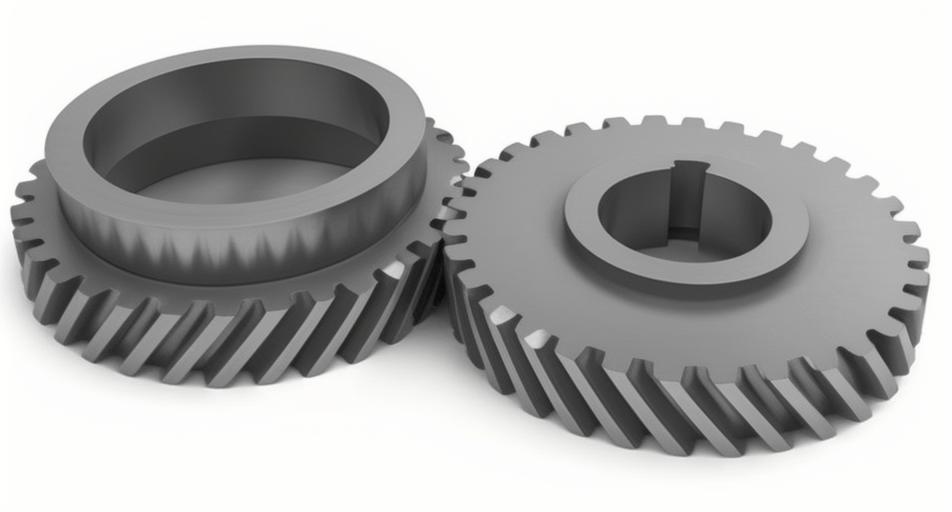
Helical gears operate with a gradual engagement process due to their angled teeth, which results in multiple tooth pairs being in contact simultaneously along a diagonal contact line. This characteristic fundamentally influences their internal excitation mechanisms. To visualize the typical configuration of such gears, consider the following representation.
The static contact analysis of helical gears provides insights into the stress distribution under a steady load, excluding dynamic effects. I constructed a finite element model representing a segment of the meshing helical gear pair, utilizing SOLID185 elements. The model consisted of 38,891 nodes and 33,840 elements. Contact pairs were defined with the driving gear as the target surface and the driven gear as the contact surface. Boundary conditions involved constraining all degrees of freedom except rotation about the central axis for the driving gear’s inner ring, while fully constraining the driven gear’s inner ring. A tangential force, derived from the ultimate torque, was applied to the nodes on the driving gear’s inner surface. The resulting stress distribution on the driven helical gear revealed that contact stresses were concentrated along a distinct斜线, aligning with the theoretical contact line. The stress was highest at the edges of the contact line, corresponding to the entry and exit points of meshing, and diminished with distance from this line. This pattern is intrinsic to the load-sharing behavior of helical gears during quasi-static conditions.
Dynamic contact analysis, which accounts for inertial effects and transient motions, presents a more complex scenario. For this analysis, a refined mesh with 76,688 elements and 98,924 nodes was employed. Both gears were permitted only rotational freedom about their axes. The driving gear was subjected to an angular velocity corresponding to the极限 speed (ω = 314 rad/s), while the driven gear experienced a resistive torque. The dynamic contact stresses were observed to be generally higher than their static counterparts. The contact line remained diagonal, but significant stress concentrations appeared at the tooth root fillets due to bending and potential弹性 interference during dynamic motion. The transient nature of engagement caused fluctuations in the contact line position and induced冲击, leading to a more severe and complex stress state. This underscores the importance of considering dynamic effects when assessing the fatigue life and noise generation of helical gears.
A cornerstone of gear dynamics is the time-varying mesh stiffness (TVMS). For helical gears, the TVMS fluctuates due to the periodic change in the total length of contact lines as tooth pairs engage and disengage. The mesh stiffness can be represented as a time-dependent spring in the direction of the line of action. A widely accepted theoretical approach expresses the TVMS as a function of the instantaneous total contact line length:
$$ k(t) = k_0 L(\tau) $$
where \( k(t) \) is the time-varying mesh stiffness, \( k_0 \) is the mesh stiffness per unit contact length (taken as \( 9 \times 10^6 \, \text{N/(mm·m)} \) for this study), \( L(\tau) \) is the instantaneous total contact line length, and \( \tau = t/T_z \) is the non-dimensional time with \( T_z \) being the mesh period. The contact line length \( L(\tau) \) can be expanded into a Fourier series:
$$ L(\tau) = \left[1 + \sum_{k=1}^{\infty} \left( A_k \cos(2\pi k \tau) + B_k \sin(2\pi k \tau) \right) \right] L_m $$
The coefficients \( A_k \) and \( B_k \) are derived from the transverse contact ratio \( \varepsilon_{\alpha} \) and the overlap ratio \( \varepsilon_{\beta} \):
$$ A_k = \frac{ \cos(2\pi k \varepsilon_{\beta}) + \cos(2\pi k \varepsilon_{\alpha}) – \cos[2\pi k (\varepsilon_{\alpha} + \varepsilon_{\beta})] }{ 2 \varepsilon_{\alpha} \varepsilon_{\beta} \pi^2 k^2 } $$
$$ B_k = \frac{ \sin(2\pi k \varepsilon_{\beta}) + \sin(2\pi k \varepsilon_{\alpha}) – \sin[2\pi k (\varepsilon_{\alpha} + \varepsilon_{\beta})] }{ 2 \varepsilon_{\alpha} \varepsilon_{\beta} \pi^2 k^2 } $$
The mean contact line length \( L_m \) is given by:
$$ L_m = \frac{b \varepsilon_{\alpha}}{\cos \beta_b} $$
where \( b \) is the face width and \( \beta_b \) is the base circle helix angle. The contact ratios are calculated as follows:
$$ \varepsilon_{\alpha} = \frac{ z_1 (\tan \alpha_{at1} – \tan \alpha_t’) + z_2 (\tan \alpha_{at2} – \tan \alpha_t’) }{ 2\pi } $$
$$ \varepsilon_{\beta} = \frac{b \sin \beta}{\pi m_n} $$
$$ \varepsilon_{\gamma} = \varepsilon_{\alpha} + \varepsilon_{\beta} $$
Here, \( z_1, z_2 \) are tooth numbers, \( m_n \) is the normal module, \( \beta \) is the helix angle, \( \alpha_{at} \) is the tip pressure angle, and \( \alpha_t’ \) is the operating transverse pressure angle. For the studied helical gears, the calculated parameters are: \( \varepsilon_{\alpha} \approx 1.68 \), \( \varepsilon_{\beta} \approx 1.45 \), leading to \( \varepsilon_{\gamma} \approx 3.13 \). The theoretical TVMS curve, plotted over one mesh cycle, exhibits a sinusoidal-like fluctuation with a maximum of approximately \( 3.95 \times 10^8 \, \text{N/m} \) and a minimum of \( 3.48 \times 10^8 \, \text{N/m} \). This周期性 variation is a primary source of parametric excitation in helical gear systems.
To validate the theoretical model, a finite element simulation of the meshing process was conducted to extract the mesh stiffness directly from the force-displacement relationship. The FE-derived TVMS curve showed a similar周期性 pattern but with a more pronounced minimum value of about \( 2.65 \times 10^8 \, \text{N/m} \). The discrepancy in the minimum stiffness highlights the limitations of the theoretical model, which idealizes contact conditions, whereas the FE model captures localized deformations and edge effects more accurately. This comparison underscores the complementary value of both approaches in understanding the stiffness behavior of helical gears.
Error excitations constitute another major category of internal激励 in helical gears. These can be classified into meshing errors, static transmission error (STE), and dynamic transmission error (DTE). Meshing errors arise from manufacturing inaccuracies and deviations in tooth profiles. They are often modeled as a harmonic function of time:
$$ e(t) = e_0 + e_a \sin(\omega t + \phi) $$
where \( e_0 \) is a constant error offset, \( e_a \) is the error amplitude, \( \omega \) is the meshing frequency, and \( \phi \) is a phase angle. For this analysis, typical values of \( e_0 = 0 \), \( e_a = 15 \, \mu\text{m} \), and \( \phi = 0 \) were assumed. The resulting error signal varies sinusoidally with the meshing frequency, directly influencing the vibratory response.
Static transmission error is defined as the deviation of the actual angular position of the driven helical gear from its ideal theoretical position under load, projected onto the line of action. It combines effects from tooth deformations (bending, shear, contact) and geometric errors. Mathematically, STE (\(\delta_{STE}\)) can be expressed as:
$$ \delta_{STE} = R_{b2} \theta_2 – R_{b1} \theta_1 = E – \Delta $$
where \( R_{b1}, R_{b2} \) are base circle radii, \( \theta_1, \theta_2 \) are rotational angles, \( E \) represents the composite geometric error (including profile and pitch errors), and \( \Delta \) represents the composite elastic deformation of the meshing tooth pairs. Theoretical calculation of STE involves summing individual tooth deflections at discrete angular positions. The results, when plotted against the driven gear rotation, show a periodic waveform with an amplitude range that reflects the combined error and compliance. Finite element analysis of the loaded helical gear pair yielded an STE curve with greater magnitude fluctuations than the theoretical prediction. This is attributed to stress concentrations and non-linear contact behavior captured by the FE model, which the simplified theoretical model overlooks. Further validation using a dedicated multibody dynamics software (Romax Designer) confirmed the FE trends, providing confidence in the simulation results. The STE is a key metric for gear noise prediction, as its fluctuation at the meshing frequency and its harmonics drives gear whine.
Dynamic transmission error extends the concept to the oscillatory motion during operation. It is essentially the relative vibratory displacement between the two helical gears along the line of action. The equations of motion for a simple two-degree-of-freedom gear pair model can be written as:
$$ J_1 \ddot{\theta}_1 = T_1 – R_{b1} F \cos \beta_b $$
$$ J_2 \ddot{\theta}_2 = R_{b2} F \cos \beta_b – T_2 $$
Here, \( J_1, J_2 \) are mass moments of inertia, \( T_1, T_2 \) are input and output torques, \( F \) is the dynamic mesh force, and \( \beta_b \) is the base helix angle. The DTE (\( \delta_{DTE} \)) is defined as:
$$ \delta_{DTE} = R_{b2} \theta_2 – R_{b1} \theta_1 $$
Differentiating these equations leads to a second-order differential equation for \( \delta_{DTE} \), which incorporates the time-varying mesh stiffness and damping. Solving this equation, either analytically or through time-domain FE simulation, reveals the dynamic response. The DTE curve obtained from transient FE analysis exhibited larger amplitude and more high-frequency content compared to the STE, clearly showing the influence of inertial and damping effects. The periodic pattern, however, remained synchronized with the mesh cycle, confirming that the fundamental excitation stems from the geometric and stiffness variations inherent to helical gear meshing.
Meshing impact is a transient phenomenon that occurs primarily due to base pitch errors between mating helical gears. When the base pitch of the driving gear is smaller than that of the driven gear (negative error), the subsequent tooth pair enters contact prematurely before the previous pair has completely disengaged. This causes a sudden acceleration of the driven gear, termed “mesh-in impact.” Conversely, a “mesh-out impact” occurs during disengagement, potentially causing deceleration. These impacts generate high-frequency force transients that contribute significantly to gear rattle and noise. Using the Romax model’s dynamic simulation capability, the root stress history of both helical gears was extracted. The results clearly showed sharp spikes in root stress corresponding to the moments of mesh-in and mesh-out events. This numerical evidence confirms the presence of冲击 loads that must be considered in durability analysis and noise-vibration-harshness (NVH) refinement of helical gear transmissions.
The distribution of load along the contact line is rarely uniform in practical helical gears due to manufacturing deviations, assembly misalignments, and elastic deformations. A micro-geometry analysis performed within Romax provided the load distribution across the tooth flank of the driven helical gear. The results are summarized in Table 2, which illustrates the normalized load intensity at various points along the face width from one end (Position 0) to the other (Position 1).
| Position Along Face Width (Normalized) | Normalized Load Intensity |
|---|---|
| 0.0 (Toe End) | 1.25 |
| 0.2 | 1.10 |
| 0.4 | 0.95 |
| 0.5 (Midpoint) | 0.90 |
| 0.6 | 0.95 |
| 0.8 | 1.10 |
| 1.0 (Heel End) | 1.25 |
The table reveals a characteristic “crowning” effect, where load intensity is highest at the edges (toe and heel) of the tooth face. This edge-loading or stress concentration is undesirable as it can lead to premature pitting, scuffing, and increased noise. It underscores the necessity of applying appropriate lead crowning or profile modifications to helical gears to promote a more uniform pressure distribution and mitigate these adverse effects. The optimization of such micro-geometry is a direct application of the insights gained from internal excitation analysis.
To further quantify the relationship between operating conditions and dynamic response, I derived an empirical expression for the dominant vibration frequency component (\( f_v \)) related to mesh stiffness variation in helical gears, considering the parametric excitation effect:
$$ f_v = n \cdot Z \cdot f_r $$
where \( n \) is the harmonic order (typically 1, 2, 3…), \( Z \) is the number of teeth on the driving helical gear, and \( f_r \) is its rotational frequency. For the studied gear at极限 speed (3000 rpm = 50 Hz), the fundamental mesh frequency (\( n=1 \)) is \( f_m = Z \cdot f_r = 61 \times 50 = 3050 \, \text{Hz} \). This high-frequency excitation is a primary contributor to gear whine. The amplitude of vibration at this frequency is modulated by the TVMS fluctuation, which can be approximated by the stiffness variation ratio \( \Delta k / \bar{k} \), where \( \Delta k \) is the peak-to-peak stiffness variation and \( \bar{k} \) is the mean mesh stiffness. For our helical gears:
$$ \bar{k} \approx \frac{3.95 \times 10^8 + 2.65 \times 10^8}{2} = 3.3 \times 10^8 \, \text{N/m} $$
$$ \Delta k \approx 3.95 \times 10^8 – 2.65 \times 10^8 = 1.3 \times 10^8 \, \text{N/m} $$
$$ \frac{\Delta k}{\bar{k}} \approx 0.394 $$
This significant relative variation (about 39.4%) highlights the substantial parametric excitation potential, explaining why helical gears, despite their smooth engagement, are still susceptible to vibration issues if not properly designed.
In conclusion, this comprehensive study dissects the key internal excitation mechanisms in helical gear meshing transmission through a multi-faceted analytical approach. The static and dynamic contact analyses reveal the stress concentration patterns unique to helical gears, emphasizing the severity of dynamic conditions. The investigation into time-varying mesh stiffness demonstrates the周期性 fluctuation inherent to the helical gear engagement process, validating theoretical models with finite element simulations while noting their respective limitations. The analysis of error excitations—meshing error, static transmission error, and dynamic transmission error—quantifies their contributions to vibration generation, with DTE showing amplified effects due to system dynamics. The examination of meshing impact identifies transient冲击 events linked to base pitch errors. Finally, the assessment of contact line load distribution pinpoints edge-loading as a critical concern. Collectively, these findings provide a robust scientific basis for targeted design improvements in helical gears, such as optimized tooth modifications, tolerance control, and system damping integration, ultimately paving the way for quieter, more reliable, and higher-performance gear transmissions. The methodologies and insights presented here are broadly applicable to the design and analysis of helical gears across various industrial sectors.