
The pursuit of higher power density and efficiency in hydraulic systems has driven the development of high-speed gear pumps. Among various designs, the high-speed cycloidal helical gear pump offers distinct advantages, such as superior meshing characteristics and reduced flow pulsation. However, operating at extreme speeds and pressures subjects the pump rotor to a complex multi-physical environment. This includes significant thermal effects from fluid friction, substantial fluid pressure loads, driving torque, and active compensation forces from bearings and end covers. These combined loads can induce deformation, vibration, and even failure, critically impacting the pump’s reliability and lifespan. Therefore, a comprehensive understanding of the rotor’s dynamic characteristics under these coupled conditions is paramount for robust design. This article presents a detailed thermo-fluid-structural coupling analysis of a high-speed cycloidal helical gear pump rotor to evaluate its static deformation, modal properties, and ultimately, its critical speed.
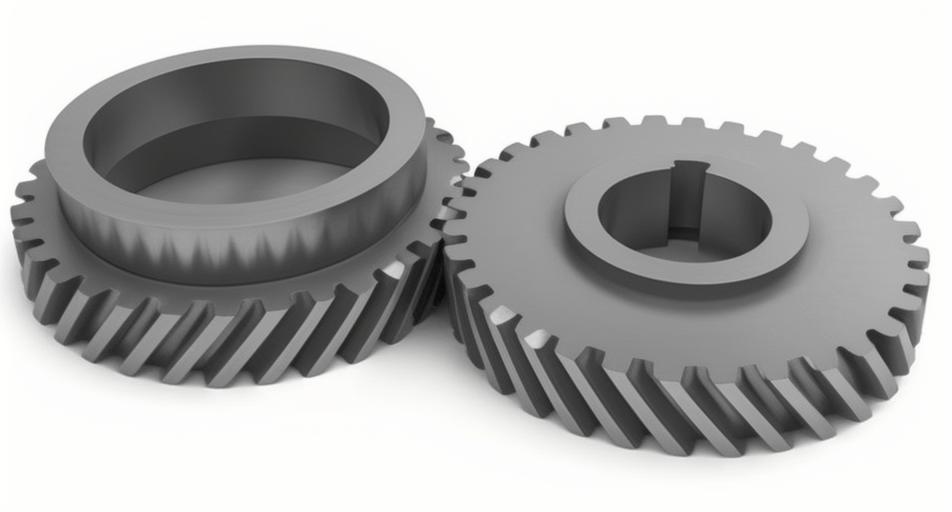
The pump under investigation utilizes a dual-arc profile for the helical gears with a point-contact meshing principle. Its key design parameters are summarized in the table below.
| Parameter | Value | Parameter | Value |
|---|---|---|---|
| Number of Teeth, $Z$ | 7 | Suction Port Diameter, $D_{in}$ (mm) | 17 |
| Module, $m$ (mm) | 3 | Discharge Port Diameter, $D_{out}$ (mm) | 11 |
| Face Width, $b$ (mm) | 15.5 | Center Distance, $D$ (mm) | 21.01 |
| Pressure Angle, $\alpha$ (°) | 14.5 | Helix Angle, $\beta_0$ (°) | 31.3 |
The design operates at a speed of 10,000 rpm, a discharge pressure of 25 MPa, and a displacement of 5 mL/rev. The rotor assembly, comprising the driving and driven shafts with their mounted helical gears, is manufactured from 20CrMnTi alloy steel. The hydraulic fluid is Shell Tellus S2 M 22.
| Material | Property | Value |
|---|---|---|
| 20CrMnTi Steel (Rotor) | Density, $\rho$ (kg/m³) | 7800 |
| Young’s Modulus, $E$ (GPa) | 207 | |
| Poisson’s Ratio, $\nu$ | 0.25 | |
| Yield Strength (MPa) | 1050 | |
| Thermal Conductivity (W/m·°C) | 1.26×10⁻⁵ | |
| Hydraulic Fluid | Density, $\rho_f$ (kg/m³) | 880 |
| Specific Heat, $c_p$ (J/kg·°C) | 1985 | |
| Dynamic Viscosity, $\mu$ (Pa·s) | 22.4 |
Theoretical Framework and Governing Equations
The analysis of the rotor system under coupled loads requires solving the interacting equations governing the thermal, fluid, and structural fields. A one-way coupling approach is adopted, justified by the significant density difference between the solid rotor and the fluid, where fluid-induced deformation feedback is negligible.
The thermo-fluid-structural coupling is enforced at the interface between the fluid domain (wet surfaces of the helical gears and shafts) and the solid rotor. The continuity conditions for stress, displacement, heat flux, and temperature are given by:
$$
\begin{aligned}
\tau_f \cdot n_f &= \tau_s \cdot n_s \\
u_f &= u_s \\
q_f &= q_s \\
T_f &= T_s
\end{aligned}
$$
where $\tau$ is the stress tensor, $u$ is the displacement vector, $q$ is the heat flux, $T$ is temperature, and subscripts $f$ and $s$ denote fluid and solid, respectively.
The governing equation for the structural dynamics of the rotor system is:
$$
M\ddot{u} + D\dot{u} + Ku = F
$$
where $M$, $D$, and $K$ are the global mass, damping, and stiffness matrices, $u$ is the displacement vector, and $F$ is the external load vector including forces from pressure, temperature (thermal stress), and torque.
For modal analysis, damping and external loads are neglected, leading to the free vibration equation:
$$
M\ddot{u} + Ku = 0
$$
Assuming harmonic motion $u = A e^{i \omega t}$, the eigenvalue problem is obtained:
$$
(K – \omega_{ni}^2 M)A_i = 0
$$
where $\omega_{ni}$ and $A_i$ are the $i$-th natural angular frequency and corresponding mode shape vector. The critical rotational speed $n_{cr}$ in rpm is directly related to the natural frequency $f_i$ (Hz):
$$
n_{cr} = 60 \times f_i
$$
Simulation Methodology and Boundary Conditions
The three-dimensional model of the pump’s internal fluid domain and the solid rotor assembly was created. A polyhedral mesh was generated for the complex fluid domain, while a tetrahedral mesh was used for the structural domain. The sequential coupled analysis was performed on the ANSYS Workbench platform:
- Fluid Flow (CFD) Analysis: A transient CFD simulation was conducted with a rotating mesh at 10,000 rpm. The inlet was set to atmospheric pressure, and the outlet to 25 MPa. The Realizable $k-\epsilon$ turbulence model with enhanced wall treatment was activated, along with the energy equation to account for viscous heating. The resulting steady-state fluid pressure and temperature distributions on the wetted surfaces were extracted.
- Thermal-Structural Analysis: The fluid temperature field was mapped onto the rotor geometry as a thermal boundary condition to compute the steady-state temperature distribution and the consequent thermal expansion.
- Static Structural Analysis: The computed fluid pressure field and the thermal strain from the temperature field were applied as loads on the rotor. Additional mechanical loads were applied based on the pump’s design:
- Driving torque on the input shaft.
- Active axial compensation force on the end face of the helical gears.
- Active radial compensation forces on the sliding bearing journals.
The forces are calculated from the pressure field and the geometry of the balance grooves. Contact was defined as frictionless between the meshing helical gears. Cylindrical supports were applied at the bearing locations.
- Modal Analysis: A prestressed modal analysis was performed using the stiffness matrix from the thermo-fluid-structural static analysis to find the natural frequencies and mode shapes of the loaded rotor.
| Boundary Condition / Load | Value / Type |
|---|---|
| Fluid Pressure Load | From CFD (Max: 25 MPa) |
| Thermal Load (Temperature Field) | From CFD |
| Driving Torque | 10,000 N·mm |
| Axial Compensation Force (per gear) | 1,133 N |
| Radial Compensation Force (Drive Shaft Bearing) | 4,957 N |
| Radial Compensation Force (Driven Shaft Bearing) | 6,667 N |
| Gear Mesh Contact | Frictionless |
| Bearing Supports | Cylindrical Constraint |
Results and Discussion
Static Deformation Under Different Coupling Scenarios
To isolate the effects of different physical fields, static analyses were conducted under four conditions: torque only, fluid-structure (pressure) coupling, thermal-structure coupling, and full thermo-fluid-structure coupling. The maximum total deformation results are compared below.
| Analysis Type | Primary Loads | Max Deformation (mm) | Critical Deformation Zone |
|---|---|---|---|
| Torque Only | Mechanical Torque | 0.0010 | Keyway & Gear Mesh Point |
| Fluid-Structure Coupling | Torque + Fluid Pressure | 0.0028 | Gear Mesh Point & Tooth Surfaces |
| Thermal-Structure Coupling | Torque + Temperature Field | 0.0083 | Gear Mesh Point & Tooth Tips |
| Thermo-Fluid-Structure Coupling | All Loads Combined | 0.0091 | Gear Mesh Point & Tooth Tips |
The results clearly indicate that the thermal load from fluid friction is the dominant factor causing deformation in the high-speed helical gear pump rotor. The deformation under thermal-structure coupling is nearly three times greater than that from fluid pressure coupling alone. The combined effect of pressure and temperature leads to the largest deformation, concentrated at the sensitive meshing point and the tips of the helical gears. This underscores the critical importance of incorporating thermal effects in the design analysis of such high-performance pumps.
Modal Analysis: Prestressed vs. Unstressed Rotor
The natural frequencies and mode shapes of the rotor are significantly altered by the prestress state induced by the operational loads. A comparative modal analysis between the unstressed (free) state and the prestressed state under thermo-fluid-structural coupling was performed. The first six natural frequencies are listed below.
| Mode Number | Natural Frequency – Unstressed (Hz) | Natural Frequency – Under Thermo-Fluid-Structural Coupling (Hz) | Reduction |
|---|---|---|---|
| 1 | 4,344 | 1,610 | 62.9% |
| 2 | 4,502 | 2,305 | 48.8% |
| 3 | 5,639 | 2,461 | 56.4% |
| 4 | 5,650 | 4,043 | 28.4% |
| 5 | 6,061 | 4,405 | 27.3% |
| 6 | 6,450 | 4,811 | 25.4% |
The thermo-fluid-structural coupling induces significant prestress, which softens the structural stiffness, leading to a dramatic decrease in natural frequencies. The first natural frequency experiences the most severe reduction, dropping by 62.9%. On average, the natural frequencies under operational loads are 41.5% lower than those in the free state. The mode shapes also shift; while the free rotor vibrates predominantly in bending and torsion of the helical gear section, the prestressed rotor exhibits more pronounced bending and twisting in the shaft sections between bearings. This highlights that the dynamic characteristics in service are fundamentally different from those of the unloaded assembly.
Critical Speed and Dynamic Safety Assessment
The critical speed is a paramount design criterion for high-speed rotors. Operating at or near a critical speed causes resonance, leading to excessive vibration and potential failure. The first critical speed is determined from the first natural frequency under the operational (coupled) condition, as this represents the true dynamic state of the rotor.
$$
n_{cr1} = 60 \times f_1 = 60 \times 1,610 = 96,600 \text{ rpm}
$$
The design operating speed is $n_{op} = 10,000$ rpm. According to rotor dynamics principles, for safe operation, the operating speed should be kept outside a range typically defined as $0.6 \times n_{cr1}$ to $1.4 \times n_{cr1}$. Calculating the lower margin:
$$
0.6 \times n_{cr1} = 0.6 \times 96,600 = 57,960 \text{ rpm}
$$
Since $n_{op} (10,000 \text{ rpm}) \ll 0.6n_{cr1} (57,960 \text{ rpm})$, the rotor operates well within the sub-critical region and is classified as a rigid rotor. This provides a substantial safety margin against resonance.
Furthermore, potential excitation frequencies in the system are evaluated:
- Shaft Frequency (1X): $f_{1X} = 10,000 / 60 = 166.7 \text{ Hz}$
- Gear Mesh Frequency (7X): $f_{mesh} = 7 \times f_{1X} = 1,166.7 \text{ Hz}$
Both of these excitation frequencies are significantly lower than the first natural frequency of the prestressed rotor (1,610 Hz), avoiding coincidence and ensuring stable operation under the designed conditions.
Conclusion
This investigation into the dynamics of a high-speed cycloidal helical gear pump rotor under thermo-fluid-structural coupling yields critical insights for engineering design. The static analysis conclusively demonstrates that the thermal load arising from fluid shear is the predominant factor causing rotor deformation, surpassing the effects of fluid pressure and driving torque alone. Ignoring this thermal effect can lead to a severe underestimation of mechanical distortions.
The modal analysis reveals that the operational loads substantially alter the dynamic signature of the rotor. The inherent stiffness is reduced by the coupled prestress, causing a drastic decrease in natural frequencies—over 60% for the fundamental mode. This means the rotor’s in-service vibration characteristics are fundamentally different and more compliant than those predicted from an unloaded model.
Despite this softening effect, the dynamic safety assessment confirms the robustness of the design. The calculated first critical speed (96,600 rpm) under the coupled condition is far higher than the design operating speed (10,000 rpm). With all major excitation frequencies (shaft and gear mesh) lying well below the system’s lowest natural frequency, the rotor operates safely in the rigid regime with a large margin. This comprehensive coupled analysis provides a validated foundation for the reliable design and operation of high-performance helical gear pumps in demanding applications.