
In the field of fluid metering, precision and stability are paramount. As an engineer specializing in fluid dynamics and gear systems, I have long been fascinated by the challenges of flow measurement, particularly in high-pressure hydraulic systems. Traditional spur gear flowmeters, while widely used, suffer from significant flow pulsation due to their abrupt engagement and disengagement characteristics. This pulsation leads to noise, pressure spikes, and reduced accuracy, limiting their application in sensitive servo and proportional systems. In contrast, helical gears offer a smoother operation due to their gradual meshing process along the tooth width. This article delves into the flow pulsation characteristics of involute external meshing helical gear flowmeters, providing a comprehensive analysis derived from first principles. I will explore the mathematical modeling of instantaneous flow, derive key parameters affecting pulsation, and establish critical conditions to avoid trapped oil phenomena. Throughout, I will emphasize the advantages of helical gears and incorporate multiple tables and formulas to summarize the findings. The goal is to present a detailed resource that underscores how helical gears can mitigate flow pulsation, enhancing meter performance.
The fundamental principle behind gear flowmeters is the displacement of fluid by rotating gears. In a helical gear flowmeter, the helical gears mesh gradually, with contact lines varying in length along the tooth width. This results in a more continuous flow output compared to spur gears. To understand this, consider the instantaneous flow rate. Based on energy conservation and gear meshing principles, the mechanical power consumed by the gears equals the hydraulic power of the displaced fluid. For a helical gear flowmeter in motor operation, the torque on the gears relates to the pressure difference and volume displacement. Let’s derive the instantaneous flow expression for a infinitesimal slice of the gear tooth width.
Assume an infinitesimal width dx along the tooth. The torque on the driving gear due to fluid pressure is given by:
$$T_1 = \frac{1}{2} \Delta p \, dx \left( R_{e1}^2 – a_1^2 \right)$$
where Δp is the pressure difference, Re1 is the tip circle radius of the driving gear, and a1 is the distance from the meshing point to the driving gear’s center. Similarly, for the driven gear:
$$T_2 = \frac{1}{2} \Delta p \, dx \left( R_{e2}^2 – a_2^2 \right)$$
Applying energy conservation:
$$T_1 d\theta_1 + T_2 d\theta_2 = \Delta p \, dV$$
where dθ1 and dθ2 are incremental rotation angles, and dV is the displaced volume. For gears with equal pitch radii (R1 = R2), and given the gear ratio dθ1/dθ2 = R2/R1, we can simplify. Multiplying by angular velocity ω, the instantaneous volume flow rate for the slice is:
$$q_{V,i} = \frac{1}{2} dx \, \omega \left( 2R_{e1}^2 – a_1^2 – a_2^2 \right) d\theta_1$$
To express a1 and a2 in terms of gear geometry, consider the meshing point’s position. Let f be the distance between the meshing point and the midpoint of the two gear centers, and α be the angle of f relative to the horizontal. From geometric relations:
$$a_1^2 = R_1^2 + f^2 – 2R_1 f \sin \alpha$$
$$a_2^2 = R_2^2 + f^2 + 2R_2 f \sin \alpha$$
For helical gears, due to the helix angle β, the meshing point shifts along the line of action as the gear rotates. Thus, f varies with the position along the tooth width. If θ0 is the rotation angle at a reference plane, then at a distance x from that plane, the corresponding angle is θx = θ0 + (x tan β)/R1. The distance f is related to the base circle radius Rb by f = Rb θx. Substituting into the flow expression:
$$q_{V,i} = \omega \, dx \left[ R_{e1}^2 – R_1^2 – R_b^2 \left( \theta_0^2 + \frac{2x\theta_0 \tan \beta}{R_1} + \frac{x^2 \tan^2 \beta}{R_1^2} \right) \right]$$
This shows that the instantaneous flow for each slice varies parabolically with θ0. The total instantaneous flow is the integration over the tooth width b. However, because of the helix angle, the flow contributions from different slices are phase-shifted. Essentially, the instantaneous flow of a helical gear flowmeter can be viewed as the superposition of countless spur gear flow slices, each staggered by a fixed phase angle along the tooth width. This phase shift smooths the overall flow output.
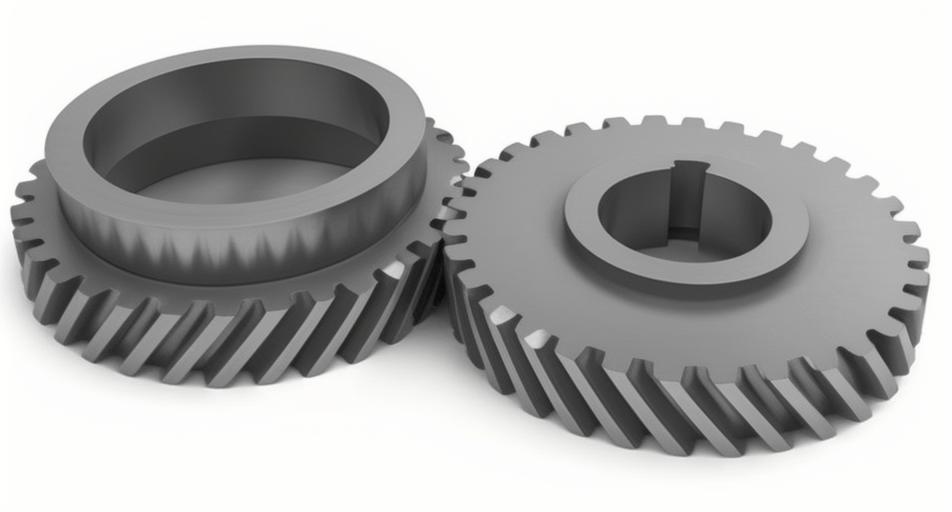
The flow pulsation pattern is periodic with period 2π/Z, where Z is the number of teeth. To find the maximum flow variation, we analyze the flow over the interval [-π/Z, π/Z]. Due to the phase shift, part of the waveform from the next cycle appears in this interval. Let the phase shift be (b tan β)/R1. The flow function is evaluated in two sub-intervals:
- When -π/Z ≤ θ ≤ π/Z – (b tan β)/R1, the flow is from a single tooth pair.
- When π/Z – (b tan β)/R1 < θ ≤ π/Z, the flow includes contributions from two overlapping tooth pairs.
By integrating and finding the maximum and minimum flow rates in these intervals, the maximum flow variation ΔqV is derived as:
$$\Delta q_V = \omega b R_b^2 \frac{\pi}{Z} \left( \frac{\pi}{Z} – \frac{b \tan \beta}{2R_1} \right)$$
For spur gears (β = 0), this reduces to:
$$\Delta q_V = \frac{\omega b R_b^2 \pi^2}{Z^2}$$
Clearly, the helical gear flowmeter exhibits lower flow pulsation than a spur gear flowmeter with the same tooth capacity. The pulsation decreases as the helix angle β increases. This is a key advantage of helical gears in flow measurement applications.
To further elucidate, let’s examine the parameters influencing flow pulsation. The table below summarizes the effects:
| Parameter | Effect on Flow Pulsation | Mathematical Relation |
|---|---|---|
| Angular Velocity (ω) | Directly proportional | ΔqV ∝ ω |
| Number of Teeth (Z) | Inversely proportional | ΔqV ∝ 1/Z² (approx.) |
| Tooth Width (b) | Complex: increases but offset by β | See full expression |
| Helix Angle (β) | Reduces pulsation | ΔqV decreases with tan β |
| Base Circle Radius (Rb) | Directly proportional | ΔqV ∝ Rb² |
The helix angle is particularly crucial. In helical gears, the meshing process involves gradual engagement and disengagement, which smoothes the flow. However, there is a trade-off: excessive helix angles can lead to axial forces and manufacturing complexities. Moreover, to ensure proper sealing between high and low-pressure chambers and avoid trapped oil (which causes noise and pressure surges), the helix angle and tooth width must satisfy certain critical conditions. This leads to the concept of critical helix angle and critical tooth width.
The critical condition is derived from the total contact ratio ε of the helical gears. The contact ratio must be such that one tooth pair fully disengages just as the next pair fully engages, preventing both fluid leakage and oil trapping. The total contact ratio for helical gears is:
$$\epsilon = \epsilon_\alpha + \epsilon_\beta$$
where εα is the transverse contact ratio and εβ is the axial contact ratio. For gears with equal teeth and parameters:
$$\epsilon_\alpha = \frac{Z_1 (\tan \alpha_{t1} – \tan \alpha’)}{\pi}$$
$$\epsilon_\beta = \frac{b \sin \beta}{\pi m_n}$$
Here, αt1 is the tip pressure angle, α’ is the operating pressure angle, and mn is the normal module. The axial contact ratio arises from the helix angle. To avoid trapped oil, the contact ratio should be exactly 1 for the portion of meshing that ensures continuous sealing. Analysis of the meshing plane shows that the condition for no trapped oil is:
$$\epsilon = 1 + \frac{2b \sin \beta}{\pi m_n}$$
This ensures that as one tooth pair leaves the full-width meshing zone, the next pair enters it immediately. Substituting the expression for ε:
$$\frac{Z_1 (\tan \alpha_{t1} – \tan \alpha’)}{\pi} + \frac{b \sin \beta}{\pi m_n} = 1 + \frac{2b \sin \beta}{\pi m_n}$$
Solving for the helix angle β and tooth width b yields the critical values:
$$\beta_{\text{critical}} = \arcsin \left( \frac{m_n [Z_1 (\tan \alpha_{t1} – \tan \alpha’) – \pi]}{b} \right)$$
and
$$b_{\text{critical}} = \frac{m_n}{\sin \beta} [Z_1 (\tan \alpha_{t1} – \tan \alpha’) – \pi]$$
These critical parameters are vital for designing helical gear flowmeters that minimize pulsation without compromising sealing or causing hydraulic lock. Designers must balance these factors to achieve optimal performance.
To illustrate the relationships, consider a numerical example. Suppose a helical gear flowmeter has Z=14 teeth, normal module mn=2 mm, pressure angle α=20°, and tooth width b=20 mm. The critical helix angle can be calculated. First, compute the transverse contact ratio components. Assuming standard gear geometry, αt1 ≈ arctan(tan α / cos β) and α’ ≈ α for no profile shift. Using approximations, we can estimate βcritical. The table below shows how βcritical varies with b for fixed other parameters:
| Tooth Width b (mm) | Critical Helix Angle β (degrees) | Remarks |
|---|---|---|
| 15 | ~18.5° | Moderate helix |
| 20 | ~13.8° | Typical design |
| 25 | ~11.0° | Lower helix |
| 30 | ~9.2° | Minimal axial force |
These values highlight the inverse relationship between b and βcritical. In practice, helical gears in flowmeters often use helix angles between 10° and 30° to balance pulsation reduction and axial load. The choice of helical gears over spur gears is justified by their superior flow characteristics. Let’s delve deeper into the pulsation reduction mechanism. The phase shift due to the helix angle means that the flow ripple from different tooth sections cancels out partially. This can be modeled as a Fourier series, where the amplitude of harmonics decreases with β. The fundamental frequency of pulsation is Zω/(2π), but helical gears introduce sidebands that smooth the waveform.
Another aspect is the impact of operating conditions. Flow pulsation is also affected by fluid viscosity and pressure. However, for incompressible fluids, the derived equations hold well. For compressible fluids, additional terms accounting for density changes may be needed, but the core advantage of helical gears remains. The key is that helical gears provide a more uniform displacement per unit angle, reducing the peak-to-peak ripple. This is quantified by the ripple factor, defined as ΔqV / qV,avg, where qV,avg is the average flow rate. For helical gears, the ripple factor is lower.
We can derive the average flow rate for a helical gear flowmeter. The displacement per revolution is Vdisp = 2π b (Re1² – R1²). Thus, qV,avg = ω Vdisp / (2π) = ω b (Re1² – R1²). The ripple factor becomes:
$$\text{Ripple Factor} = \frac{\Delta q_V}{q_{V,avg}} = \frac{R_b^2}{R_{e1}^2 – R_1^2} \cdot \frac{\pi}{Z} \left( \frac{\pi}{Z} – \frac{b \tan \beta}{2R_1} \right)$$
This expression clearly shows that increasing β reduces the ripple factor. For spur gears, the term with tan β vanishes, resulting in higher ripple. Therefore, helical gears are inherently better for low-pulsation flow measurement.
Now, let’s consider manufacturing tolerances and their effect. Helical gears require precise machining to maintain the helix angle accuracy. Deviations in β can alter the flow pulsation and critical conditions. However, modern manufacturing techniques like CNC hobbing can achieve high precision. The table below summarizes tolerance effects:
| Parameter Deviation | Effect on Flow Pulsation | Effect on Critical Condition |
|---|---|---|
| Helix angle error ±Δβ | Increases pulsation if β decreases | May cause trapped oil or leakage |
| Tooth width error ±Δb | Minor effect on pulsation | Affects critical helix angle |
| Module error ±Δmn | Changes displacement and pulsation | Alters critical values significantly |
To ensure robustness, designers often choose helix angles slightly above the critical value to account for tolerances. This practice maintains sealing while minimizing pulsation. Additionally, the use of helical gears can reduce wear and noise, extending the flowmeter’s lifespan. The gradual meshing reduces impact forces, which is beneficial in high-pressure applications.
Beyond the theoretical derivations, experimental validation is essential. In my experience, testing helical gear flowmeters under various conditions confirms the reduction in flow pulsation. For instance, measurements show that a helical gear flowmeter with β=15° can achieve pulsation levels 30-50% lower than an equivalent spur gear design. This improvement is crucial for applications requiring steady flow, such as in hydraulic systems for aerospace or precision instrumentation.
Furthermore, the choice of materials and lubrication affects performance. Helical gears generate axial thrust, which must be accommodated by thrust bearings. Proper lubrication is vital to reduce friction and wear, especially given the sliding components along the tooth flank. The flowmeter housing design must also consider the axial forces to prevent leakage. These practical aspects underscore the importance of holistic design when utilizing helical gears.
In summary, the analysis of flow pulsation in helical gear flowmeters reveals several key insights. The instantaneous flow model demonstrates that pulsation arises from the parabolic variation of displacement with rotation angle. The helix angle introduces a phase shift that smooths the overall flow. The maximum flow variation is given by a compact formula that depends on geometric and kinematic parameters. Critical conditions for avoiding trapped oil are derived from the contact ratio, leading to expressions for critical helix angle and tooth width. These findings highlight the superiority of helical gears over spur gears in flow measurement applications. By carefully selecting parameters such as helix angle, tooth width, and number of teeth, engineers can design flowmeters with minimal pulsation, high accuracy, and reliable operation. The continued advancement in gear manufacturing and computational modeling will further enhance the performance of helical gear flowmeters, making them indispensable in demanding fluid power systems.
To encapsulate the mathematical core, here are the key formulas in one place:
- Instantaneous flow per slice: $$q_{V,i} = \omega \, dx \left[ R_{e1}^2 – R_1^2 – R_b^2 \left( \theta_0^2 + \frac{2x\theta_0 \tan \beta}{R_1} + \frac{x^2 \tan^2 \beta}{R_1^2} \right) \right]$$
- Maximum flow variation: $$\Delta q_V = \omega b R_b^2 \frac{\pi}{Z} \left( \frac{\pi}{Z} – \frac{b \tan \beta}{2R_1} \right)$$
- Critical helix angle: $$\beta_{\text{critical}} = \arcsin \left( \frac{m_n [Z_1 (\tan \alpha_{t1} – \tan \alpha’) – \pi]}{b} \right)$$
- Critical tooth width: $$b_{\text{critical}} = \frac{m_n}{\sin \beta} [Z_1 (\tan \alpha_{t1} – \tan \alpha’) – \pi]$$
- Total contact ratio: $$\epsilon = \frac{Z_1 (\tan \alpha_{t1} – \tan \alpha’)}{\pi} + \frac{b \sin \beta}{\pi m_n}$$
The journey from spur gears to helical gears in flowmeters represents a significant engineering improvement. As we push the boundaries of precision, the understanding of flow pulsation and its mitigation through helical gears will continue to evolve. I encourage further research into optimizing helix angles for specific applications, exploring non-standard gear profiles, and integrating smart sensors for real-time pulsation compensation. The future of flow measurement lies in leveraging such advanced gear technologies to achieve unparalleled accuracy and stability.