
In modern mechanical transmission systems, helical gears play a pivotal role due to their smooth operation, high load-bearing capacity, and reduced noise and vibration. As a key component in applications such as automotive seat adjusters and household appliances, the contact behavior between helical gears and their mating components, like cylindrical worms, directly impacts performance and longevity. In this article, I will explore the contact characteristics of transmission pairs involving helical gears, focusing on theoretical modeling, parametric influences, and experimental validation. The goal is to provide insights into optimizing helical gear designs for enhanced reliability and efficiency.
Helical gears are widely used in crossed-axis transmissions, where they engage with components like involute cylindrical worms to achieve compact motion transfer. The contact between these elements is typically point-based, evolving into elliptical areas under load. Understanding this contact geometry is essential for predicting wear, fatigue, and overall system durability. Based on spatial meshing theory and differential geometry, I have developed mathematical models to analyze contact trajectories and instantaneous contact ellipses. These models allow for precise control over contact positions and areas, which is crucial for improving the load-bearing capacity of helical gears.
The foundation of this analysis lies in the geometric representation of the gear surfaces. For an involute cylindrical worm, the tooth surface Σ1 can be expressed in a coordinate system σ1 as follows:
$$ \mathbf{r}_1 = x_1 \mathbf{i}_1 + y_1 \mathbf{j}_1 + z_1 \mathbf{k}_1, $$
$$ x_1 = r_{b1} \cos(u_1 + \theta_1) + r_{b1} u_1 \sin(u_1 + \theta_1), $$
$$ y_1 = r_{b1} \sin(u_1 + \theta_1) – r_{b1} u_1 \cos(u_1 + \theta_1), $$
$$ z_1 = p_1 \theta_1, $$
where \( u_1 \) is the involute parameter, \( \theta_1 \) is the surface parameter, \( r_{b1} \) is the base circle radius, and \( p_1 \) is the helical parameter. Similarly, for a helical gear, the tooth surface Σ2 in coordinate system σ2 is given by:
$$ \mathbf{r}_2 = x_2 \mathbf{i}_2 + y_2 \mathbf{j}_2 + z_2 \mathbf{k}_2, $$
$$ x_2 = r_{b2} \cos(u_2 + \theta_2) + r_{b2} u_2 \sin(u_2 + \theta_2), $$
$$ y_2 = r_{b2} \sin(u_2 + \theta_2) – r_{b2} u_2 \cos(u_2 + \theta_2), $$
$$ z_2 = p_2 \theta_2, $$
with \( r_{b2} \) as the base circle radius and \( p_2 \) as the helical parameter for the helical gear. These equations describe the complex geometry of helical gears, which is essential for contact analysis.
To determine the contact trajectory during meshing, I consider the coordination of position vectors and unit normal vectors in a fixed coordinate system. The condition for continuous tangency at the contact point is:
$$ \mathbf{r}_{m1} + \mathbf{a} = \mathbf{r}_{m2}, $$
$$ \mathbf{n}_{m1} = \mathbf{n}_{m2}, $$
where \( \mathbf{a} \) is the center distance vector. Solving these equations yields the instantaneous contact points on both surfaces. For helical gears, this results in a contact path that typically starts near the mid-width of the tooth and extends toward the top, influenced by parameters like helix angle and pressure angle.
Under load, the point contact deforms into an elliptical area. The dimensions of this ellipse are derived from the principal curvatures of the helical gear and its mating worm. The major axis \( a \) and minor axis \( b \) of the contact ellipse are calculated as:
$$ a = \sqrt{\frac{\gamma}{A}}, \quad b = \sqrt{\frac{\gamma}{B}}, $$
$$ A = \frac{1}{4} \left[ K^{(1)}_{\Sigma} – K^{(2)}_{\Sigma} – \sqrt{g_1^2 – 2g_1 g_2 \cos 2\sigma + g_2^2} \right], $$
$$ B = \frac{1}{4} \left[ K^{(1)}_{\Sigma} – K^{(2)}_{\Sigma} + \sqrt{g_1^2 – 2g_1 g_2 \cos 2\sigma + g_2^2} \right], $$
where \( \gamma \) is the relative deformation (often taken as 0.00635 mm), \( K^{(i)}_{\Sigma} \) are the sum of principal curvatures, and \( \sigma \) is the angle between principal directions. The contact area \( S \) is then:
$$ S = \pi a b. $$
This model allows for evaluating how geometric parameters affect the contact area, which is critical for optimizing helical gear designs.
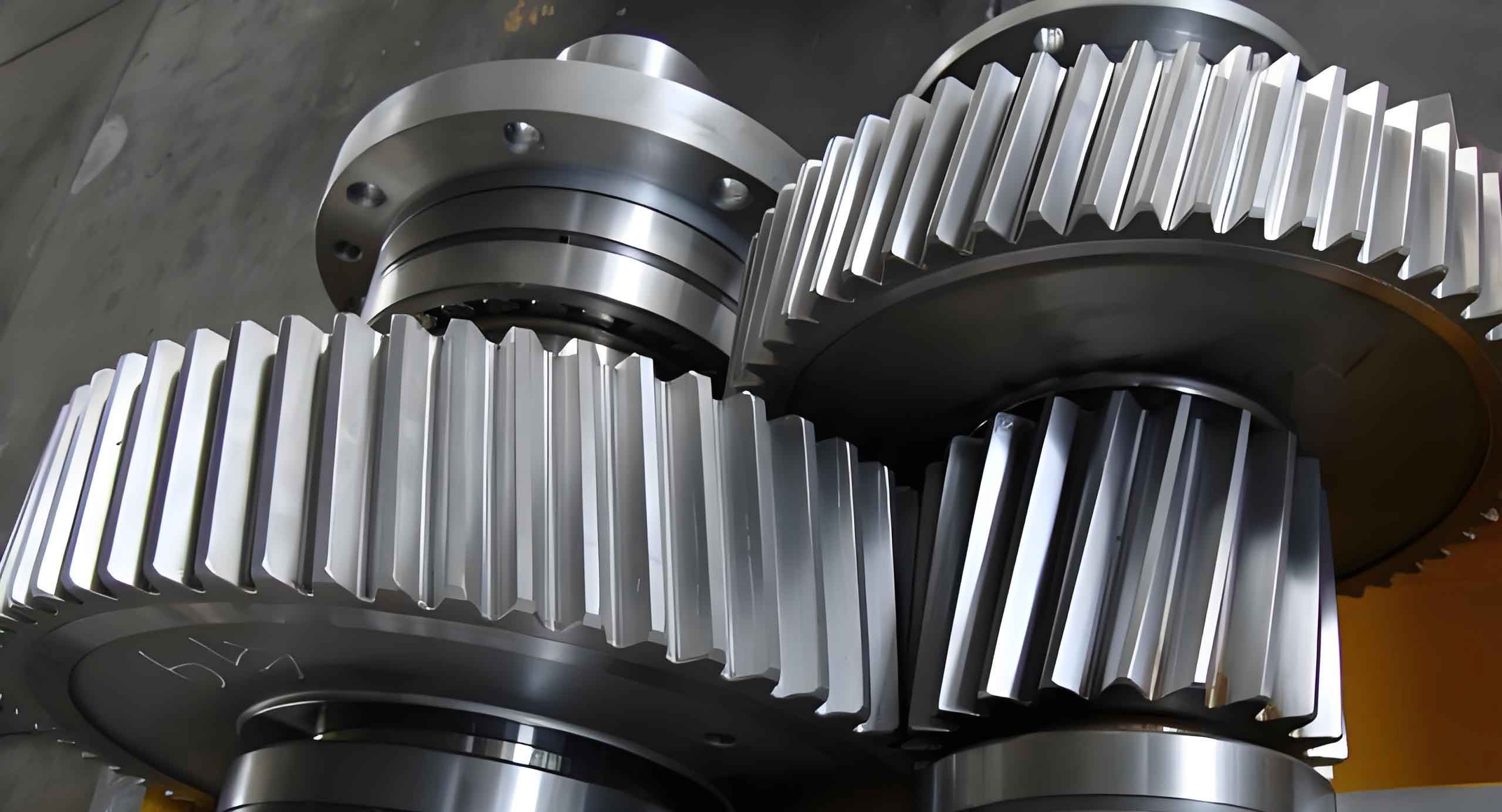
To illustrate the application, I consider a helical gear pair from an automotive seat horizontal adjuster. The geometric parameters are summarized in Table 1, which highlights key aspects such as normal module, helix angle, and pressure angle for both the worm and helical gear. These parameters are typical for light-duty transmission systems where helical gears are preferred for their smooth engagement.
| Component | Normal Module \( m_n \) (mm) | Number of Teeth \( z \) | Helix Angle \( \beta \) (°) | Normal Pressure Angle \( \alpha_n \) (°) | Pitch Radius \( r \) (mm) |
|---|---|---|---|---|---|
| Worm | 0.95 | 2 | 77 | 20 | 8.5 |
| Helical Gear | 0.95 | 13 | 13 | 20 | 12.7 |
Using numerical methods, I simulated the contact patterns on the helical gear tooth surface. The results show that the contact trajectory originates from the mid-width region and ascends at an angle toward the tooth tip. This pattern is consistent with theoretical predictions and emphasizes the importance of proper alignment in helical gear systems. The contact area calculated from the ellipse model provides insights into load distribution, which is vital for preventing premature failure in helical gears.
Next, I investigated the influence of various parameters on the contact characteristics of helical gears. The key factors include helix angle \( \beta \), normal module \( m_n \), normal pressure angle \( \alpha_n \), and transmission ratio \( i \). Each parameter was varied while keeping others constant, and the effects on contact area and trajectory were analyzed. The findings are summarized in Table 2, which quantifies the sensitivity of contact area to these parameters.
| Parameter | Range | Effect on Contact Area | Effect on Contact Trajectory | Sensitivity to Area Change |
|---|---|---|---|---|
| Helix Angle \( \beta \) | 10° to 30° | Negligible change | Inclination angle decreases; length increases | Low |
| Normal Module \( m_n \) | 0.5 to 5.5 mm | Significant increase | Initial point may shift beyond tooth width | Medium |
| Normal Pressure Angle \( \alpha_n \) | 15° to 25° | Decreases | Small increase in inclination angle | Medium |
| Transmission Ratio \( i \) | 5 to 15 | Significant increase | No consistent pattern | High |
The sensitivity analysis reveals that the contact area of helical gears is most affected by the transmission ratio, followed by normal module and pressure angle, while the helix angle has minimal impact. This is crucial for design optimization: to enhance load capacity, designers should prioritize adjusting the transmission ratio and select appropriate module and pressure angle values, while the helix angle can be chosen based on other constraints like space and noise reduction.
For the contact trajectory, the helix angle plays a dominant role. As \( \beta \) increases, the inclination angle \( \alpha \) of the trajectory decreases, causing the path to elongate and potentially approach the tooth edges. This can lead to edge contact, which is undesirable for helical gears as it increases stress concentrations and noise. The relationship can be expressed as:
$$ \alpha = \arctan\left( \frac{h_{\text{out}} – h_{\text{in}}}{x_{\text{out}} – x_{\text{in}}} \right), $$
where \( h \) and \( x \) represent coordinates on the tooth surface. To avoid edge contact in helical gears, it is advisable to use smaller helix angles within practical limits. The normal module also affects trajectory length; excessive values may cause the contact to extend beyond the tooth width, underscoring the need for careful dimensioning in helical gear design.
To validate the theoretical models, I conducted an experimental study on a helical gear pair from a seat adjuster. The gears were installed in a gearbox with proper alignment, lubricated, and subjected to往复 motion for 100 hours under a torque of 0.1 N·m. After testing, the helical gear tooth surface exhibited contact marks that matched the predicted trajectory: starting at the mid-width and extending upward at an angle. This correlation confirms the accuracy of the mathematical models for helical gears and demonstrates their utility in real-world applications.
The experimental results emphasize the importance of controlling contact patterns in helical gears to ensure even load distribution and longevity. In practice, helical gears are often paired with worms in compact drives, and their performance hinges on precise geometric tuning. The models presented here provide a framework for such tuning, enabling designers to optimize helical gear systems for specific requirements.
In summary, the contact characteristics of helical gears in transmission systems are governed by a complex interplay of geometric parameters. Through theoretical analysis, numerical simulation, and experimentation, I have shown that:
- The transmission ratio has the highest sensitivity on contact area, making it a key lever for improving load capacity in helical gears.
- The normal module and pressure angle moderately influence area and trajectory, requiring balanced selection to avoid edge contact.
- The helix angle significantly affects the trajectory inclination but has little impact on area, allowing flexibility in design for noise and efficiency.
- Optimal helical gear designs should aim for contact paths centered on the tooth width, with sufficient area to distribute stresses evenly.
These insights contribute to the broader understanding of helical gear mechanics and offer practical guidelines for engineers. Future work could explore dynamic effects or material variations in helical gears to further enhance transmission performance. As helical gears continue to evolve in applications from automotive to industrial machinery, mastering their contact behavior remains essential for advancing mechanical system reliability.