
The transmission system stands as a critical component within the automotive powertrain, responsible for managing torque and speed to meet varying driving demands. In contemporary automotive design, traditional methodologies often fall short in addressing the increasingly stringent requirements for structural integrity, performance optimization, and development efficiency. The adoption of three-dimensional Computer-Aided Design (CAD) software for the digital design of transmission components is therefore of paramount importance. This digital approach significantly shortens product development cycles, reduces prototyping costs, and facilitates rapid design iterations and simulations.
Among the various components of an automotive transmission, the creation of accurate digital models for helical gears presents one of the most complex yet foundational challenges. Helical gears, with their angled teeth, offer smoother and quieter operation compared to their spur gear counterparts, making them ubiquitous in modern vehicle transmissions. Their geometry, however, involves complex three-dimensional curves derived from precise mathematical definitions. This article delves into a detailed methodology for the parametric modeling of helical gears, specifically for a two-shaft manual transmission, utilizing a leading CAD platform. The focus is on establishing a robust, equation-driven model that can adapt to design changes through parameters, providing a valuable reference for modeling helical gears and similar mechanical components.
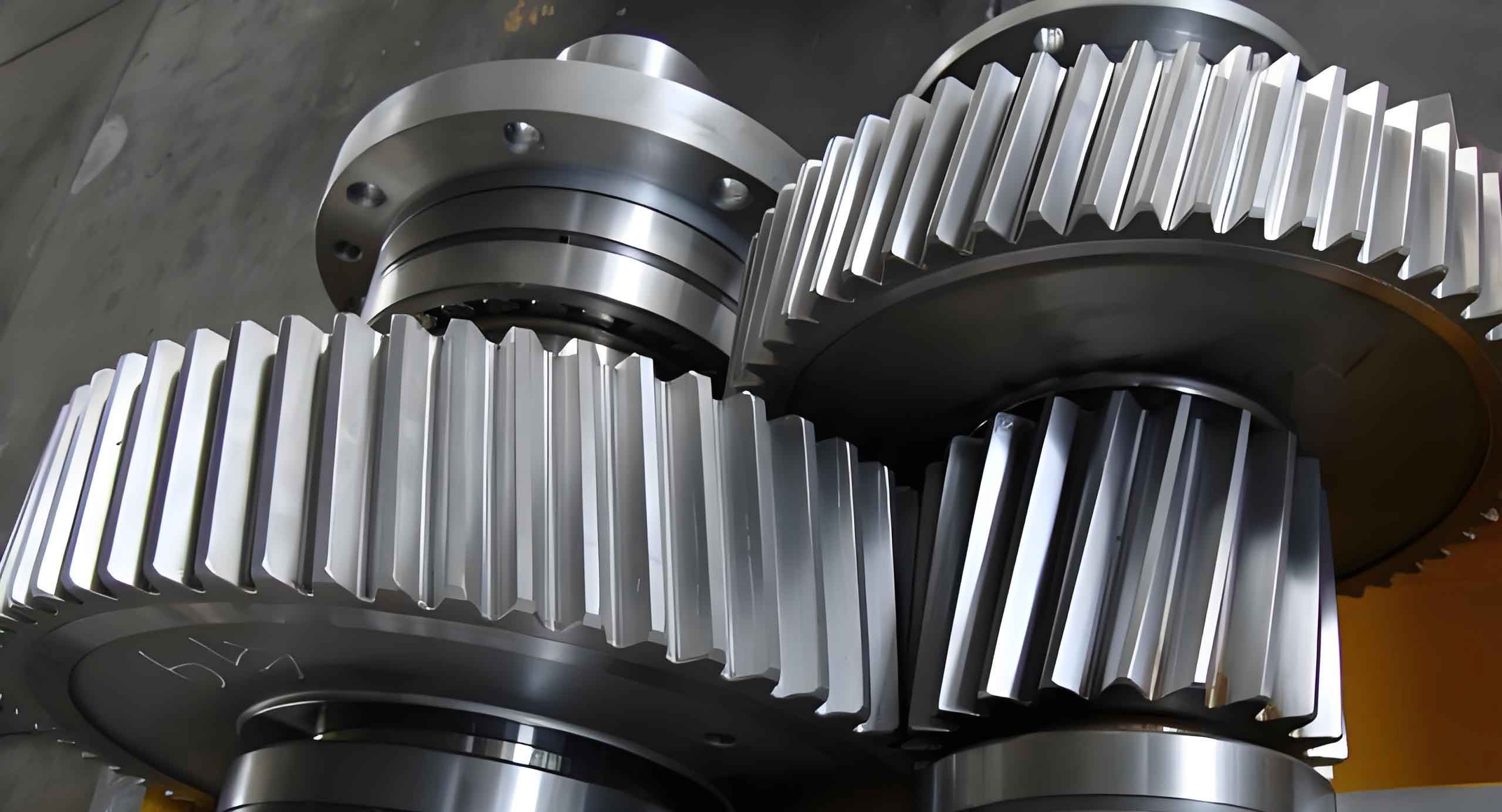
1. Fundamentals of Two-Shaft Transmissions
Mechanical transmission layouts primarily fall into two categories: two-shaft (or countershaft-less) transmissions and three-shaft (or countershaft) transmissions. The two-shaft design is characterized by its reliance on two parallel shafts—the input shaft (primary shaft) and the output shaft (secondary shaft)—to transmit power. An additional, shorter idler shaft is incorporated to enable reverse gear operation.
In this configuration, power enters via the input shaft and is transmitted directly to the output shaft through a single pair of mating helical gears (or spur gears for reverse). This design is predominantly employed in front-engine, front-wheel-drive (FF) vehicle layouts. Here, the output shaft of the transmission is often integrated with the drive pinion gear of the final differential, allowing for a compact and direct power path.
The advantages of two-shaft transmissions are notable when compared to three-shaft designs. They typically utilize fewer shafts and bearings, resulting in a simpler, more lightweight, and space-efficient structure that is easier to package within a vehicle’s chassis. Furthermore, for all forward gears except possibly the highest, power flows through only one gear mesh, leading to higher mechanical efficiency and reduced noise generation under most driving conditions.
However, these advantages come with inherent trade-offs. A primary limitation is the inability to incorporate a direct drive gear (where input and output shafts lock together), as there is no separate countershaft to facilitate this. Consequently, even in the highest gear, the power must traverse a gear pair, subjecting the gears and bearings to continuous load, which can increase wear and operational noise at cruising speeds. Additionally, geometric constraints often limit the maximum achievable gear ratio for the first gear.
The following table summarizes the key comparative aspects:
| Feature | Two-Shaft Transmission | Three-Shaft (Countershaft) Transmission |
|---|---|---|
| Primary Components | Input Shaft, Output Shaft, Idler Shaft (Reverse) | Input Shaft, Countershaft, Output Shaft |
| Typical Application | Front-engine, Front-wheel-drive (FF) | Front-engine, Rear-wheel-drive (FR); Heavy-duty vehicles |
| Structural Complexity | Lower (fewer shafts/bearings) | Higher |
| Power Flow (Forward Gears) | Through one gear pair per ratio | Through two gear pairs per ratio (except direct drive) |
| Efficiency & Noise | Generally higher efficiency, lower noise in indirect gears | Potential for higher efficiency in direct drive; more meshes can increase noise |
| Direct Drive Capability | Not possible | Possible (input shaft locked to output shaft) |
| Maximum 1st Gear Ratio | Limited by design constraints | Can be designed for very high ratios |
2. Parametric Modeling Methodology for Helical Gears
The core of an accurate transmission model lies in the precise digital representation of its helical gears. Parametric modeling involves defining the gear’s geometry through a set of governing equations and parameters (e.g., module, number of teeth, helix angle). Changing a parameter automatically updates the entire geometry. This process can be broken down into three fundamental stages: parameter definition, generation of the tooth profile, and creation of the three-dimensional helical form.
2.1. Gear Parameters and Expression Creation
The geometry of a standard involute helical gear is defined in two planes: the normal plane (perpendicular to the tooth) and the transverse plane (perpendicular to the gear axis). Key parameters must be established. For a pair of mating external parallel-axis helical gears, the following fundamental relations hold, where the subscripts ‘n’ and ‘t’ denote normal and transverse plane values, respectively:
- Module Equality: $$m_n^{(1)} = m_n^{(2)}$$ and $$m_t^{(1)} = m_t^{(2)}$$
- Pressure Angle Equality: $$\alpha_n^{(1)} = \alpha_n^{(2)}$$
- Helix Angle Equality (Hand Opposed): $$\beta^{(1)} = -\beta^{(2)}$$
The relationship between normal and transverse module is governed by the helix angle $\beta$:
$$m_t = \frac{m_n}{\cos \beta}$$
The standard center distance $a$ for the gear pair is calculated as:
$$a = \frac{d_1 + d_2}{2} = \frac{m_t (z_1 + z_2)}{2} = \frac{m_n (z_1 + z_2)}{2 \cos \beta}$$
where $d$ is the pitch diameter and $z$ is the number of teeth.
For a standard gear with normal pressure angle $\alpha_n = 20^\circ$, normal module $m_n$, normal addendum coefficient $h_{an}^* = 1$, normal dedendum coefficient $c_n^* = 0.25$, and helix angle $\beta$, the primary dimensions for a single gear are calculated as shown in the table below. These formulas form the basis for the parametric expressions to be created in the CAD software.
| Parameter | Symbol | Formula |
|---|---|---|
| Transverse Module | $m_t$ | $$m_t = \frac{m_n}{\cos \beta}$$ |
| Transverse Pressure Angle | $\alpha_t$ | $$\alpha_t = \arctan \left( \frac{\tan \alpha_n}{\cos \beta} \right)$$ |
| Pitch Diameter | $d$ | $$d = z \cdot m_t = \frac{z \cdot m_n}{\cos \beta}$$ |
| Base Diameter | $d_b$ | $$d_b = d \cdot \cos \alpha_t$$ |
| Addendum Diameter (Outside Diameter) | $d_a$ | $$d_a = d + 2 \cdot h_{an}^* \cdot m_n$$ |
| Dedendum Diameter (Root Diameter) | $d_f$ | $$d_f = d – 2 \cdot (h_{an}^* + c_n^*) \cdot m_n$$ |
| Helix Lead (for one complete turn) | $L$ | $$L = \pi \cdot d \cdot \cot \beta$$ |
Within the CAD environment (e.g., UG/NX, CATIA, SolidWorks), the first step is to create a set of user-defined expressions or parameters. For example, one would create variables like mn=2.5, z=24, beta=20deg, alpha_n=20deg, and then define dependent variables like d = (z * mn) / cos(beta), da = d + 2 * mn, etc. This ensures that any change to a fundamental parameter like mn or z propagates correctly throughout the entire model.
2.2. Generation of the Involute Tooth Profile
The tooth form of a standard gear is based on an involute curve. While the involute is commonly described by a polar coordinate equation, CAD systems typically require Cartesian (x, y) coordinates for sketching. Therefore, a coordinate transformation is necessary.
The polar equation of an involute is:
$$r(\theta) = \frac{r_b}{\cos \theta}$$
where $r_b$ is the base circle radius and $\theta$ is the involute roll angle (the angle through which the generating line has rolled from the point of tangency on the base circle). More usefully, the Cartesian coordinates of a point on the involute are given parametrically by the roll angle $u$:
$$
x(u) = r_b (\sin u – u \cos u) \\
y(u) = r_b (\cos u + u \sin u)
$$
Here, $u = \tan \alpha_t$, where $\alpha_t$ is the transverse pressure angle at the point on the involute. The base radius $r_b$ is calculated as $d_b / 2$.
Procedure in CAD:
- Create Gear Blank: Model a cylindrical solid with a diameter equal to $d_a$ (addendum diameter) and a height equal to the desired face width $F$.
- Define Reference Geometry: On one end face of the blank, create a new sketch. Draw construction circles representing the key diameters: Addendum Circle ($d_a$), Pitch Circle ($d$), Base Circle ($d_b$), and Dedendum Circle ($d_f$).
- Generate Involute Curve: This is the critical step. The parametric equations $x(u)$ and $y(u)$ are used. The process can be automated:
- Create a Law Curve or use an Equation-Driven Curve feature.
- Define parameter $t$ ranging from $0$ to a value representing the roll angle at the addendum circle ( $u_a = \sqrt{(d_a/d_b)^2 – 1}$ ).
- Input the formulas:
Xt = rb * ( sin(t) - t * cos(t) ),Yt = rb * ( cos(t) + t * sin(t) ),Zt = 0.
Alternatively, points can be calculated externally and imported to create a spline.
- Complete a Single Tooth Space (Transverse Section):
- Find the intersection point of the generated involute curve with the pitch circle.
- Draw a line from the gear center to this intersection point. This line represents the centerline of the tooth space in the transverse plane.
- The angular tooth thickness on the pitch circle is $\pi m_t / 2$ (for a standard gear). Therefore, the half-tooth-space angle is $\pi / (2z)$. Rotate the centerline by this angle $\pm \pi / (2z)$ to define boundaries.
- Mirror the involute curve across one of these centerlines.
- Connect the root of the two involute segments (near the dedendum circle) with a fillet radius, typically $0.38 m_n$ or as per manufacturing standards, to reduce stress concentration.
- Trim the curves using the addendum and dedendum circles as boundaries. The resulting closed profile is the transverse section of a single tooth gap (or “space”).
2.3. Creation of the Three-Dimensional Helical Form
To transform the 2D tooth space into a 3D helical gear tooth, a sweeping operation along a helical path is performed.
Procedure in CAD:
- Create Helical Path (Guide Curve):
- Use the helix/spiral curve tool.
- The pitch of the helix is the lead $L$, not the axial pitch $p_x$ ($p_x = \pi m_t / \tan \beta$ is the distance between corresponding points on adjacent teeth). For a single tooth space sweep, the required turn is the face width $F$ divided by the lead $L$. Therefore:
$$\text{Number of Turns} = \frac{F}{L} = \frac{F}{\pi d \cot \beta}$$ - Define the helix with this calculated number of turns, the pitch equal to the lead $L$, and a radius equal to the pitch radius $d/2$ (or an appropriate radius for the path). The helix angle $\beta$ must be specified correctly (right-hand or left-hand).
- Sweep the Tooth Space Profile:
- Use the “Sweep” or “Sweep along Guide” feature.
- Section Curve: Select the closed 2D tooth space profile created in Section 2.2.
- Guide Curve: Select the helical path.
- Orientation: Set the section orientation to follow the path (e.g., “Follow Path” or “Fixed”).
- Boolean Operation: Crucially, perform a Subtract Boolean operation, using the cylindrical gear blank as the target body. This cuts the helical tooth space (gap) out of the solid cylinder.
- Pattern the Tooth Space to Complete the Gear:
- Use the circular pattern (array) feature.
- Select the single helical tooth space (the subtracted feature) as the object to pattern.
- Specify the axis of rotation (the central axis of the gear blank).
- Define the total number of instances equal to the number of teeth $z$.
- The angular spacing between instances is $360^\circ / z$.
- The software will then replicate the subtracted tooth space feature $z$ times around the axis, resulting in a complete, solid model of the helical gear with all teeth correctly formed.
The table below summarizes this 3D creation workflow:
| Step | CAD Feature/Tool | Key Inputs & Parameters | Output/Result |
|---|---|---|---|
| 1. Helical Path Creation | Helix/Spiral Curve | Pitch = Lead $L$, Turns = $F/L$, Radius = $d/2$, Handedness. | A 3D helical curve. |
| 2. Single Tooth Sweep | Sweep along Guide / Pipe | Section: 2D Tooth Gap, Guide: Helix, Orientation: Follow Path, Boolean: Subtract. | Cylinder with one helical tooth gap cut out. |
| 3. Full Gear Generation | Circular Pattern / Array | Feature: Subtracted Gap, Axis: Gear Centerline, Count = $z$, Angle = $360/z$. | Complete solid model of the helical gear. |
3. Advanced Considerations and Applications
The basic parametric modeling process lays the foundation. For engineering-ready models, several advanced aspects must be incorporated, particularly for transmission helical gears which are high-precision, highly stressed components.
3.1. Incorporating Modifications and Tolerances
Real-world helical gears are rarely perfect standard gears. Common modifications include:
- Profile Shift (Addendum Modification): To avoid undercut with low tooth counts, adjust center distance, or improve strength. This modifies the addendum and dedendum calculations. The profile shift coefficient $x_n$ is introduced. The working pitch diameters and center distance change accordingly. Parametric models must include variables for $x_n^{(1)}$ and $x_n^{(2)}$ and update all diameter formulas.
- Tip and Root Relief: Intentional slight modification of the involute near the tip and root to reduce meshing impact and noise. This can be modeled by adding small chamfers or blending curves to the 2D tooth profile sketch based on relief magnitude and length parameters.
- Crowning: A slight barrel-shaped modification along the tooth length (face width) to compensate for misalignment and ensure even load distribution. This requires a more complex sweep operation where the 2D tooth profile itself varies along the helical path.
3.2. Analysis and Simulation Readiness
A parametric model is not just for visualization; it serves as input for critical engineering analyses. The model quality directly impacts the accuracy of these simulations:
- Finite Element Analysis (FEA) for Stress: The model must have a clean, watertight geometry without microscopic gaps or sliver faces, especially in the root fillet region where stress concentration is highest. The parametric fillet radius is a key variable for optimization studies.
- Kinematic and Dynamic Simulation: To simulate the transmission’s operation in a multi-body dynamics software, the gear model must have correctly defined coordinate systems, mass properties, and most importantly, an accurate definition of the gear mesh. The parametric model ensures consistent geometry when testing different gear ratios ($z_1$, $z_2$).
- Contact Pattern Analysis: Simulating how teeth contact under load (Loaded Tooth Contact Analysis – LTCA) requires extremely precise tooth surfaces. The parametric involute and helix definitions must be of high geometric quality.
3.3. Integration into Larger Assembly
The true power of parametric modeling is realized when individual components like helical gears are integrated into a full transmission assembly with defined kinematic relationships.
- Master Model / Skeleton Approach: A top-level “skeleton” part or layout can contain all critical parameters: center distances $a$, gear ratios, shaft diameters, and helix angles. The individual gear parts are then driven by equations that link back to this master model. Changing the center distance in the master automatically updates the profile shift coefficients and regenerates all mating helical gears.
- Mating Conditions: In the assembly, gears are mated with their axes aligned at the correct center distance. A “gear mate” or “contact” constraint can be applied, often referencing the pitch cylinders. The parametric model ensures pitch diameters are always correct for the given center distance and ratio.
The following table outlines the extended workflow from a basic model to a simulation-ready system component:
| Stage | Objective | Enhancements to Basic Model | Key Parameters Added |
|---|---|---|---|
| Basic Parametric Model | Accurate 3D form | Standard involute, constant helix. | $m_n, z, \beta, \alpha_n, F, h^*, c^*$ |
| Engineering Model | Manufacturable & strong design | Profile shift ($x_n$), specified root fillet radius ($r_f$), tip/root relief. | $x_n, r_f$, Relief_Start_Dia, Relief_Magnitude |
| Analysis-Ready Model | Input for CAE software | Defeaturing (removing tiny cosmetic edges), ensuring meshable geometry, defining load application surfaces. | Mesh_Size, Refinement_Zone_Radius |
| Assembly-Driven Model | Integrated system component | Equations linked to master layout parameters (center distance, ratio). | a_master, ratio_master, d1 = 2*a_master/(1+1/ratio_master) |
4. Conclusion
The parametric modeling of helical gears represents a sophisticated but essential task in the modern digital design of automotive transmissions, particularly for compact designs like the two-shaft configuration. This detailed exploration has outlined a complete methodology, starting from the fundamental mathematical definitions of the involute curve and helical kinematics, through the practical steps of implementing these in CAD software using expressions, law curves, sweep operations, and patterns.
The core strength of this approach lies in its adaptability. By establishing a network of equations that define the gear geometry, designers can rapidly explore the design space. The impact of changing the normal module $m_n$, the number of teeth $z$, or the helix angle $\beta$ on gear size, strength, and mesh conditions can be evaluated instantaneously through model regeneration. This is invaluable for optimizing transmission packages for size, weight, and performance.
Moving beyond the basic form, the integration of engineering modifications like profile shift and advanced features like crowning ensures the model reflects manufacturable and high-performance components. Furthermore, the emphasis on creating clean, watertight geometry makes these parametric models directly usable for subsequent finite element analysis and dynamic system simulation, closing the loop between design and verification.
In summary, mastering the parametric modeling of helical gears is more than a CAD exercise; it is a fundamental competency for enabling efficient, robust, and innovative transmission design. The methodology described provides a structured foundation applicable not only to two-shaft transmissions but to any mechanical system utilizing parallel-axis helical gears, serving as a critical enabler in the iterative, simulation-driven engineering processes that define modern automotive development.