
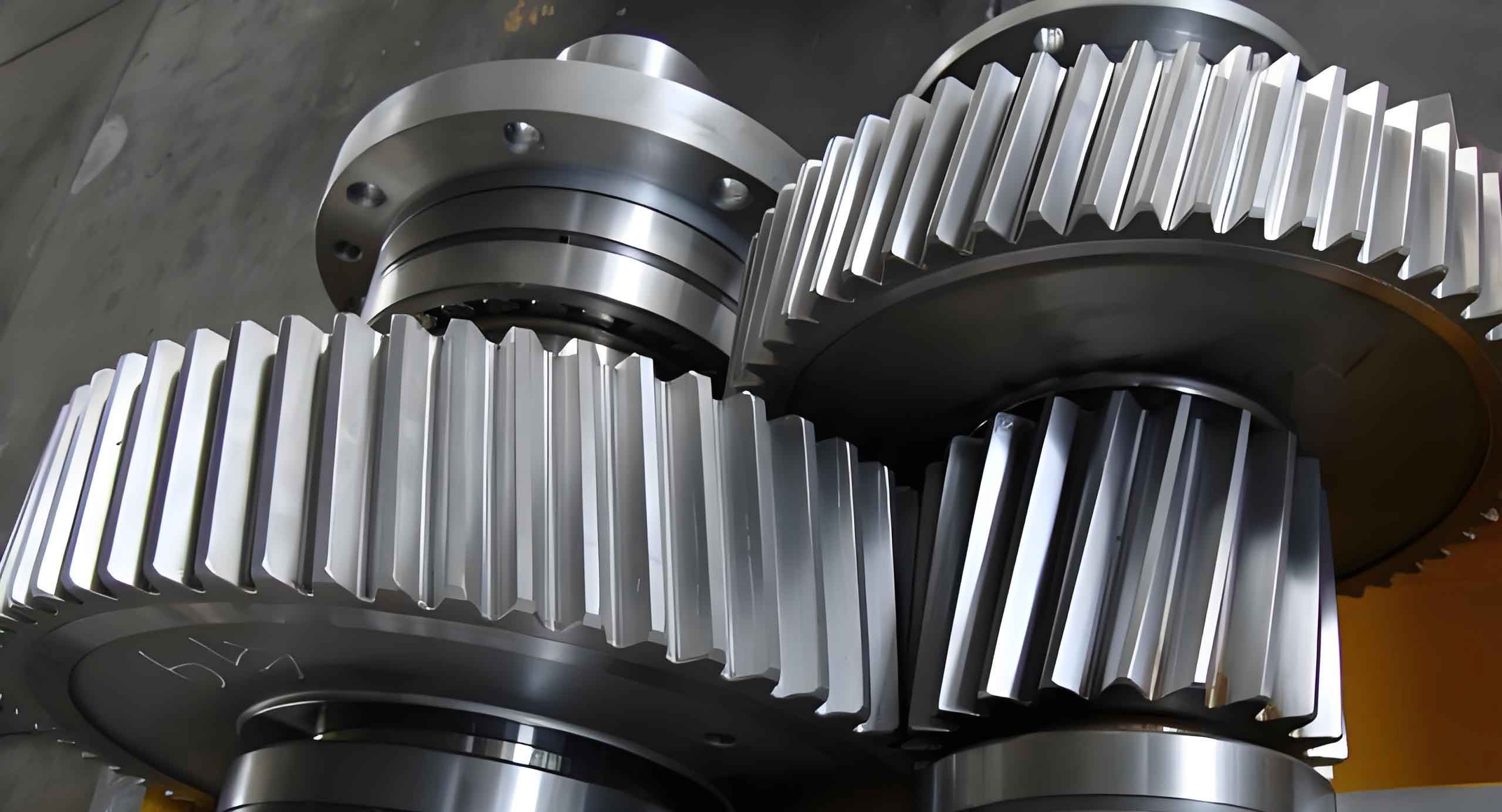
Helical gears serve as the cornerstone of timing transmission systems in modern marine diesel engines. These components operate under exceptionally demanding conditions characterized by high torque, elevated power density, and transient variations in load and speed. The lubrication regime at the tooth contact interface is rarely a perfect, full-fluid film separation. Instead, it exists in a mixed lubrication state, where the load is shared between a thin, pressurized lubricant film and direct contact between microscopic surface asperities. This regime is critically influenced by the surface topography resulting from manufacturing processes. The coupling of severe operational transients with micro-scale roughness interactions frequently leads to surface distress, manifesting as pitting and wear, which compromises reliability and longevity. This analysis delves into the transient mixed elastohydrodynamic lubrication (EHL) characteristics of marine diesel engine timing helical gears, explicitly incorporating the three-dimensional topography of real machined surfaces to provide a more deterministic and realistic assessment.
1. Analytical Framework for Helical Gear Mixed Lubrication
The analysis of mixed lubrication in helical gears requires a sophisticated model that bridges transient gear dynamics, continuum fluid mechanics, contact mechanics, and stochastic surface characterization. The foundation lies in accurately representing the instantaneous contact conditions between mating teeth.
1.1 Geometrical and Kinematic Transformation
The complex, spatially and temporally varying contact between helical gear teeth can be equivalently modeled as the contact between two opposing, rotating frustums (truncated cones). This analogy effectively captures the essential features: the line of contact, its varying length, and the continuously changing radii of curvature along it. The key geometrical parameters for this transformation are derived from the gear’s basic geometry and its instantaneous meshing position.
The equivalent radius of curvature for the gear pair at any point along the contact line and at any time is given by:
$$R(y,t) = \frac{r_1(y,t) \cdot r_2(y,t)}{r_1(y,t) + r_2(y,t)}$$
where \( r_1(y,t) \) and \( r_2(y,t) \) are the time-dependent and position-dependent radii of curvature for the pinion and gear, respectively, calculated based on the base circle and contact line geometry. The entrainment velocity \( U(y,t) \), which drives lubricant into the contact conjunction, is:
$$U(y,t) = \frac{1}{2} [u_1(y,t) + u_2(y,t)] = \frac{1}{2} [\omega_1 r_1(y,t) + \omega_2 r_2(y,t)]$$
where \( \omega \) denotes angular velocity.
1.2 Governing Equations for Mixed Lubrication
The core of the model is formed by coupling the equations governing fluid film pressure generation, surface deformation, and load balance, all modified to include surface roughness.
Film Thickness Equation: The total separation between the two contacting surfaces comprises a rigid body displacement, geometric gap, elastic deformation, and the superimposed surface roughness profiles.
$$h(x,y,t) = h_0(t) + \frac{x^2}{2R(y,t)} + v_e(x,y,t) + \delta_1(x,y,t) + \delta_2(x,y,t)$$
Here, \( h_0(t) \) is the central offset, the second term describes the parabolic gap based on equivalent curvature \( R(y,t) \), \( v_e \) is the elastic deformation calculated using the Boussinesq integral, and \( \delta_1 \) and \( \delta_2 \) are the 3D measured roughness heights of the two contacting gear teeth surfaces.
Reynolds Equation: The pressure distribution within the lubricant film for a transient, non-Newtonian, piezoviscous fluid is governed by the generalized Reynolds equation:
$$\frac{\partial}{\partial x} \left( \frac{\rho h^3}{\eta \phi_x} \frac{\partial p}{\partial x} \right) + \frac{\partial}{\partial y} \left( \frac{\rho h^3}{\eta \phi_y} \frac{\partial p}{\partial y} \right) = 12 \frac{\partial (\rho U h)}{\partial x} + 12 \frac{\partial (\rho h)}{\partial t}$$
The density \( \rho \) and viscosity \( \eta \) are functions of pressure, described by the Dowson-Higginson and Roelands equations, respectively. Flow factors \( \phi_x \) and \( \phi_y \) can be incorporated to account for roughness effects on an average flow basis, though in a deterministic model with measured surfaces, their effect is directly simulated.
Load Balance Equation: The integrated pressure over the entire contact domain must balance the instantaneous dynamic load on the tooth pair, \( w(t) \), calculated from the engine torque and the sharing of load among multiple contacting tooth pairs.
$$w(t) = \iint_{\Omega} p(x,y,t) \, dx \, dy$$
1.3 Characterization of Real Machined Surfaces
A critical advancement over statistical roughness models is the use of deterministic, measured 3D surface topographies. Typical finishing processes for high-performance helical gears include shaving, honing, and polishing. Each process leaves a distinct signature.
| Surface Finish Type | Arithmetic Mean Roughness, \( R_a \) (nm) | Root Mean Square Roughness, \( R_q \) (nm) | Peak-to-Valley Height, \( R_t \) (nm) |
|---|---|---|---|
| Polished | ~110 | ~150 | ~4,300 |
| Honed | ~280 | ~360 | ~58,000 |
| Shaved | ~720 | ~920 | >200,000 |
These measured profiles, discretized into a grid of height points, are directly superimposed onto the nominal smooth geometry in the film thickness equation, allowing for a direct simulation of asperity interactions.
2. Numerical Methodology and Model Validation
The coupled, highly nonlinear system of equations is solved using a robust numerical scheme, such as the multigrid multi-level method or the efficient semi-system approach, which offers stability under the severe conditions of low speed and high load typical of marine diesel engine start-up or low-speed, high-torque operation. The computational domain covers the Hertzian contact area with sufficient inlet and outlet zones.
Validation is a two-step process. First, results for smooth surface EHL are compared against established empirical formulas for central film thickness, such as Hamrock and Dowson’s or Yang’s formula:
$$H_c = 11.9 U^{0.74} G^{0.4} W^{-0.2}$$
Agreement within 5-10% confirms the baseline EHL solver’s accuracy. Second, experimental validation using optical interferometry on a disk-on-disk test rig, simulating the equivalent contact pressure, speed, and slide-to-roll ratio of the gear mesh, provides a direct check on film thickness predictions under controlled conditions.
3. Impact of Real Surface Topography on Lubrication State
The introduction of real 3D machined surface roughness drastically alters the lubrication landscape from the idealized smooth-surface EHL prediction.
3.1 Pressure and Film Thickness Distribution
Under identical operating conditions, the three surface finishes exhibit profoundly different behaviors:
- Polished Surfaces: The pressure distribution remains relatively smooth, closely resembling the classical EHL pressure spike and horseshoe-shaped constriction. Film thickness shows mild, high-frequency fluctuations around the smooth EHL prediction. The average film thickness is highest among the three finishes.
- Honed Surfaces: The pressure profile begins to show significant local perturbations. Micro-pressure spikes occur where prominent asperities pass through the contact, often reaching pressures far exceeding the smooth-case maximum. The film thickness distribution becomes erratic, with local reductions corresponding to these asperity interactions.
- Shaved Surfaces: This finish produces the most severe disturbance. The contact zone is dominated by numerous intense, localized pressure peaks. Critically, the computed film thickness reaches zero at many discrete points, indicating direct metal-to-metal contact of asperities. The average film is the thinnest and most unstable.
3.2 Quantitative Lubrication Performance Metrics
The state of mixed lubrication is best quantified by two key parameters calculated over the meshing cycle:
1. Contact Area Ratio (\( A_c / A_h \)): This is the ratio of the area where surface asperities are in direct contact (where \( h \leq 0 \)) to the nominal Hertzian contact area.
$$ \text{Contact Area Ratio} = \frac{\text{Area}(h \leq 0)}{A_h} $$
2. Lambda Ratio (\( \Lambda \)): Defined as the ratio of the central or average film thickness to the composite root-mean-square roughness of the two surfaces.
$$ \Lambda = \frac{h_{avg}}{\sqrt{R_{q1}^2 + R_{q2}^2}} $$
A \( \Lambda > 3 \) typically indicates full-film lubrication, \( 1 < \Lambda < 3 \) indicates mixed lubrication, and \( \Lambda < 1 \) indicates boundary lubrication.
| Performance Metric | Polished Helical Gears | Honed Helical Gears | Shaved Helical Gears |
|---|---|---|---|
| Avg. Contact Area Ratio over cycle | 0.1% – 0.8% | 0.6% – 2.1% | 1.6% – 5.8% |
| Avg. Lambda Ratio (\( \Lambda \)) | ~5.5 (Full-Film) | ~4.0 (Full-Film) | ~1.9 (Mixed) |
| Peak Local Pressure Increase | Minimal | Significant | Very Severe |
| Risk of Direct Asperity Contact | Very Low | Low | High |
The table clearly shows that for marine diesel engine helical gears, where reliability is paramount, polished surfaces offer the most favorable lubrication condition, maintaining a full fluid film with minimal direct contact. Honed surfaces are acceptable but introduce higher pressure fluctuations. Shaved surfaces, while potentially cost-effective for some applications, operate deep in the mixed lubrication regime for these demanding conditions, significantly increasing the risk of wear-initiated pitting and scuffing.
4. Influence of Operational Transients on Mixed Lubrication
The transient nature of engine operation—varying speed and load—interacts strongly with surface roughness effects.
4.1 Effect of Rotational Speed
Speed is the most influential parameter on film thickness. For a polished helical gear pair under constant load:
$$ h_{avg} \propto U^{0.7} $$
As engine speed increases from low idle to rated speed, the average film thickness can increase by a factor of 4 or more. Consequently, the contact area ratio decreases dramatically. At low speeds (e.g., during start-up or maneuvering), even polished helical gears may see their lambda ratio drop into the mixed lubrication range, making this a critical period for surface damage. The analysis underscores the importance of minimizing time spent at very low rotational speeds under high load.
4.2 Effect of Load (Power)
Increased transmitted power raises the tooth contact load. The effect on film thickness is negative but less pronounced than speed:
$$ h_{avg} \propto W^{-0.13} $$
However, load dramatically increases the contact pressure and, more importantly for mixed lubrication, the pressure at asperity tips during contact. This significantly raises the shear stress in the lubricant film and the contact stress in the asperities. While the contact area ratio increases moderately with load (e.g., from <1% at 50% load to ~4% at 125% load for a polished surface), the severity of each asperity interaction intensifies, accelerating fatigue and wear processes.
5. Implications for Design and Maintenance of Marine Diesel Helical Gears
This integrated analysis leads to several practical conclusions for the design and operation of timing helical gears in marine diesel engines:
- Surface Finish Specification: Polishing should be the preferred final finishing process for high-power-density marine diesel engine helical gears. The additional manufacturing cost is justified by the substantial improvement in lubrication regime, leading to extended service life and reduced risk of catastrophic failure.
- Operational Guidelines: Engine operating profiles should be managed to avoid prolonged operation at high load and very low speed. Quick passage through low-speed, high-torque ranges is beneficial for gear health.
- Lubricant Selection: Given the prevalence of mixed lubrication, especially during transients or with less-than-ideal surface finishes, lubricants with robust extreme pressure (EP) and anti-wear (AW) additive packages are essential to protect surfaces during asperity contact.
- Condition Monitoring: Wear debris analysis is a highly effective condition monitoring tool for these gears. An increase in ferrous wear debris can signal a shift towards more severe mixed or boundary lubrication, prompting inspection or intervention before pitting failure occurs.
6. Conclusion
The study of mixed lubrication in marine diesel engine helical gears under real machined surfaces reveals a complex interplay between transient dynamics and microscopic topography. Deterministic modeling using measured 3D roughness provides a far more realistic and severe picture of contact conditions than smooth or statistically generated surface models. For the critical timing helical gears, a polished surface finish is highly advantageous, maintaining a protective fluid film and minimizing direct asperity contact. Operational transients, particularly low speed, pose the greatest threat to lubricant film integrity, pushing the system into a mixed regime where surface finish quality becomes decisive. Therefore, an integrated approach combining superior surface finishing (polishing), careful management of engine low-speed operation, and the use of high-performance lubricants is recommended to ensure the reliability and longevity of these essential power transmission components. The life and performance of helical gears are fundamentally dictated by the lubrication regime sustained at their contacting flanks, making its accurate analysis and optimization a cornerstone of marine diesel engine design.