
In the evolving landscape of automotive technology, the demand for enhanced comfort and quieter cabin environments has become paramount. As electric seats become standard in many vehicle models, the issue of noise generated during adjustment processes has garnered significant attention. My research focuses on addressing this acoustic challenge within the core transmission system of automotive electric seat adjusters, specifically through the modification of worm and helical gear pairs. The primary objective is to reduce meshing impacts and subsequent noise by implementing tooth profile modifications on these components. This article delves into the mathematical modeling, experimental testing, and analysis of such modifications, emphasizing the role of helical gears in achieving noise reduction. Throughout this work, the term helical gears will be frequently referenced, as they are central to the transmission system under study.
The transmission system in question employs a plastic worm paired with a steel helical gear, a common configuration due to its compact design and high reduction ratio. However, this pairing often leads to undesirable noise during operation, primarily due to meshing vibrations and impacts. To mitigate this, I propose a tooth profile modification strategy for both the worm and the helical gear. This approach is grounded in the principle of reducing sudden contact forces during engagement, thereby dampening vibrations and lowering acoustic emissions. The following sections will outline the theoretical foundation, experimental methodology, and results of this investigation, with a particular focus on helical gears and their modified profiles.
Before proceeding, it is essential to visualize the components involved. Below is an image depicting helical gears, which are integral to this study:
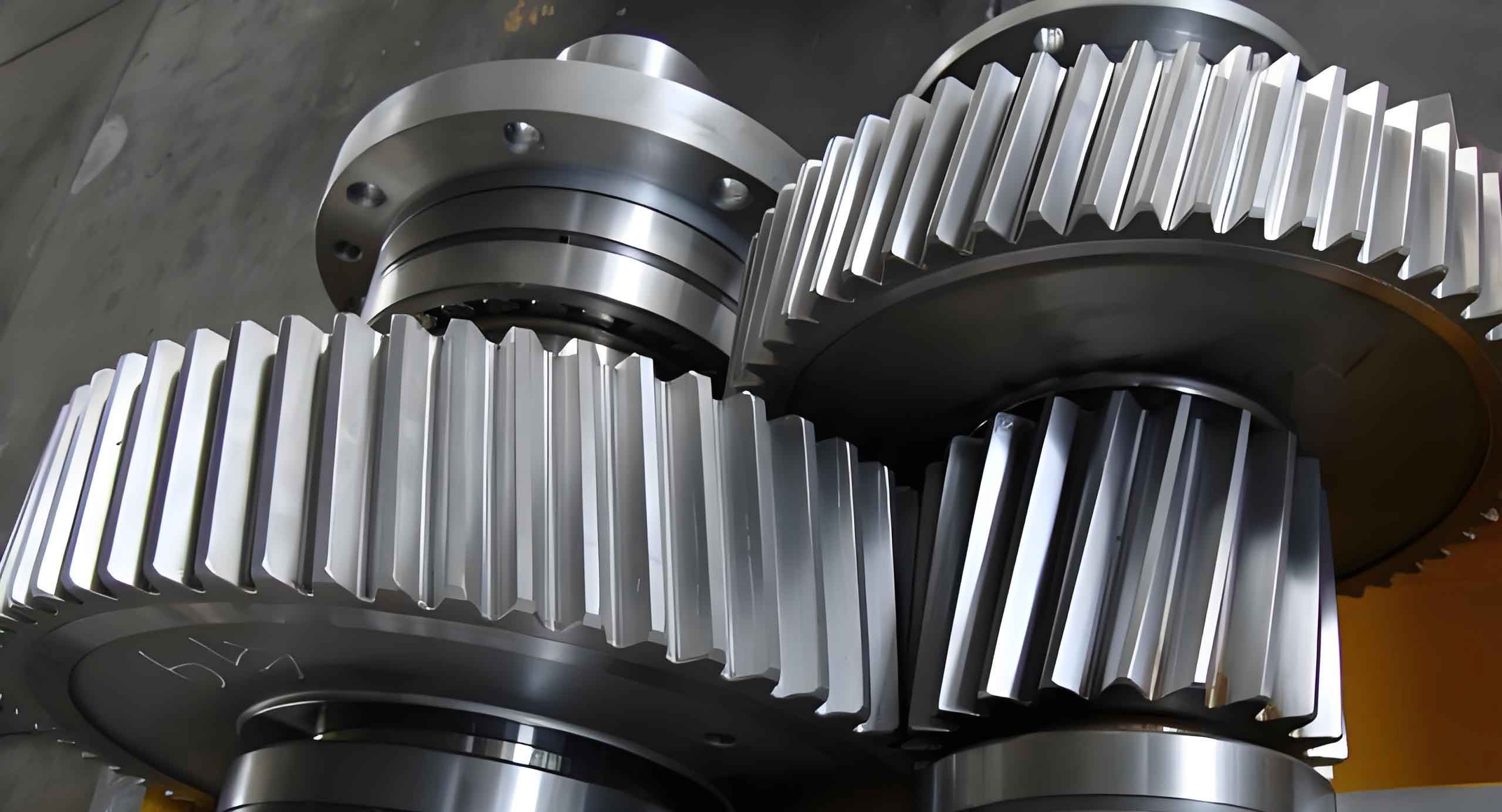
The helical gear shown here exemplifies the type used in seat adjusters, characterized by angled teeth that facilitate smoother engagement compared to spur gears. This smoother engagement is crucial for noise reduction, but further optimization through profile modification can enhance performance.
To systematically address the noise issue, I began by establishing a mathematical model for the worm and helical gear pair. This model serves as the basis for understanding meshing dynamics and guiding the modification design. The coordinate systems for the involute cylindrical worm and helical gear pair are defined as follows: Let $$\sigma_p (o_p-x_p, y_p, z_p)$$ and $$\sigma_t (o_t-x_t, y_t, z_t)$$ represent fixed reference frames. The worm is associated with frame $$\sigma_1 (o_1-x_1, y_1, z_1)$$, and the helical gear with frame $$\sigma_2 (o_2-x_2, y_2, z_2)$$. The angular velocities are denoted as $$\omega_1$$ for the worm and $$\omega_2$$ for the helical gear, with a center distance $$a$$. At any given time, the angular displacements are $$\phi_1$$ and $$\phi_2$$ for the worm and helical gear, respectively.
The tooth surface of the involute cylindrical worm can be described using the following parametric equations. These equations are derived from the geometry of the worm, considering its base circle radius and helix angle. The position vector in the worm coordinate system is given by:
$$\mathbf{r}_1 = x_1 \mathbf{i}_1 + y_1 \mathbf{j}_1 + z_1 \mathbf{k}_1$$
where the components are defined as:
$$x_1 = r_{b1} \cos u_1 + \theta_1 \cos \delta_1 \sin u_1$$
$$y_1 = r_{b1} \sin u_1 – \theta_1 \cos \delta_1 \sin u_1$$
$$z_1 = p_1 u_1 – \theta_1 \sin \delta_1$$
In these equations, $$r_{b1}$$ is the base circle radius of the worm, $$\delta_1$$ is the helix angle, $$u_1$$ is the involute parameter, $$p_1$$ is the spiral parameter, and $$\theta_1$$ is the tooth surface parameter. The unit vectors $$\mathbf{i}_1, \mathbf{j}_1, \mathbf{k}_1$$ correspond to the worm’s coordinate axes.
Similarly, the tooth surface of the helical gear is expressed in its own coordinate system. The position vector is:
$$\mathbf{r}_2 = x_2 \mathbf{i}_2 + y_2 \mathbf{j}_2 + z_2 \mathbf{k}_2$$
with the components:
$$x_2 = r_{b2} \cos(u_2 + \theta_2) + r_{b2} u_2 \sin(u_2 + \theta_2)$$
$$y_2 = r_{b2} \sin(u_2 + \theta_2) – r_{b2} u_2 \sin(u_2 + \theta_2)$$
$$z_2 = p_2 \theta_2$$
Here, $$r_{b2}$$ is the base circle radius of the helical gear, $$u_2$$ is the involute parameter, $$p_2$$ is the spiral parameter, and $$\theta_2$$ is the tooth surface parameter. The unit vectors $$\mathbf{i}_2, \mathbf{j}_2, \mathbf{k}_2$$ are aligned with the helical gear’s axes.
These equations form the foundation for analyzing the meshing behavior between the worm and helical gear. By modifying the tooth profiles, we can alter the contact patterns and reduce impact forces. The modification is typically applied as a slight deviation from the ideal involute profile, often using curves such as the Walker modification curve. For helical gears, the modification is applied along the tooth flank, affecting the engagement process.
To quantify the effect of modifications, I designed and manufactured several worm and helical gear specimens with different modification amounts. The basic parameters of the worm and helical gear pair used in this study are summarized in the table below. These parameters are critical for ensuring proper meshing and for comparing the performance of modified versus unmodified components.
| Parameter | Worm | Helical Gear |
|---|---|---|
| Normal Module (mm) | 0.9 | 0.9 |
| Number of Teeth | 2 | 13 |
| Pressure Angle (°) | 20 | 20 |
| Reference Radius (mm) | 8.1 | 12.3 |
| Helix Angle (°) | 77 | 13 |
| Modification Coefficient | 0 | 0.252 |
| Center Distance (mm) | 10.4 | |
| Material | Polyetheretherketone (PEEK) | 40Cr Steel |
| Machining Accuracy | Grade 8 | Grade 7 |
The helical gears were modified using a Walker curve with a modification length of 1.06 mm. The modification amounts tested were 0.02 mm and 0.04 mm. For the worm, modification amounts of 0.01 mm, 0.02 mm, 0.04 mm, and 0.08 mm were evaluated. These values were chosen to cover a range from subtle to more aggressive modifications, allowing for a comprehensive assessment of their impact on noise and vibration.
The experimental setup for noise testing was designed to replicate real-world conditions. A test bench was constructed to mount the seat adjuster assembly, simulating its installation in vehicle seat rails. The drive motor operated at a speed of 3000 rpm, driving the seat adjuster. A triaxial acceleration sensor was mounted on the output bearing seat of the adjuster to measure vibrations in three directions: radial (X-axis), axial (Y-axis), and tangential (Z-axis). The radial direction, corresponding to the center distance direction of the reducer, was found to be the most critical for vibration peaks. Data acquisition was performed using a BK3050-60 front-end collector with a sampling frequency of 10 kHz, and the data were analyzed using Pulse Lapshop software.
The noise and vibration metrics were assessed through acceleration spectra and sound pressure levels. Acceleration peaks in the frequency domain were used as indicators of vibration severity, which directly correlates with noise generation. Additionally, microphone measurements were taken to capture acoustic noise levels in decibels (dB). This multi-faceted approach ensured a robust evaluation of the modification effects.
Initial tests focused on the helical gear modifications. Three configurations were compared: the original unmodified helical gear, a helical gear with 0.02 mm modification, and a helical gear with 0.04 mm modification. Each was paired with the same unmodified worm, and the acceleration spectra were recorded during both forward and reverse operation. The results showed that the original helical gear produced the highest acceleration peaks in the radial direction, with values of 1.04 m/s² for forward motion and 0.705 m/s² for reverse motion, at a frequency of 700 Hz. The 0.02 mm modified helical gear showed a slight increase in forward acceleration but a decrease in reverse, with peak frequencies shifting to 600 Hz and 800 Hz, respectively. However, the 0.04 mm modified helical gear demonstrated a significant reduction in acceleration peaks: forward acceleration dropped to 0.6 m/s², and reverse acceleration to 0.41 m/s². This preliminary evidence suggested that a 0.04 mm modification on helical gears could effectively reduce vibrations.
To validate the consistency of this finding, I conducted further tests with multiple samples. Three original seat adjuster products were randomly selected, and their helical gears were replaced with 0.04 mm modified helical gears. The acceleration peaks for both original and modified configurations are summarized in the table below. The percentage change indicates the reduction achieved through modification.
| Test Product | Original Forward (m/s²) | Modified Forward (m/s²) | Change (%) | Original Reverse (m/s²) | Modified Reverse (m/s²) | Change (%) |
|---|---|---|---|---|---|---|
| Product 1 | 0.746 | 0.622 | -16.62 | 1.090 | 0.716 | -34.31 |
| Product 2 | 1.020 | 0.768 | -24.70 | 1.090 | 0.875 | -19.72 |
| Product 3 | 0.700 | 0.548 | -21.70 | 0.759 | 0.605 | -20.29 |
The data clearly show that the 0.04 mm modification on helical gears consistently reduced acceleration peaks by 16% to 35% across different samples. This confirms the effectiveness of helical gear profile modification in damping vibrations and, by extension, reducing noise. The helical gears, with their angled teeth, already offer smoother engagement, but the additional profile optimization further minimizes impact forces during meshing.
Next, I evaluated the effect of worm modifications. Four worms with different modification amounts (0.01 mm, 0.02 mm, 0.04 mm, and 0.08 mm) were paired with unmodified helical gears. The acceleration peaks in three directions were measured, and the results are presented in the following table. The values represent the maximum acceleration observed during forward and reverse operations.
| Modification Amount | Direction | Forward X (m/s²) | Forward Y (m/s²) | Forward Z (m/s²) | Reverse X (m/s²) | Reverse Y (m/s²) | Reverse Z (m/s²) |
|---|---|---|---|---|---|---|---|
| 0.01 mm | Values | 0.771 | 0.750 | 0.743 | 0.864 | 0.802 | 0.798 |
| Notes | Moderate peaks, with reverse slightly higher. | ||||||
| 0.02 mm | Values | 0.670 | 0.641 | 0.608 | 0.672 | 0.650 | 0.636 |
| Notes | Lowest peaks overall, indicating best noise reduction. | ||||||
| 0.04 mm | Values | 0.743 | 0.737 | 0.720 | 0.733 | 0.716 | 0.702 |
| Notes | Peaks higher than 0.02 mm but lower than 0.01 mm. | ||||||
| 0.08 mm | Values | 0.830 | 0.808 | 0.818 | 0.822 | 0.764 | 0.750 |
| Notes | Highest peaks, suggesting excessive modification degrades performance. | ||||||
From this data, the 0.02 mm modification on the worm yielded the lowest acceleration peaks, demonstrating an optimal balance. Excessive modifications (e.g., 0.08 mm) led to increased vibrations, likely due to altered contact patterns that introduced new sources of impact. This highlights the importance of selecting appropriate modification amounts for both worms and helical gears.
Based on these findings, I proceeded to conduct full-scale noise reduction tests using the optimal combination: a helical gear with 0.04 mm modification and a worm with 0.02 mm modification. Six seat adjuster units were assembled with this configuration, and their noise and vibration performance was compared against two benchmark products, which are considered industry standards for low noise. The tests measured sound pressure levels (in dB) and acceleration peaks in three directions. The results are summarized in the tables below.
First, the noise levels for forward and reverse operations are shown in this table:
| Product Type | Forward Noise (dB) | Reverse Noise (dB) |
|---|---|---|
| Benchmark Product 1 | 32.4 | 33.7 |
| Benchmark Product 2 | 36.2 | 31.7 |
| Test Product 1 | 36.6 | 34.5 |
| Test Product 2 | 32.3 | 29.5 |
| Test Product 3 | 35.2 | 34.3 |
| Test Product 4 | 33.1 | 36.0 |
| Test Product 5 | 34.5 | 32.6 |
| Test Product 6 | 37.8 | 35.3 |
Among the six test products, four had noise levels below 36 dB in both directions, outperforming the highest benchmark noise of 36.2 dB. The maximum noise difference between test products and benchmarks was within 1.6 dB, and some test products even achieved lower minimum noise levels. This indicates that the modification strategy can yield noise performance comparable to or better than existing standards.
Furthermore, the acceleration peaks for these products were measured and are presented in the following table. The values correspond to the maximum acceleration in the radial (X), axial (Y), and tangential (Z) directions during forward and reverse motion.
| Product Type | Forward X (m/s²) | Forward Y (m/s²) | Forward Z (m/s²) | Reverse X (m/s²) | Reverse Y (m/s²) | Reverse Z (m/s²) |
|---|---|---|---|---|---|---|
| Benchmark Product 1 | 0.22 | 0.02 | 0.38 | 0.34 | 0.02 | 0.43 |
| Benchmark Product 2 | 0.22 | 0.05 | 0.25 | 0.16 | 0.04 | 0.40 |
| Test Product 1 | 0.37 | 0.04 | 0.30 | 0.38 | 0.10 | 0.34 |
| Test Product 2 | 0.14 | 0.03 | 0.30 | 0.30 | 0.10 | 0.12 |
| Test Product 3 | 0.28 | 0.07 | 0.23 | 0.30 | 0.07 | 0.30 |
| Test Product 4 | 0.28 | 0.30 | 0.21 | 0.20 | 0.20 | 0.13 |
| Test Product 5 | 0.40 | 0.02 | 0.36 | 0.17 | 0.06 | 0.13 |
| Test Product 6 | 0.19 | 0.05 | 0.30 | 0.38 | 0.02 | 0.17 |
The acceleration peaks for the test products are generally lower than those of the original unmodified products (which had peaks above 0.7 m/s² as shown earlier) and are on par with the benchmark products. This demonstrates that the profile modifications effectively reduced vibration amplitudes, contributing to noise reduction.
To delve deeper into the mathematical reasoning behind these results, let’s consider the meshing dynamics. The contact between the worm and helical gear can be modeled using the equations of motion. The relative velocity at the meshing point influences impact forces. For a modified tooth profile, the effective radius of curvature changes, altering the contact stress. The modified profile can be represented as a deviation from the ideal involute curve. If we denote the modification function as $$f(s)$$, where $$s$$ is the arc length along the tooth flank, the actual tooth surface becomes:
$$\mathbf{r}_{\text{mod}} = \mathbf{r}_{\text{ideal}} + f(s) \mathbf{n}$$
where $$\mathbf{r}_{\text{ideal}}$$ is the ideal involute surface vector and $$\mathbf{n}$$ is the unit normal vector. For helical gears, this modification is applied along the helix, affecting the line of contact. The function $$f(s)$$ is typically a parabolic or linear curve, such as the Walker curve, which minimizes abrupt changes in curvature.
The impact force during meshing can be approximated using a spring-damper model. Let the effective stiffness at the contact point be $$k$$ and the damping coefficient be $$c$$. The equation of motion for the system during a single tooth engagement is:
$$m \ddot{x} + c \dot{x} + k x = F_{\text{impact}}$$
where $$m$$ is the equivalent mass, $$x$$ is the displacement, and $$F_{\text{impact}}$$ is the force due to meshing impacts. With profile modification, the initial contact occurs more gradually, reducing $$F_{\text{impact}}$$. This reduction can be quantified by integrating the modification function over the engagement path. For helical gears, the engagement is continuous due to the angled teeth, so the modification smooths the transition between tooth pairs.
The acceleration spectrum peaks observed in the experiments correspond to resonant frequencies of the system. The fundamental meshing frequency $$f_m$$ is given by:
$$f_m = \frac{\omega_1 N_1}{2\pi}$$
where $$\omega_1$$ is the worm angular velocity in rad/s, and $$N_1$$ is the number of worm threads. For our parameters, $$\omega_1 = \frac{3000 \times 2\pi}{60} = 314.16 \, \text{rad/s}$$, and $$N_1 = 2$$, so $$f_m = \frac{314.16 \times 2}{2\pi} \approx 100 \, \text{Hz}$$. However, the peaks in the acceleration spectra occurred at higher frequencies (e.g., 600-800 Hz), indicating harmonics or structural resonances. The modifications likely dampened these higher-frequency components by reducing nonlinear excitations.
Another aspect to consider is the material pairing. The worm is made of PEEK, a polymer with good damping properties, while the helical gear is steel. This combination already offers some noise reduction due to the polymer’s ability to absorb vibrations. However, the profile modifications on both components further enhance this effect. The interaction between the modified surfaces can be analyzed through contact pressure distribution. Using Hertzian contact theory, the maximum contact pressure $$p_{\text{max}}$$ for two cylinders in contact is:
$$p_{\text{max}} = \sqrt{\frac{F E^*}{\pi R^*}}$$
where $$F$$ is the normal force, $$E^*$$ is the equivalent Young’s modulus, and $$R^*$$ is the equivalent radius of curvature. With profile modification, $$R^*$$ increases locally, reducing $$p_{\text{max}}$$ and thus wear and noise.
In summary, the experimental and theoretical analyses confirm that tooth profile modification on both worms and helical gears is a viable strategy for noise reduction in automotive seat adjusters. The helical gears, with their inherent design for smooth engagement, benefit significantly from precise modifications that minimize meshing impacts. The optimal modification amounts found in this study—0.04 mm for helical gears and 0.02 mm for the worm—provide a tangible reduction in vibration and noise levels.
Looking forward, this research can be extended to optimize modification profiles using advanced algorithms, such as genetic algorithms or finite element analysis, to achieve even greater noise reduction. Additionally, the effects of manufacturing tolerances and wear over time on modified profiles warrant further investigation. Nevertheless, the current findings offer practical insights for automotive engineers seeking to enhance the acoustic comfort of electric seat systems. The focus on helical gears underscores their critical role in transmission systems, and through careful design modifications, their performance can be significantly improved.
In conclusion, the journey from mathematical modeling to experimental validation has demonstrated that targeted tooth profile modifications can effectively address noise issues in worm and helical gear pairs. The synergy between theoretical insights and practical testing has yielded a robust solution that aligns with the automotive industry’s push towards quieter and more comfortable vehicles. As helical gears continue to be integral components in various mechanical systems, the principles outlined here may find applications beyond seat adjusters, contributing to noise reduction in a wide array of machinery.