
In modern engineering education, the integration of information technology with experimental teaching has become a crucial trend, especially in fields like mechanical engineering where complex concepts and processes are involved. The Education Informatization Development Plan (2011–2020) emphasizes deepening the fusion of information technology with higher education experimental teaching, enhancing resource construction, and improving teaching quality. Traditional experimental methods often face limitations due to resource constraints, such as insufficient hardware and software environments, which hinder students’ hands-on experience. Virtual experiments, leveraging technologies like virtual reality (VR), offer a solution by providing immersive, interactive learning experiences不受时间和空间限制. This article, from my first-person perspective as an educator and designer, details the design and implementation of a virtual experiment focused on the generation machining of involute helical gears—a core topic in courses like Mechanical Principles and Mechanical Design.
Helical gears are widely used in传动系统 due to their smooth operation, high load capacity, and reduced noise compared to spur gears. Understanding their generation machining, which involves complex motions and precise adjustments, is essential for students. However, traditional teaching methods, such as animation demonstrations or site visits, often fail to fully and clearly展示 the movements of cutters and gear blanks, leading to student difficulties in comprehension. To address this, I developed a virtual experiment using VR and WebGL technologies, allowing students to亲自演示并观察 the motions involved in helical gear generation. This experiment not only covers the fundamental principles but also incorporates gear modification techniques, such as profile and lead crowning, to enhance啮合性能 and reduce noise. Through this virtual platform, students can explore the structure of gear hobbing machines, the determination of installation angles, and the effects of修形, thereby laying a solid foundation for advanced studies in mechanical engineering.
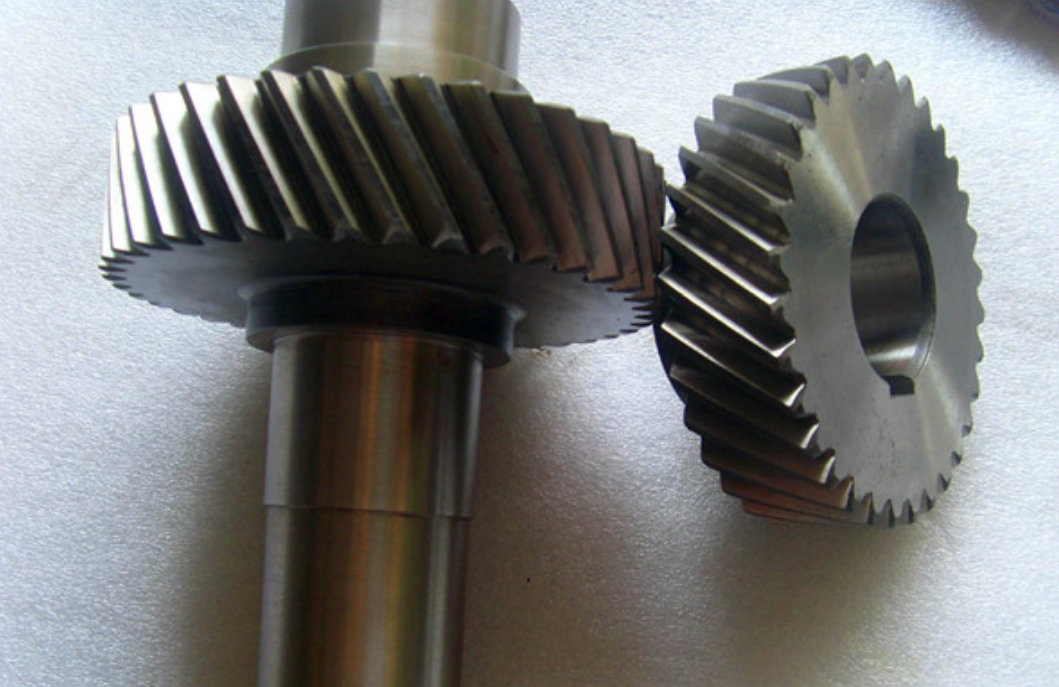
The key知识点 related to the generation machining of involute helical gears encompass several areas: the认知 of gear processing machines like hobbing machines, the various motions in hobbing, the determination of hob installation angles for helical gears, hob selection, and common modification methods. In this virtual experiment, I focus on the Y3150E hobbing machine model, which is典型 in industry. The generation machining of helical gears relies on the principle of simulating the meshing between a rack and a gear, where the hob acts as a rack with cutting edges. The process involves multiple coordinated motions to ensure accurate tooth profile generation. For helical gears, the hob must be installed at a specific angle relative to the gear blank axis to match the helix direction. This installation angle $\lambda$ is calculated based on the gear’s helix angle $\beta$ and the hob’s lead angle $\gamma$, as given by the formula:
$$ \lambda = \gamma \pm \beta $$
Here, the sign depends on the hand of the helical gear and the hob. For example, when machining a right-hand helical gear with a right-hand hob, the installation angle is $\lambda = \gamma – \beta$, whereas for a left-hand hob, it becomes $\lambda = \gamma + \beta$. This adjustment ensures that the cutting edges align properly with the gear’s tooth direction, which is critical for achieving the correct involute profile. The table below summarizes the key motions involved in hobbing helical gears:
| Motion Type | Description | Purpose |
|---|---|---|
| Hob Installation Angle Adjustment | Rotating the hob axis relative to the gear blank axis to achieve the calculated angle $\lambda$. | Align hob cutting edges with gear helix direction. |
| Centering Motion | Adjusting the hob and gear blank positions to align a hob tooth or groove symmetrically with the workpiece centerline. | Ensure对称性 for accurate tooth generation. |
| Generating Motion | Synchronous rotation of the hob and gear blank according to a specified transmission ratio, simulating gear-rack meshing. | Form the involute tooth profile through展成原理. |
| Cutting Motion | Axial feed of the hob along the gear blank axis to cut the entire tooth width. | Complete the gear teeth across the face width. |
In addition to these motions, gear modification is a vital aspect of modern gear design to improve performance. For helical gears, common modification methods include profile modification (tip and root relief) and lead modification (crowning). These techniques compensate for errors like base pitch deviations and elastic deformations under load, reducing啮合冲击 and noise. In this virtual experiment, I integrate修形刀具, such as modified hobs, to demonstrate how齿轮修形 can be achieved during generation machining. The修形 parameters, like modification amount and curve, are based on my research成果, allowing students to explore their effects on gear meshing. For instance, profile modification can be expressed mathematically as a function of the roll angle $\theta$:
$$ \Delta s = C \cdot \theta^2 $$
where $\Delta s$ is the modification amount and $C$ is a constant depending on gear geometry and load conditions. This equation helps students understand the theoretical basis behind修形.
The development of the virtual experiment software was a collaborative effort with a technology company, utilizing VR and WebGL technologies for immersive 3D interactions. The software is built with Unity3D, providing a user-friendly interface with menus such as “Experiment Introduction,” “Hobbing Machine认知,” “Cutting Motions,” “Gear Parameters,” “Hob Selection,” “Hob Modification,” and “Generation Experiment.” Each menu offers interactive elements; for example, in the “Hobbing Machine认知” section, students can rotate, zoom, and translate the 3D model to examine components like the bed, column,刀架溜板, and worktable. The software also includes dynamic simulations of the motions, allowing students to control and observe each step in real-time. This design aligns with educational goals to enhance student engagement and practical能力.
The experimental process is structured to guide students through a comprehensive learning experience. Initially, they review the experiment introduction to refresh their knowledge on involute helical gears and generation machining. Then, they explore the hobbing machine model, identifying key components and their functions. Next, they engage with the cutting motions menu, where they can activate simulations of the main rotation, vertical feed, and radial feed motions. For instance, the main motion shows the hob rotating at high speed, while the vertical feed demonstrates the hob’s axial movement along the gear blank. This hands-on approach helps students visualize the complex coordination required in gear machining.
In the gear parameters section, students input or adjust parameters for helical gears, such as module $m$, number of teeth $z$, helix angle $\beta$, and pressure angle $\alpha$. The software calculates derived parameters like pitch diameter $d$ and axial pitch $p_a$ using standard formulas:
$$ d = \frac{m \cdot z}{\cos \beta} $$
$$ p_a = \frac{\pi \cdot m}{\sin \beta} $$
These calculations reinforce theoretical concepts from mechanical principles courses. The hob selection menu allows students to choose between right-hand and left-hand hobs, observing how the installation angle $\lambda$ changes automatically in the virtual environment. They then perform centering motions to align the hob with the gear blank, a critical step for accuracy. The table below summarizes key gear parameters used in the experiment:
| Parameter | Symbol | Typical Value | Description |
|---|---|---|---|
| Module | $m$ | 2 mm | Size parameter defining tooth dimensions. |
| Number of Teeth | $z$ | 30 | Determines gear ratio and diameter. |
| Helix Angle | $\beta$ | 15° | Angle of tooth inclination relative to axis. |
| Pressure Angle | $\alpha$ | 20° | Angle defining tooth profile shape. |
| Hob Lead Angle | $\gamma$ | 3° | Angle of hob thread, affecting installation. |
The hob modification section introduces修形 concepts, where students can apply profile modifications to the hob and observe the resulting gear tooth geometry. For example, they might set a tip relief amount of 0.02 mm to reduce engagement冲击. The software simulates the generation process with the modified hob, showing how the tooth profile deviates from the standard involute. This interactive feature helps students understand the practical implications of修形 for helical gears in reducing noise and improving load distribution.
The core of the experiment is the generation experiment menu, where students run a full simulation of helical gear machining. They start by selecting the gear type (e.g., right-hand helical gear) and configuring parameters. Then, they install the hob, adjust the installation angle, perform centering, and initiate the generating and cutting motions. The software provides a real-time 3D animation of the process, highlighting the formation of each tooth along the helix. Students can pause, rewind, or zoom in to observe details, such as the contact between hob teeth and the gear blank. This immersive experience deepens their understanding of the展成原理, which is based on the kinematic relationship between the hob and gear blank. The generating motion follows the fundamental equation for gear hobbing:
$$ \frac{N_h}{N_g} = \frac{z_g}{k} $$
where $N_h$ is the hob rotational speed, $N_g$ is the gear blank rotational speed, $z_g$ is the number of gear teeth, and $k$ is the number of hob threads (usually $k=1$ for single-thread hobs). This equation ensures that the hob and gear blank rotate in synchrony to generate the correct tooth profile.
After completing the virtual experiment, students take a self-assessment test covering topics like the components of generating motion, determination of hob installation angles, and effects of gear modification. The test questions are directly tied to the实验内容, ensuring that students have engaged actively. For instance, one question might ask: “For a helical gear with $\beta = 20°$ and a hob with $\gamma = 5°$, calculate the installation angle $\lambda$ for a right-hand configuration.” This reinforces the formula $\lambda = \gamma – \beta$ and encourages application of knowledge. The scores are integrated into overall course grades, motivating students to participate thoroughly.
The implementation of this virtual experiment in mechanical engineering courses has yielded positive outcomes. Based on feedback from students, such as those in the Machine Design 1701 class, the experiment significantly enhanced their understanding of helical gears and generation machining. Students reported increased ability to visualize complex motions, such as the coordination between hob rotation and gear blank feed. Moreover, the inclusion of修形 elements sparked interest in advanced topics like gear dynamics and noise reduction. The virtual platform also addressed resource limitations, allowing multiple students to conduct experiments simultaneously without physical equipment. From an educational perspective, this approach aligns with constructivist learning theories, where students build knowledge through interactive experiences.
In terms of technical details, the software development involved several challenges, such as accurately modeling the involute tooth profile for helical gears. The involute curve is defined parametrically as:
$$ x = r_b (\cos \theta + \theta \sin \theta) $$
$$ y = r_b (\sin \theta – \theta \cos \theta) $$
where $r_b$ is the base radius and $\theta$ is the roll angle. For helical gears, this profile is modified by the helix angle, resulting in a three-dimensional surface. The virtual experiment simulates this using mathematical algorithms in Unity3D, ensuring that the generated teeth meet ISO standards for accuracy. Additionally, the simulation of cutting forces and material removal was simplified to focus on kinematic principles, but future versions could incorporate more物理-based models for advanced studies.
The benefits of virtual experiments extend beyond teaching efficiency. They provide a safe environment for trial and error, where students can explore “what-if” scenarios without risk of damaging equipment. For example, they can test incorrect installation angles and observe resulting gear errors, such as undercut or uneven tooth profiles. This experiential learning fosters critical thinking and problem-solving skills. Furthermore, the virtual experiment can be easily updated to include new technologies, such as digital twins or AI-based optimization for gear design.
In conclusion, the virtual experiment for involute helical gear generation machining represents a significant advancement in engineering education. By leveraging VR and WebGL technologies, it offers an immersive, interactive platform for students to master complex concepts related to helical gears. The experiment covers key知识点, from hobbing machine operations to gear modification, and emphasizes hands-on learning through simulations. The integration of formulas, tables, and real-time animations enhances comprehension and retention. As educational institutions continue to embrace digital transformation, such virtual experiments will play a crucial role in preparing students for the challenges of modern mechanical engineering. Future work could expand the experiment to include other gear types, such as bevel or worm gears, and incorporate collaborative features for team-based learning. Overall, this initiative underscores the value of innovation in teaching, ensuring that students develop the practical skills and theoretical knowledge needed to excel in their careers.