
In the field of mechanical engineering, the design and manufacturing of helical gears have always been critical for transmitting power and motion efficiently. As a researcher focused on gear technology, I have explored various methods to enhance the performance of helical gears through modification techniques. Traditional parametric design often limits itself to standard involute gears, but in practical applications, modified helical gears are essential to reduce noise, vibration, and stress concentrations. In this study, I delve into a parametric design approach for helical gears that leverages a modified worm grinding wheel. By adjusting the wheel’s profile and controlling its radial feed during the grinding process, we can achieve precise modifications on both the tooth profile and lead of helical gears. This method not only streamlines the modeling process but also supports advanced analyses like finite element simulation. Throughout this article, I will detail the mathematical foundations, software implementation, and practical examples, emphasizing the versatility of helical gear design.
My investigation begins with the grinding process of helical gears using a worm grinding wheel. This process mimics the interaction between a gear and a rack, allowing us to simplify the complex geometry into manageable mathematical models. The core idea is to modify the worm grinding wheel’s tooth profile to impart desired modifications onto the helical gear. For instance, by introducing a modification curve on the wheel, we can control the tooth profile of the helical gear. Similarly, by varying the radial feed of the wheel along the gear’s axis, we can implement lead modifications. These adjustments are crucial for optimizing the performance of helical gears in high-precision applications, such as aerospace or automotive systems. I will present this in a first-person narrative, sharing the insights and challenges encountered during this research.
To establish a parametric mathematical model, I first defined the coordinate systems involved in the grinding process. The worm grinding wheel, represented as a virtual rack cutter, operates in a coordinate system σr with axes xr and yr, where yr aligns with the rack’s pitch line. The helical gear is situated in a coordinate system σ1 with axes x1 and y1, centered on the gear’s axis. During grinding, the relative motion between the wheel and the gear generates the tooth surface. The modification of the worm grinding wheel’s tooth profile is described by a modification curve, which I derived using gear meshing principles. For the tooth profile modification, the modification amount Δ is given by a power function:
$$ \Delta = \Delta_{max} \times \left( \frac{l_x}{l} \right)^b $$
Here, Δmax is the maximum modification amount, b is the modification exponent that dictates the curve’s shape, l is the total modification length along the meshing line, and lx is the distance from the starting point, ranging from 0 to l. This equation ensures a smooth transition between modified and unmodified sections, which is vital for maintaining the integrity of the helical gear’s tooth surface. I applied this to various segments of the wheel’s profile, such as the straight line and rounded portions, to derive comprehensive equations for the modified worm grinding wheel.
The tooth profile of the worm grinding wheel consists of multiple segments, including straight lines and circular arcs. For the straight-line segment LK, the coordinates in the wheel’s system are expressed as functions of the helical gear’s rotation angle φ. Using the geometry of the rack-gear interaction, I derived the following equations:
$$ x_{LK} = \frac{(y_A – y_B)[r_p \phi (x_A – x_B) + x_B y_A – x_A y_B]}{(x_A – x_B)^2 + (y_A – y_B)^2} $$
$$ y_{LK} = \frac{r_p \phi (y_A – y_B)^2 – (x_A – x_B)(x_B y_A – x_A y_B)}{(x_A – x_B)^2 + (y_A – y_B)^2} $$
In these equations, xA, yA, xB, and yB are coordinates defining the wheel’s standard tooth profile, rp is the distance from the wheel’s pitch line to the gear’s center, and φ represents the gear’s rotation angle within a specific range. For the modified segments, such as LM, the coordinates are adjusted by adding the modification amount Δ to the y-coordinate, while the x-coordinate remains unchanged. This yields:
$$ x_{LM} = x_{LB} $$
$$ y_{LM} = y_{LB} + \Delta $$
where xLB and yLB are the coordinates of the unmodified profile. By combining these segments, I formulated the complete tooth profile equation for the worm grinding wheel, denoted as Rr(φ). This parametric representation allows for flexible adjustments to achieve different modification patterns on the helical gear.
Transitioning to the helical gear itself, the tooth surface is generated through the relative motion between the gear and the modified worm grinding wheel. Based on meshing theory, I performed coordinate transformations to map the wheel’s profile onto the gear’s coordinate system. The gear tooth profile equation in its own coordinate system σ1 is obtained by applying a transformation matrix M1r:
$$ \mathbf{R}(\phi) = \mathbf{M}_{1r} \times \mathbf{R}_r(\phi) $$
Here, R(φ) is the gear’s tooth profile vector, and Rr(φ) is the wheel’s profile vector. The transformation matrix accounts for the rotation and translation between the two systems, incorporating parameters like the gear’s rotation angle φ and the initial alignment angle ξ, which is related to the gear’s tooth spacing. Specifically, ξ is set as π/z, where z is the number of teeth on the helical gear. This step ensures that the gear tooth profile accurately reflects the modifications imposed by the wheel.
For lead modification, I introduced a control mechanism via the radial feed of the worm grinding wheel during its axial movement along the helical gear. As the wheel traverses the gear’s face width, varying the radial feed amount Δx enables modifications along the tooth’s longitudinal direction. The radial feed is defined by a similar power function:
$$ \Delta x = \Delta x_{max} \times \left( \frac{l_x}{l_z} \right)^b $$
In this context, Δxmax is the maximum radial feed, lz is the length over which lead modification occurs, and lx ranges from 0 to lz. This approach allows for continuous adjustment, ensuring that the modified helical gear tooth surface blends smoothly with unmodified regions. The spiral nature of the helical gear tooth surface is modeled by considering the helicoid generation. The tooth surface point equation R(φ, Φ) is derived by applying a spiral motion transformation matrix M01 to the gear’s tooth profile R(φ):
$$ \mathbf{R}(\phi, \Phi) = \mathbf{M}_{01} \times \mathbf{R}(\phi) $$
Here, Φ is the spiral motion angle, and P is the spiral parameter related to the helical gear’s lead, with P × Φ representing the axial displacement along the gear’s face width. For lead modification, the parameter rp in the profile equation is adjusted to rp – Δx during the spiral motion, where Δx varies based on the axial position. This integration of profile and lead modifications into a single parametric model facilitates comprehensive design of helical gears.
To implement this parametric design method, I developed a software application using Visual Studio 2008 with MFC (Microsoft Foundation Classes). The software features a user-friendly interface that allows input of various helical gear parameters and modification settings. Key functionalities include calculating tooth surface points based on the derived equations, exporting data for 3D modeling, and visualizing modification effects. The interface is designed to handle inputs such as gear module, number of teeth, pressure angle, helix angle, face width, and modification parameters like Δmax and Δxmax. By programming the mathematical models in C++, I ensured accurate computation of helical gear tooth surfaces, including both profile and lead modifications. The software outputs point cloud data in TXT format, which can be imported into CAD software for further analysis and visualization.
An example application illustrates the effectiveness of this parametric design method for helical gears. I considered a helical gear with specific basic parameters, as summarized in Table 1. These parameters define the standard geometry of the helical gear, which serves as the foundation for applying modifications.
| Parameter | Value | Description |
|---|---|---|
| Module (mn) | 2 mm | Normal module of the helical gear |
| Number of Teeth (z) | 34 | Total teeth on the helical gear |
| Pressure Angle (α) | 20° | Standard pressure angle |
| Helix Angle (β) | 18° | Helix angle defining the spiral |
| Face Width (B) | 20 mm | Axial length of the helical gear |
| Modification Coefficient | 0 | No initial profile shift |
For modification, I applied both profile and lead parameters, as detailed in Table 2. These parameters control the extent and shape of modifications on the helical gear, derived from the worm grinding wheel adjustments.
| Parameter | Value | Description |
|---|---|---|
| Modification Height | 1 mm | Height over which profile modification is applied |
| Maximum Profile Modification Δmax | 0.03 mm | Peak modification amount for tooth profile |
| Profile Modification Exponent (b) | 1.5 | Exponent shaping the profile modification curve |
| Lead Modification Length (lz) | 5 mm | Length along face width for lead modification |
| Maximum Radial Feed Δxmax | 0.1 mm | Peak radial feed for lead modification |
| Lead Modification Exponent (b) | 2 | Exponent shaping the lead modification curve |
By inputting these values into the software, I generated tooth surface point data for the helical gear. The results demonstrate how modifications propagate from the worm grinding wheel to the helical gear. For instance, when applying only profile modification (Δmax = 0.03 mm, Δx = 0), the maximum modification on the helical gear tooth surface is approximately 0.03 mm, indicating a direct transfer from the wheel. For lead modification alone (Δmax = 0, Δx = 0.1 mm), the helical gear exhibits a maximum modification of about 0.049 mm, which arises from the radial feed effect. When both modifications are combined, the helical gear’s maximum modification reaches 0.079 mm, showcasing the additive nature of these adjustments. This example confirms that our parametric design method effectively controls helical gear modifications through precise manipulation of the worm grinding wheel.
To visualize the output, I exported the tooth surface point data to CATIA, a 3D modeling software. The point cloud represents the modified helical gear tooth surface, with boundary curves illustrating the standard involute profile for reference. This visualization aids in verifying the accuracy of the parametric model and facilitates further design iterations. The image below shows the tooth surface points for a profile-modified helical gear, highlighting the smooth transition achieved through our method.
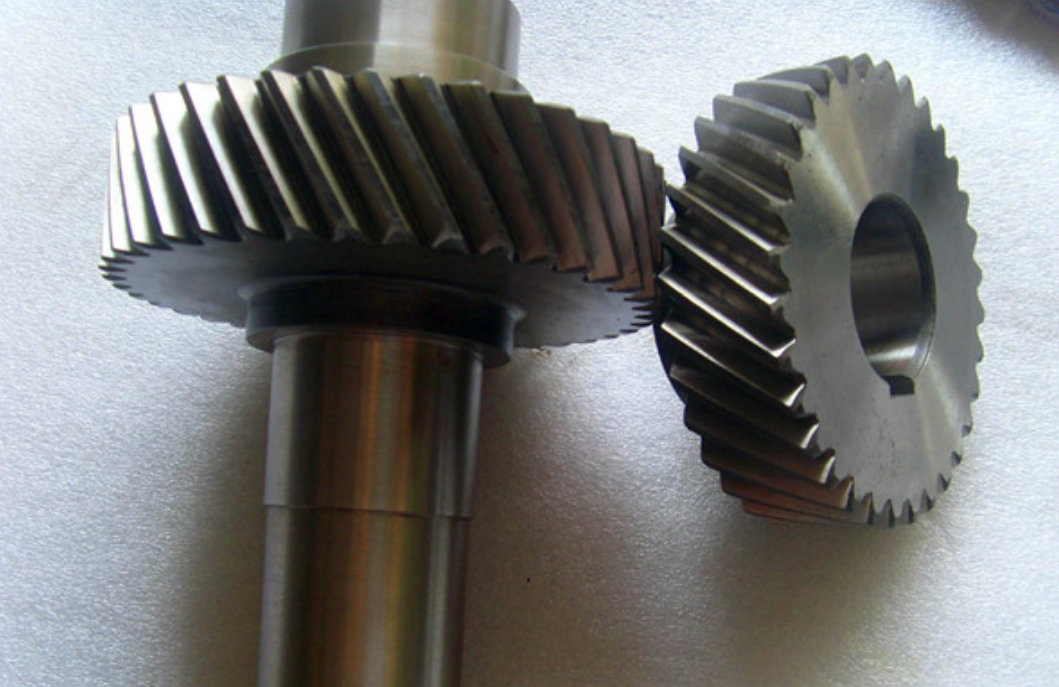
The image depicts a helical gear model with modified tooth surfaces, emphasizing the intricate geometry that can be achieved via parametric design. Such visualizations are crucial for engineers to assess the impact of modifications on helical gear performance, including contact patterns and stress distributions.
Beyond the example, I explored the mathematical derivations in greater depth to ensure robustness. The coordinate transformations involve multiple steps, starting from the worm grinding wheel’s profile to the helical gear’s tooth surface. For instance, the transformation matrix M1r is composed of rotation and translation components:
$$ \mathbf{M}_{1r} = \begin{bmatrix} \cos(\phi + \xi) & -\sin(\phi + \xi) & 0 & R_1 \\ \sin(\phi + \xi) & \cos(\phi + \xi) & 0 & R_2 \\ 0 & 0 & 1 & 0 \\ 0 & 0 & 0 & 1 \end{bmatrix} $$
where R1 = rp[cos(φ + ξ) + φ sin(φ + ξ)] and R2 = rp[sin(φ + ξ) – φ cos(φ + ξ)]. These expressions account for the rolling motion between the gear and the wheel, which is fundamental to generating the correct tooth geometry for helical gears. Similarly, the spiral motion matrix M01 is defined as:
$$ \mathbf{M}_{01} = \begin{bmatrix} \cos\Phi & -\sin\Phi & 0 & 0 \\ \sin\Phi & \cos\Phi & 0 & 0 \\ 0 & 0 & 1 & P \times \Phi \\ 0 & 0 & 0 & 1 \end{bmatrix} $$
Here, P is the spiral parameter calculated as P = mn z / (2 sin β), where mn is the normal module and β is the helix angle. This parameter ensures that the helical gear tooth surface follows the desired spiral path, which is essential for maintaining proper meshing in helical gear pairs.
The modification curves play a pivotal role in tailoring the helical gear’s performance. For profile modification, the exponent b in the power function allows for customization of the curve’s curvature. Values of b > 1 produce concave curves, while b < 1 yields convex shapes, enabling designers to optimize stress distribution on the helical gear tooth flank. In lead modification, the radial feed function can be adapted to achieve various modification patterns, such as crown or taper modifications, which are beneficial for compensating deflections under load. These flexible equations empower engineers to design helical gears that meet specific operational requirements, such as high-speed or high-torque applications.
In terms of software development, the MFC application provides a comprehensive platform for helical gear parametric design. The interface includes input fields for all relevant parameters, with validation checks to ensure realistic values. For example, the helix angle must be within typical ranges for helical gears, and modification amounts should not exceed geometric limits. The computational core solves the equations iteratively, generating thousands of surface points to define the helical gear tooth geometry accurately. The output data can be formatted for various CAD systems, enhancing interoperability in design workflows. Additionally, the software includes visualization tools to plot modification curves, aiding in the design validation process.
To further illustrate the parametric design process, I expanded the example with additional calculations. The helical gear’s tooth root fillet, often a critical region for stress concentration, is also modeled parametrically. Using the worm grinding wheel’s rounded profile, I derived equations for the transition surface between the tooth flank and root. This involves solving for the wheel’s circular arc segment and applying similar coordinate transformations. The resulting fillet equation ensures a smooth blend, which is vital for the durability of helical gears. The parametric model thus covers the entire tooth surface, from tip to root, providing a complete representation for analysis.
The implications of this parametric design method extend beyond modeling. By enabling rapid generation of modified helical gear geometries, it supports virtual prototyping and simulation. For instance, finite element analysis (FEA) can be performed to assess the impact of modifications on stress, strain, and dynamic behavior. This is particularly important for helical gears in demanding environments, where even minor geometric adjustments can significantly enhance performance. Moreover, the parametric approach facilitates optimization studies, where algorithms can automatically adjust modification parameters to minimize noise or maximize strength. This aligns with modern design paradigms that emphasize efficiency and innovation.
In conclusion, the parametric design of helical gears based on a modified worm grinding wheel offers a powerful methodology for advancing gear technology. Through detailed mathematical modeling and software implementation, we can achieve precise control over both profile and lead modifications, tailoring helical gears to specific applications. The example presented demonstrates the feasibility and effectiveness of this approach, with clear quantitative results. As helical gears continue to be integral in machinery, this parametric design method provides a foundation for future research, such as integrating real-time manufacturing feedback or exploring novel modification patterns. Ultimately, it contributes to the broader goal of optimizing helical gear systems for enhanced reliability and performance.
Reflecting on this research, I recognize the importance of interdisciplinary collaboration in helical gear design. Combining principles from geometry, mechanics, and computer science has enabled the development of a robust parametric framework. Future work could involve extending the method to other gear types, such as bevel or worm gears, or incorporating advanced materials and manufacturing constraints. By continuing to refine these models, we can push the boundaries of what helical gears can achieve, driving innovation in industries ranging from aerospace to renewable energy. The journey of parametric design is ongoing, and I am excited to contribute to its evolution in the realm of helical gears.