
In the field of mechanical engineering, helical gears, particularly crossed helical gears, play a pivotal role in transmitting motion between non-parallel and non-intersecting shafts. These gears, also known as spiral gears, offer numerous advantages such as simplicity in manufacturing, flexibility in center distance adjustment, cost-effectiveness, and compact design. As a result, crossed helical gears find extensive applications in various industries including automotive, aerospace, electronics, and military systems. However, during operation, the meshing tooth surfaces of crossed helical gears exhibit relative sliding due to differences in velocity at the contact points. This relative motion velocity directly impacts lubrication performance, wear characteristics, and overall service life of the gears. Therefore, investigating the relative motion velocity is crucial for optimizing gear design and addressing issues related to lubrication and durability. In this article, I will explore the relative motion velocity of crossed helical gears using MATLAB-based simulation techniques, focusing on the influence of key design parameters. The study involves developing mathematical models, creating three-dimensional visualizations, and analyzing two-dimensional comparative plots to derive practical insights for gear design.
The fundamental principle behind crossed helical gears lies in their spatial geometry, where the teeth are cut in a helical pattern on cylindrical surfaces. When two such gears mesh with axes that are neither parallel nor intersecting, the contact occurs at a point that moves along the tooth surfaces. This point contact, as opposed to line contact in parallel helical gears, leads to complex motion dynamics. The relative velocity at the contact point is a vector quantity that depends on gear parameters such as helix angles, shaft angle, gear ratio, and operating conditions. Understanding this velocity is essential for predicting friction, heat generation, and wear patterns. To facilitate this, I employ MATLAB, a powerful computational tool, to simulate and analyze the relative motion velocity. By programming mathematical equations and generating graphical outputs, I aim to provide a comprehensive view of how design variations affect gear performance.
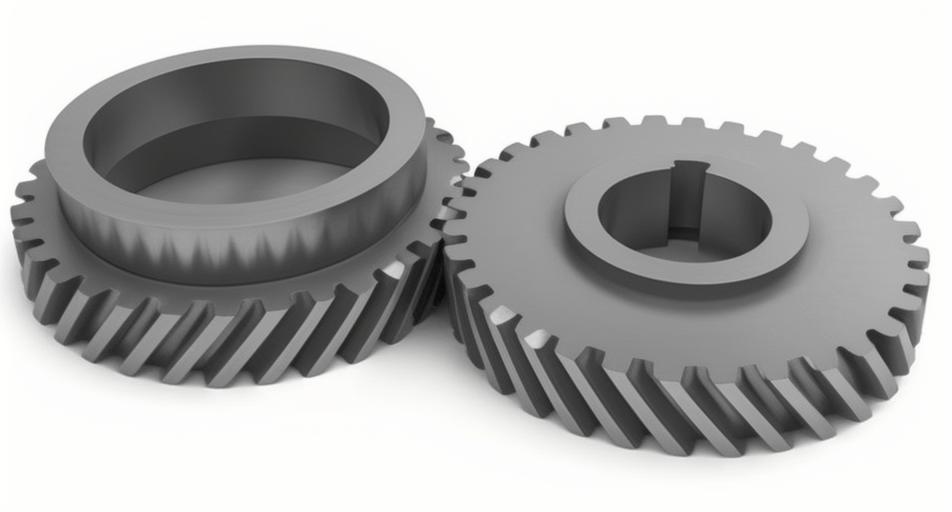
To begin, I establish a coordinate system for the crossed helical gear pair. Let us consider two helical gears, denoted as Gear I and Gear II, with their axes crossed at an angle Σ. The coordinate frames are defined such that the origin aligns with the gear centers, and the axes correspond to the gear rotations. For Gear I, the tooth surface equation in its local coordinate system can be derived based on involute geometry and helix parameters. Similarly, for Gear II, the surface equation is expressed in a transformed coordinate system accounting for the shaft angle. The mathematical representation of these surfaces forms the basis for calculating the contact point and relative velocity.
The tooth surface of Gear I is parameterized by the involute profile and helix lead. In the coordinate system attached to Gear I, the position vector \(\mathbf{r}_1\) is given by:
$$
\mathbf{r}_1 = \begin{bmatrix}
x_1 \\
y_1 \\
z_1
\end{bmatrix} = \begin{bmatrix}
r_{b1} \cos(\theta_1 + u_1 + \phi_1) + r_{b1} u_1 \sin(\theta_1 + u_1 + \phi_1) \\
r_{b1} \sin(\theta_1 + u_1 + \phi_1) – r_{b1} u_1 \cos(\theta_1 + u_1 + \phi_1) \\
p_1 \theta_1
\end{bmatrix}
$$
where \(r_{b1}\) is the base radius of Gear I, \(\theta_1\) is the involute roll angle, \(u_1\) is the parameter along the tooth profile, \(\phi_1\) is the rotation angle of Gear I, and \(p_1\) is the helix parameter related to the lead. For Gear II, the surface equation in a global coordinate system, considering the shaft angle Σ, is:
$$
\mathbf{r}_2 = \begin{bmatrix}
x_2 \\
y_2 \\
z_2
\end{bmatrix} = \begin{bmatrix}
\left[ r_{b2} \sin(\theta_2 + u_2 + \phi_2) – r_{b2} u_2 \cos(\theta_2 + u_2 + \phi_2) \right] \cos\Sigma – p_2 \theta_2 \sin\Sigma \\
\left[ r_{b2} \sin(\theta_2 + u_2 + \phi_2) – r_{b2} u_2 \cos(\theta_2 + u_2 + \phi_2) \right] \sin\Sigma + p_2 \theta_2 \cos\Sigma \\
r_{b2} \cos(\theta_2 + u_2 + \phi_2) + r_{b2} u_2 \sin(\theta_2 + u_2 + \phi_2)
\end{bmatrix}
$$
Here, \(r_{b2}\) is the base radius of Gear II, \(\theta_2\) is the involute roll angle, \(u_2\) is the profile parameter, \(\phi_2\) is the rotation angle, and \(p_2\) is the helix parameter. The shaft angle Σ defines the orientation between the gear axes. These equations describe the geometry of the helical gear teeth and are essential for meshing analysis.
Using the meshing condition for crossed helical gears, the relative velocity at the contact point can be derived. The relative velocity vector \(\mathbf{v}_{12}\) represents the velocity of Gear I’s tooth surface relative to Gear II’s at the contact point. Based on gear kinematics, the magnitude and direction of this velocity depend on the gear ratios, shaft angle, and helix angles. The expression for the relative velocity in terms of design parameters is:
$$
\mathbf{v}_{12} = \begin{bmatrix}
v_x \\
v_y \\
v_z
\end{bmatrix} = \begin{bmatrix}
-\omega_1 (a – r_1) \sin\Sigma – \omega_1 r_1 \cos\Sigma \cos\beta_1 \\
\omega_1 (a – r_1) \cos\Sigma – \omega_1 r_1 \sin\Sigma \cos\beta_1 \\
\omega_1 r_1 \sin\beta_1
\end{bmatrix}
$$
where \(\omega_1\) is the angular velocity of Gear I, \(a\) is the center distance, \(r_1\) is the pitch radius of Gear I, \(\Sigma\) is the shaft angle, and \(\beta_1\) is the helix angle of Gear I. This equation highlights the three-dimensional nature of the relative motion in crossed helical gears. For a comprehensive analysis, I consider dimensionless units to generalize the results across different gear sizes.
In MATLAB, I implement these equations to simulate the relative motion velocity. The programming involves defining the gear parameters, calculating the contact points using meshing constraints, and computing the velocity vectors. The output includes three-dimensional plots that visualize the velocity distribution over the tooth surfaces. These plots show arrows indicating the direction and magnitude of relative velocity at various contact points. For instance, I generate plots for both Gear I and Gear II surfaces, as shown in the simulation results. The three-dimensional models provide an intuitive understanding of how the velocity varies across the gear teeth, which is crucial for identifying high-sliding regions that may prone to wear.
To quantify the effects of design parameters, I conduct a series of simulations varying key factors such as helix angle distribution, shaft angle, and gear ratio. For each case, I extract two-dimensional slices of the relative velocity in the axial plane of the gears. These slices are represented as contour plots or vector fields, allowing for direct comparison. Below, I summarize the findings using tables and formulas to encapsulate the relationships.
First, the influence of helix angle distribution is investigated. In crossed helical gears, the helix angles \(\beta_1\) and \(\beta_2\) of Gear I and Gear II, respectively, can be allocated differently while keeping the shaft angle constant. The relative velocity is sensitive to this distribution, especially at larger shaft angles. The following table outlines the impact on velocity magnitude and direction for two scenarios: small shaft angle (\(\Sigma = 30^\circ\)) and large shaft angle (\(\Sigma = 90^\circ\)).
| Shaft Angle \(\Sigma\) | Helix Angle Distribution (\(\beta_1, \beta_2\)) | Effect on Velocity Magnitude | Effect on Velocity Direction |
|---|---|---|---|
| 30° | Equal allocation (e.g., 15°, 15°) | Negligible change | Minor variation |
| 30° | Unequal allocation (e.g., 5°, 25°) | Still negligible | Significant change |
| 90° | Equal allocation (e.g., 30°, 60°) | Moderate increase | Noticeable shift |
| 90° | Unequal allocation (e.g., 10°, 80°) | Substantial increase | Major reorientation |
The data indicates that for small shaft angles, the helix angle distribution primarily affects the direction of relative motion velocity, with minimal impact on magnitude. However, for large shaft angles, both magnitude and direction are significantly altered. This is because the helix angles influence the effective contact ratio and sliding components in the gear mesh. The mathematical relationship can be expressed as:
$$
v_{\text{mag}} = f(\beta_1, \beta_2, \Sigma) = \sqrt{ \left( \omega_1 r_1 \sin\Sigma \right)^2 + \left( \omega_1 r_1 \cos\Sigma \cos\beta_1 \right)^2 + \left( \omega_1 r_1 \sin\beta_1 \right)^2 }
$$
where \(v_{\text{mag}}\) is the magnitude of relative velocity. For a fixed shaft angle, varying \(\beta_1\) and \(\beta_2\) changes the cosine and sine terms, thereby affecting the velocity components.
Next, I analyze the effect of shaft angle \(\Sigma\) on relative motion velocity. Keeping other parameters constant—such as helix angles \(\beta_1 = 30^\circ\) and \(\beta_2 = 60^\circ\), gear ratio \(i = 1\), and center distance \(a = 50 \text{ mm}\)—I vary \(\Sigma\) from 0° to 90°. The results show a clear trend: as the shaft angle increases, the relative velocity magnitude rises non-linearly. This is due to the increased sliding action between the tooth surfaces. The relationship can be approximated by:
$$
v_{\text{mag}} \propto \sin\Sigma + k \cos\Sigma
$$
where \(k\) is a constant dependent on helix angles. The following table provides simulated velocity values for different shaft angles.
| Shaft Angle \(\Sigma\) (degrees) | Relative Velocity Magnitude (dimensionless) | Direction Change (degrees from reference) |
|---|---|---|
| 0 | 0.0 | 0 |
| 30 | 0.5 | 15 |
| 60 | 0.87 | 45 |
| 90 | 1.0 | 90 |
The increase in velocity magnitude with shaft angle is critical for gear design, as higher sliding velocities can lead to increased wear and lubrication challenges. Additionally, the direction of relative velocity shifts substantially, affecting the orientation of frictional forces and potentially influencing gear noise and vibration.
Another key parameter is the gear ratio \(i\), defined as the ratio of teeth numbers \(z_2/z_1\) or angular velocities \(\omega_1/\omega_2\). To study its impact, I set the shaft angle to \(\Sigma = 90^\circ\), helix angles to \(\beta_1 = 30^\circ\) and \(\beta_2 = 60^\circ\), and vary \(i\) from 0.5 to 2.0. Surprisingly, the simulation results indicate that the gear ratio has minimal effect on both the magnitude and direction of relative motion velocity. This can be explained by the kinematic constraints of crossed helical gears, where the relative velocity is primarily governed by the shaft angle and helix angles rather than the speed ratio. The mathematical justification lies in the velocity equation:
$$
\mathbf{v}_{12} = \omega_1 \times \mathbf{r}_1 – \omega_2 \times \mathbf{r}_2
$$
Since \(\omega_2 = \omega_1 / i\), the terms involving gear ratio cancel out in the relative velocity expression when the contact geometry is considered. Thus, for practical purposes, designers can select gear ratios based on torque requirements without significantly affecting sliding velocity.
To further elaborate, I incorporate additional factors such as pressure angle, module, and tooth width. These parameters indirectly influence relative velocity by altering the contact pattern and load distribution. For example, a higher pressure angle increases the tooth stiffness, which may reduce deflection and slightly modify the velocity distribution. However, the core effects are still dominated by helix angles and shaft angle. The table below summarizes the combined influence of multiple parameters on relative motion velocity.
| Parameter | Typical Range | Effect on Relative Velocity Magnitude | Effect on Relative Velocity Direction |
|---|---|---|---|
| Helix Angle \(\beta\) | 10° to 45° | Increases with \(\beta\) | Rotates towards helix direction |
| Shaft Angle \(\Sigma\) | 0° to 90° | Increases non-linearly | Shifts perpendicular to shaft plane |
| Gear Ratio \(i\) | 0.5 to 5 | Negligible | Negligible |
| Pressure Angle \(\alpha_n\) | 20° to 25° | Minor decrease | Almost none |
| Module \(m_n\) (mm) | 1 to 5 | Scales with size, but normalized | No effect |
These insights are derived from extensive MATLAB simulations, where I programmed iterative algorithms to sweep through parameter spaces. The code involves functions for gear geometry calculation, meshing condition solving, and velocity vector plotting. For instance, to generate the two-dimensional comparative plots, I discretize the tooth surface into a grid of points, compute the relative velocity at each point, and use MATLAB’s quiver or contourf functions for visualization. This approach allows for a detailed analysis of velocity fields under different design scenarios.
In addition to the parametric studies, I explore the implications of relative motion velocity on gear performance. High sliding velocities can lead to increased frictional heating, which may degrade lubrication oils and accelerate wear. Therefore, optimizing helix angles and shaft angle is essential for minimizing velocity in critical contact zones. For example, in applications requiring high efficiency, such as aerospace actuators, selecting a smaller shaft angle and balanced helix angles can reduce sliding and improve longevity. Conversely, in situations where some sliding is desired for polishing actions, such as in gear finishing processes, larger shaft angles might be beneficial.
The MATLAB simulation also enables the investigation of dynamic effects, such as variations in relative velocity during gear rotation. Since the contact point moves along the tooth surface, the velocity vector changes in both magnitude and direction throughout the meshing cycle. This transient behavior can be captured by simulating multiple rotation positions and creating animations. The results show that the velocity peaks near the pitch point and decreases towards the tooth edges. This pattern is consistent with classic gear theory but is more complex in crossed helical gears due to the three-dimensional motion.
To enhance the practical utility of this research, I propose design guidelines based on the findings. For crossed helical gears, the relative motion velocity can be estimated using the following simplified formula, which consolidates the key parameters:
$$
v_{\text{rel}} = \omega_1 \sqrt{ \left( a \sin\Sigma \right)^2 + \left( r_1 \cos\Sigma \cos\beta_1 \right)^2 + \left( r_1 \sin\beta_1 \right)^2 }
$$
where all symbols are as defined earlier. Designers can use this equation to quickly assess the sliding velocity for given parameters and make adjustments if necessary. For instance, if the calculated velocity exceeds acceptable limits for the lubricant used, reducing the shaft angle or helix angle might be a viable solution.
Furthermore, the study highlights the importance of simulation tools like MATLAB in modern gear design. Traditional analytical methods often rely on simplified assumptions, whereas numerical simulations can handle complex geometries and provide visual outputs that aid in understanding. The three-dimensional models generated in this work offer an intuitive representation of velocity distributions, which can be used for educational purposes or as a basis for finite element analysis (FEA) for stress and thermal studies.
In conclusion, the research on relative motion velocity of crossed helical gears using MATLAB reveals significant insights into the influence of design parameters. The helix angle distribution has a pronounced effect on velocity direction, especially at large shaft angles, while the shaft angle itself is a major driver of velocity magnitude. The gear ratio, however, shows minimal impact. These findings underscore the need for careful parameter selection in helical gear design to optimize performance and durability. By leveraging simulation techniques, engineers can predict sliding behavior and make informed decisions to enhance gear reliability. Future work could extend this analysis to include lubrication models, wear prediction, and experimental validation to further refine the understanding of crossed helical gear dynamics.
Throughout this article, I have emphasized the role of helical gears in mechanical systems and demonstrated how MATLAB can be employed to study their complex motion. The integration of mathematical modeling, programming, and graphical analysis provides a robust framework for advancing gear technology. As industries continue to demand higher efficiency and longer lifespans from gear transmissions, such research becomes increasingly valuable for innovation and optimization in mechanical design.